Delhi to Jaipur Wedding Guest Transport | Private Cars, Tempo Travellers & Buses
The Direct Answer
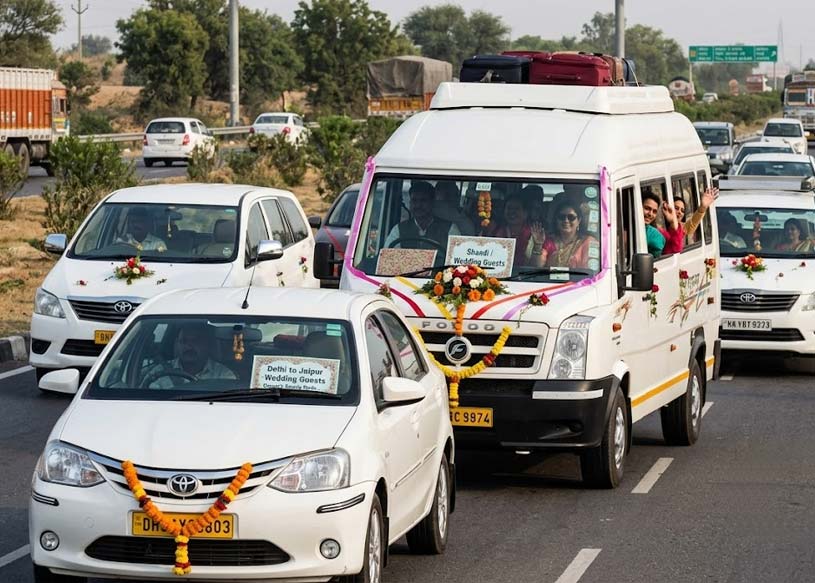
Delhi to Jaipur wedding transport should be planned as a coordinated guest journey, not as a last-minute taxi booking. The right vehicle, pickup point, luggage plan, road schedule and Jaipur drop-off depend on the group. Private cars suit a few guests, tempo travellers suit a travelling family or friend group, and buses work best when many people share one clear departure and arrival plan.
Who Is This Guide For?
Wedding families and planners: Anyone arranging a destination wedding in Jaipur for guests arriving from Delhi, Gurgaon, Noida, Delhi Airport or nearby areas.
International guests: Visitors who land in Delhi and need a dependable, comfortable private journey to a Jaipur hotel or wedding venue, with enough time to rest and prepare.
What it covers: Cars, SUVs, tempo travellers, buses, airport pickups, luggage, departure timing, group coordination, quote inclusions and practical questions to ask before confirming.
A Jaipur destination wedding often brings relatives and friends together from many places. Some arrive directly into Rajasthan; others land at Delhi Airport, stay with family in Gurgaon or Noida, or spend a day in the capital before continuing by road. On paper, the Delhi-to-Jaipur transfer looks simple. In real life, wedding clothing, guest arrivals, traffic, children, senior relatives, multiple hotels and event deadlines make it a small logistics operation.
A strong plan does not begin with “How many people can fit in this bus?” It begins with the real journey. Where are the guests starting? Are they coming from Delhi Airport or a hotel? Do they have large cases and garment bags? Which Jaipur hotel or venue are they joining? Is there a mehendi, sangeet, ceremony or welcome dinner that evening? Are the guests travelling only one way, returning after the wedding, or adding sightseeing in Jaipur? The answers determine everything else.
This guide explains how to plan door-to-door wedding guest transport from Delhi to Jaipur with private cars, premium SUVs, tempo travellers, mini-coaches and buses. It is written for families, planners, NRI guests and international visitors who want clarity before moving people across state lines. It is not a promise that one vehicle type suits every group. The best arrangement is the one that lets guests arrive safely, comfortably and early enough to enjoy the celebration.
What's in This Guide
- 1. Quick Answer: Planning Delhi to Jaipur Wedding Transport
- 2. What Wedding Guest Transport Actually Includes
- 3. Which Groups Need a Private Delhi to Jaipur Plan?
- 4. Delhi Airport, Hotel and Home Pickups
- 5. Departure Timing, Rest Stops and Wedding Deadlines
- 6. Cars, SUVs, Tempo Travellers and Buses Compared
- 7. Private Cars and SUVs for Small Groups
- 8. Tempo Travellers for Families and Friends
- 9. Buses and Mini-Coaches for Larger Guest Movements
- 10. Luggage, Wedding Clothing and Comfort on the Road
- 11. How to Build a Clear Group Movement Plan
- 12. Jaipur Arrival, Hotel Check-In and Wedding Venue Transfers
- 13. Return and Onward Travel After the Wedding
- 14. What a Written Transport Quote Should Include
- 15. Safety, Driver Welfare and Responsible Travel
- 16. Practical Wedding Guest Transport Schedules
- 17. Extra Care for International Guests
- Questions to Ask Before Booking
- Ready-to-Send Enquiry Message
- Common Planning Mistakes to Avoid
- Frequently Asked Questions
- Final Advice for Delhi to Jaipur Wedding Guests
1. Quick Answer: Planning Delhi to Jaipur Wedding Transport
For one or two wedding guests with manageable luggage, a private sedan or SUV can be the most straightforward choice. It provides direct pickup from a hotel, residence or airport and allows the guests to leave at a time that suits their arrival and wedding schedule. For a larger family or a group of friends travelling together, a tempo traveller may give everyone a shared journey without splitting the party into several cars. For a substantial guest list, a mini-coach or bus can be efficient, but only when the group has a common pickup plan and luggage has been considered properly.
The decision should not be made by seats alone. A 12-seat vehicle can be too tight for 10 adults carrying large international suitcases and garment bags. A bus can be economical on paper but inefficient if it must collect guests from five distant Delhi hotels. A private car can feel luxurious but unnecessary when 30 relatives all depart from the same hotel. Ask the travel team to recommend a mix of vehicles based on real guest movement rather than a simple passenger total.
The most important detail is the wedding deadline. If guests must be at a Jaipur hotel by late afternoon to change for an evening event, their Delhi departure should include room for airport delays, city traffic, rest stops, fuel, highway conditions, hotel check-in and dressing. A schedule that assumes everything will run perfectly is not an elegant wedding plan. It is a stressful gamble.
2. What Wedding Guest Transport Actually Includes
Delhi-to-Jaipur wedding guest transport is a private intercity service designed around the people attending a confirmed celebration. It may be a one-way guest transfer, a return movement after the wedding, a multi-vehicle convoy, a group coach, or a broader plan that also covers Jaipur hotel-to-venue transfers. The transport service does not replace the wedding planner, venue coordinator or family host; it works alongside them.
A typical arrangement can include a designated pickup point in Delhi NCR, a commercially appropriate vehicle with driver, carefully planned route and breaks, luggage assistance, the Jaipur hotel or wedding-venue drop, and clear driver contact details. Depending on the quotation, it can also include airport waiting, tolls, parking, state entry charges, driver allowance, driver night halt, group coordinator support or a return plan. These terms are not universal. They must be written down.
It does not automatically include wedding attendance, hotel rooms, food, event entry, bridal cars, décor, photography, tourist guides, monument tickets or shopping purchases. It is tempting to call every transport element “all-inclusive,” but this is meaningful only when the inclusion list is specific. The less vague the quote, the easier it is for a family to make a good decision.
The best providers understand one useful principle: wedding transport is about emotional comfort as much as physical movement. A guest arriving from another country should not have to negotiate prices at an airport after a long flight. A grandmother should not be pushed into a high-step vehicle without warning. A busload of relatives should not learn at the last moment that their hotel cannot accommodate the coach at its entrance. Small details create a smoother celebration.
3. Which Groups Need a Private Delhi to Jaipur Plan?
Not every person travelling to a Jaipur wedding needs a separate vehicle. Guests who are on the same flight and staying at the same hotel may be happy with a family-organised coach. A private or tailored plan is most useful when arrival times, locations, luggage or needs differ.
- International guests: travellers landing at Delhi Airport with suitcases, wedding outfits and limited familiarity with local transport.
- Small families: parents, children and senior relatives who value direct pickup and flexible rest breaks.
- Friend groups: guests who want to travel together in a tempo traveller rather than coordinate several taxis.
- NRI and out-of-town relatives: people arriving at separate Delhi hotels, homes or airport terminals.
- Wedding hosts: families who want to make sure priority guests reach Jaipur comfortably and on time.
- Large coordinated groups: guests leaving from one main Delhi location who can travel efficiently by mini-coach or bus.
Use the service where it solves an actual logistics issue. The purpose is not to send an empty luxury vehicle merely because it sounds impressive. The purpose is to match vehicle, guest and journey intelligently.
4. Delhi Airport, Hotel and Home Pickups
Delhi guest transport can begin at Indira Gandhi International Airport, a hotel, a residence, a wedding function in Delhi NCR, a railway station or another agreed point. Each requires a slightly different plan. Delhi Airport publishes current terminal-arrival and ground-transport information through its official website, but a wedding transfer should still have a direct person-to-person procedure: flight number, guest contact, meeting point, vehicle details and what happens if baggage or immigration takes longer than expected.
For airport pickups, share the live flight number rather than only the scheduled arrival time. Confirm the terminal, number of guests, luggage volume, mobile contact, preferred meeting method and final Jaipur destination. If guests land on different flights, decide whether they will wait for one another, leave in separate vehicles or be collected at a Delhi hotel after a recovery break. A driver cannot make this decision sensibly at the kerbside without prior direction.
Hotel or home pickups in Delhi, Gurgaon, Noida, Faridabad or another NCR location also need precision. Give the full address, hotel name, entrance or gate where the vehicle can wait, contact person and departure time. A large bus may not be able to enter every residential lane or hotel driveway, so a nearby legal pickup point may be necessary. This is not a failure of service; it is ordinary urban planning. Tell guests clearly where to stand and when to be ready.
When a group has multiple pickup locations, avoid a long, improvised loop. Either set one central meeting point, divide the group into sensible clusters or use several vehicles. Time that looks small on a map can expand quickly in Delhi traffic, and a wedding day is not the time to discover that the first guest has been waiting for ninety minutes while the bus collects everyone else.
5. Departure Timing, Rest Stops and Wedding Deadlines
Intercity wedding transport succeeds when it has margin. Do not schedule a departure based only on the fastest possible road time. Account for the guests' pickup, loading luggage, exiting Delhi, comfort breaks, weather, fuel, traffic and the time needed on arrival in Jaipur. Wedding guests also need to check in, freshen up, change clothing, locate the venue and sometimes collect an outfit or gift before an event.
For international guests, the first question is often not “Can we stop for sightseeing?” but “Will we have time to sleep?” A long-haul arrival followed immediately by a road journey can be tiring. If a group lands at Delhi Airport in the morning and has an evening Jaipur function, it may be wiser to arrange a direct journey, a calm rest stop and a generous arrival buffer than to add an unnecessary detour.
Planned stops are useful when they serve the group. A clean comfort break, a relaxed meal, a baby-feeding stop or a chance for seniors to stretch can make the ride much better. Stops should be agreed with the driver and kept realistic; a transport plan should not promise a series of tourist visits unless the wedding programme genuinely allows it.
Tell the driver which time is immovable. For example: “All guests must be at the Jaipur hotel no later than 4:00 PM because the family shuttle leaves at 6:00 PM.” This lets the operator build the journey around the truth, not an idealised itinerary.
6. Cars, SUVs, Tempo Travellers and Buses Compared
There is no universally “best” Delhi to Jaipur wedding vehicle. The correct choice follows the group, not the other way around. Consider the number of travellers, size of luggage, travel duration, age range, wedding clothing, pickup pattern and whether the group must remain together. A good operator will explain the trade-offs honestly instead of sending whatever happens to be available.
| Guest Situation | Usually Suitable | Why It Works | What to Confirm |
|---|---|---|---|
| One or two adults with light luggage | Private sedan | Simple door-to-door travel with privacy and flexible pickup. | Boot capacity, exact car category, airport waiting and hotel drop point. |
| Couple or small family with formalwear and larger cases | Premium SUV | More luggage room and comfortable seating for a long road day. | Number of large suitcases, child-seat requirement and leg room. |
| Family or friend group travelling together | Tempo traveller or premium van | Keeps the group together and can make rest stops easier to coordinate. | Seat layout, luggage area, boarding step, air-conditioning and final passenger count. |
| Guests leaving one main Delhi hotel or venue | Mini-coach or bus | Efficient for a shared departure and group arrival. | Hotel coach access, luggage loading, rest stop, seating and Jaipur drop gate. |
| Mixed-age group with seniors or small children | Vehicle chosen for comfort, sometimes a mixed fleet | Allows better boarding, sensible breaks and a less crowded journey. | Step height, wheelchair or stroller handling, child seats and driver duty plan. |
| VIPs, close family or guests with different schedules | Dedicated private cars plus group transport | Protects important arrival timing while the main guest group travels together. | Named pickup windows, driver contacts and whether vehicles wait or return later. |
Choosing the least expensive seat count can create problems later. A bus may carry many guests, but it is less nimble for several hotel pickups. A tempo traveller may be ideal for a close-knit group, but an older traveller may find the step higher than a sedan. A small SUV may look spacious until eight large cases appear at Delhi Airport. Think through the journey from hotel lobby to Jaipur hotel lobby, not only the road in between.
For a larger wedding, the most effective solution is often a mixed fleet: private cars for priority guests or different airport arrivals, one tempo traveller for a family group and a coach for guests leaving together from a main hotel. This can be better value and much more comfortable than forcing every guest into a single transport model.
7. Private Cars and SUVs for Small Groups
Private cars suit a couple, a small family or a guest who needs their own schedule. They can start at Delhi Airport, a hotel in central Delhi, Gurgaon, Noida or another agreed NCR location, then travel directly to a Jaipur hotel, resort or venue. For a destination wedding, the benefit is not only privacy. It is the ability to control the pickup, comfort breaks, luggage and arrival time.
When a sedan is sensible
A sedan can work well for one or two adults with ordinary luggage, especially when the journey is direct and guests are not carrying several garment bags. It is a practical, discreet choice for someone who wants to leave early, rest on the way and reach a Jaipur hotel without sharing a vehicle. Ask about the exact vehicle, not only the phrase “sedan”, because boot size and interior comfort vary.
When an SUV is the better choice
An SUV is often more suitable for a couple with larger cases, a family with children or travellers carrying wedding attire. It may also help guests who want a more comfortable seating position during a long road day. More capacity does not mean unlimited capacity: be honest about suitcases, stroller, wheelchair, gifts or boxes. The right SUV should provide actual space, not a promise that bags will somehow fit.
Private does not mean rushed
A dedicated car gives flexibility, but the driver still needs safe working hours and planned rest. Do not turn the vehicle into a rolling wedding timetable. Tell the operator whether guests need a meal break, a medication stop, a baby break or a hotel check-in buffer. A thoughtful road plan is a mark of good hospitality.
Useful for different airport arrivals
Private cars are particularly helpful when guests arrive on different flights or at different times. Rather than holding one whole group at an airport for hours, priority guests can travel when ready while the main group follows on its own agreed schedule. This avoids a common wedding-logistics problem: everyone assumes somebody else is organising the late arrival.
8. Tempo Travellers for Families and Friends
A tempo traveller can be one of the most useful options for Delhi to Jaipur wedding transport when a family or friend group wants to stay together. It creates a shared journey: one departure time, one driver team, planned breaks and one arrival. For people who know each other well, this can feel much more relaxed than splitting into separate cars and trying to coordinate on the highway.
Tempo travellers vary significantly. Some are designed for a smaller premium group with generous seating; others maximise the passenger count. Do not book only by reading “12-seater” or “17-seater”. Ask for the seating plan, whether the quoted number includes the driver, luggage space, aisle room, air-conditioning, USB charging if important, and whether a larger group will also need a luggage vehicle. A group in formal clothing needs room to sit comfortably, not only legal seats.
When a tempo traveller is ideal
- Six to twelve relatives or friends are leaving from one main hotel or home.
- The group has a common wedding check-in deadline in Jaipur.
- Guests would enjoy travelling together and can agree a reasonable departure time.
- Luggage has been counted and the vehicle is large enough to handle it safely.
- A coordinated rest stop will make the journey easier for everyone.
When it may not be the best fit
A tempo traveller can be less comfortable for a traveller who has difficulty with boarding steps, needs frequent individual stops, arrives much later than the group or cannot manage with shared pickup timing. It can also be a poor choice if everyone carries international-size luggage and the vehicle lacks a proper luggage solution. In that case, several SUVs or a tempo plus a support vehicle may be smarter.
Make the group rules clear
Shared travel works when a group knows the plan. State the time guests must be in the lobby, how many bags each person may bring, where the vehicle stops, who has the driver contact and what happens if someone is late. It is not strictness for its own sake; it prevents one late guest from delaying an entire wedding party and creating stress for everyone else.
9. Buses and Mini-Coaches for Larger Guest Movements
For a large wedding group travelling from one Delhi location to Jaipur, a mini-coach or bus may be the most efficient solution. It keeps guests together, gives the family a clear headcount and reduces the number of cars arriving at the Jaipur hotel or venue. But a coach becomes convenient only when the operational details are already organised.
What makes a bus plan work
A bus is strongest when guests are staying at one or two nearby Delhi hotels, the family can set one firm departure time, luggage loading has been planned and the Jaipur destination can accept a coach nearby. It is also helpful to nominate a guest coordinator who checks the headcount, handles late arrivals and communicates with the driver. A bus should not be treated as a large taxi that can wait indefinitely for individual decisions.
Check access at both ends
Before booking, confirm whether a bus can legally and practically enter the hotel driveway, residential lane, wedding venue or resort gate. Sometimes the best solution is a nearby meeting point, followed by a short walk or smaller shuttle. Share the exact property name and entrance with the transport operator, not only a city name. Jaipur's wedding resorts can be outside the centre, and the final approach may affect vehicle choice and timing.
Luggage changes the calculation
Passengers are not the same as bags. A guest coach with a full seat count can still need additional luggage capacity, especially if people are arriving from overseas with large suitcases and event clothing. Ask where bags will be stored, whether loading assistance is included and how guests should label or identify belongings. Keep passports, jewellery, medicine and other valuables with the passenger, not in the coach hold.
Comfort and rest stops
A group bus needs a realistic stop plan. Tell guests in advance that there will be a scheduled break and that the coach cannot stop repeatedly for individual needs except where necessary. If older guests or young children are travelling, make the rest break more generous. A short conversation before departure prevents discomfort and unnecessary delays on the road.
Use smaller vehicles where they help
One large bus does not have to carry every person. Close family with a different schedule, very late airport arrivals, guests needing privacy or travellers with limited mobility may be better in separate private cars. A mixed fleet is not a failure to consolidate; it is a smarter response to real human needs.
10. Luggage, Wedding Clothing and Comfort on the Road
Wedding guests usually carry more than holidaymakers. There may be large suitcases, formal outfits, garment bags, jewellery boxes, gifts, child equipment, photography gear, flower baskets or shopping bags. A vehicle plan that ignores this becomes uncomfortable immediately. Tell the operator the true number and approximate size of bags before the vehicle is assigned.
For overseas travellers, “two bags” can mean two very large hard-shell cases plus cabin luggage. For a family, it may include a stroller. For an Indian wedding guest, it can also include delicate clothes that cannot simply be crushed under other luggage. This is why the group should be counted in both people and bags. A good operator may recommend fewer passengers per vehicle or a support vehicle for luggage.
Keep important belongings with you
Passports, visas, cash, cards, medication, phones, wedding jewellery and fragile essentials should stay with the guest. Luggage can go in the boot or vehicle hold, but no one should treat a parked car or bus as a safe unattended storage room. When stopping for food or a restroom, check that the vehicle is locked and valuables are not visible.
Plan comfort for the real people travelling
Seat comfort, air-conditioning, water, rest breaks and boarding ease affect the journey as much as vehicle size. A family travelling with a baby, a person with a back problem or an elderly relative may need a different plan from a group of young friends. Tell the transport provider early. A small adjustment at booking can make a big difference on the road.
11. How to Build a Clear Group Movement Plan
Good wedding transport is mostly communication. Before you book, build a simple movement sheet for each group. It does not need complicated software. A clear table in a message or spreadsheet is enough if it records the essential details and is shared with the people who need them.
| Detail to Record | Why It Matters |
|---|---|
| Guest names and mobile numbers | Lets the coordinator confirm that the correct people have reached the correct vehicle. |
| Pickup location and exact entrance | A Delhi hotel name alone may not identify the correct vehicle gate or lobby. |
| Airport flight number, terminal and live arrival | Allows the team to monitor delays and revise the pickup when necessary. |
| Adults, children and any mobility requirement | Helps allocate appropriate seating, boarding and comfort stops. |
| Luggage and garment bags | Prevents a vehicle from being chosen on passenger capacity alone. |
| Wedding check-in deadline in Jaipur | Keeps the route and departure time focused on the event that cannot be missed. |
| Jaipur hotel or venue name and entrance | Ensures the driver understands the real final drop point, not just the city. |
| One lead coordinator | Prevents several guests from sending conflicting instructions to the driver. |
Divide guests into practical groups, not social labels. A “friends group” may need two vehicles if some people land at Delhi Airport at noon and others leave from a Gurgaon hotel the next day. A family group may need an SUV and a tempo traveller if grandparents need a low-step car but cousins want to travel together. The planner's job is to create a plan that works in real life, even if it looks less tidy than putting everyone into one coach.
Send a clear pre-departure message
On the evening before travel, share the pickup time, pickup place, vehicle number if available, driver contact, luggage expectation, scheduled stop and Jaipur destination. Ask guests to be ready before the vehicle arrives, not when it arrives. A group does not need military precision, but it does need common understanding.
Plan for late changes without panic
Flights move, relatives change rooms and wedding schedules evolve. Decide who can approve a change, who informs the transport provider and whether a delayed guest will join the group later or take a separate car. This stops every small change from becoming a family-wide WhatsApp emergency.
12. Jaipur Arrival, Hotel Check-In and Wedding Venue Transfers
Reaching Jaipur is only the first half of the job. Guests need to get to the right hotel, check in, collect rooms, refresh, unpack essential clothing and understand how they will reach the wedding venue. If the main celebration is at a heritage hotel or resort, the hosts may arrange a separate shuttle. If it is at another property, the guests may need private or group transfers after check-in.
Give the driver the exact Jaipur destination, including the hotel name, street or area, and any gate or entrance instructions. Large resorts and wedding venues can have more than one approach. A driver who knows only “Jaipur wedding” cannot reliably deliver guests to the correct lobby. For a group bus, confirm where it can stop and whether guests must use a smaller shuttle for the final approach.
Protect the preparation window
Wedding guests often need more time than they expect after a road journey. They may need a shower, clothes steaming, a meal, phone charging, a quick nap or help understanding an unfamiliar schedule. Leave this window intentionally. If a sangeet starts at 7:00 PM, a group reaching the hotel just before 7:00 PM has not “made it on time”; it has arrived too late to participate comfortably.
Keep the first evening simple
When guests have travelled from overseas via Delhi, a calm arrival and a well-timed event transfer can be more hospitable than adding optional sightseeing or shopping on the same day. Jaipur can be explored later. The wedding welcome should not feel like the final stage of a race.
13. Return and Onward Travel After the Wedding
Return transport is easier to organise when it is planned at the same time as the outbound journey. Guests may return to Delhi Airport, a Delhi hotel, Gurgaon, Noida or another point. Others may continue with a private Rajasthan holiday, a Delhi–Agra extension or an onward flight from Jaipur. These are different plans and should not be left vague until the farewell brunch.
For an airport-bound group, work backward from the flight or train deadline and include hotel checkout, luggage loading, road time, rest stops and terminal arrival. Guests after a late wedding celebration may need a later pickup or a recovery day before an early departure. The right plan is the one that keeps the end of the celebration pleasant rather than turning it into another rushed transfer.
Ask whether the same vehicle and driver will return, whether there is a waiting day or night halt in Jaipur, and how any Jaipur local transfers are handled in between. A written answer prevents misunderstandings about what is included in a “round trip”.
14. What a Written Transport Quote Should Include
Never compare two wedding transport quotes by the headline figure alone. One price may cover the vehicle and driver only; another may include fuel, tolls, parking, airport waiting, driver allowance and a Jaipur night halt. A lower-looking option can cost more once you add separate expenses. Ask for a written, itemised proposal before paying a deposit.
| Item | What to Confirm |
|---|---|
| Vehicle | Exact category or model, age/condition where relevant, seating and luggage capacity. |
| Driver | English communication level, same-driver continuity and emergency contact process. |
| Pickup | Location, terminal or hotel gate, waiting policy and flight-delay procedure. |
| Route and stops | Departure window, planned rest or meal stop and whether sightseeing detours are included. |
| Fuel | Whether it is included for the complete confirmed route. |
| Tolls, parking and road charges | Whether all highway tolls, parking and applicable road expenses are included. |
| Interstate paperwork | Any state tax, permit or commercial-vehicle charge applicable to the planned route. |
| Driver allowance and night halt | Who covers the driver's meals and accommodation when the vehicle remains in Jaipur. |
| Airport waiting | How long the driver waits, what happens during a long delay and whether parking is included. |
| Wedding-event waiting | Whether the vehicle waits during a function, returns later or operates on a set pickup time. |
| Extra use | Per-hour, per-kilometre or late-night charges if the itinerary changes. |
| Taxes and payment | Whether the stated amount is final, payment schedule and accepted payment method. |
| Cancellation and changes | Rules for a guest cancellation, flight change, reduced group size or rescheduled wedding function. |
| Breakdown procedure | Backup vehicle process and the operator contact responsible for resolving a problem. |
For a large group, also ask for a vehicle allocation list: how many cars, vans or buses; which guests are assigned to each; who holds the driver contacts; and whether there is a luggage support vehicle. This reduces the chance that a bus carries only seats while bags are left without a safe plan.
Do not assume every driver speaks the same language or uses the same schedule. For international guests, say that clear English communication is required. For a wedding, state the event deadline. For a multi-day arrangement, request the daily duty outline. Transparency before booking is not difficult; it is a sign that the operator understands group travel.
15. Safety, Driver Welfare and Responsible Travel
Guest transport is part of wedding hospitality, and safe transport is part of guest care. Use vehicles that are commercially appropriate for the service, well maintained and insured. Confirm seat belts where fitted, functioning air-conditioning, luggage handling and a practical emergency contact. For a group coach, ask about the driver team, rest plan and vehicle backup process.
Driver welfare matters too. A wedding route should not depend on a driver staying awake through an unrealistic schedule, waiting all night without a plan or taking a long road journey immediately after another lengthy duty. A responsible operator sets reasonable duty hours, rest arrangements and replacements when needed. This is not an extra luxury; it is basic road safety.
Protect vulnerable travellers
If someone has limited mobility, a child seat requirement, a medical need, a stroller, a wheelchair or a dietary need that affects rest stops, share it discreetly at booking. You do not need to disclose private details to every guest. You do need the relevant driver or coordinator to understand what will make the journey safe and comfortable.
Keep passports and valuables personal
Drivers can assist with loading, but guests should keep passports, visas, medicines, cash, jewellery, electronics and fragile wedding items with them. Store bulk luggage securely and do not leave valuables visible during rest stops. The same common-sense care applies in a private car, tempo traveller or coach.
16. Practical Wedding Guest Transport Schedules
The following examples show how a transport plan can be designed around real wedding needs. They are not fixed itineraries or promises of travel time. Each family should adjust them to live road conditions, flight status, hotel locations, local regulations and the actual wedding programme. Their value is in the order of decisions: first protect the must-attend event, then choose the most appropriate vehicle and route.
Example A: International couple landing at Delhi Airport
A couple lands at Delhi Airport with two large cases, cabin bags and formal clothes for a Jaipur wedding that begins the following evening. The sensible plan may be an airport meet-and-greet, a private SUV or similar vehicle with confirmed boot space, one clean comfort or meal stop, a Jaipur hotel check-in and no sightseeing on the road. The couple has time to sleep, check their outfits and understand the next day's functions.
The weak version of this plan is very different: the couple meets a driver after immigration without a clear phone contact, learns that their luggage does not fit, makes several unplanned pickups across Delhi, adds a rushed tourist stop and reaches Jaipur just before the welcome dinner. Both plans are technically “Delhi to Jaipur by car”. Only one respects the guests.
Example B: A family group leaving from a Gurgaon hotel
Eight relatives are staying in one Gurgaon hotel and need to reach a Jaipur resort before an evening sangeet. They have large bags, garment bags and two older family members. A suitable plan could be one well-appointed tempo traveller or two SUVs, depending on luggage and boarding comfort. The family confirms one lobby departure time, has breakfast before leaving, carries passports and valuables personally, plans a comfort stop and reaches the resort with enough time to rest and dress.
The decision between one shared vehicle and two smaller vehicles should be based on the physical reality of seats, steps and bags. If grandparents would be uncomfortable in a high-step vehicle, it is better to assign them a private SUV rather than insist that every relative share the same van. Family togetherness is valuable, but not at the expense of comfort or safety.
Example C: Bus transfer for guests at one Delhi hotel
Thirty-five guests are staying in a Delhi hotel for a destination wedding in Jaipur. The family wants them to leave together after breakfast. A coach can work well if the hotel has a suitable pickup point, bags are loaded systematically, every guest is told the lobby time and the Jaipur hotel can accept the bus or provide a final short shuttle. One guest coordinator checks the headcount and carries the driver contact.
The group should receive one simple message: when to be ready, where the bus leaves, what luggage goes underneath, when the planned stop occurs and whom to call if a person is delayed. At the Jaipur end, guests should know whether the bus stops at their hotel, the wedding venue or a nearby point. This lets the ride feel like an organised part of the celebration rather than a crowded public transfer.
Example D: Mixed group with different arrivals
One part of the guest list arrives at Delhi Airport, another is already in Noida and a third is staying in a Gurgaon hotel. Trying to put everyone into one bus may create a long collection route and large delays. A better plan could use airport cars for the late arrivals, a tempo traveller for the family in Gurgaon and a separately timed coach or cars for the guests already together in Noida. All groups can reach the same Jaipur hotel within an agreed arrival window.
There is no need for a transport plan to look uniform. A family will remember whether their guests arrived well, not whether every vehicle looked identical on a spreadsheet. Mixed transport is often the most practical response to different lives, flights and needs.
Use one schedule for each travel day
For every group, write a small itinerary that includes pickup time, meeting point, passenger list, driver contact, planned break, Jaipur destination and final wedding deadline. Send it to guests the night before, then confirm any changes with the lead coordinator. This habit saves everyone from a flood of morning messages and avoids the classic problem of a guest who assumes the vehicle is collecting them from a different hotel.
17. Extra Care for International Guests
Guests flying in from the USA, UK, Canada, Australia, Europe, Japan, the Gulf or elsewhere need a little more clarity than local guests already familiar with Delhi and Jaipur. The journey may be their first experience of India after a long flight. They should not need to learn the transport system, road etiquette and wedding schedule all at the airport kerb.
Give contact details before the flight
Before travel, send the guest the driver or coordinator's name, phone number, WhatsApp number if used, vehicle description, meeting point, hotel address and a backup contact. Ask guests to save the numbers offline and make sure they know what to do if their phone has no signal or their bag is delayed. Delhi Airport provides current passenger and ground-transport information, but a personal pickup plan is still much easier than trying to arrange an intercity wedding transfer after arrival.
Explain the journey in plain English
International visitors do not need a long briefing. They need a simple note: “You will be met after baggage collection; please keep your passport and valuables with you; we will make a comfort stop; you will arrive at the Jaipur hotel before the event; your driver will message you when outside.” This reduces anxiety and lets the guest enjoy the welcome rather than wonder whether they are in the correct car.
Allow recovery time
Jet lag, unfamiliar food, humid or dry weather, a change of climate and a large Indian wedding can be exciting but tiring. Do not mistake a guest's enthusiasm for unlimited energy. Where possible, give them one calm arrival evening or a free morning. A full programme with an airport landing, highway journey, shopping trip and late wedding event can be too much, even for an experienced traveller.
Make cultural hosting practical
International guests often appreciate small operational guidance: which event is formal, whether traditional attire is expected, how the family shuttle works, whether shoes must be removed at a ceremony, where to keep a gift and who can answer questions. The host family should decide these details. The transport coordinator should simply ensure that guests reach the place with enough time and feel comfortable asking for help.
Keep itinerary changes calm and clear
Foreign guests may not be accustomed to a wedding programme that evolves during the day. If the venue, transfer time or dress schedule changes, send one direct message rather than assuming they will hear it through relatives. An English-speaking driver and one lead host contact are particularly valuable when plans move quickly.
Questions to Ask Before Booking
Send these questions to the transport provider before you confirm. Written answers make it much easier to compare proposals fairly.
- Which exact vehicle category will be provided, and how many large bags will it realistically hold?
- Can you collect our guests from Delhi Airport, hotel, Gurgaon, Noida or the agreed meeting point?
- What is the airport meeting and delay procedure?
- What departure time do you recommend to meet our Jaipur wedding check-in deadline?
- Are fuel, tolls, parking, state charges and driver allowance included?
- Will the vehicle stop for a planned meal and restroom break?
- Can our group carry formalwear, garment bags, a stroller or wheelchair safely?
- What happens if one guest is delayed or misses the group departure?
- Can the driver communicate in English with international guests?
- How are Jaipur hotel-to-venue transfers, waiting time or a return journey priced?
- What is the breakdown and backup-vehicle process?
- Is the final quote tax-inclusive, and what is the cancellation or change policy?
Ready-to-Send Enquiry Message
Copy this message, complete the details and send it for a written Delhi to Jaipur wedding guest transport proposal.
Subject: Delhi to Jaipur Wedding Guest Transport Enquiry - [Wedding / Family Name]

Hello,

We are arranging transport for confirmed wedding guests travelling from Delhi NCR to Jaipur.

Travel date: [Date]
Pickup location(s): [Delhi Airport terminal / hotel / residence / meeting point]
Required Jaipur arrival deadline: [Time and date]
Jaipur hotel or venue: [Full name and address if known]
Number of adults: [Number]
Number of children and ages: [Number]
Luggage: [Large suitcases / cabin bags / garment bags / stroller]
Preferred vehicles: [Private cars / SUVs / tempo traveller / bus / please advise]
Return or onward plan: [Details, if required]

Please provide a written quotation confirming:
1. Exact vehicle categories and luggage capacity
2. Driver language and airport meeting procedure
3. Included fuel, tolls, parking, driver allowance and applicable charges
4. Planned stops, waiting time and extra-use terms
5. Jaipur drop-off, local transfer and return options
6. Emergency, breakdown, cancellation and payment policy

Thank you.
Common Planning Mistakes to Avoid
Booking by passenger count only
Seats alone do not solve the problem. Count large bags, garment bags, children, seniors and mobility equipment. A vehicle that is technically legal can still be uncomfortable and impractical for a wedding journey.
Leaving Delhi too late for the first event
The road trip is only one part of the day. Guests still need hotel check-in, rest, dressing and a venue transfer. Plan around the real wedding deadline, not the best-case arrival time on a map.
Using one bus for scattered pickup points
A long multi-hotel collection can leave guests tired before the highway begins. Create one meeting point, use separate clusters or add a mixed fleet. Efficiency is not only about having fewer vehicles.
Ignoring flight delays
International arrivals can take longer than expected. Share live flight details and agree in advance whether late guests wait, travel separately or join from a Delhi hotel later.
Assuming “all-inclusive” explains everything
It does not. Confirm fuel, tolls, parking, interstate expenses, airport waiting, driver allowance, night halt, taxes and extra-hour terms in writing.
Making sightseeing a compulsory arrival-day stop
Guests who have travelled a long way may need food, rest and preparation more than another attraction. Add only the stops that genuinely fit the wedding schedule.
Not sharing the Jaipur hotel entrance
A city name is not a drop plan. Send the exact hotel or resort name, entrance, gate instructions and wedding coordinator contact before departure.
Forgetting the return trip
Return transport becomes harder when the wedding is ending and guests are tired. Arrange the homeward or onward movement while planning the outbound journey.
Frequently Asked Questions
Can wedding guests travel from Delhi to Jaipur by private car?
Yes. A private car is useful for a couple, small family or guest who wants a direct pickup from Delhi Airport, a hotel or a residence and a door-to-door Jaipur drop. Confirm luggage capacity and the written route inclusions first.
Which vehicle is best for Delhi to Jaipur wedding guests?
A sedan may suit one or two guests with light luggage; an SUV suits a small family or extra cases; a tempo traveller suits a larger group; and a bus suits a common departure for many guests. The right choice depends on people, bags, comfort and the schedule.
Can a tempo traveller take wedding guests from Delhi to Jaipur?
Yes. It can work very well for relatives or friends travelling together. Check the actual seat layout, boarding comfort, luggage capacity, air-conditioning and the planned rest stop instead of relying only on the advertised seat number.
Can a bus be arranged for Delhi to Jaipur wedding transport?
Yes. A bus or mini-coach can be efficient for a larger group leaving from one main Delhi location. Confirm hotel and venue access, luggage loading, a rest stop, guest coordinator and the final Jaipur drop before booking.
Can pickup be arranged from Delhi Airport?
Yes. Share the flight number, terminal, guest phone number, luggage details and Jaipur destination. Agree the meeting point, waiting period and delay process in writing before the flight.
How early should we leave Delhi for a Jaipur wedding?
Leave with enough time for the whole journey: pickup, airport or city traffic, road travel, breaks, Jaipur hotel check-in, clothing changes and the venue transfer. Do not plan to arrive only minutes before an important ceremony.
Are tolls, parking and interstate charges included?
It varies by operator. Ask for a written itemised quote that clearly states fuel, tolls, parking, state taxes or permits, driver allowance, night halt, waiting and taxes.
Can guests stop for sightseeing on the way?
Yes, if the wedding programme has enough margin. A planned stop may be suitable for guests with a free day, but should not risk their Jaipur arrival or leave them without time to prepare for an event.
What happens if a flight into Delhi is delayed?
A professional operator should agree a delay procedure in advance. Share the live flight number and decide whether the driver waits, the guest travels later in a separate car, or the group meets at a hotel after the delay.
Can we book return transport from Jaipur to Delhi after the wedding?
Yes. Confirm the return date, pickup location, flight or train deadline, luggage and guest count while organising the outward trip. Ask whether the same vehicle and driver will be used or whether a new arrangement is planned.
Final Advice for Delhi to Jaipur Wedding Guests
The best Delhi to Jaipur wedding transport plan is quiet, organised and human. Guests know where to meet, the vehicle fits their luggage, the driver knows the hotel, the family has a contact person and the arrival leaves room to breathe. That is what turns a highway transfer into good hospitality.
Start with the wedding deadline, then work backward. Choose vehicles according to real people and real bags. Put inclusions in writing. Protect driver rest and guest comfort. When the plan is built this way, friends and family arrive ready to celebrate rather than tired from solving logistics.
Research and Editorial Method
This guide combines practical private-transport planning with current public information from official airport and destination sources. Flight schedules, airport procedures, road conditions, vehicle availability, government charges and wedding venue access can change. Confirm every live operational detail with the airport, hosts, hotel and chosen transport provider before travel.
- Delhi Airport transport information for current arrival and ground-transport guidance.
- Delhi Transport Department for official transport information.
- Rajasthan Tourism: Jaipur for destination information.
- Rajasthan Tour Trip packages for private Rajasthan journey options.