Can You Hire a Driver in Rajasthan and Book Your Own Hotels?
The Short Answer
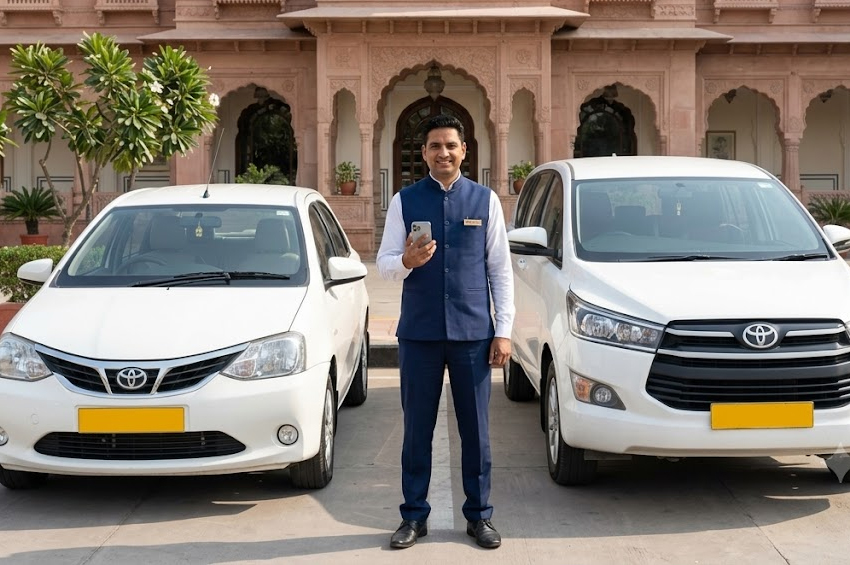
Yes, in many cases. Some Rajasthan operators sell a private car with a driver on its own, and you book the hotels yourself. The route, hotel addresses, daily schedule, charges and terms still have to be agreed with the provider before you pay. "Driver-only" usually means the operator's car and driver without hotels, not a driver for a vehicle you have rented elsewhere. A chauffeur is also not automatically a licensed sightseeing guide, and hotels you book yourself still have to fit the driving plan.
- Rajasthan Tour Trip: its contact page says you can enquire about a private car and driver only. The pages reviewed for this guide do not say whether independently booked hotels are accepted, so that is a question to put to the team.
- No universal rules: operator terms differ on fuel, tolls, kilometre limits and driver costs. Where this guide quotes a policy, it names the operator that published it.
- No price table: the rates found online were undated or incomplete, so this guide shows how to compare quotes instead of offering a number that could mislead.
What's in This Guide
- How the Arrangement Works
- Who It Suits, and When a Package Is Easier
- Car and Driver, Package or Trains
- What to Agree Before Booking Hotels
- What a Quote Should Spell Out
- How Pricing Works
- Driver Accommodation and Meals
- Choosing the Right Car
- Driver, Guide and Language
- Flexibility, Shopping Stops and Boundaries
- Four Route Examples
- Sightseeing Transfers and Luggage
- Practical Points for International Visitors
- Solo Travellers, Families and Older Visitors
- Deposits, Cancellation and Changes
- Common Booking Mistakes
- A Ready-to-Send Enquiry
- Frequently Asked Questions
How a Car-and-Driver Booking Works When You Book the Hotels
In the simplest version, you and the operator each handle one half of the trip. You choose and pay for the hotels, directly or through a booking platform. The operator supplies a vehicle and driver for the days you agree and quotes for that alone. The two halves meet in a day-by-day route: where you sleep, where the car collects you, and where it leaves you.
One operator's website describes exactly this: if you book your own hotel, the driver takes you directly to it, and if you have not booked anywhere, the driver can suggest options on arrival. The same page notes that booking ahead is wise. Treat the on-arrival help as a courtesy rather than a booking service unless the operator has agreed it in writing.
Who does what
- You choose the hotels, pay them, keep the confirmations, and send the operator each hotel's name, address and map pin.
- The operator supplies the vehicle and driver, quotes for the agreed use, and confirms the terms in writing.
- The driver follows the agreed route and collects you at agreed times and places. A driver is not normally your hotel agent, and one Rajasthan destination-expert reply in a 2024 forum thread was blunt that choosing and booking hotels is the traveller's job.
Transfers, sightseeing, or both
A booking can cover point-to-point transfers only, such as the airport to your hotel or Jaipur to Jodhpur, or it can cover full days with the vehicle available for sightseeing. These are priced differently. A transfer is priced around one journey. A multi-day booking is usually priced around days and distances, with the car and driver kept for you.
Even when a car is "available all day", use is normally bounded by hours and kilometres set in the terms. One Jaipur operator publishes a city sightseeing day as 8 hours and 80 km, with extra time and distance charged on top. Another operator's forum reply in 2023 described a minimum of 250 km per day on outstation hire. Those are two different operators with two different structures, which is the point: you cannot assume what "a day" means.
Why a hotel change is not a small change
Moving from an old-city haveli to a resort on the outskirts can add driving to every sightseeing day. A quote built on one set of addresses may need revising if the addresses change. Tell the operator before you switch, not after.
Who This Arrangement Suits, and When a Package Is Easier
Booking hotels yourself and hiring only the vehicle tends to suit travellers who want control over the places they sleep:
- Points and loyalty users whose reward stays cannot be swapped for an operator's hotel list.
- Heritage-hotel hunters who have a particular haveli, fort-palace or boutique property in mind.
- Couples who want to choose room type, view or quietness themselves.
- Families needing particular bed arrangements or connecting rooms that are easier to confirm directly.
- Mixed-budget travellers who want one splurge night between modest ones.
- Visitors who have already booked accommodation, sometimes non-refundably, and now need transport around it.
A coordinated package can be easier when you are unsure whether your route is realistic, when you would rather deal with one company if something goes wrong, when you have little time to research hotels, or when you want tickets, guides or safari arrangements handled together. Rajasthan Tour Trip's own package pages, for example, describe itineraries where accommodation and private transport sit under one confirmed programme.
Neither option is always cheaper or better. Buying the parts separately can cost less or more depending on the hotels you choose and how the operator prices the vehicle. What matters is that you can see what you are buying.
Car and Driver Versus a Package, and Versus Trains and Transfers
This comparison describes tendencies, not guarantees. Individual operators and trips vary.
| Factor | Car and driver, your own hotels | Coordinated package | Trains and separate transfers |
|---|---|---|---|
| Accommodation control | You choose every hotel, room and cancellation term. | The operator proposes hotels. How much choice you get varies. | You choose every hotel. |
| Planning responsibility | You plan hotels and check the route. The operator handles the vehicle. | Mostly with the operator; you review the plan. | Entirely yours: tickets, station transfers and timings. |
| Travel flexibility | Stops and start times can flex within agreed hours and distance. | Similar with a private vehicle, but built around the package itinerary. | Tied to train timetables and station access. |
| Cost transparency | Hotel and vehicle costs are separate, but only comparable if quote terms match. | One total, so check what sits inside it. | Fares are itemised; local transfers add up separately. |
| Luggage handling | The vehicle carries bags, limited by its size. You handle bags at each hotel. | Similar if the package uses a private vehicle. | You move bags to and from stations, or arrange help. |
| Support when plans change | Two parties, the hotel and the operator, so you coordinate between them. | Often one point of contact, subject to the operator's terms. | You rebook tickets and transfers yourself. |
| Suits | Independent planners, points users, heritage-stay seekers. | First-timers, short planning windows, travellers wanting one contact. | Confident travellers on well-served rail corridors with lighter luggage. |
What to Agree Before You Book the Hotels
The safest order is route first, hotels second. Rajasthan Tour Trip's contact page makes a similar point, noting that Rajasthan is large, that travel times between cities can be longer than first-time visitors expect, and inviting travellers to ask before finalising an itinerary.
Route order and realistic travel days
Road distances between the main cities are long, and the sources reviewed for this guide disagree with each other by tens of kilometres depending on route and start point. Timings depend on traffic, road works, city exits and stops. One traveller's 2014 forum post, describing ten car-and-driver trips across India, put a good average at about 50 km/h. That is one person's experience, not a standard, but it is a useful corrective to expecting highway speeds all day.
Treat a long transfer as a travel day with a sight or two on the way, not as a sightseeing day with a drive attached.
Start and finish points
Decide which airport or station you arrive at and which you leave from. A route that ends far from where the car started may cost more. Forum replies from 2023 and 2024 both note that on one-way hires the traveller may end up meeting the cost of the vehicle returning to its base. Ask whether it is built into the quote or itemised.
Hotel access, parking and old-town lanes
Some hotels inside walled or old-city districts sit on lanes that a full-size car cannot enter, so guests are met at the nearest vehicle point and walk or are taken by a smaller vehicle. Others have a courtyard or forecourt but limited parking. A map pin often marks the front door, which may be a pedestrian entrance rather than where a vehicle can stop.
Before paying a deposit, ask each hotel two things: where can a car stop with luggage, and is there parking or a waiting area for the driver? Pass the answers to the operator with the pin.
Remote properties and late arrivals
Desert camps, fort hotels outside town and rural heritage properties may have a last stretch on smaller roads, and arriving after dark can change the plan. One operator's FAQ advises against late-night driving. If a flight lands at midnight or a transfer day runs late, tell the hotel your expected arrival and confirm that it will keep the room and a meal available.
Check the route before any non-refundable booking
Send the operator your draft route with hotel names, cities and dates before you book anything non-refundable. Ask two questions: is each transfer day realistic, and would it be sensible to move a night? It costs a short email and can save a badly shaped trip. Our Rajasthan destination guides can help you decide how many nights each city deserves.
What a Car-and-Driver Quote Should Spell Out
Two quotes with the same headline figure can cover very different things. Ask for the following in writing, and never assume any of it is included.
| Item | What to ask |
|---|---|
| Vehicle and driver | Which vehicle category, air-conditioned throughout, and whether a substitute of the same class is promised if it breaks down. |
| Fuel | Whether fuel is in the price or billed separately. |
| Tolls and parking | Whether both are included, and if not, how they will be charged and evidenced. |
| Taxes and permits | Whether applicable taxes are in the figure, and whether any state-entry charge applies if your route leaves Rajasthan. |
| Driver allowance | Whether a daily driver allowance is included, and how nights away from the driver's base are handled. |
| Driver meals and lodging | Who pays, and whether anything is expected from you at your hotels. |
| Daily kilometre limit | The kilometres per day, whether it is averaged over the trip, and the charge beyond it. |
| Daily duty hours | Start and end times, and how long a day can run before overtime applies. |
| Airport and station pickups | Whether arrival and departure transfers are part of the itinerary total. |
| Sightseeing use | Whether the vehicle stays with you at sights, and whether local runs count toward the kilometre limit. |
| Overtime and extra kilometres | The rate for each, and who authorises them. |
| Early starts and late finishes | Whether pickups before dawn or drop-offs late at night carry a charge. |
| Waiting time | How long the car waits at a site before it counts as extra, and what happens on a delayed flight. |
| One-way or return-to-base | Whether the vehicle's journey home is priced in, and how. |
Included, extra, or needs confirmation: how real operators differ
The examples below come from operators' own published pages and forum replies, not from a market survey. They show how far quotes can differ, not what any given quote will contain.
- Stated as included by some operators: one Jaipur operator says its city sightseeing rate includes the driver's day allowance, parking and applicable taxes, and its tour packages include driver lodging and boarding, tolls, parking and taxes. Its FAQ repeats that driver food and lodging are covered.
- Stated as extra by others: another Jaipur operator's undated rate card lists a per-kilometre rate, a separate nightly driver charge, and describes tolls, parking and taxes as excluded. A 2023 forum reply from an operator said driver halts are additional on its terms.
- Needs confirmation whatever the operator: everything else in the table above.
Rajasthan Tour Trip's package and Golden Triangle pages list driver allowance, fuel, tolls and road taxes among inclusions "where included", and list monument tickets and professional guides among exclusions unless confirmed. In other words, the written quotation decides. The same discipline applies to a car-and-driver-only enquiry.
Permits and state crossings
India has national rules for tourist-vehicle permits. The All India Tourist Vehicles (Permit) Rules, 2023 let an operator's tourist vehicle ply across the country under an All India Tourist Permit, and a ministry circular has advised states not to levy other taxes on vehicles operating under a valid permit. Later amendments have been drafted, so details can change. Whether a specific vehicle holds a valid permit, and whether any state-entry charge is in your price on a route such as Delhi to Agra to Jaipur, is something only the operator can confirm.
The Rajasthan Transport Department's Contract Carriage Permit page explains that a tourist permit for a motor cab is valid for 9 years from first registration, and an application fee of ₹500 per year is payable. The department also publishes a tax table for vehicles of other states plying under a tourist permit, with rates varying by seating capacity. For a four-wheeler with up to 6 seats, the temporary permit rate is ₹100 per seat for 7 days or part thereof, or ₹70 per day. These are the statutory frameworks that sit behind any commercial quote.
How Car-and-Driver Pricing Works
Four common quote shapes
- Per-day quotes fix a daily price for a stated number of hours and kilometres. They are easy to understand, but the limits matter more than the headline.
- Per-kilometre quotes charge for distance, often with a minimum daily distance, so a parked car can still be billed. A 2023 forum reply described a basic per-kilometre charge with a minimum number of kilometres, even when the car sat in the hotel car park.
- Whole-itinerary quotes give one total for the route. They are easiest to compare only if the itinerary, inclusions and limits are written into the quote.
- One-way transfer quotes price a single journey and may reflect the vehicle's return.
What moves the price
The vehicle category is the main lever; in a 2023 forum thread, one frequent poster called it the prime determinant. The others are the number of days, total driving distance, route direction, season and availability, passengers and luggage, long waiting periods, and any state crossings. Expect a quote to change if you change any one of them.
Published rate cards and fare calculators give a sense of the range. One Rajasthan taxi fare calculator shows a base fee of ₹50 and ₹15 per kilometre, with waiting time at ₹110 per hour. For local sightseeing in Jodhpur, a sedan (Dzire/Etios) is quoted at ₹2,000–₹2,500 for 8 hours and 80 km, with extra kilometres at ₹12 and extra hours at ₹150. An Innova Crysta is quoted at ₹3,500–₹4,000 for the same 8-hour/80 km package, with extra kilometres at ₹18 and extra hours at ₹250. These figures are for context only; your operator's quote for a multi-day Rajasthan circuit will use different limits and inclusions.
Why this guide does not print a typical price
Several operators show per-day or per-kilometre figures online, but the pages reviewed did not state a date, or did not say which limits and inclusions applied. In the 2023 forum thread mentioned above, the per-day figures mentioned for car-and-driver travel differed substantially, and the replies came from a mix of travellers and operators. Rajasthan Tour Trip's own pages give package prices on request. Publishing a single "average" would blur these differences.
Comparing quotes without a benchmark
- Ask every operator to quote the same route, dates, passengers and vehicle class.
- Rewrite each quote as a total for the whole trip, adding anything listed as extra that you know you will need, such as tolls, parking or a driver night charge.
- Note the daily kilometre and hour limits and ask what a realistic overrun costs on your longest day.
- Compare what remains, and ask the cheapest operator what is missing before assuming it is a bargain.
For a structure to budget hotels, transport, meals and guides together, our guide to Rajasthan trip costs for couples uses clearly labelled illustrative allowances rather than market averages.
Driver Accommodation and Meals
This is the question that confuses independent travellers most. In a 2024 Tripadvisor forum thread, a traveller planning to choose their own hotels asked how to make sure the hotels offered space for the driver, whether to add a set amount to the fee, and who pays for the driver's meals. The replies contradicted each other. One said drivers sometimes sleep in the car. A Jaipur operator replied that no driver is expected to, and that the quoted price normally includes an allowance for the driver's room. Others said many larger hotels have a basic driver rest area or dormitory, while some drivers prefer their own arrangements.
Those replies illustrate why you should not rely on hearsay. What you can do is settle it with the operator:
- Ask whether driver meals, lodging and allowance are inside the quoted price, and get the answer in writing. One Jaipur operator's FAQ states they are included in its pricing; others may not do the same.
- Do not assume you must book the driver a room at your own hotels. Ask whether the operator expects you to.
- If your hotel offers driver accommodation, you can ask about it, but a hotel's facilities are the hotel's own decision. Check before relying on them, especially at remote or premium properties where facilities vary.
The traveller in that thread raised a fair worry about driver rest on long trips, and asking the operator how it is handled is reasonable. One operator's page describes drivers as available around the clock; test that marketing claim against the duty hours in your quote.
Choosing the Right Car
Passenger seating capacity and usable luggage space are different numbers. A vehicle can list seats for four while a large suitcase for each of those four leaves nobody comfortable. In many seven-seat vehicles, using the rear row also reduces boot space. Ask about the arrangement for your party, not the brochure maximum.
- Two adults with large suitcases: a sedan may be enough for two people with modest luggage. If you carry two large suitcases each, ask whether a larger vehicle is more comfortable for a multi-day trip.
- Four adults with checked luggage: this is the case where seats and bags collide. Share your luggage count and ask the operator to confirm the vehicle for that load.
- Families with children: ask about seat belts in every seating position and whether child seats can be supplied. Availability should be confirmed, not assumed.
- Small groups: larger vehicles such as minibuses exist, but narrow old-town lanes may limit where they can go.
- Long-distance comfort: ask about air conditioning, legroom and whether the vehicle suits several days of long transfers.
Rajasthan Tour Trip's fleet section lists a Toyota Etios sedan (up to four passengers, described as suitable for small luggage), a Maruti Ertiga (up to six, described as having good luggage space), Toyota Innova Crysta and Hycross people carriers, and larger Tempo Traveller and Force Urbania vehicles. Descriptions like "good luggage space" are general, not a statement about your particular load. Availability for your dates, the exact model and its luggage arrangement should be confirmed in your quote.
Whichever operator you use, send passenger numbers, suitcase counts and approximate sizes, plus any bulky items such as golf clubs, prams or camera cases, before confirming a vehicle.
Driver, Guide and Language Expectations
A driver's job is to drive safely, keep to the route and the schedule, and look after the vehicle. Many are helpful about restaurants, photo stops and local knowledge, but that is not the same as a trained sightseeing guide who interprets a monument.
One Jaipur operator's FAQ draws the line clearly: its drivers can take you to local markets but cannot guide at monuments, and its local guides are provided separately at an extra cost. Rajasthan Tour Trip's package pages likewise list professional guides as excluded unless confirmed. If you want commentary at Amber Fort, Mehrangarh or a City Palace, book a guide for that visit and confirm whether the guide's fee includes entry tickets.
The Rajasthan Tourism Department's compendium of policies and guidelines states that drivers employed for tourist vehicles should wear uniform and have a good speaking knowledge of English. It also requires that vehicles and safari animals provided to tourists carry comprehensive insurance. When you receive a quote, these are reasonable expectations to check: a uniformed, English-speaking driver and a commercially insured vehicle are part of the professional standard the state expects.
Language. A driver who speaks conversational English can handle directions, timings and logistics. That is enough for many trips. If you need more, such as detailed history or help with a medical or dietary issue, say so at booking. A short WhatsApp exchange with the operator before you pay gives a sense of how communication will work, though it will not necessarily be with the driver you get.
The same driver throughout. Some operators run a multi-day trip with one driver. Others rotate drivers between legs or cities. Request continuity, and ask what happens if the driver falls ill or the vehicle must be replaced. Without a written commitment it is a preference, not a promise.
Flexibility, Shopping Stops and Boundaries
"Flexible itinerary" usually means you can adjust stops and timing within the agreed hours and distance. It rarely means unlimited changes at no cost. One operator's FAQ says route changes or extra distance can be chargeable, depending on the case. Agree in advance what happens if you want to add a viewpoint, skip a fort or stay late at a market.
- Sightseeing priorities. Tell the driver each morning which one or two places matter most, so they can protect the time for them.
- Restaurants. Say whether you want a local recommendation or somewhere you have chosen. Mention dietary needs before lunchtime, not at the door.
- Comfort and photo stops. Reasonable requests. Mention them early on a long transfer.
- Driver rest. Drivers need breaks and sleep, which is one reason daily duty limits exist.
- Last-minute changes. Possible, but ask what they will cost before agreeing, not afterwards.
Asking for a sightseeing-focused trip
Some travellers worry about being steered towards shops. That is not a fair description of every driver, and recommendations do not always involve commissions. It is still reasonable to state your preference at the start. One operator's FAQ says it would replace a driver within a day if guests felt pushed towards shops; that is one operator's stated policy, so ask your own operator what it does. A polite line you can use:
We would like a sightseeing-focused trip, so please plan without shopping stops unless we ask for one. If we would like to shop, we will tell you.
Four Route Examples and Where Independent Bookings Need Care
The distances below are approximate ranges drawn from the sources listed at the end. They differ because of route choice and starting points within each city. Add a buffer, and confirm the plan with your operator.
| Leg | Approximate road distance | Drive time quoted by sources |
|---|---|---|
| Delhi to Agra | 230–240 km | About 3–4 hours via the Yamuna Expressway |
| Agra to Jaipur | About 240 km | About 4–5 hours without stops |
| Jaipur to Pushkar | 142–150 km | About 2.5–4 hours |
| Pushkar to Jodhpur | About 190 km | Not consistently stated |
| Jaipur to Jodhpur | 330–372 km | About 5.5–6 hours in normal traffic |
| Jodhpur to Udaipur | 250–310 km | About 4.5–5 hours via Ranakpur |
| Jaipur to Udaipur | 395–430 km | About 6–8 hours |
| Jodhpur to Jaisalmer | 280–290 km | About 4.5–5 hours |
| Udaipur to Ranakpur | About 90 km | About 2–2.5 hours |
| Ranakpur to Jodhpur | About 160 km | Not stated |
Where sources do not give a time, this guide does not invent one. As arithmetic only, a 250–310 km transfer at the 50 km/h average one traveller reported works out at roughly five to six hours before any stops. Your operator will know current road conditions better than any table.
Jaipur, Jodhpur and Udaipur
This is the classic shape for a first Rajasthan trip and the route used in our couples' budget guide. It has two long intercity days. If you book hotels yourself, check that your Jodhpur and Udaipur properties are reachable by car at a sensible time on arrival day. In Udaipur and Jodhpur, hotels close to the old town or lakes may have restricted vehicle access, so the property's own instructions matter. This route works well one way, but ask about the return-to-base charge for finishing in Udaipur.
Jaipur, Pushkar, Jodhpur and Udaipur
Pushkar sits on the corridor between Jaipur and Jodhpur. The two legs, about 145 km and about 190 km, add up to roughly 335 km, close to the direct Jaipur to Jodhpur ranges, so the distance barely changes but the stop turns one very long day into two shorter ones. The trade-off is one more hotel to book and one more change of location. Ask your operator whether a Pushkar night suits your dates, and whether your chosen Pushkar hotel can be reached by car.
Adding Jaisalmer
Jodhpur to Jaisalmer is a further 280–290 km each way. Going from Jaipur straight to Jaisalmer is 570–615 km by the sources reviewed. Adding Jaisalmer changes the pace: the desert leg is long, you will probably want at least a night there to justify the drive, and if you finish there the vehicle's return can add cost. Decide whether Jaisalmer is worth the extra travel days before booking hotels, and ask how the operator prices finishing there or returning to Jodhpur. Our Jaisalmer destination page gives context for deciding.
Delhi, Agra and Jaipur, with a Rajasthan extension
The Golden Triangle route begins with an airport arrival, which often consumes much of the first day. Long-haul flights can land at awkward hours, so do not plan sightseeing for the day you arrive. The Taj Mahal is closed on Fridays according to the official Taj Mahal site, so plan Agra around that. If you stay only one night in Agra, check that hotel's vehicle access. From Jaipur you can continue into Rajasthan as above. See our Golden Triangle tour packages for how these routes are usually combined.
Whichever route you choose, avoid stacking long transfers on consecutive days. A long transfer followed by a sightseeing day is a workable rhythm; three in a row is where independent hotel bookings most often come unstuck.
Sightseeing Transfers and Luggage
Udaipur to Ranakpur to Jodhpur
Udaipur to Ranakpur is about 90 km and takes about two to two and a half hours by one source's estimate; Ranakpur to Jodhpur is about 160 km. Ranakpur's Jain temple has a specific opening pattern: tourist guides and forum replies give a general-visitor window of roughly noon to 5 pm, with mornings reserved for worship. The trust that manages the temple sets its timings and they can change, so confirm before you go.
That timing shapes the day. Leaving Udaipur mid-morning puts you at Ranakpur around midday, which fits the visitor window. Allow time for the temple and lunch, then the remaining drive to Jodhpur, and check what time light fades in the season you travel. If a Jodhpur hotel has a late-arrival policy, tell it your expected arrival time.
Jaipur to Abhaneri to Fatehpur Sikri to Agra
Abhaneri, home of Chand Baori stepwell, is about 95 km from Jaipur and is described by sources as a short detour off the highway to Agra. Fatehpur Sikri lies about 40 km from Agra. The direct journey is about 240 km, and both stops add time, so plan most of the day and let the operator confirm the schedule. Agra sightseeing, including the Taj Mahal, should fall on a non-Friday. Opening times for these sites should be checked close to travel.
Luggage, valuables and time at each stop
- Ask what the arrangement is for luggage left in the vehicle during a visit. Do not assume the driver stays with the car, and do not assume the vehicle is secure. Get the answer in writing.
- Keep passports, cash, cards, medication and anything irreplaceable with you, not in the boot.
- Ask how far ahead you should tell the driver about your plans for the next day, and agree a departure time that leaves margin for lunch and comfort stops.
- On arrival days, check that the hotel knows your estimated time.
Practical Points for International Visitors
- Airport meeting. Share your flight number, arrival terminal and a phone number that works abroad. Agree exactly where the driver will wait and how he will identify you.
- Delayed flights. Ask how a delayed arrival is handled: whether the operator monitors flights, and how long the driver waits before extra charges begin.
- Hotel details. Send each hotel's full name, address and map pin, plus a booking reference. Similar names are common, and two properties with almost identical names can sit in different districts.
- Communication. Confirm whether WhatsApp is the main channel, and who answers if the driver cannot be reached.
- Payment. Methods vary by operator. One Jaipur operator publishes UK bank transfer, PayPal and cards for international guests and UPI or cards for Indian guests. Rajasthan Tour Trip's payment methods are not stated on the pages reviewed, so ask. Keep a receipt for every payment.
- Currency and fees. Ask which currency the quote is in. Your card issuer or transfer provider may add conversion charges, so the amount you pay can differ from the quoted figure.
- Dietary preferences. Tell the driver early. Roadside stops vary widely in what they offer, so do not assume specific dishes will be available.
- Toilet breaks. One operator's FAQ says you can choose where to stop. Facilities vary; do not assume every stop has them.
- Heat. One operator's FAQ puts April to July temperatures at 40–45°C. In hot months, ask whether long drives can start early and whether the vehicle's air conditioning is reliable.
- Tipping. Discretionary unless your quote states a specific charge. One operator's FAQ calls it not mandatory but customary; decide based on the service you receive.
- Commercial insurance. The Rajasthan Tourism Department requires that vehicles provided to tourists carry comprehensive insurance. Ask the operator to confirm this in writing.
Solo Travellers, Families and Older Visitors
A few questions carry more weight for some travellers. None of the following is a promise of safety, accessibility or medical suitability; each is something to ask about.
- Driving hours. Ask what daily driving time is planned and whether the schedule includes frequent breaks. Longer transfers are easier with shorter legs and an early start.
- Emergency contacts. Ask for a named contact at the operator, a phone number that is answered, and how a vehicle breakdown is handled. One operator's FAQ says it would arrange a replacement car from the nearest city.
- Seat belts and child seats. Confirm working seat belts in the seat you will use and whether a child seat can be supplied.
- Hotel access. Ask hotels about steps, lifts, room floor and how far the car can stop from the entrance. Many heritage properties have stairs, and information on accessibility is not always complete on booking platforms.
- Walking requirements. Forts, stepwells and temples involve steps and uneven ground. Discuss pace and rest breaks with the driver and any guide.
- Sharing your plan. Give a trusted contact at home your itinerary, hotel names, the operator's phone number and the vehicle registration once you have it.
Deposits, Cancellation and Changes
Before paying, ask for the following in writing. Do not accept assumptions.
- The deposit amount, when the balance is due, and accepted payment methods.
- The cancellation terms, including how much is refundable, at what notice, and how quickly refunds are paid.
- Charges for a route change, and what happens if you change a hotel and the driving increases.
- Whether the operator can substitute a vehicle, and what class it must be.
- What happens if the driver must be replaced.
- What support is provided in a breakdown: replacement vehicle, timing, and who bears the cost.
- What happens if your flight is delayed or a connection is missed.
There is no universal cancellation window, and this guide does not invent one. Rajasthan Tour Trip's pages reviewed do not state cancellation terms for a car-and-driver-only booking, so ask before paying anything.
Your hotels have their own cancellation rules, and those can decide how easily you can move a night if the driving plan changes. Keep both sets of terms side by side.
Common Booking Mistakes
- Comparing quotes with different inclusions. A quote that excludes tolls, parking and the driver's night charge is not comparable with one that includes them.
- Booking distant hotels before checking the route. Two hotels that look close on a map can involve a long detour on a busy road.
- Underestimating luggage. Four adults with four large suitcases in a car listed for four passengers is an easy squeeze to miss.
- Assuming a driver is a guide. Your driver may know the sites well, but will not necessarily interpret a monument.
- Assuming evening trips are included. Daily hours and kilometres may end before dinner.
- Leaving the driver's stay unclear. Settle who pays and where he sleeps before you arrive.
- Adding too many cities. A trip with a long drive every day leaves little time at any single place.
- Choosing solely on headline price. A low figure with strict limits can cost more than a higher one without them.
- Assuming "all-inclusive" covers hotel stays or monument tickets. In a car-and-driver quote, it almost never covers hotels, and it may not cover tickets either. Ask what the phrase means.
A Ready-to-Send Enquiry
Copy this into an email or WhatsApp message and complete the bracketed fields. It is a template for travellers, not a sample customer message.
Hello,

I am planning a private Rajasthan trip and would like a quote
for a car and driver only. I will book my own hotels.

Travel dates: [start date] to [end date]
Starting point: [city / airport / station]
Finishing point: [city / airport / station]
Travellers: [number] adults, [number] children (ages [ ])

Luggage: [number] large suitcases, [number] cabin bags, [other]
Proposed route and nights: [city (nights), city (nights) ...]
Hotels: [booked / to be booked]. I will send names, addresses
and map pins. Please tell me if any looks awkward for vehicle
access.
Vehicle preference: [type, or "please advise"]
Sightseeing: [places you want to visit each day]
Guide: [driver only / local guides in these cities]
Language: the driver should be able to communicate in [language]
for directions and logistics.
Shopping: I would like a sightseeing-focused trip without
shopping stops.

Please confirm in writing:
- total price, the currency and what it includes (fuel, tolls,
  parking, taxes, driver allowance, driver meals and lodging)
- daily kilometre and hour limits, and the charge beyond them
- any one-way or return charges
- whether the same driver will stay throughout
- deposit, payment methods and the balance date
- cancellation and change terms
- what happens after a breakdown or a delayed flight

Thank you.
Frequently Asked Questions
Can I book my own hotels and hire only a car and driver?
Often, yes, but it depends on the operator, so confirm before you pay. Some operators state on their websites that guests may book their own hotels and the driver will go to the address supplied. Rajasthan Tour Trip's contact page says you can enquire about a private car and driver only; ask the team whether your route and hotels suit that arrangement.
Should I book the hotels or the driver first?
Neither in isolation. Send the operator a draft route and the approximate hotel locations, ask whether the day-by-day plan is realistic, then book hotels you can still cancel. Confirm the car once the route settles. Non-refundable hotels booked first are how many travellers end up with an exhausting transfer day.
Can the driver collect me from a hotel I booked myself?
Yes, provided the operator has the hotel name, address and map pin. Also confirm where the car can actually stop: some hotels in old-city lanes are reached on foot from the nearest vehicle point. Ask the hotel for its vehicle drop-off point and pass it to the operator.
Can I use hotel points or loyalty rewards?
Points bookings are between you and the hotel group, so they do not change a car-and-driver quote. Timing is what matters: reward bookings may carry their own change and cancellation rules, so settle the route with the operator before locking in dates. Send the operator the confirmed hotel details afterwards.
Who pays for the driver's accommodation and meals?
It depends on how the quote is written. Some operators publish that driver food and lodging are inside the price. Traveller-forum replies disagree about what happens in practice. Ask for the answer in writing, and do not assume you must book the driver a room at your hotel.
Are fuel, tolls and parking included?
Not always. One Jaipur operator's published rate card lists tolls, parking and taxes as extra, while another operator's FAQ says tolls, parking and taxes sit inside its tour prices. Rajasthan Tour Trip's package pages make the same point: it depends on the quotation. Your quote should name each item as included or extra.
Will I have the same driver every day?
You can ask, but do not assume it. Operators handle this differently, and a trip is easier when one driver knows your plans. Request it in writing, along with what happens if the driver is unwell or the vehicle has to be replaced partway through.
Is an English-speaking driver also a guide?
No. A driver with conversational English can manage directions and logistics; that is different from interpreting a fort or palace. One operator's FAQ says its drivers can point out markets but do not guide inside monuments. Book a local guide separately if you want commentary at the sites.
Can I ask for no shopping stops?
Yes. Say so in your enquiry and again at the start of the first day. A clear line such as "sightseeing only, no shopping stops unless we ask" sets the expectation politely. Restaurant choices and comfort breaks are worth agreeing at the same time.
Can I change hotels during the trip?
You can, but tell the operator as early as possible, because a new address can change the day's driving and the price. One operator's FAQ says route changes and extra distance may be chargeable. Ask how changes are handled and how much notice is needed.
Can the trip start in Jaipur and end in Udaipur?
Yes, that is a common one-way shape, and Jaipur to Jodhpur to Udaipur is a straightforward order. Ask whether the quote includes any charge for the vehicle's return, because forum replies note that operators may price the car getting back to its base.
Can I leave luggage in the car during sightseeing?
Do not assume so. Ask what the arrangement is at each stop, keep passports, cash, medication and valuables with you, and get any assurance in writing. Treat any statement about luggage being safe in the vehicle as something to confirm, not a given.
Important Booking Note
Permit rules and individual operator terms can change. Confirm the vehicle permit, insurance, inclusions, cancellation terms and your final route directly with the operator before payment. For official travel and permit context, see the Rajasthan Transport Department, the Rajasthan Tourism guidelines and the official Taj Mahal travel information.