Khatu Shyam Ji Tour from Jaipur: Taxi Fare, Distance, Darshan Timings & Complete Travel Guide 2026–27
2026 Quick Answer
Khatu Shyam Ji is approximately 80–95 km from Jaipur — about 1.5 to 2.5 hours by private taxi via NH-52 through Chomu and Ringas. A comfortable same-day return trip is absolutely possible. A private round-trip taxi starts at ₹5,000 (sedan) and ₹7,000–₹8,000 (Innova/SUV) as of 2026. Phalgun Mela 2026 took place from 18–28 February 2026, with Ekadashi on 27 February. The next Phalgun Mela will be in February–March 2027. A new 48 km dedicated pilgrimage pathway near the temple has also been nearing completion in 2026, improving the overall infrastructure for devotees.
Khatu Shyam Ji is one of Rajasthan's most deeply revered pilgrimage destinations — and in 2026, it continues to grow in scale and significance. Over 20 lakh devotees visit the temple each year during Phalgun Mela alone, and thousands more arrive every Ekadashi, every weekend, and on major Hindu festivals throughout the year. For pilgrims travelling from Jaipur, the route is clear, the road is good and a private taxi remains the most comfortable and reliable way to make this journey.
This is not a guide frozen in 2023 or 2024. It reflects what is actually happening at Khatu Shyam Ji and on the Jaipur route in 2026 — current taxi fares from active operators, confirmed Phalgun Mela 2026 dates, the latest temple infrastructure news, updated darshan information and practical advice for the kind of journey that is happening right now. If you are planning your Khatu Shyam Ji trip from Jaipur this year or in 2027, this is the guide to read.
Jaipur is the ideal base for this pilgrimage. You are close enough to make a same-day return trip without stress, the road via Chomu is well-maintained for most of the year, and the city has excellent vehicle options for every group size. Whether you are a solo devotee, a family of six, or a large pilgrimage group travelling in a Tempo Traveller, this guide gives you everything you need — fares, timings, festival dates, route details, what to carry and how to make the journey as peaceful as the destination itself deserves.
What's in This 2026 Khatu Shyam Ji Travel Guide
- Who is Khatu Shyam Ji — the legend and the temple
- Distance and route from Jaipur
- 2026 taxi fare and vehicle options
- Darshan timings and aarti schedule
- Phalgun Mela 2026 dates and what to expect
- Best time to visit — month-by-month 2026–27
- One-day itinerary from Jaipur
- New in 2026 — pilgrimage pathway and infrastructure
- Combining with Salasar Balaji and other temples
- What to carry and temple rules
- Practical 2026 travel tips
- Frequently asked questions
Who Is Khatu Shyam Ji — The Legend Behind the Temple
Khatu Shyam Ji is believed by devotees to be Barbarika — grandson of Bhima, great-grandson of the Pandava lineage — a warrior of extraordinary power described in Mahabharata tradition. According to the legend, Lord Krishna asked Barbarika to offer his head before the great war, as Barbarika's presence would have determined the outcome decisively. In an act of absolute devotion, Barbarika agreed. Deeply moved, Krishna blessed him: in Kaliyuga, Barbarika would be worshipped as Shyam — his own name — and any devotee who came to him with a sincere heart would receive blessings.
The phrase that defines this temple's spiritual identity is "Haare ka Sahara — Shyam Hamara" — Shyam is the refuge of those who have lost all other hope. This belief resonates with millions across India. It is why the temple sees gatherings of extraordinary emotional depth, particularly on Ekadashi, during Phalgun Mela, and on the anniversary of Baba Shyam's divine manifestation. Families come with prayers for health, success and gratitude. Individuals come in moments of difficulty, seeking strength. Newlyweds come for blessings on a new beginning. The temple holds all of them equally.
The temple complex in Khatu village is built primarily of white marble, beautifully carved and well maintained. The bazaar lane leading to the main gate is vibrant with flower sellers, prasad vendors, religious items, local sweets and devotional music. Even arriving at the temple — walking through this lane, hearing the sound of ghanta, seeing the white marble gleam in the morning light — is a complete experience before the darshan itself begins.
Distance and Route from Jaipur to Khatu Shyam Ji
Current sources confirm the distance from Jaipur to Khatu Shyam Ji is approximately 80–95 km depending on the starting point within Jaipur and the exact route taken. The journey takes 1.5 to 2.5 hours one way under normal traffic conditions. The standard route used by most taxi operators is via NH-52 through Chomu, then towards Ringas and Khatu village.
| Route detail | Information (2026) |
|---|---|
| Distance (one way) | Approx. 80–95 km depending on Jaipur departure point |
| Main highway | NH-52 via Chomu → Ringas → Khatu |
| Travel time (one way) | 1.5 to 2.5 hours (normal traffic) |
| Travel time on Ekadashi / Mela days | Add 30–60 minutes near Khatu due to heavy pilgrim traffic |
| Nearest railway station | Ringas Junction (RGS) — approximately 17 km from Khatu |
| Nearest airport | Jaipur International Airport (JAI) — approx. 95–100 km from Khatu |
| Road condition | Generally good on NH-52; narrow final stretch into Khatu village |
| Total round-trip distance | Approx. 160–190 km |
The Chomu-Ringas stretch is well-maintained national highway. After Ringas, the road narrows as you enter Khatu village, but the distance is short. During major festival periods — Phalgun Mela and Ekadashi — local administration sometimes implements one-way traffic systems near the temple. Parking is available on the outskirts, and devotees walk 10–15 minutes to the main gate. Plan for this extra time when scheduling your day.
Jaipur to Khatu Shyam Ji Taxi Fare — Updated 2026 Rates
Based on current market rates from active Jaipur taxi operators in 2026, here is an honest and practical fare guide. These are real rates gathered from operators currently running this route — not outdated 2023 figures.
| Vehicle type | Passengers | One-Way Fare | Round-Trip Fare | Best for |
|---|---|---|---|---|
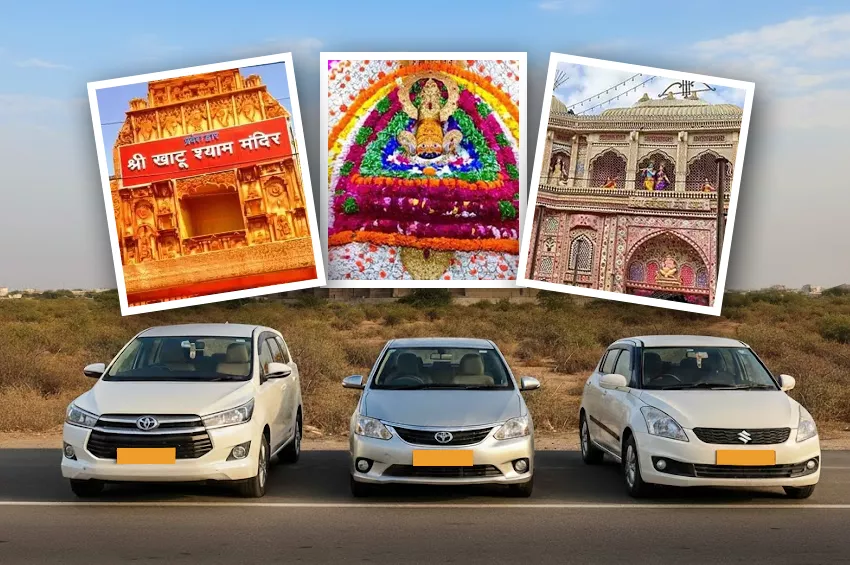
| Sedan (Swift Dzire / Etios) | Up to 4 | ₹3,000 | ₹5,000 | Solo, couples, small groups |
| SUV / Maruti Ertiga | Up to 6 | ₹3,500 – ₹4,000 | ₹6,000 – ₹7,000 | Families of 4–6 |
| Toyota Innova Crysta | Up to 7 | ₹4,000 – ₹4,500 | ₹7,000 – ₹8,000 | Comfortable family travel |
| Tempo Traveller (12–14 seat) | Up to 14 | ₹7,000 – ₹8,000 | ₹12,000 – ₹15,000 | Large groups, extended families |
| Luxury (Innova HyCross / Crysta Premium) | Up to 7 | ₹5,000 – ₹6,000 | ₹9,000 – ₹11,000 | Comfort-first travellers |
All fares are all-inclusive — toll, parking, state tax, driver allowance and fuel are covered in the quoted price. No hidden charges added on the day of travel. Always confirm the final figure at the time of booking.
What a standard round-trip fare typically includes in 2026:
- Driver charges for the full day
- Fuel for the agreed route (Jaipur → Khatu → Jaipur)
- Toll charges both directions on NH-52
- State tax and all permits
- Driver waiting time at the temple (typically 3–5 hours)
- Parking charges at Khatu
- Drop back to your Jaipur address
Not included (personal expenses):
- Temple prasad, donations, chunri, flowers
- Your meals and tea on the route
- Shoe storage at temple cloakroom (nominal fee)
- Any side-trip additions not agreed in advance
Always get a WhatsApp or written confirmation of the exact fare before the trip. Note whether toll is included or extra — some operators include it, some charge separately. At our service, the quoted price is the final price with no additions on the day.
Darshan Timings at Khatu Shyam Ji Temple — 2026
The temple operates on a morning and evening darshan schedule with a midday closure. Below are the current general timings. Note that these can be extended significantly during Phalgun Mela, Ekadashi and major Hindu festivals.
| Session | Time (approx.) | Notes |
|---|---|---|
| Mangala Aarti | 5:00 AM | First aarti of the day — very peaceful, limited crowd |
| Morning darshan opens | 5:30 AM | Temple gates open to general devotees |
| Shringar darshan / morning bhog | 7:00 – 8:00 AM | Deity decorated and offered morning prasad |
| General morning darshan | 5:30 AM – 1:00 PM | Best window for day-trippers from Jaipur: 8 AM – 11 AM |
| Afternoon closure | Approx. 1:00 – 4:00 PM | Temple closed for midday rest and bhog |
| Evening darshan opens | 4:00 PM | Temple reopens; good time for late-departure travellers |
| Sandhya Aarti | 7:00 – 7:30 PM | Atmospheric and crowded on Ekadashi; beautiful on regular evenings |
| Shayan Aarti / Closing | Approx. 9:00 PM | Final aarti; temple closes for the night |
During the Phalgun Mela and major Ekadashi dates, the temple often remains open continuously (24 hours or near-continuous darshan) due to the massive influx of devotees. The temple committee manages queue systems, and VIP/special entry protocols are suspended during peak festival periods so that all devotees enter under the general darshan system — this actually makes the experience more egalitarian and spiritually unified.
Best darshan time for Jaipur day-trippers: Arrive between 8:00 AM and 10:30 AM. The queue is most manageable, the morning light is beautiful, the atmosphere is devotional without being overwhelming, and you have time to visit the full temple complex, take prasad, walk the bazaar and eat lunch before the midday closure.
Phalgun Mela 2026 — Dates, Scale and What to Expect
Phalgun Mela 2026 at Khatu Shyam Ji ran from 18 February to 28 February 2026. The peak crowd days were Ekadashi on 27 February and Dwadashi on 28 February 2026. This is the most significant annual festival at the temple, drawing over 20 lakh (2 million) devotees over the 10-day period. The main celebration centres on Phalguna Shukla Ekadashi, which marks the divine manifestation day of Khatu Shyam Ji.
During the mela, Khatu village transforms completely. The bazaar expands along multiple lanes, bhajan mandalis perform through the night, the Nishan Yatra procession moves through the village, and devotees perform Shyam Kund snan (ritual bath in the sacred pond). The atmosphere is unlike anything else in the Rajasthan pilgrimage calendar — large, emotional, musically rich and deeply devotional.
For the next Phalgun Mela in 2027: it will fall in February or early March 2027 based on the Hindu lunar calendar. Specific dates will be announced by the temple trust approximately 6–8 weeks in advance. If you are planning a 2027 mela visit, monitor the temple's official communications from January 2027.
| Detail | Phalgun Mela 2026 |
|---|---|
| Mela period | 18 February – 28 February 2026 |
| Main Ekadashi day | 27 February 2026 |
| Estimated footfall | Over 20 lakh (2 million) devotees |
| Key ritual | Nishan Yatra, Shyam Kund snan, overnight bhajans |
| Darshan timings during mela | Near-continuous or 24-hour darshan on peak days |
| VIP entry | Suspended during peak mela days — general darshan only |
| Recommended Jaipur departure time | Before 4:30–5:00 AM on Ekadashi and peak days |
| Next Phalgun Mela | February–March 2027 (exact dates TBD) |
Best Time to Visit Khatu Shyam Ji — Month-by-Month 2026–27
| Month | Weather | Crowd level | Key dates / events | Visit rating |
|---|---|---|---|---|
| January 2027 | Cool to cold (8–22°C) | Moderate | Makar Sankranti Ekadashi | ✅ Very good |
| February 2027 | Pleasant (12–27°C) | Very high (Phalgun Mela) | Phalgun Mela 2027 — biggest festival of the year | ✅ Best for full experience |
| March 2027 | Warm (18–33°C) | High (Mela end, Holi) | Holi Ekadashi, Rang Panchami | ✅ Excellent |
| April 2027 | Warm–hot (24–39°C) | Moderate | Chaitra Navratri Ekadashi | ✅ Good with early start |
| May–June 2027 | Hot (35–46°C) | Low | Regular Ekadashi dates | ⚠️ Only with 5 AM departure |
| July–September 2027 | Warm, humid (28–37°C) | Low–moderate | Shravan, Janmashtami Ekadashi | ⚠️ Check roads; early mornings comfortable |
| October 2026 / 2027 | Comfortable (22–35°C) | High | Sharad Navratri, Dussehra Ekadashi | ✅ Very good |
| November 2026 / 2027 | Pleasant (14–28°C) | Very high | Dev Uthani / Kartik Ekadashi — most sacred Ekadashi of the year | ✅ Excellent |
| December 2026 | Cool (8–24°C) | Moderate–high (New Year influx) | New Year period (29 Dec – 2 Jan); VIP entry suspended | ✅ Very comfortable |
Ekadashi Dates — Why They Matter
Every Ekadashi (11th day of the lunar fortnight) is an especially auspicious day for Khatu Shyam Ji darshan. Two Ekadashis occur every month — one in the bright fortnight (Shukla Paksha) and one in the dark fortnight (Krishna Paksha). Among these, Dev Uthani Ekadashi in Kartik (November) and Phalguna Shukla Ekadashi (Phalgun Mela day) are the most significant. Plan accordingly: these days draw the largest crowds, the longest queues and the most intense devotional atmosphere.
One-Day Itinerary: Jaipur to Khatu Shyam Ji and Back — 2026
| Time | Activity | Practical note |
|---|---|---|
| 5:30 – 6:00 AM | Depart Jaipur by private taxi | Early start is the single best decision for this trip |
| 7:00 – 7:30 AM | Breakfast stop at Chomu | Dhabas open early; puri-sabzi, chai, paratha available |
| 8:00 – 8:30 AM | Arrive Khatu — park and freshen up | Parking at designated area; 10–15 min walk to temple gate |
| 8:30 – 10:30 AM | Darshan at Khatu Shyam Ji | Morning window is the best — calm queue, beautiful light |
| 10:30 – 11:30 AM | Temple bazaar, prasad, Shyam Kund area | Browse devotional items, marigold offerings, local sweets |
| 11:30 AM – 12:30 PM | Lunch near the temple | Vegetarian thali, dal-bati, puri restaurants throughout the area |
| 12:30 – 1:00 PM | Depart from Khatu | Before the afternoon closure; avoid returning post-12 PM rush |
| 2:30 – 3:00 PM | Arrive back in Jaipur | Afternoon free for rest, Jaipur sightseeing or onward travel |
Evening aarti option: If you want to stay for the Sandhya Aarti at 7:00–7:30 PM, depart Khatu by 8:00 PM and arrive back in Jaipur by 10:00–10:30 PM. Inform your driver in advance — evening return trips may attract a slightly higher fare. This extended-day trip is especially worthwhile on a regular weekday when the aarti atmosphere is intimate and unhurried.
New in 2026 — Pilgrimage Pathway and Infrastructure
One of the most significant developments at Khatu Shyam Ji in 2026 is the near-completion of a 48 km dedicated pilgrimage pathway designed for walking devotees making the parikrama-style journey to the temple. This pathway — reported in major Indian media in 2026 — significantly improves the infrastructure for the hundreds of thousands of devotees who walk to Khatu Shyam Ji on Phalgun Mela and Ekadashi days.
For taxi-based travellers from Jaipur, this development improves overall traffic management near the temple area. Separate routing for walking pilgrims reduces road congestion on peak days, which can make vehicle approach to the Khatu parking area faster than in previous years. The temple committee has also continued to refine queue management, cloakroom facilities and devotee welfare arrangements at the site.
Additionally, the temple trust periodically suspends VIP/special entry during the busiest festival days — as confirmed during the December 2025 New Year period — to ensure all devotees are treated equally under the general darshan system. This is an important policy shift that reflects the temple's commitment to fair access for all.
Combining Khatu Shyam Ji with Other Pilgrimage Sites
Khatu Shyam Ji + Salasar Balaji (Most Popular Combination)
Salasar Balaji — dedicated to Hanuman Ji — is approximately 60 km from Khatu Shyam Ji. This two-temple combination is the most popular pilgrimage circuit in this part of Rajasthan. As a single-day trip from Jaipur, total distance is roughly 280–300 km. Leave Jaipur by 4:30–5:00 AM. A more comfortable version is a two-day trip with a night's stay at Salasar or Ringas.
Khatu Shyam Ji + Jeenmata Temple
Jeenmata, one of the 108 Shakti Peethas, is located in the Sikar hills. Combining it with Khatu Shyam Ji works best on a two-day itinerary with a night at Sikar. The total experience is deeply devotional and covers two very different but equally powerful sacred sites.
Khatu Shyam Ji + Ringas
Ringas Junction, 17 km before Khatu, is a natural stop for passengers combining train and taxi. If any member of your group arrives by train at Ringas, your taxi can pick them up there and proceed directly to Khatu. Ringas also has good dhabas and a small market for a meal break.
| Combination | Total distance from Jaipur | Recommended format | Approx. taxi fare (Innova) |
|---|---|---|---|
| Khatu Shyam Ji only | 160–190 km round trip | Same-day return | ₹7,000 – ₹8,000 |
| Khatu Shyam Ji + Salasar Balaji | 280–300 km round trip | Same-day (early start) or 2-day | ₹9,000 – ₹12,000 |
| Khatu Shyam Ji + Jeenmata | 300+ km round trip | 2-day recommended | ₹11,000 – ₹14,000+ |
| Khatu Shyam Ji + Ringas pickup | Variable | Same-day | Discuss with operator |
What to Carry and Temple Rules
Essential carry list
- Water — minimum 1.5 litres per person; more in summer months
- Cash — ₹500–₹1,000 in small denominations for prasad, parking, tea, cloakroom
- Government ID (Aadhaar, driving licence) — useful to carry
- Light dupatta or stole for head covering in the sanctum
- Comfortable slip-on footwear for easy removal at temple entrance
- Small cloth bag for personal items inside (large bags go to cloakroom)
- Sunscreen, hat, electrolytes for summer trips
- Any personal medication or first-aid essentials for family travel
- Prasad items from home or purchase at the bazaar lane before entry: coconut, chunri, marigold garland
Temple rules and conduct
- Remove all footwear before the temple complex entrance — use the designated cloakroom area
- Dress modestly — covered shoulders and legs; traditional Indian attire is always appropriate
- No mobile photography inside the main sanctum — follow posted signage at all times
- Leather items (belts, bags) should not be visibly worn inside the sanctum area
- Maintain respectful silence near the deity — bhajan and prayer are welcome; loud conversation is not
- Queue with patience on all days; on Ekadashi and mela days, pushing causes accidents — be firm but calm
- Do not block the pathway during darshan for those behind you in the queue
Practical 2026 Travel Tips
Book your taxi 2–3 days in advance on regular days; 1–2 weeks in advance for Ekadashi and festival periods
Jaipur-based taxi availability for the Khatu Shyam Ji route is good on regular days. During Ekadashi, Phalgun Mela season, Dev Uthani Ekadashi in November and the New Year period, vehicles are in very high demand. Book early, confirm in writing and keep the driver's contact number saved.
Leave before 6 AM — this is the most important decision you will make
An early departure from Jaipur gives you the best darshan experience regardless of the season or crowd level. By 8:00–8:30 AM you are at the temple in the calm morning window. By 10:30 AM you have completed darshan, explored the bazaar and are ready for a relaxed lunch. Late departures mean afternoon queues, midday heat and a rushed experience.
Cash is still king at Khatu
UPI is increasingly accepted at some larger shops in the temple bazaar, but many vendors, the cloakroom, prasad sellers and parking attendants operate in cash. Carry ₹500–₹1,000 in small notes. Do not rely on finding an ATM near the temple on busy days — they can have long queues or run out of cash on Ekadashi.
Travelling with elderly devotees or young children
Inform your taxi operator in advance so they can arrange for a comfortable, accessible vehicle. Arrive early to avoid long queue standing times. The temple trust has some provisions for elderly and mobility-limited devotees — ask at the temple office on arrival. Carry a small water bottle, snacks and any required medication at all times. Set a clear meeting point in case of separation in a crowd.
Festival-period traffic management is improving
With the new 48 km pilgrimage pathway nearing completion and better local administration of vehicle routing near Khatu, access has improved compared to peak years before 2026. However, on Ekadashi and Phalgun Mela days, always add 30–45 minutes to your expected arrival time and plan your departure from the temple before the post-darshan midday rush begins.
Our Jaipur to Khatu Shyam Ji Taxi Service — 2026
At Rajasthan Tour Trip, we have been running the Jaipur to Khatu Shyam Ji route for years and understand what makes this pilgrimage trip work well. Here is what our service provides.
| Feature | Our service |
|---|---|
| Vehicles available | Sedan (Dzire/Etios), Ertiga, Innova Crysta, Tempo Traveller 12-seat |
| Pick-up | Your hotel, home or any Jaipur address at your chosen time |
| Fare transparency | All-inclusive confirmed fare before travel — no additions on the day |
| Toll, parking, state tax | All included in quoted fare |
| Booking method | Phone, WhatsApp, website contact form |
| Payment | Cash and UPI accepted on the day of travel |
| Driver experience | Drivers know the Khatu route, festival-period conditions and parking areas |
| Multi-temple itineraries | Salasar Balaji combo, Jeenmata, Ringas pickup — discuss at booking |
| No commission-based shop stops | We never route you through shops you did not ask to visit |
Frequently Asked Questions — Jaipur to Khatu Shyam Ji 2026–27
How far is Khatu Shyam Ji from Jaipur?
Approximately 80–95 km by road via NH-52 through Chomu and Ringas. Travel time is 1.5 to 2.5 hours one way under normal traffic conditions.
What is the taxi fare from Jaipur to Khatu Shyam Ji in 2026?
A one-way sedan trip starts at ₹3,000. A round-trip sedan costs approximately ₹5,000. An Ertiga/SUV round trip is ₹6,000–₹7,000. An Innova Crysta round trip is ₹7,000–₹8,000. A Tempo Traveller for large groups costs ₹12,000–₹15,000 round trip. All fares include toll, parking, state tax and driver allowance — no hidden charges.
When was Phalgun Mela 2026 at Khatu Shyam Ji?
Phalgun Mela 2026 ran from 18 to 28 February 2026, with the main Ekadashi celebration on 27 February 2026. The next Phalgun Mela is expected in February–March 2027.
What are the darshan timings at Khatu Shyam Ji in 2026?
Morning darshan: approximately 5:30 AM to 1:00 PM. Evening darshan: 4:00 PM to 9:00 PM. Mangala Aarti is at 5:00 AM. On Ekadashi and festival days, darshan may be near-continuous. Always confirm with the temple trust before travel as timings can change.
Can I visit Khatu Shyam Ji in one day from Jaipur?
Yes, easily. Leave Jaipur by 5:30–6:00 AM, arrive at Khatu by 8:00–8:30 AM, take darshan, explore the temple complex and return to Jaipur comfortably by 2:00–3:00 PM.
What is the best time of year to visit Khatu Shyam Ji from Jaipur?
October to March is the most comfortable season. Phalgun Mela (February 2026; February–March 2027) is the biggest annual event. Kartik/Dev Uthani Ekadashi in November is the most sacred single Ekadashi of the year. Avoid May–June unless you leave before 5 AM.
Is there a new pilgrimage pathway at Khatu Shyam Ji?
Yes. A 48 km dedicated pilgrimage pathway for walking devotees was under construction and nearing completion as of 2026. This improves infrastructure and reduces vehicle congestion near the temple on peak days.
Which vehicle is best for a family of 5–6 travelling from Jaipur to Khatu Shyam Ji?
An Innova Crysta or Maruti Ertiga is ideal for 5–6 passengers, offering comfortable seating, good luggage space and reliable AC for the journey. Book an Innova if you want the most comfortable ride; Ertiga is slightly more economical.
Is VIP entry available at Khatu Shyam Ji?
The temple normally has a special/VIP entry system. However, during peak periods — including Phalgun Mela Ekadashi, Dev Uthani Ekadashi, and the New Year period — VIP entry is suspended and all devotees use the general darshan system. Check current temple policy before your visit date.
Can I do Salasar Balaji and Khatu Shyam Ji in one day from Jaipur?
Yes, but it requires leaving Jaipur by 4:30–5:00 AM and is a long day (roughly 280–300 km total). A two-day itinerary with an overnight stay is more comfortable and gives both temples the time they deserve.
Is food available near Khatu Shyam Ji temple?
Yes. The temple bazaar lane and surrounding area have numerous vegetarian restaurants and food stalls serving puri-sabzi, thali, dal-bati and chai. The entire area is vegetarian. You can also stop at dhabas on the NH-52 route at Chomu for breakfast.
Is it safe to travel to Khatu Shyam Ji at night?
The road is generally safe and many devotees travel at night on Ekadashi. An experienced driver is important for night journeys on rural stretches after Ringas. For most first-time visitors and families, an early morning departure is recommended over a night journey.
Final Thought: Jaipur to Khatu — A Journey That Begins Before You Arrive
The phrase "Haare ka Sahara Shyam Hamara" captures something millions of people feel before they even board the car. The journey from Jaipur to Khatu Shyam Ji is not simply a road trip. For most who make it, the intention is set the night before — the early alarm, the morning prayer, the familiar road in the dark with bhajans playing softly on a phone. By the time you reach Khatu and walk through the bazaar lane towards the white marble temple gate, the journey has already done something to your spirit.
In 2026, with improved infrastructure, a growing devotee community, and the same ancient story of devotion at its heart, Khatu Shyam Ji remains one of the most powerful and accessible pilgrimage destinations in northern India. From Jaipur, it is close enough for a single day and significant enough to stay with you long after you return.
Plan well, leave early, travel comfortably, and give the temple the unhurried time it deserves. Baba Shyam's doors are open every day — all you need is to begin.
🙏 Jai Shri Shyam — Haare ka Sahara Shyam Hamara 🙏
Research and Editorial Note
This guide was updated in September 2026 to reflect current taxi fares from active Jaipur operators, confirmed Phalgun Mela 2026 dates (18–28 February 2026), the latest Khatu Shyam Ji infrastructure news including the 48 km pilgrimage pathway, and updated darshan and festival information. Temple timings, festival dates, taxi rates and road conditions can change. Always verify with the temple trust and your taxi operator before travel.