Jaipur to Salasar Balaji Taxi: Fare, Distance, Darshan Timings & Complete Pilgrimage Guide 2026–27
2026 Quick Answer
Salasar Balaji is approximately 170–175 km from Jaipur via NH-52 through Sikar — around 3 to 4 hours by private taxi. A same-day return trip is possible with an early start. A private round-trip taxi starts at ₹6,500–₹7,000 (sedan) and ₹8,500–₹10,000 (Innova Crysta) as of 2026, with all tolls, parking and driver allowance included. The biggest festival — Chaitra Purnima (Hanuman Jayanti) — fell on 2 April 2026 this year; the next falls in March–April 2027. Tuesday is the most auspicious day for darshan throughout the year, with a special Rajbhog Mahaprasad Aarti offered only on Tuesdays.
Salasar Balaji is one of Rajasthan's most powerful and beloved pilgrimage destinations — a temple to Bajrangbali, Lord Hanuman, that draws lakhs of devotees from across northern India every year. Located in Salasar village in the Churu district, the temple sits on NH-65 near Sujangarh and has been a centre of Hanuman devotion in this region for centuries. Its significance reaches beyond Rajasthan: devotees travel from Haryana, Delhi, Madhya Pradesh, Gujarat and across the country to seek the blessings of Salasar Balaji.
From Jaipur, Salasar Balaji is the natural pilgrim's companion to Khatu Shyam Ji — the two temples sit roughly 60 km apart, and thousands of families make the combined circuit every month. But Salasar also stands entirely on its own as a destination: the temple atmosphere, the Tuesdays, the Purnima fairs, the bhajan culture, the warm and generous spirit of the place — all of this creates an experience that is distinct, deeply devotional and worth planning properly.
This is a 2026-updated guide. It uses real current taxi fares from active operators on this route, confirmed 2026 festival dates, actual temple darshan and aarti timings, and practical advice that reflects the journey as it is happening right now. Whether you are planning a solo trip, a family pilgrimage, a group Tempo Traveller booking or a combined Salasar Balaji and Khatu Shyam Ji circuit, this guide has everything you need before you go.
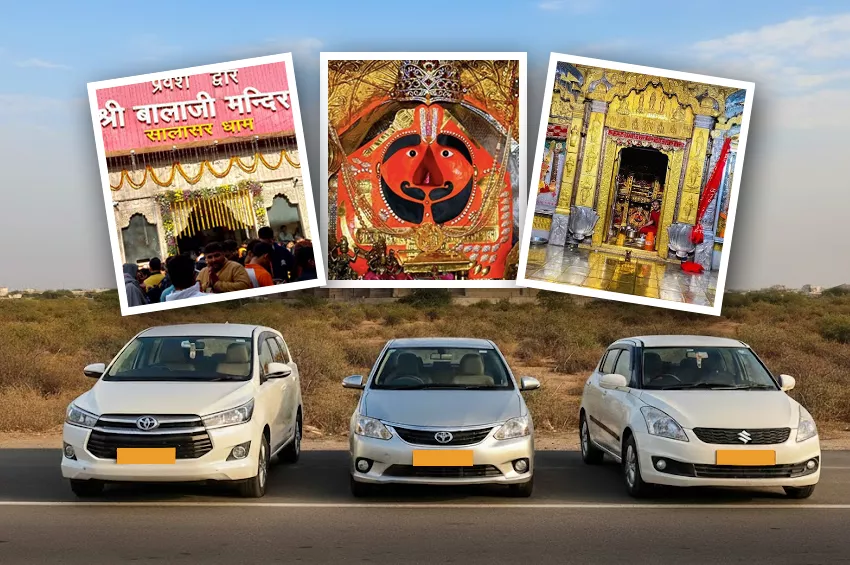
What's in This 2026 Salasar Balaji Travel Guide
- Who is Salasar Balaji — the legend and the temple
- Distance and route from Jaipur
- 2026 taxi fare and vehicle options
- Darshan timings and complete aarti schedule
- Chaitra Purnima 2026 and Ashwin Purnima — festival guide
- Why Tuesday is special at Salasar Balaji
- Best time to visit — month-by-month 2026–27
- One-day itinerary from Jaipur
- Combining with Khatu Shyam Ji and other temples
- What to carry and temple rules
- Where to stay near Salasar Balaji
- Practical 2026 travel tips
- Frequently asked questions
Who Is Salasar Balaji — The Legend Behind the Temple
The story of Salasar Balaji begins in a ploughed field. According to tradition, a farmer from Asota village in Nagpur district (Rajasthan) discovered a divine idol of Lord Hanuman while ploughing his land on a Saturday of Shravan Shukla Navami. The idol was recognised as self-manifested (swayambhu) — not carved by human hands — and its discovery was accompanied by signs that confirmed its sacred significance. The idol was brought to Salasar, where the great devotee Mohandas Ji — a Jat saint of extraordinary faith — established the temple and devoted his entire life to Balaji's seva (service).
Mohandas Ji is central to the spiritual identity of Salasar Balaji. His devotion was absolute and his life became the model for the temple's way of worship. The daily aarti schedule at Salasar Balaji still honours his memory — one of the daily aartis is called "Mohandas Ji Aarti" in his name. Devotees believe that his presence continues to bless the temple and all who visit with sincere hearts.
The temple is managed by the Jat community of Salasar and is famous for one unique ritual: devotees tie a coconut wrapped in red cloth on a sacred tree near the temple, making a wish or vow to Balaji. The belief is that Bajrangbali fulfills sincere wishes and removes hardships, and when a wish is fulfilled, the devotee returns to tie another coconut in gratitude. This ritual is one of the most visually distinctive aspects of a visit to Salasar — the tree is dense with offerings, each representing a prayer made and a faith placed.
The phrase most associated with Salasar Balaji is simple and absolute: Balaji Maharaj ki Jai. The trust between devotee and deity here has a quality of directness, warmth and confidence. People come with specific prayers — for health, for a child, for success in an exam, for the safety of a family member — and they leave with the feeling of having been genuinely heard.
Distance and Route from Jaipur to Salasar Balaji
Salasar Balaji is located in Salasar village, Churu district, Rajasthan — on NH-65 near Sujangarh. From Jaipur, the distance is approximately 170–175 km by road. The most comfortable route is via NH-52 through Sikar, then onwards to Losal and Salasar. The one-way journey takes 3 to 4 hours depending on traffic and any stops along the way.
| Route detail | Information (2026) |
|---|---|
| Distance (one way) | Approx. 170–175 km |
| Main highway | NH-52 via Sikar → Losal → Salasar |
| Travel time (one way) | 3 to 4 hours (normal traffic) |
| Travel time on Purnima / festival days | Add 45–90 minutes near Salasar due to heavy pilgrim traffic |
| Nearest town / stop | Sikar (approx. 60 km from Salasar) — good for a breakfast break |
| Nearest railway station | Sujangarh Junction — approx. 25 km from Salasar |
| Road condition | NH-52 is well-maintained; roads around Salasar are good but busy on festival days |
| Total round-trip distance | Approx. 340–350 km |
The route through Sikar is the most commonly used and the most comfortable. Sikar itself is a good place to stop for chai, paratha or poha on the morning drive out. After Sikar, the road continues through Losal towards Salasar. The final stretch into Salasar village can become very congested on Tuesdays, Purnima days and major festivals — local administration sometimes implements one-way traffic near the temple on these days. A 5:00 AM departure from Jaipur ensures you arrive well before the worst of the crowd builds.
Jaipur to Salasar Balaji Taxi Fare — Updated 2026 Rates
The following fares are based on current 2026 market rates from active Jaipur taxi operators running this route. Because Salasar Balaji is roughly twice the distance of Khatu Shyam Ji from Jaipur, the fares are naturally higher. All quoted fares cover a full-day round trip including driver waiting time at the temple.
| Vehicle type | Passengers | One-Way Fare | Round-Trip Fare | Best for |
|---|---|---|---|---|
| Sedan (Swift Dzire / Etios) | Up to 4 | ₹3,500 | ₹6,500 – ₹7,000 | Solo, couples, small groups |
| SUV / Maruti Ertiga | Up to 6 | ₹4,000 – ₹4,500 | ₹7,500 – ₹8,500 | Families of 4–6 |
| Toyota Innova Crysta | Up to 7 | ₹4,800 – ₹5,500 | ₹8,500 – ₹10,000 | Comfortable family travel |
| Tempo Traveller (12–14 seat) | Up to 14 | ₹8,000 – ₹9,500 | ₹14,000 – ₹18,000 | Large groups, extended families |
| Luxury (Innova HyCross / Crysta Premium) | Up to 7 | ₹6,000 – ₹7,000 | ₹11,000 – ₹13,000 | Comfort-first travellers |
What a standard round-trip fare includes in 2026:
- Driver charges for the full day
- Fuel for the agreed route (Jaipur → Salasar → Jaipur)
- Toll charges both directions on NH-52
- State tax and all permits
- Driver waiting time at the temple (typically 3–5 hours)
- Parking charges at Salasar
- Drop back to your Jaipur address
Not included (personal expenses):
- Prasad, coconut offerings, chunri, marigold garlands at the temple
- Your meals and chai on the route
- Shoe storage at temple cloakroom
- Any overnight stay or extended itinerary additions
Always confirm the all-inclusive final fare in writing or via WhatsApp before the journey begins. Our service provides a confirmed quote with no additions on the day of travel.
Darshan Timings and Complete Aarti Schedule at Salasar Balaji
The temple is open from 6:00 AM daily, with Mangala Aarti beginning even earlier at 5:00–5:30 AM. The full daily aarti schedule is one of the most detailed and devotionally rich aspects of a Salasar Balaji visit. Both summer and winter schedules are provided below.
Temple Opening Hours
| Season | Opening time | Closing time |
|---|---|---|
| Summer (April to September) | 6:00 AM | 10:00 PM |
| Winter (October to March) | 6:00 AM | 9:00 PM |
Full Aarti Schedule — Winter (October to March)
| Aarti name | Time | Notes |
|---|---|---|
| Mangala Aarti | 5:30 AM | First aarti of the day — most peaceful and intimate |
| Mohandas Ji Aarti | 6:00 AM | Honouring the great saint-devotee of Salasar |
| Rajbhog Aarti | 10:15 AM | Main midday aarti; significant and well-attended |
| Rajbhog Mahaprasad Aarti | 11:00 AM (Tuesdays only) | Special aarti offered only on Tuesdays — the most auspicious day |
| Dhoop Gwal Aarti | 5:00 PM | Afternoon incense aarti |
| Mohandas Ji Aarti (evening) | 5:30 PM | Second daily Mohandas Ji Aarti |
| Sandhya Aarti | 6:00 PM | Beautiful evening aarti — highly recommended for late-departure visitors |
| Bal Bhog Stuti | 7:00 PM | Evening offering and devotional stuti |
| Shyan Aarti | 9:00 PM | Final aarti before the temple closes for the night |
Full Aarti Schedule — Summer (April to September)
| Aarti name | Time | Notes |
|---|---|---|
| Mangala Aarti | 5:00 AM | Earlier start in summer — arrives with sunrise |
| Mohandas Ji Aarti | 5:30 AM | Pre-dawn devotion in the quiet morning hours |
| Rajbhog Aarti | 10:00 AM | Main midday aarti |
| Rajbhog Mahaprasad Aarti | 10:00 AM (Tuesdays only) | Most auspicious single aarti of the week |
| Dhoop Gwal Aarti | 6:30 PM | Later in summer due to longer daylight |
| Mohandas Ji Aarti (evening) | 7:00 PM | Evening Mohandas Ji Aarti |
| Sandhya Aarti | 7:30 PM | Popular evening aarti |
| Bal Bhog Stuti | 8:00 PM | Evening offering |
| Shyan Aarti | 10:00 PM | Later closing in summer |
Best darshan time for Jaipur day-trippers: Arriving between 9:00 AM and 11:00 AM gives you access to the Rajbhog Aarti, a manageable queue and the full morning temple atmosphere. On Tuesdays, try to arrive before 10:00 AM to be present for the special Mahaprasad Aarti. On Purnima days, arrive before 8:00 AM to avoid peak crowd buildup.
Chaitra Purnima 2026 and Ashwin Purnima — Festival Guide
Two Purnima (full moon) fairs are the most important annual events at Salasar Balaji. Both draw lakhs of devotees and transform the town into a vibrant pilgrimage hub for three days each.
Chaitra Purnima (Hanuman Jayanti) — The Biggest Festival
Chaitra Purnima 2026 fell on 2 April 2026, coinciding with Hanuman Jayanti. This is the single most important date in the Salasar Balaji calendar. The three-day fair centred on this date draws devotees from across Rajasthan, Haryana, Delhi, Punjab and beyond. Hundreds of thousands arrive on foot, by bus, by car and by train. The temple remains open near-continuously, bhajan mandalis perform through the night, and the entire Salasar town is decorated and alive.
| Detail | Chaitra Purnima 2026 |
|---|---|
| Date | 2 April 2026 (Hanuman Jayanti) |
| Fair duration | 3 days centred on Purnima date |
| Tithi begins | 7:06 AM on 1 April 2026 |
| Tithi ends | 7:41 AM on 2 April 2026 |
| Crowd level | Extremely high — lakhs of devotees |
| Recommended Jaipur departure | Before 4:30 AM on the main Purnima day |
| Special rituals | Coconut tying, continuous bhajans, special Hanuman Jayanti aarti |
| Next Chaitra Purnima | March–April 2027 (exact date TBD per Hindu calendar) |
Ashwin Purnima — October Festival
The second major annual fair at Salasar Balaji is held on Ashwin Purnima — the full moon of the Hindu month of Ashwin, typically in October. This fair is equally important in the devotional calendar and draws a similarly large gathering. For October 2026, the Ashwin Purnima date should be confirmed with the temple trust or a local panchang as the specific date varies year to year. The atmosphere during Ashwin Purnima has a post-monsoon freshness and the evenings are cool and beautiful — many devotees consider this the more comfortable of the two annual fairs for travel.
Why Tuesday is the Most Auspicious Day at Salasar Balaji
Tuesday — Mangalwar — is sacred to Lord Hanuman throughout India, and at Salasar Balaji this significance is honoured in a concrete and special way: the Rajbhog Mahaprasad Aarti is offered only on Tuesdays. This aarti is not part of the regular daily schedule on other days — it is exclusive to Tuesday and is considered the most blessed offering of the week.
As a result, Tuesdays at Salasar Balaji are always significantly busier than other weekdays. Devotees who cannot make the long journey on Purnima days often choose a Tuesday for their darshan, knowing the temple carries a particular energy and that the Mahaprasad Aarti makes the visit especially complete. If you are planning a trip from Jaipur specifically for a devotional experience rather than a tourist outing, a Tuesday is the natural choice — provided you leave early enough to arrive before the crowd builds and before the 10:00–11:00 AM Mahaprasad Aarti.
Best Time to Visit Salasar Balaji — Month-by-Month 2026–27
| Month | Weather | Crowd level | Key dates / events | Visit rating |
|---|---|---|---|---|
| January 2027 | Cool to cold (8–22°C) | Moderate | Makar Sankranti; regular Tuesdays | ✅ Very good |
| February 2027 | Pleasant (12–27°C) | Moderate | Maha Shivaratri; regular Tuesdays | ✅ Very good |
| March 2027 | Warm (18–33°C) | Moderate–high | Chaitra Navratri Purnima approaching | ✅ Excellent |
| April 2027 | Warm (24–38°C) | Very high (Chaitra Purnima / Hanuman Jayanti) | Chaitra Purnima 2027 — biggest annual fair | ✅ Best for full festival experience |
| May–June 2027 | Hot (36–46°C) | Low | Regular Tuesdays | ⚠️ Only with very early 4:30 AM departure |
| July–September 2027 | Warm, humid (28–38°C) | Low–moderate | Shravan month — especially auspicious Tuesdays | ⚠️ Shravan Tuesdays are worth it; early departure essential |
| October 2026 / 2027 | Comfortable (22–35°C) | Very high (Ashwin Purnima) | Ashwin Purnima fair — second biggest annual festival | ✅ Excellent — comfortable weather, big festival |
| November 2026 / 2027 | Pleasant (14–28°C) | Moderate | Kartik month; Dev Uthani Ekadashi | ✅ Very good |
| December 2026 | Cool (8–24°C) | Moderate | Regular Tuesdays; Margashirsha auspicious days | ✅ Comfortable and calm |
Shravan Month Tuesdays — Special Note
The month of Shravan (July–August) is considered deeply sacred to Lord Shiva and is also especially auspicious for Hanuman devotion. Tuesdays during Shravan carry additional devotional significance at Salasar Balaji. Devotees who can make the journey during Shravan Tuesdays often describe the atmosphere as particularly charged and spiritually alive, even though the weather is warm and humid. If you are visiting during Shravan, leave Jaipur by 4:30 AM and carry extra water.
One-Day Itinerary: Jaipur to Salasar Balaji and Back — 2026
Because Salasar Balaji is roughly twice as far from Jaipur as Khatu Shyam Ji, the itinerary requires an earlier departure and careful planning to make the most of the day. The following schedule works comfortably for a same-day return trip.
| Time | Activity | Practical note |
|---|---|---|
| 4:30 – 5:00 AM | Depart Jaipur by private taxi | Early departure is essential — the extra distance demands it |
| 6:30 – 7:00 AM | Breakfast stop at Sikar | Good dhabas on NH-52 near Sikar; puri-sabzi, paratha, chai |
| 8:30 – 9:00 AM | Arrive Salasar — park vehicle | Parking area available; 5–10 min walk to temple gate |
| 9:00 – 10:30 AM | Temple darshan and morning aarti | On Tuesday: be at temple by 9:30 AM for Rajbhog Mahaprasad Aarti at 10–11 AM |
| 10:30 – 11:30 AM | Coconut tree ritual, bazaar, prasad | Buy coconut with red cloth at market; tie on sacred tree near temple |
| 11:30 AM – 12:30 PM | Lunch in Salasar | Vegetarian thali restaurants throughout the temple area |
| 12:30 – 1:00 PM | Depart from Salasar | Midday departure for a 4:00–5:00 PM Jaipur return |
| 4:00 – 5:00 PM | Arrive back in Jaipur | Evening free for rest or onward travel |
For evening Sandhya Aarti: If you wish to stay for the 6:00–7:30 PM Sandhya Aarti, plan to return to Jaipur by 10:30–11:00 PM. This is a longer day but the evening at Salasar — with the cooling air, the bhajans beginning again, the lamps being lit — is an experience worth the late return. Inform your driver in advance as evening return fares may be slightly adjusted.
Combining Salasar Balaji with Other Pilgrimage Sites
Salasar Balaji + Khatu Shyam Ji — Most Popular Combination
The Salasar Balaji and Khatu Shyam Ji combination is the most iconic pilgrimage circuit in this part of Rajasthan. The two temples are approximately 60 km apart. The standard approach is to visit Khatu Shyam Ji first in the early morning (being there by 8:00–9:00 AM), take darshan, then drive to Salasar for afternoon darshan and return to Jaipur in the evening. Leave Jaipur by 4:30 AM for this combination.
For a more relaxed experience — especially with elderly devotees or young children — a two-day itinerary with an overnight stay at Salasar is much more comfortable. This allows unhurried darshan at both temples, participation in morning and evening aartis at both, and avoids the fatigue of a very long single day.
Salasar Balaji + Rani Sati Temple, Jhunjhunu
Rani Sati Dadi temple in Jhunjhunu is another major pilgrimage site in this northern Rajasthan region. It can be combined with Salasar Balaji on a two-day trip, making a full northern Rajasthan spiritual circuit from Jaipur. Jhunjhunu is approximately 50–60 km from Salasar.
Salasar Balaji + Sikar Heritage Temples
Sikar district has several notable temples and havelis. Harshnath Temple, located in the Aravalli hills near Sikar, is a historically significant Shiva temple with scenic surroundings. It can be added to the route on the return journey from Salasar without significantly extending the travel time.
| Combination | Total distance | Recommended format | Approx. fare (Innova) |
|---|---|---|---|
| Salasar Balaji only | 340–350 km round trip | Same-day (early start) | ₹8,500 – ₹10,000 |
| Salasar + Khatu Shyam Ji | 400–430 km round trip | Same-day (4:30 AM departure) or 2-day | ₹11,000 – ₹14,000 |
| Salasar + Rani Sati Jhunjhunu | 450–480 km round trip | 2-day recommended | ₹13,000 – ₹16,000 |
| Salasar + Khatu + Jeenmata | 500+ km | 2–3 day itinerary | ₹16,000 – ₹20,000+ |
What to Carry and Temple Rules at Salasar Balaji
Essential carry list
- Water — minimum 1.5–2 litres per person; more in summer months on this longer journey
- Cash — ₹800–₹1,500 in small denominations for prasad, coconut, parking, meals, cloakroom
- Government ID — Aadhaar or driving licence
- Red cloth and coconut — can be purchased at the bazaar near the temple, but some families prefer to bring from home as a personal offering
- Light stole or dupatta for head covering inside the sanctum
- Comfortable slip-on footwear for easy removal
- Small cloth bag for phone, wallet and keys (large bags go to cloakroom)
- Sunscreen, cap and electrolytes for summer and post-monsoon visits
- Personal medication, basic first-aid kit for family travel
- Light snacks for the road — biscuits, dry fruits, namkeen — especially for the longer journey with children
Temple conduct and entry rules
- Remove footwear before entering the temple complex and use the designated cloakroom area
- Dress modestly — covered shoulders and legs are expected as a mark of respect
- No photography inside the main sanctum — follow posted signage strictly
- The coconut tying ritual: purchase a coconut wrapped in red cloth at the market, make your prayer at the sacred tree near the temple and tie it there — do not throw or place it carelessly
- Maintain silence and reverential behaviour in the inner temple hall
- Queue with patience at all times — pushing is both dangerous and disrespectful
- Balaji Mahaprasad is distributed after certain aartis — receive it with both hands as a mark of respect
Where to Stay Near Salasar Balaji
For those planning an overnight trip or a two-day Salasar-Khatu combination, accommodation is available in and around Salasar town. The temple trust and various dharamshalas offer basic but clean rooms at nominal charges for pilgrims. Several private hotels and guest houses have also developed in the town in recent years to cater to the growing number of devotees who stay overnight.
Advance booking is strongly recommended during Chaitra Purnima, Ashwin Purnima and major Tuesdays. During these periods, rooms in Salasar can fill up days in advance. If you are combining Salasar with Khatu Shyam Ji and plan to stay one night, Ringas town (between the two temples) also has basic accommodation options and is a practical midpoint base.
Practical 2026 Travel Tips for Salasar Balaji from Jaipur
Book your taxi at least 3 days in advance — 1–2 weeks for Purnima and Tuesday peak days
Because Salasar Balaji is a longer trip, vehicles are booked further in advance than for shorter Jaipur day-trips. During Chaitra Purnima, Ashwin Purnima, Hanuman Jayanti and the major Shravan Tuesdays, taxi availability from Jaipur can be limited. Book early, confirm all details in writing and keep the driver's contact number saved from the night before.
4:30–5:00 AM departure is the sweet spot
For a same-day return, leaving Jaipur between 4:30 and 5:00 AM puts you at the temple between 8:30 and 9:30 AM. This is the most comfortable arrival window: the morning is fresh, the queue is manageable, you can be present for the Rajbhog Aarti, and you have the whole morning at the temple before the midday crowd peaks. A later departure means arriving in the heat of the day with longer queues and a rushed return.
Tuesday strategy: arrive before 9:30 AM
If you are going specifically for the Tuesday Mahaprasad Aarti, depart Jaipur by 4:30 AM and aim to arrive at the temple by 9:00–9:30 AM. The aarti begins at 10:00–11:00 AM depending on season, and the queue builds significantly after 9:00 AM on Tuesdays. Early arrival means you take darshan calmly before the Aarti and are settled in a good position when it begins.
The journey is longer — plan accordingly for children and elderly
Unlike the 2-hour Khatu Shyam Ji trip, Salasar Balaji requires 3–4 hours of travel each way. Plan for at least one comfortable break at Sikar on the way out, carry enough water and snacks for the vehicle, and ensure the vehicle you book is genuinely comfortable for a longer journey. For elderly devotees, an Innova or similar SUV with proper seating and AC is strongly recommended over a compact sedan for a trip of this length.
Cash is essential at Salasar
While some shops near the temple accept UPI, parking attendants, cloakroom, dhaba stops, coconut vendors and roadside chai stalls all operate in cash. Carry ₹1,000–₹1,500 in smaller notes for a comfortable day without needing to hunt for a working ATM near the temple on a busy day.
Festival period — traffic management
During Chaitra Purnima and Ashwin Purnima, traffic within Salasar town can become gridlocked for hours. Local police often manage one-way systems and designated parking zones. Your driver will know the current access routes but should still depart Jaipur well before 5:00 AM on these days. The walk from the parking area to the temple gate may be 15–20 minutes on peak days. Keep your group together and set a clear meeting point.
Our Jaipur to Salasar Balaji Taxi Service — 2026
Rajasthan Tour Trip provides private taxi service for the Jaipur to Salasar Balaji route with experienced drivers, confirmed all-inclusive fares and the flexibility to customise your itinerary. Here is what you can expect.
| Service feature | Details |
|---|---|
| Vehicles available | Sedan (Dzire/Etios), Maruti Ertiga, Innova Crysta, Tempo Traveller (12–14 seat) |
| Pick-up | Your hotel, home or any Jaipur address at your chosen time |
| Fare transparency | All-inclusive confirmed fare before travel — toll, parking, driver allowance all included |
| Booking | Phone, WhatsApp or website contact form |
| Payment | Cash and UPI accepted on the day of travel |
| Driver experience | All drivers are familiar with the Salasar route, festival-period conditions and parking |
| Customisation | Khatu Shyam Ji combo, Rani Sati Jhunjhunu, overnight trips, group bookings |
| Shop stops | Never — your time at the temple is entirely your own |
Frequently Asked Questions — Jaipur to Salasar Balaji 2026–27
How far is Salasar Balaji from Jaipur?
Approximately 170–175 km by road via NH-52 through Sikar and Losal. The one-way journey takes 3 to 4 hours under normal traffic conditions.
What is the taxi fare from Jaipur to Salasar Balaji in 2026?
A round-trip sedan costs approximately ₹6,500–₹7,000. A Maruti Ertiga round trip is ₹7,500–₹8,500. An Innova Crysta round trip is ₹8,500–₹10,000. A Tempo Traveller for groups is ₹14,000–₹18,000 round trip. All fares include toll, parking, state tax and driver allowance.
When is Chaitra Purnima 2026 at Salasar Balaji?
Chaitra Purnima 2026 was on 2 April 2026 (Hanuman Jayanti). The three-day fair around this date is the biggest annual event at the temple, drawing lakhs of devotees. The next Chaitra Purnima is in March–April 2027.
What are the darshan timings at Salasar Balaji?
The temple opens at 6:00 AM daily. Mangala Aarti begins at 5:00–5:30 AM. The temple closes at 9:00 PM in winter and 10:00 PM in summer. The full aarti schedule includes 8 daily aartis, with a special Rajbhog Mahaprasad Aarti offered only on Tuesdays.
Which day is best for darshan at Salasar Balaji?
Tuesday is the most auspicious day — Mangalwar is sacred to Lord Hanuman, and the special Rajbhog Mahaprasad Aarti is offered only on Tuesdays. Chaitra Purnima (April) and Ashwin Purnima (October) are the most important festival days of the year.
Can I visit Salasar Balaji in one day from Jaipur?
Yes, with an early 4:30–5:00 AM departure from Jaipur. You arrive by 8:30–9:30 AM, spend 3–4 hours at the temple complex and return to Jaipur by 4:00–5:00 PM. It is a full day but very manageable.
Can I combine Salasar Balaji and Khatu Shyam Ji in one trip from Jaipur?
Yes, this is the most popular pilgrimage combination. Visit Khatu Shyam Ji first in the morning (arrive by 8:00 AM), then drive 60 km to Salasar for afternoon darshan. Leave Jaipur before 4:30 AM. A two-day version with an overnight stay is more comfortable and recommended for families and elderly devotees.
Is food available near Salasar Balaji temple?
Yes. The area around the temple has numerous vegetarian restaurants and food stalls serving thali, puri-sabzi, dal-bati and chai. The entire Salasar area is vegetarian. A comfortable dhaba stop in Sikar on the way out is recommended for breakfast.
Is accommodation available at Salasar Balaji?
Yes. Dharamshalas (trust accommodation), private hotels and guest houses are available in Salasar town. Advance booking is essential during Chaitra Purnima, Ashwin Purnima and major Tuesdays.
What is the significance of the coconut tying ritual at Salasar Balaji?
Devotees tie a coconut wrapped in red cloth on a sacred tree near the temple while making a wish or prayer to Balaji. The belief is that Hanuman Ji fulfills sincere wishes made here. When a wish is fulfilled, the devotee returns to tie another coconut in gratitude. Coconuts with red cloth are available at the temple bazaar.
Is it safe to travel to Salasar Balaji at night?
The road is generally safe and many devotees travel in the pre-dawn hours on Purnima and Ekadashi days. An experienced driver is important on the longer NH-52 route. For first-time visitors and families, a pre-dawn 4:30–5:00 AM departure is recommended over a nighttime drive.
Which vehicle is best for a family of 5–6 on this trip?
An Innova Crysta or Maruti Ertiga is ideal for families of 5–6 on this longer journey. The extra distance (170 km each way) makes seating comfort and reliable AC significantly more important than on shorter trips. Do not compromise on vehicle quality for a round trip of 340+ km.
Final Thought: The Road to Salasar Begins in Devotion
There is something particular about the road from Jaipur to Salasar Balaji in the pre-dawn hours. The city is still dark when the taxi pulls away. By the time you reach the highway towards Sikar, the sky is beginning to lighten at its edges. The car may be quiet, or there may be bhajans playing. By the time you pass Sikar and continue north towards Losal, the light is fully arrived and the road is moving. When the first flags and pennants of the Salasar temple area come into view, something settles in the atmosphere of the vehicle.
This journey — from Jaipur to Salasar, through the Rajasthan morning — is itself a form of preparation for the darshan that waits at the end of it. Balaji does not require elaborate preparation. He requires sincerity. The long road, the early rising, the willingness to arrive — these are themselves a kind of offering.
Travel well. Arrive with patience. Let the coconut tree and the temple hall and the aarti bell do what they have always done. And return to Jaipur with something settled that was restless before.
🙏 Jai Salasar Balaji — Bajrangbali Maharaj ki Jai 🙏
Research and Editorial Note
This guide was updated in September 2026 to reflect current taxi fares from active Jaipur operators, confirmed Chaitra Purnima 2026 date (2 April 2026 / Hanuman Jayanti), accurate temple darshan and aarti timings, and the complete Salasar Balaji festival calendar. Temple timings, festival dates, taxi rates and road conditions can change. Always verify with the Salasar Balaji temple trust and your taxi operator before travel.