Kanak Vrindavan Garden Jaipur: Latest Timings, Entry Fee, Krishna Temple, Photography & Amer Route
Kanak Vrindavan Jaipur: Quick Facts
- Location: foothills of Nahargarh, on the Jaipur–Amber route.
- Official Rajasthan Tourism description: landscaped garden with an intricately carved temple, terrace sites, marble columns and lattices.
- Current central-government timing reference: Incredible India lists 9:00 AM–7:00 PM.
- Entry fee: no separate current tariff was found on the Rajasthan Tourism/RTDC government pages checked; third-party listings conflict, so verify the authorised gate/counter on arrival.
- Temple: Shri Govind Deoji Parisar / Krishna temple is part of the garden's spiritual identity.
- Design: Incredible India describes a blend of Mughal and Rajput styles.
- Special feature: eight garden sections and the marble Parikrama fountain.
- Good for: families, couples, photographers, architecture lovers and travellers going toward Amber.
- Best route: Jal Mahal → Kanak Vrindavan → Amber Fort → Jagat Shiromani / Panna Meena ka Kund.
- Time required: roughly 45–90 minutes for most visitors.
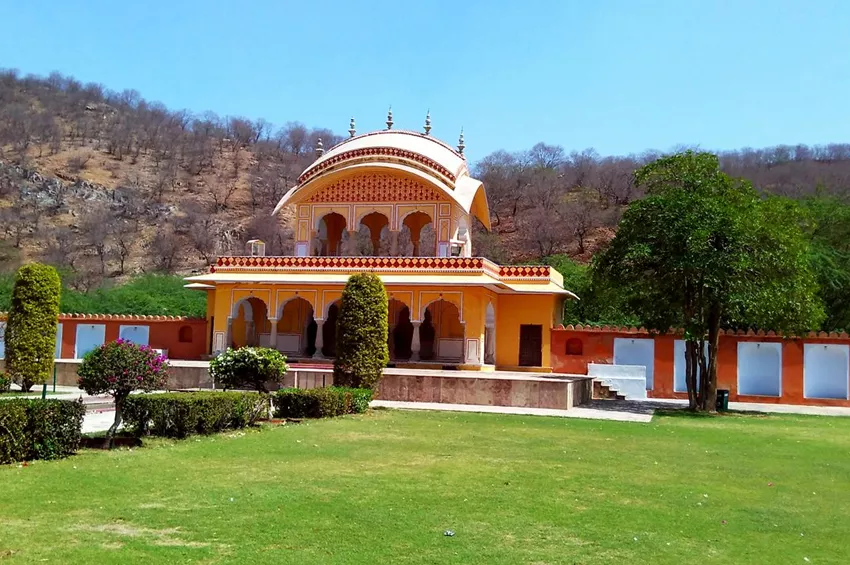
Kanak Vrindavan is one of Jaipur's easiest places to miss for a very simple reason: almost everybody passing its road is going somewhere more famous.
Jal Mahal has already caught your eye. Amber Fort is ahead. Nahargarh and Jaigarh rise around the valley. In that company, a garden can look like an optional stop.
That is exactly why Kanak Vrindavan works.
Rajasthan Tourism's current Jaipur page places it at the foothills of the Nahargarh hills on the way to Amber and describes a landscaped garden containing an intricately carved temple, terrace sites, marble columns and lattices. The same government page notes that locals use it for picnics and that its appearance has made it attractive for film shoots.
The Government of India's Incredible India portal adds more useful detail: the complex is approximately 275 years old, is associated with Maharaja Sawai Jai Singh, combines Mughal and Rajput design, contains eight sections, marble fountains and chhatris, and includes the Shri Govind Deoji temple complex.
So Kanak Vrindavan is not merely “a park near Jal Mahal.” It works best as a short heritage landscape stop where garden design, Krishna devotion and Jaipur's hill geography meet.
Complete Kanak Vrindavan Guide
Kanak Vrindavan Timings: Latest Government Reference
The most useful current government timing reference we found is the Government of India's Incredible India page, which lists:
| Detail | Current Reference |
|---|---|
| Opening | 9:00 AM |
| Closing | 7:00 PM |
| Source | Incredible India, Ministry of Tourism ecosystem |
| Recommended visit | Morning or late afternoon |
| Time required | 45–90 minutes for most travellers |
Why do some websites say 8:00 AM–5:00 PM, 9:00 AM–5:00 PM or 6:30 PM? Because private listings are inconsistent and may reflect older gate schedules. If your itinerary depends on entering immediately after opening or shortly before closing, verify locally on the day.
Do not automatically choose noon because it fits between monuments. Morning gives softer light and cooler walking; late afternoon gives the garden warmer light and works naturally before returning from the Amber side.
Kanak Vrindavan Entry Fee: Indian & Foreign Tourist Reality
This is the part where travel websites create unnecessary confusion.
Current private listings quote everything from free entry to nominal Indian, foreigner and camera charges. We did not find a separate current Kanak Vrindavan ticket tariff published on the Rajasthan Tourism/RTDC pages retrieved during this update.
| Visitor / Charge | What We Can Verify |
|---|---|
| Indian adult | No separate current government tariff found in the official tourism pages checked |
| Indian child | No separate current government tariff found |
| Foreign visitor | No separate current government foreigner tariff found |
| Still camera | Do not rely on an old blog amount; follow current gate instructions |
| Professional shoot | Different from ordinary visitor photography; permission requirements can apply |
Rajasthan Tourism's official film-shooting portal confirms that formal film-shoot permissions in Rajasthan can involve a single-window clearance process depending on the location and authorities involved. A normal tourist taking phone photographs should not confuse that process with commercial production.
Is Kanak Vrindavan on Rajasthan OBMS?
Do not assume every Jaipur attraction has an OBMS monument ticket. The OBMS portal is used for Rajasthan's ticketed tourist monuments and services, but the current official material retrieved for Kanak Vrindavan does not establish a standard Indian/foreigner OBMS admission schedule for the garden.
If the official gate displays a current fee when you visit, that on-site authorised amount takes priority over an old article.
Kanak Vrindavan History: What Government Sources Actually Say
Incredible India describes Kanak Vrindavan as approximately 275 years old and associates its creation with Maharaja Sawai Jai Singh. Jaipur Municipal Corporation's heritage page also links the naming of Kanak Vrindavan to Sawai Jai Singh and says he found the valley reminiscent of Lord Krishna's sacred Vrindavan.
That Vrindavan association is central to understanding the place. The garden was not named simply because it was green. Its landscape was interpreted through Krishna devotion and the memory of Vrindavan near Mathura.
Was It a Royal Retreat?
Incredible India describes the garden as a serene retreat conceived for the Maharani and Maharaja. That helps explain why the place combines formal garden design with a devotional temple rather than functioning as either a pure palace garden or a standalone shrine.
Why “Kanak” Vrindavan?
Popular explanations of the “Kanak” part vary across older secondary sources. Because the current Rajasthan Tourism description does not establish one definitive etymology, it is better not to turn a repeated internet explanation into a hard historical fact.
Shri Govind Deoji Temple at Kanak Vrindavan
Incredible India states that Maharaja Sawai Jai Singh consecrated an idol of Sri Krishna in the temple within Kanak Vrindavan, identified there as the Shri Govind Deoji Parisar.
This is important because it explains why Kanak Vrindavan feels different from a municipal lawn. The garden's Krishna/Vrindavan symbolism continues into the temple.
Is This the Same as Govind Dev Ji Temple in City Palace?
No. Visitors should not confuse the Kanak Vrindavan temple complex with Jaipur's famous Govind Dev Ji Temple in the City Palace/Jai Niwas area.
Some local heritage accounts refer to the Kanak Ghati shrine as an “old Govind Devji” or Radha Madhav temple and discuss traditions about the Govind Dev image staying in this area before its final Jaipur installation. Those claims should be treated carefully where official documentation is not explicit.
Temple Etiquette
- remove footwear where instructed;
- dress respectfully;
- do not block devotees for photographs;
- follow current rules around the sanctum;
- do not assume garden photography rules automatically apply inside the temple.
Architecture: Why Kanak Vrindavan Looks Different
Incredible India describes the complex as a blend of Mughal and Rajput styles. Rajasthan Tourism highlights its terraces, marble columns and lattices.
Eight Garden Sections
The Incredible India description says the garden is organised into eight sections. Instead of walking directly to the temple and back, look at how paths, terraces, water and built elements divide and frame the landscape.
Marble Fountains
The central visual vocabulary includes marble fountains. Incredible India specifically highlights the Parikrama fountain, described as carved from a single marble slab.
Chhatris
Traditional chhatris add Rajasthan's architectural language to the formal garden.
Jali & Marble Work
Rajasthan Tourism's current description specifically calls attention to marble columns and lattices. These details are easiest to appreciate when the garden is not crowded.
Mirror & Decorative Work
Incredible India notes mirrors decorating the walls of the Govind Deoji temple and delicate work within the Garbha Griha.
What to See at Kanak Vrindavan
- Overall valley setting: notice the Aravalli/Nahargarh foothills before focusing on individual structures.
- Formal garden sections: walk rather than photographing from one point.
- Parikrama fountain: one of the complex's signature details.
- Marble columns and jalis: specifically highlighted by Rajasthan Tourism.
- Chhatris and terraces: useful for understanding the Rajput garden vocabulary.
- Shri Govind Deoji temple: the devotional heart of the complex.
- Hill views: the surrounding landscape is part of the experience.
How Much Time Do You Need?
| Visit Style | Suggested Time |
|---|---|
| Quick road-trip stop | 30–45 minutes |
| Garden + temple | 45–75 minutes |
| Photography / slow visit | 75–120 minutes |
| Commercial shoot | Plan separately; permissions may be required |
Photography, Pre-Wedding Shoots & Film Location
Rajasthan Tourism itself calls Kanak Vrindavan a dream location for film shoots. The reason is easy to understand: marble, greenery, symmetrical garden elements, chhatris and hills all fit into a compact area.
Best Photography Time
Morning and late afternoon are better than harsh midday light. The hills can create changing shadows, so the same courtyard looks very different as the sun moves.
Can You Do a Professional or Pre-Wedding Shoot?
Do not assume ordinary tourist entry gives commercial-shoot rights. Rajasthan Tourism maintains a formal film-shoot permission system. For professional productions, advertising, elaborate equipment or crew-based shoots, confirm the current permission and fee requirements before arriving.
Best Season to Visit
October to March
The easiest months for walking, photography and combining several outdoor attractions.
July to September
Monsoon can make the surrounding Aravalli hills greener and more dramatic. Carry rain protection and watch for slippery surfaces.
April to June
Visit in the morning. Jaipur's afternoon heat can make a garden stop much less enjoyable.
Kanak Vrindavan for Foreign Tourists
For an international visitor, Kanak Vrindavan is useful because it provides context between Jaipur's better-known landmarks. It is less about a single “must-see object” and more about how Rajasthan's royal, garden and Krishna traditions overlap.
There is no separate current government foreigner tariff visible in the official tourism pages retrieved for this update. If a visitor fee is being collected at the time of your visit, use the authorised counter/gate board rather than a rate copied from an old travel page.
Foreign Visitor Tips
- carry small INR notes for local transport and incidental costs;
- dress modestly for the temple section;
- ask before photographing worshippers;
- do not pay a claimed “foreigner ticket” without checking the official counter;
- combine the garden with Amber rather than making a separate long taxi trip;
- keep extra time for Jaipur-Amer traffic on weekends and holidays.
Kanak Vrindavan for Families, Couples & Senior Citizens
Families with Children
The garden offers a slower break between forts and museums. Keep children supervised around steps, fountains and landscaped sections.
Couples
Late afternoon is attractive for relaxed photographs, but remember that parts of the complex are religious spaces rather than photo sets.
Senior Citizens
Kanak Vrindavan can be easier than a hill fort because the main experience does not require a major climb. Still, surfaces and steps vary, so choose the most comfortable sections.
How to Reach Kanak Vrindavan Jaipur
Rajasthan Tourism places Kanak Vrindavan on the way to Amber at the foothills of Nahargarh. It fits naturally into the Amer Road sightseeing corridor.
From Jal Mahal
Kanak Vrindavan is a logical next stop while travelling toward Amber. Taxi, auto or private car is easiest.
From Amber Fort
Visit while returning toward Jaipur if you skipped it in the morning. This works particularly well in late-afternoon light.
From Jaipur Railway Station
Cab/auto is simplest. If you are sightseeing for the day, book the route as Jal Mahal–Kanak Vrindavan–Amber rather than taking separate point-to-point rides.
From Jaipur Airport
A direct cab is the practical option. For most tourists it makes more sense to include Kanak Vrindavan in a full Jaipur sightseeing day than to travel from the airport solely for the garden.
By Metro
There is no metro station at the garden. Badi Chaupar/old-city side can be used as a transfer point before continuing toward Amer by road.
Best Kanak Vrindavan + Amber Route
| Order | Place | Why This Order Works |
|---|---|---|
| 1 | Jal Mahal viewpoint | Quick roadside stop before the hills |
| 2 | Kanak Vrindavan | Garden and Krishna-temple break |
| 3 | Amber Fort | Main heritage attraction |
| 4 | Jagat Shiromani Temple | Historic temple below Amber |
| 5 | Panna Meena ka Kund | Compact Amer heritage stop |
| 6 | Jaigarh Fort | Add if time and energy allow |
RTDC Jaipur Sightseeing & Kanak Vrindavan
Kanak Vrindavan is not merely a place appearing on private blogs. Rajasthan Tourism Development Corporation's official Jaipur city-tour material includes Kanak Vrindavan in its full-day Jaipur sightseeing itinerary along with Amber, City Palace, Jantar Mantar, Jal Mahal, Nahargarh, Jaigarh and Birla Mandir.
The current RTDC city-tour webpage lists the full-day A.C. bus sightseeing product from 9:00 AM to 6:00 PM and includes Kanak Vrindavan among the stops. The tour price is a transport/sightseeing-package tariff—not proof of Kanak Vrindavan's individual garden entry fee.
12 Mistakes to Avoid
- Skipping it simply because Amber Fort is more famous.
- Publishing a ₹20/₹25/₹50 amount as an official government rate without a current tariff source.
- Confusing an RTDC city-tour fare with the garden entry fee.
- Calling the garden only a picnic park and ignoring the Krishna-temple context.
- Confusing the Kanak temple with the main Govind Dev Ji Temple near City Palace.
- Arriving at the last minute based on an old closing time.
- Planning professional photography without checking permission rules.
- Visiting at peak summer noon when an early visit was possible.
- Walking straight to the temple without noticing the garden layout.
- Ignoring marble jali, fountain and chhatri details.
- Making a separate cross-city journey instead of combining it with Amber Road.
- Treating a living temple like a commercial photo backdrop.
Official Sources & Latest Checks
- Rajasthan Tourism — Jaipur / Kanak Vrindavan
- Incredible India — Kanak Vrindavan
- RTDC — Jaipur City Tours
- Rajasthan OBMS — Official Tourist Monument Booking Portal
- Rajasthan Tourism — Film Shooting Permission
Related Jaipur Guides
- Amber Fort Jaipur Complete Guide
- Jal Mahal Jaipur Complete Guide
- Jagat Shiromani Temple Amer Guide
- Govind Dev Ji Temple Jaipur Guide
- Jaipur Complete Travel Guide
- Jaipur Monument Timings & Entry Fees
Kanak Vrindavan Jaipur FAQs
Where is Kanak Vrindavan?
Rajasthan Tourism places it at the foothills of the Nahargarh hills on the way to Amber in Jaipur.
What are the latest Kanak Vrindavan timings?
The current Incredible India page lists 9:00 AM to 7:00 PM. Private listings differ, so verify locally if you plan to arrive close to opening or closing.
What is the Kanak Vrindavan entry fee?
The Rajasthan Tourism and RTDC government pages retrieved for this update do not publish a separate current individual admission tariff. Private sources conflict between free and nominally paid entry, so use the authorised gate/counter amount on the day.
Is there a foreign tourist ticket?
We did not find a current separate foreigner tariff in the official government tourism pages checked. Do not treat an old private-blog rate as official.
Is Kanak Vrindavan listed on Rajasthan Tourism?
Yes. Rajasthan Tourism's current Jaipur page specifically lists Kanak Vrindavan.
Is it included in RTDC Jaipur sightseeing?
Yes. RTDC's official city-tour material includes Kanak Vrindavan in its Jaipur full-day sightseeing route.
What is Kanak Vrindavan famous for?
Its landscaped valley setting, Krishna temple, terraces, marble columns, lattices, fountains, chhatris and photography potential.
Who built Kanak Vrindavan?
Incredible India associates the approximately 275-year-old complex with Maharaja Sawai Jai Singh.
Why is it called Vrindavan?
Government tourism descriptions connect its name and spiritual concept with Krishna's Vrindavan.
Which temple is inside Kanak Vrindavan?
Incredible India identifies the Krishna temple complex as Shri Govind Deoji Parisar.
Is it the same as the Govind Dev Ji Temple at City Palace?
No. They are separate locations.
How many sections does the garden have?
Incredible India describes eight sections.
What is the Parikrama fountain?
It is a highlighted marble fountain in the complex, described by Incredible India as carved from a single marble slab.
Is Kanak Vrindavan good for photography?
Yes. Rajasthan Tourism itself highlights the location's appeal for film shoots. Ordinary photography and professional/commercial shoots should not be treated as the same activity.
Can I do a pre-wedding shoot?
Confirm current commercial/professional photography permission requirements before planning equipment, crew or an organised shoot.
How long should I spend there?
About 45–90 minutes is enough for most garden-and-temple visits.
Is Kanak Vrindavan near Jal Mahal?
Yes. It fits naturally into the same Jaipur-to-Amer road itinerary.
Is it near Amber Fort?
Yes. Rajasthan Tourism specifically describes it as being on the way to Amber.
What is the best time to visit?
Morning or late afternoon, especially from October through March.
Can senior citizens visit?
Yes, and the garden is generally less physically demanding than Jaipur's hill forts, though individual steps and surfaces should still be considered.
Can foreign tourists visit the temple?
International visitors can visit, subject to normal current temple etiquette and any restrictions displayed on site.
Final Advice
Kanak Vrindavan does not need an exaggerated “secret Jaipur” story to be worth your time. Rajasthan Tourism already gives it a clear identity: a landscaped garden beneath the Nahargarh hills, on the Amber route, with an intricately carved temple, terraces, marble columns and lattices.
The better reason to visit is its position between Jaipur's worlds. Behind you is the old city. Ahead is Amber. Jal Mahal lies nearby. Around you are the Aravalli hills. Inside the garden, royal landscape design meets Krishna devotion.
Use the current government timing reference, but verify if you are travelling close to gate opening or closing. Do not copy an uncertain ₹ figure from an old page and call it an official entry fee. And if you are already travelling to Amber, give Kanak Vrindavan an hour rather than driving straight past it.