Nahargarh Fort Jaipur Complete Guide 2026: Latest Ticket Price, Timings, Sunset, Route & Visitor Tips
Nahargarh Fort: Quick Answers Before You Go
- Indian Adult ticket: ₹100 under the revised 2026 structure.
- Indian Student: ₹50 with valid student proof.
- Foreigner Adult: ₹600.
- Foreigner Student: ₹300 with valid proof.
- Working visit timing: commonly listed around 10:00 AM–5:30 PM; recheck the live OBMS timing before a late visit.
- Distance: Rajasthan Tourism states about 20 km from Jaipur railway station/bus stand.
- Transport: current government tourism page recommends taxi/rental car for the return journey.
- Must-see: Madhavendra Bhawan, royal apartments/corridors, fort architecture and Jaipur panorama.
- Wax Museum + Sheesh Mahal: separate ticket — Rajasthan Tourism currently publishes ₹500 Indian / ₹700 foreign.
- Do not confuse: Nahargarh Fort and Nahargarh Biological Park are different attractions.
Nahargarh Fort Ticket Price 2026 — Latest Planning Table
| Ticket Category | Current 2026 Rate | Note |
|---|---|---|
| Indian Adult | ₹100 | State monument entry |
| Indian Student | ₹50 | Carry valid current student ID |
| Foreigner Adult | ₹600 | State monument entry |
| Foreigner Student | ₹300 | Carry valid student/travel ID |
| Jaipur Wax Museum + Sheesh Mahal | ₹500 Indian | Separate attraction ticket |
| Jaipur Wax Museum + Sheesh Mahal | ₹700 Foreign | Separate attraction ticket |
Checked: 22 August 2026. The ₹100/₹50/₹600/₹300 basic fort rates reflect the revised 2026 state-monument pricing. Use the Rajasthan Government OBMS live product as the final authority on the payment date.
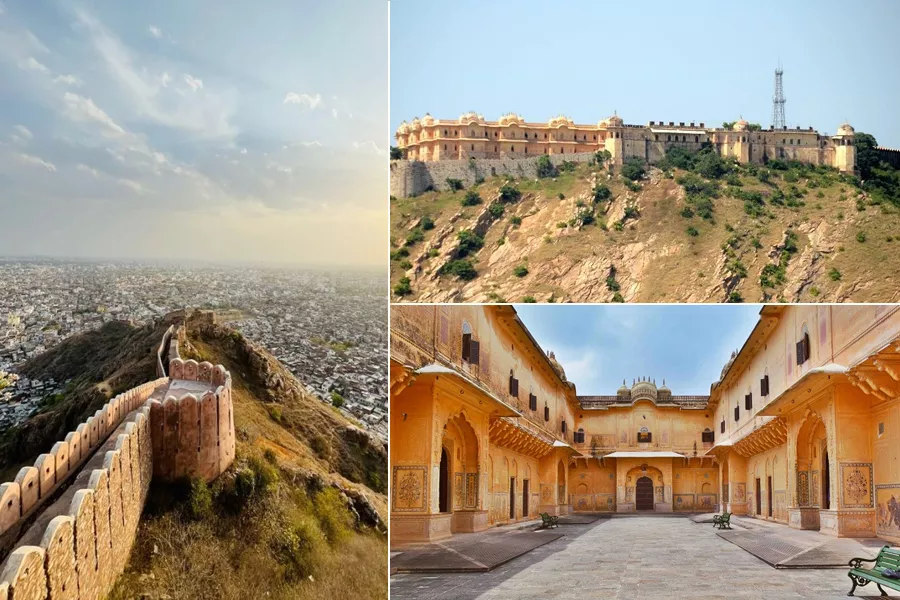
Nahargarh is the Jaipur fort people often visit for the wrong reason and then accidentally enjoy for the right one.
They come because someone says “go there for sunset.” Then they discover Madhavendra Bhawan, a sequence of royal apartments connected by corridors, delicate mural work, fort walls, the Aravalli setting and a view that explains Jaipur's geography better than almost any map.
The problem is that online information about Nahargarh is unusually messy. Old blogs still show the pre-2026 ticket. Some pages mix the basic fort with Jaipur Wax Museum and Sheesh Mahal. Others mix Nahargarh Fort with Nahargarh Biological Park. Sunset guides sometimes imply that a normal fort-entry ticket remains valid indefinitely into the night. It does not make sense to build a travel day from those mixed-up numbers.
This guide separates every part clearly: government fort ticket, student/foreigner categories, current timing caution, Jaipur composite ticket, Madhavendra Bhawan, Wax Museum, Sheesh Mahal, Biological Park, taxi route, parking, sunset planning, families, foreign travellers, photography and the best Amber–Jaigarh–Nahargarh itinerary.
Complete Nahargarh Fort Guide
- Latest Ticket Price
- Timings & Late-Entry Rule
- Sunset & Night View
- How to Reach from Jaipur
- What to See Inside
- Madhavendra Bhawan
- History
- Wax Museum & Sheesh Mahal
- Nahargarh Biological Park
- Jaipur Composite Ticket
- Families & Senior Citizens
- Foreign Visitors
- Photography
- Amber–Jaigarh–Nahargarh Route
- FAQs
Nahargarh Fort Jaipur Ticket Price 2026
Rajasthan's 2026 monument-fee revision changed the price visitors should budget for Nahargarh. The current structure is:
| Visitor | Ticket |
|---|---|
| Indian Adult | ₹100 |
| Indian Student | ₹50 |
| Foreigner Adult | ₹600 |
| Foreigner Student | ₹300 |
Children & Free-Entry Rules
Rajasthan's protected-monument rules establish free entry for young children, and current government monument information commonly uses the below-7-years category. Student-group and special free-entry-day rules can also be announced. Confirm the current condition on OBMS or at the official counter rather than treating an old circular as permanent.
Nahargarh Fort Timings 2026
Current 2026 visitor listings commonly show the basic fort visit around 10:00 AM to 5:30 PM. This is the sensible working timing for trip planning.
However, the current Rajasthan Tourism Nahargarh destination page—updated 30 July 2026—does not publish a simple gate-opening/closing line in its main visitor text. Separate facilities on the hill can have different operating hours.
If you are making a normal daytime fort visit, plan to enter well before 5:00 PM. If your entire trip depends on sunset or evening access, check the live OBMS timing/facility directly on the same day. Do not arrive at 5:25 PM because an old blog says “open till 10 PM.”
Nahargarh Fort Sunset: Is It Really the Best Time?
Nahargarh is genuinely one of Jaipur's strongest viewpoints. Rajasthan Tourism describes the fort overlooking the city and specifically notes how impressive Jaipur looks when the fort is floodlit and the city lights come on.
But there are two separate questions:
Is the View Good at Sunset?
Yes. The ridge gives a broad city panorama, and late-afternoon light is especially attractive in clear weather.
Does a Basic Fort Ticket Guarantee Sunset Access?
No. Sunset changes through the year, while gate and facility timings are operational decisions. In summer, sunset can be later than a commonly listed 5:30 PM monument closing time.
Best Practical Plan
- Reach the hill around 3:30–4:00 PM.
- Visit Madhavendra Bhawan and fort interiors first.
- Use the viewpoint while it is definitely accessible.
- Check current evening facility/gate rules locally.
- Arrange your return vehicle before darkness.
How to Reach Nahargarh Fort from Jaipur
Rajasthan Tourism's current official page states that Nahargarh is approximately 20 km from Jaipur railway station and bus stand. It also states that there is no public transport and recommends hiring a taxi or renting a car for the to-and-fro journey.
By Private Taxi / Car
The easiest option. It also solves the biggest Nahargarh problem: getting down the hill after your visit.
By Auto-Rickshaw
You may find drivers willing to go, but the steep hill route, waiting and return need to be agreed in advance. A taxi is generally more practical.
By Two-Wheeler
Possible for experienced riders, but the hill road demands caution—especially at dusk, in rain and around bends.
From Jaipur Airport
Nahargarh is on the opposite side of the central city from the airport. It is better combined with north/old Jaipur sightseeing than treated as an airport stop with luggage.
From Jaipur Railway Station
Use a direct taxi if Nahargarh is your only destination. If sightseeing all day, keep the same car for Amber/Jaigarh/Nahargarh or old-city combinations.
Taxi Cost: What to Ask Before Booking
There is no single official city-taxi rate for a private Nahargarh return trip. Price depends on pickup area, vehicle, waiting time and whether you are adding Jaigarh/Amber.
- Is waiting included?
- Is parking included?
- Is the quote one-way or return?
- What happens if you stay for evening views?
- Does the driver remain at the fort?
- Is Amber/Jaigarh included in the same sightseeing package?
What to See Inside Nahargarh Fort
1. Madhavendra Bhawan
The architectural heart of the fort. Do not spend the entire trip looking at Jaipur from the edge and skip the palace.
2. Royal Apartments & Corridors
The repetition of suites, interlinked movement and painted details makes the palace more interesting when you imagine how the royal household actually used the building.
3. Fort Walls & Aravalli Setting
Nahargarh's defensive position makes immediate sense from the ridge.
4. Jaipur Panorama
The city view is useful not just for photos. From above, Jaipur's dense old and modern development, hills and northern fort landscape become readable.
5. Contemporary-Art Context
Rajasthan Tourism also lists the Sculpture Park at Nahargarh as a Government of Rajasthan/SathSaath Arts initiative using palace spaces for contemporary art. Current exhibition status can change, so confirm what is operating during your visit.
Madhavendra Bhawan: The Part of Nahargarh You Should Not Rush
Rajasthan Tourism describes Madhavendra Bhawan as the royal family's summer destination. Its current Nahargarh page says the palace contains matching boudoirs for queens with a suite for the king, connected by corridors decorated with murals.
Different historical descriptions count/describe the apartments differently, so it is better to understand the design idea than obsess over one simplified number from a guidebook: the palace created a repeated, connected residential arrangement for the royal household.
What to Notice
- symmetry and repetition;
- private vs shared circulation;
- painted decoration;
- windows and ventilation;
- relationship between apartments and courtyard;
- views toward the city/hills.
Nahargarh Fort History — The Useful Version
Rajasthan Tourism dates the fort to 1734 during the reign of Jai Singh and notes that it was expanded in 1868. The fort stands on the Aravalli ridge above Jaipur and functioned as part of the city's defensive landscape.
The name is commonly translated as the “abode of tigers.” Government environmental/tourism material also records the popular Nahar Singh legend associated with the fort's construction and naming.
Was Nahargarh Ever Captured?
It is generally remembered more as a defensive stronghold and royal retreat than as the scene of a famous successful siege. The strategic value is obvious once you see how completely the ridge overlooks Jaipur.
1857 Context
Government planning material for the Nahargarh eco-sensitive zone notes the fort's use as a refuge for Europeans during the events of 1857.
Jaipur Wax Museum & Sheesh Mahal at Nahargarh
This is where many ticket guides become confusing. The Jaipur Wax Museum/Sheesh Mahal experience is a separate attraction inside the broader Nahargarh complex. It is not the same thing as the basic Archaeology & Museums fort ticket.
Current Rajasthan Tourism Published Price
| Visitor | Wax Museum + Sheesh Mahal |
|---|---|
| Indian Visitor | ₹500 |
| Foreign Visitor | ₹700 |
Timing Discrepancy on Government Tourism Pages
One current Rajasthan Tourism Wax Museum page lists 10:00 AM–6:00 PM. The main Jaipur tourism page says 10:00 AM–6:30 PM. Because even government pages differ by 30 minutes, use the earlier time for safe planning and confirm at the attraction before making a late trip.
Is Nahargarh Sheesh Mahal the Same as Amber Sheesh Mahal?
No. Do not confuse them. Amber's historic Sheesh Mahal is part of the Amber Palace complex. The Nahargarh visitor attraction uses its own Sheesh Mahal experience associated with the Jaipur Wax Museum.
Nahargarh Fort vs Nahargarh Biological Park
They are completely different visitor experiences.
| Nahargarh Fort | Nahargarh Biological Park |
|---|---|
| Historic hill fort above Jaipur | Wildlife/zoological attraction near Jaipur–Delhi highway |
| Madhavendra Bhawan & city views | Flora, fauna and zoo/park experience |
| Fort monument ticket | Separate park ticket |
| Best for heritage & panorama | Best for wildlife/family outing |
Rajasthan Tourism currently lists the Biological Park as about 12 km from Jaipur, spread across 720 hectares. Its published zoo timings vary seasonally and it is closed on Tuesdays. Do not drive to the Biological Park expecting to arrive at Nahargarh Fort.
Is Nahargarh Included in Jaipur Composite Ticket?
Yes, Nahargarh is part of the state-managed Jaipur composite monument system. Current 2026 pricing used across the government system should be checked on OBMS at booking time.
As a practical rule, the composite ticket becomes useful when you are entering several state sites such as Amber, Hawa Mahal, Jantar Mantar, Nahargarh and Albert Hall instead of buying only one or two monuments.
See our Jaipur Monument Ticket Prices & Timings Guide for the latest city-wide comparison.
How Much Time Do You Need at Nahargarh?
| Time | What You Can Do |
|---|---|
| 45 minutes | Quick panorama + limited fort walk |
| 1.5 hours | Madhavendra Bhawan + fort + views |
| 2 hours | Comfortable first visit |
| 2.5–3 hours | Add Wax Museum/Sheesh Mahal or slow photography |
If you are paying a driver to wait and planning a sunset-style visit, budget at least two hours rather than racing through Madhavendra Bhawan in twenty minutes.
Best Time of Day
Morning
Best for quieter architecture and cooler weather. The city can be hazier in winter mornings.
Afternoon
Good in winter, hot in summer.
Late Afternoon
Best light and atmosphere, but current closing time matters. Enter early enough to complete the palace before focusing on the view.
Best Season
October–March
Best overall. Cool evenings make the hill more comfortable.
April–June
Hot. Use a car, carry water and avoid long exposed walking at midday.
July–September
The Aravalli hills can turn much greener. Wet roads and viewpoints require more caution, and visibility depends on rain/cloud.
Nahargarh with Children & Senior Citizens
Senior Citizens
- Use a private car rather than walking/cycling up the hill.
- Confirm easiest vehicle drop point.
- Wear shoes with grip.
- Allow more time for Madhavendra Bhawan.
- Avoid trying Amber + Jaigarh + Nahargarh + old Jaipur all in one exhausting day.
Children
The city view and palace corridors usually keep children interested. The Wax Museum can be added if it suits the family, but it is not required for a complete heritage visit.
Nahargarh Fort for Foreign Tourists
The revised 2026 foreign-adult monument ticket is ₹600, with a ₹300 foreign-student category.
What International Visitors Should Know
- carry passport/travel identification or an accessible copy;
- student concession needs acceptable current proof;
- the Wax Museum ticket is separate;
- taxi return should be arranged before going uphill;
- Nahargarh is not a UNESCO component like Amber; do not let inaccurate tour copy blur the two;
- late-afternoon access should be reconfirmed if sunset is the main goal.
Nahargarh Photography Guide
Best Subjects
- Jaipur panorama;
- Madhavendra Bhawan corridors;
- repeated doors/windows;
- Aravalli ridge;
- fort walls and skyline;
- blue-hour city lights where legally/accessibly possible.
Professional Shoots
Do not assume a normal visitor ticket covers commercial, pre-wedding, film or professional production. Protected monuments use separate permission systems under Rajasthan Archaeology & Museums rules.
Drone
Do not fly a drone simply because the hill is open. Heritage, wildlife/eco-sensitive-zone and aviation rules may all apply. Obtain required permissions.
Food & Restaurants at Nahargarh
Nahargarh has long had restaurant/facility operations on the hill, including RTDC-associated dining references. These facilities can have different operating hours from the basic fort monument.
If your main plan is dinner or evening city views, verify the exact restaurant/facility booking directly rather than assuming the daytime monument ticket covers evening access.
Best Amber + Jaigarh + Nahargarh Itinerary
This is Jaipur's most logical fort day because all three sit on the northern/hill side of the city.
| Time | Plan |
|---|---|
| 8:00 AM | Amber Fort |
| 10:30/11:00 AM | Jaigarh Fort |
| 12:30 PM | Lunch / break |
| 2:30–3:00 PM | Head toward Nahargarh |
| 3:30 PM onward | Madhavendra Bhawan + views |
The exact final timing depends on the live Nahargarh closing hour. Do not sacrifice Amber's morning visit simply to chase a sunset that may fall outside normal fort-entry time.
Can You Combine Nahargarh with Jal Mahal?
Yes. Jal Mahal is a natural photo stop on the Amber/Nahargarh side of Jaipur. Its normal tourist experience is the lakeside view; the palace itself is not a standard public interior visit.
Can You Cycle to Nahargarh?
Rajasthan Tourism has promoted cycling routes around Jaipur including Amber–Nahargarh-style hill routes. This is for fit, experienced riders who are comfortable with climbing, traffic and descent. For most first-time tourists, a taxi is easier and safer.
What to Carry
- water;
- comfortable walking shoes;
- sun protection;
- light layer in winter evenings;
- student/travel ID where applicable;
- phone battery/power bank;
- driver number and meeting point.
15 Nahargarh Mistakes to Avoid
- Using the old ₹50/₹200 ticket price.
- Confusing Nahargarh Fort with Nahargarh Biological Park.
- Assuming Wax Museum is included in the fort ticket.
- Confusing Nahargarh Sheesh Mahal with Amber's historic Sheesh Mahal.
- Arriving at closing time because a sunset blog said the fort is open late.
- Going uphill without arranging return transport.
- Spending the whole visit only at the viewpoint.
- Skipping Madhavendra Bhawan.
- Doing Amber, Jaigarh, Nahargarh and five old-city monuments in one day.
- Underestimating summer heat.
- Riding a two-wheeler too fast on hill bends.
- Standing on unsafe walls/edges for photos.
- Assuming a normal ticket permits professional shooting.
- Flying a drone without permission.
- Buying every separate attraction simply because it is on the hill.
Official Planning Links
- Rajasthan Tourism — Nahargarh Fort
- Rajasthan Government OBMS — Official Monument Booking
- Rajasthan Tourism — Jaipur
- Rajasthan Tourism — Jaipur Wax Museum
- Rajasthan Tourism — Nahargarh Biological Park
- Rajasthan Archaeology & Museums — Protected Monument Rules
Related Jaipur Guides
- Amber Fort Jaipur Complete Guide
- Jaipur Monument Tickets & Timings
- Albert Hall Museum Jaipur Guide
- Jaipur Complete Travel Guide
- Jaipur UNESCO World Heritage Guide
- Jaipur Airport Taxi Guide
Nahargarh Fort Jaipur FAQs
What is Nahargarh Fort ticket price for Indians?
The revised 2026 Indian Adult ticket is ₹100.
What is the Indian student ticket?
₹50 under the revised 2026 category, with valid student proof.
What is Nahargarh ticket for foreigners?
₹600 for a Foreigner Adult.
What is the foreign student ticket?
₹300 with accepted current student/travel identification.
What time does Nahargarh Fort open?
Current visitor listings commonly show 10:00 AM. Recheck the live OBMS timing before your visit.
What time does Nahargarh close?
Around 5:30 PM is commonly listed for the daytime fort visit in 2026. Separate hill facilities can operate different hours, so verify if arriving late.
Can I see sunset from Nahargarh?
The viewpoint is excellent, but sunset time may fall after normal monument entry/closing hours depending on season. Confirm current access before planning specifically for sunset.
How far is Nahargarh from Jaipur railway station?
Rajasthan Tourism says approximately 20 km from the railway station and bus stand.
Is there a bus to Nahargarh?
The current Rajasthan Tourism fort page says there is no public transport and recommends taxi/rental car for the return journey.
How much time is enough?
About 1.5–2 hours for the basic fort and Madhavendra Bhawan. Add more time for the Wax Museum.
Is Madhavendra Bhawan inside Nahargarh?
Yes. It is the palace/residential highlight inside the fort.
What is the Wax Museum ticket?
Rajasthan Tourism currently publishes ₹500 for Indians and ₹700 for foreign visitors, including the Wax Museum/Sheesh Mahal attraction.
Is Wax Museum included in Nahargarh ticket?
No. Treat it as a separate attraction and separate cost.
Is Nahargarh Sheesh Mahal the same as Amber Sheesh Mahal?
No. Amber's historic mirrored palace is inside Amber Fort. Nahargarh's Sheesh Mahal visitor attraction is associated with the Jaipur Wax Museum.
Is Nahargarh Biological Park at the fort?
No. It is a separate wildlife/zoological attraction on the Jaipur–Delhi highway side.
Is Biological Park open Tuesday?
Rajasthan Tourism currently states that the zoo/park is closed on Tuesdays.
Can senior citizens visit Nahargarh?
Yes. Use a private car for the hill and allow extra walking time inside the fort.
Is Nahargarh good for children?
Yes. The palace corridors and city views are family friendly, and the separate Wax Museum can be added if desired.
Can I visit Amber, Jaigarh and Nahargarh together?
Yes. Start Amber at opening, visit Jaigarh next and keep Nahargarh for later, subject to current closing time.
Is Nahargarh included in composite ticket?
Yes, it participates in Jaipur's state-managed composite ticket system. Verify current OBMS price and inclusions before purchase.
Is parking included in monument ticket?
Do not assume so. Parking and private transport should be budgeted separately unless your vehicle package explicitly includes them.
Can I take professional photos?
Ordinary tourist photography and commercial/professional shooting are different. Protected-monument shooting can require separate permission and fees.
Can I fly a drone?
Do not fly without checking all heritage, eco-sensitive-zone and aviation permissions applicable on the date.
Is Nahargarh UNESCO listed?
No. Amber is a component of UNESCO's Hill Forts of Rajasthan property; Nahargarh should not be described as one of those six UNESCO components.
Final Advice
Nahargarh is worth visiting even if you never see a textbook-perfect sunset. Go for Madhavendra Bhawan, the ridge setting and the way Jaipur opens beneath you.
The smart plan is simple: use the correct 2026 ticket category, arrive with enough time to see the palace before the viewpoint, keep the Wax Museum optional rather than assuming it is included, arrange your ride down the hill and verify same-day closing rules if evening light is the reason you are going.
That gives you a better Nahargarh visit than chasing an old blog's ticket price or arriving five minutes before a gate closes.