Patrika Gate & Jawahar Circle Jaipur: Latest Timings, Musical Fountain, Photography & Complete Visitor Guide
Patrika Gate & Jawahar Circle: Quick Answers
- Location: Jawahar Circle, Jawaharlal Nehru Marg / Malviya Nagar side, close to Jaipur International Airport.
- Jawahar Circle official timing: 6:00 AM–9:00 PM on the current Government of India Incredible India page.
- Musical fountain: current Rajasthan Tourism and Incredible India references say the 30-minute show begins at 7:00 PM.
- Patrika Gate inauguration: Prime Minister Narendra Modi inaugurated it virtually on 8 September 2020.
- Built by: Patrika Group of Newspapers, confirmed by the Press Information Bureau.
- Why visit: painted arches, Rajasthan-themed visual panels, symmetry, photography, garden walks, jogging tracks, rose garden and evening fountain.
- Jawahar Circle size: Incredible India currently gives a diameter of 452 metres and circumference of 1,420 metres.
- Fountain technology: Government tourism information describes a 27 m × 9 m water screen; Rajasthan Tourism mentions 270+ effects, 300+ coloured lights and water reaching about 25 feet.
- Best photography: early morning for cleaner frames; late afternoon for warm light; evening if you also want the fountain.
- Airport-day value: one of Jaipur's easiest sightseeing stops to combine with an arrival or departure because of its airport-side location.
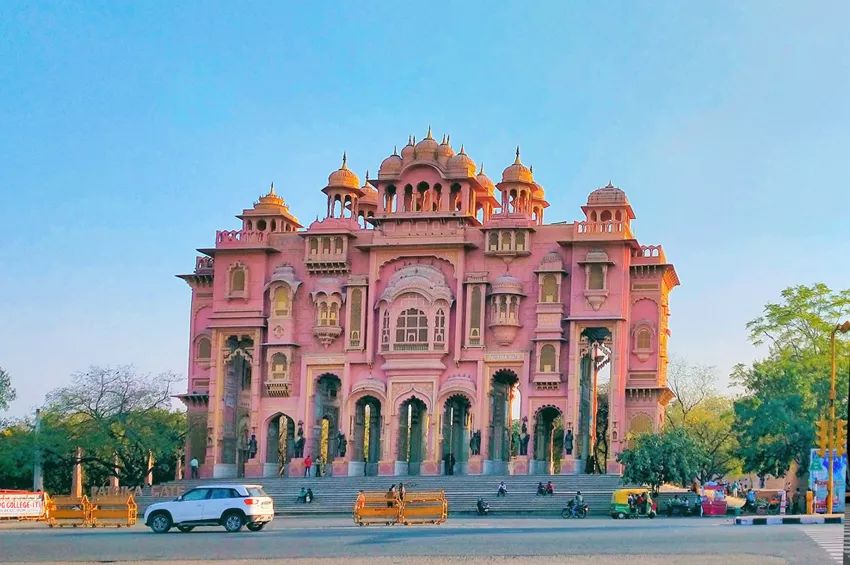
Jaipur has a habit of making visitors look backward.
Amber sends you into the era of Rajput courts. Jantar Mantar takes you into eighteenth-century astronomy. Hawa Mahal explains the life of a royal city. Patrika Gate does something different: it uses a modern landmark to retell Rajasthan through colour.
That is why it is misleading to describe Patrika Gate as an ancient city gate. It is a contemporary cultural landmark. The Press Information Bureau records that the Patrika Group of Newspapers built the gate on Jawaharlal Nehru Marg and that Prime Minister Narendra Modi inaugurated it by video conference on 8 September 2020.
Behind it is Jawahar Circle, developed by the Jaipur Development Authority. The current Incredible India page describes the park as a 452-metre-diameter, 1,420-metre-circumference circular green space near Sanganer Airport, with rose gardens, jogging tracks, open gym, children's facilities and the musical fountain.
For travellers, the two places work naturally as one stop: Patrika Gate for the visual story and photographs; Jawahar Circle for the walk, greenery and evening fountain.
Complete Visitor Guide
Patrika Gate & Jawahar Circle Timings
The most reliable current government timing we found is for Jawahar Circle. The Government of India's Incredible India portal currently lists:
| Visitor Detail | Latest Government Reference |
|---|---|
| Jawahar Circle opening | 6:00 AM |
| Jawahar Circle closing | 9:00 PM |
| Musical fountain | 7:00 PM start |
| Fountain duration | About 30 minutes according to Rajasthan Tourism |
| Best quiet photography | Near opening time / early morning |
| Best combined visit | Late afternoon through the 7 PM fountain |
Many private pages describe Patrika Gate itself as accessible beyond the park's formal hours. For a practical tourist guide, however, the government-confirmed 6 AM–9 PM Jawahar Circle window is the safer planning range, especially if you want the garden as well as the gate.
Patrika Gate Entry Fee & Jawahar Circle Ticket
Patrika Gate is widely experienced as an open public photography landmark, but the current government pages we checked do not publish a dedicated Patrika Gate ticket.
More importantly, current Rajasthan Tourism and Incredible India pages do not give a confirmed ₹10/₹20 Jawahar Circle tariff. Private 2026 guides repeat those figures, but repeating a price across multiple blogs does not make it an official current rate.
If the garden gate displays a current entry charge, follow the official on-site/JDA notice. Do not rely on an old screenshot or a private travel blog when planning exact ticket cost.
Jawahar Circle Musical Fountain: Current Government Timing
This is one detail where current government sources are unusually specific.
Rajasthan Tourism says the musical fountain creates more than 270 types of effects, uses more than 300 colourful lights, can send water up to around 25 feet, and presents a 30-minute show beginning at 7 PM.
Incredible India also says the fountain comes alive every evening at 7 PM. Its current description adds that the water screen is 27 metres wide and 9 metres high and can display music videos.
Should You Plan Your Whole Evening Around the Fountain?
No. Use 7 PM as the current official planning time, but fountains are mechanical installations. Maintenance, weather, event arrangements or operational issues can affect a show. If the fountain is the main reason for travelling across Jaipur, confirm locally the same day.
Best Fountain Plan
Arrive around 5:30–6:00 PM, photograph Patrika Gate, walk the garden, find your fountain-viewing position before 7 PM, watch the show and leave before the park's current 9 PM closing.
Patrika Gate History: Modern Jaipur, Not an Ancient Palace
The strongest dated source for Patrika Gate is the Government of India's Press Information Bureau.
On 7 September 2020, PIB announced that Prime Minister Narendra Modi would inaugurate Patrika Gate the next day. It identified the structure as an iconic gate built by the Patrika Group of Newspapers on Jawaharlal Nehru Marg in Jaipur.
On 8 September 2020, PIB confirmed that the Prime Minister had inaugurated the gate through video conference and said the gate reflects Rajasthan's culture and was expected to become an attraction for domestic and international tourists.
This matters because many search results mix the dates when the structure was designed, completed, opened informally or formally inaugurated. For a visitor page, 8 September 2020 is the official inauguration date confirmed by PIB.
What Makes Patrika Gate Special?
The outside gives you the big pink architectural statement. The interior gives you the reason to slow down.
The current Incredible India Jawahar Circle page describes Patrika Gate's panels as visual stories celebrating Rajasthan's heritage. The value is not one single mural; it is the cumulative effect of arches, painted ceilings, decorative borders, repeated geometry and regionally inspired scenes.
Most visitors immediately aim their camera down the centre line because the receding arches create near-perfect visual symmetry. Take that photograph—but then stop photographing for a minute and look upward and sideways. The smaller details are where the gate becomes more than an Instagram backdrop.
What to Notice
- repeated arches creating depth;
- painted ceiling panels;
- floral and geometric decoration;
- visual references to Rajasthan's architecture and cultural traditions;
- changes in colour from one section to another;
- how human figures provide scale inside the corridor;
- the contrast between the restrained pink exterior and richly painted interior.
Jawahar Circle Garden: More Than the Gate
Incredible India says Jawahar Circle was developed by the Jaipur Development Authority and gives a diameter of 452 metres and circumference of 1,420 metres.
Rajasthan Tourism currently describes it as a distinctive Jaipur park with rose gardens, concentric jogging tracks, benches and landscaped greenery. The central government page additionally mentions an open gym, yoga/meditation space and children's play area with swings and slides.
Rose Garden & Walking
If you arrive early for Patrika Gate photography, do not immediately get back into the car. A walk inside the circle changes the pace of a Jaipur itinerary, especially after several crowded monuments.
Jogging & Fitness
Jawahar Circle is a local recreation space as much as a tourist attraction. Morning visitors will often see walkers, joggers and people using open fitness areas.
Families
The lawns and children's play facilities make it easier for families to spend more time here than at Patrika Gate alone.
Recycled Water
Incredible India notes that recycled water is used for the garden/fountain system as an environmental measure appropriate to Rajasthan's dry climate, and specifically warns that the fountain water is not for drinking or bathing.
Is Jawahar Circle Really Asia's Largest Circular Park?
Both Rajasthan Tourism and Incredible India currently describe Jawahar Circle as Asia's largest circular park. Incredible India provides the more useful physical numbers: 452 m diameter and 1,420 m circumference.
Rather than turning the claim into a competition with every park in Asia, a useful visitor guide should focus on what the official tourism sources actually say and provide the dimensions so readers understand the scale.
Patrika Gate Photography Guide
Early Morning: Best for Clean Symmetry
If the photograph matters more than the fountain, come close to the 6 AM park opening. The light is softer, temperatures are kinder and there are generally fewer people crossing the arches.
Late Afternoon: Best Colour
Warm light can make the pink exterior richer. The trade-off is more visitors.
Evening: Best Two-in-One Visit
Evening is efficient if you want both gate photographs and the 7 PM fountain, but do not expect empty corridors.
How to Get the Classic Arch Photo
- Stand on the central axis of the corridor.
- Keep the phone/camera level so vertical lines do not lean unnecessarily.
- Use the repeating arches as a natural frame.
- Step back instead of immediately using an ultra-wide lens.
- Wait for a brief gap rather than blocking the passage for a long shoot.
- Take vertical and horizontal versions.
- Photograph ceiling details separately.
Pre-Wedding & Commercial Photography
A casual tourist photo and a production shoot are not the same thing. Large crews, lights, tripods, costume changes, advertising shoots or commercial filming can be subject to permission and local management rules. Check with the responsible authority/security before setting up equipment.
Drones
Patrika Gate and Jawahar Circle are close to Jaipur International Airport. Do not assume a drone can be flown simply because the park is open. Indian aviation/drone restrictions and airport-zone controls apply independently of tourist access.
Best Time of Year
October to March: easiest for long walks and morning/evening photography.
April to June: avoid the hottest afternoon hours. Sunrise is far more comfortable.
July to September: clouds and monsoon light can produce excellent photographs, but rain can affect an outdoor plan.
How Much Time Do You Need?
| Plan | Suggested Time |
|---|---|
| Patrika Gate photos only | 30–45 minutes |
| Gate + relaxed garden walk | 1–1.5 hours |
| Gate + garden + fountain | 2–2.5 hours |
| Professional-style photo session | Allow extra time and check permission requirements |
| Airport stop | 45–60 minutes plus traffic/security buffer |
Patrika Gate for Foreign & International Visitors
Patrika Gate works particularly well for international visitors because it does not require deep historical context to enjoy. The visual language is immediate: colour, repeated arches and Rajasthan-inspired imagery.
It is also useful at the beginning of a Rajasthan journey. The murals introduce visual motifs that you may later recognise in palaces, textiles, painted havelis and craft traditions across the state.
For exact garden admission, do not rely on a separate “foreigner price” copied from an old travel page. The current government tourism pages checked do not publish a confirmed foreign visitor tariff for Jawahar Circle.
Patrika Gate Near Jaipur Airport: One of the Best Arrival/Departure Stops
Incredible India places Jawahar Circle in Malviya Nagar near Sanganer Airport and identifies Jaipur International Airport as the nearest airport.
This makes the attraction unusually practical. Amber Fort, Nahargarh and the old city can be inconvenient immediately before a flight; Patrika Gate sits on the airport side of Jaipur and can often be fitted into the same travel corridor.
Arrival-Day Idea
Airport → Patrika Gate/Jawahar Circle → hotel. This works especially well for a morning arrival when you do not want to begin with a long fort visit.
Departure-Day Idea
Hotel → Patrika Gate → airport can work if you leave a generous flight-security and traffic buffer. Never let a photo session eat into airport reporting time.
How to Reach Patrika Gate & Jawahar Circle
From Jaipur International Airport
Taxi/app cab/auto is the simplest option. Because the attraction is near the airport side of Jaipur, travel is much shorter than going first to Amber or the old city.
From Jaipur Railway Station
Use a cab or auto via central Jaipur toward JLN Marg/Malviya Nagar. Allow extra time during peak traffic.
From Hawa Mahal / City Palace
This is a cross-city road journey rather than a walkable extension of the old-city circuit. A taxi or auto is easiest.
From Jawahar Kala Kendra
Both sit on the broader JLN Marg side of Jaipur, making them a logical cultural/architecture pairing.
What to Combine with Patrika Gate
| Place | Why Combine It |
|---|---|
| Jawahar Circle | Same stop: garden, walking and fountain |
| Jawahar Kala Kendra | Modern Jaipur art + architecture day |
| Birla Mandir | Easy central/south Jaipur continuation |
| Central Park | Green-space and relaxed itinerary |
| Albert Hall | Modern photo landmark + historic museum contrast |
| Jaipur Airport | Ideal arrival/departure-day combination |
Best Half-Day Plans
Photography evening: Jawahar Kala Kendra → Patrika Gate golden hour → Jawahar Circle walk → 7 PM fountain.
Airport arrival: Airport → Patrika Gate → Jawahar Circle → hotel → evening Jaipur plan.
Modern Jaipur route: Jawahar Circle/Patrika Gate → Jawahar Kala Kendra → Central Park → Birla Mandir.
18 Mistakes to Avoid
- Calling Patrika Gate a centuries-old royal gate.
- Confusing its construction/completion references with the official 8 September 2020 inauguration.
- Publishing an unverified ₹10/₹20 garden fee as if current government pages confirm it.
- Using random fountain timings when current government sources say 7 PM.
- Assuming the fountain can never be cancelled for maintenance/weather.
- Arriving at peak evening time and expecting an empty arch photograph.
- Blocking the central corridor for a long photo shoot.
- Looking only straight ahead and missing the painted ceilings.
- Visiting only the gate and ignoring Jawahar Circle.
- Flying a drone near the airport without checking aviation restrictions.
- Assuming a casual-entry rule covers a commercial production crew.
- Going at 2 PM in May for comfortable photography.
- Leaving for the airport without a flight-security buffer.
- Planning it in the same geographical cluster as Amber Fort.
- Assuming every online “Asia's largest” claim uses the same definition; use the official dimensions instead.
- Entering fountain water—the government tourism page says recycled water is used and it is not for drinking/bathing.
- Expecting Patrika Gate to provide the same historical experience as Hawa Mahal or City Palace.
- Copying old visitor information without checking current government tourism pages.
Official & High-Authority Sources
- Incredible India — Jawahar Circle (Ministry of Tourism, Government of India)
- Rajasthan Tourism — Jaipur / Jawahar Circle
- Press Information Bureau — Patrika Gate Inauguration Announcement
- Press Information Bureau — Patrika Gate Inaugurated on 8 September 2020
Related Jaipur Guides
- Jawahar Kala Kendra Jaipur Guide
- Ram Niwas Garden & Albert Hall Guide
- Jaipur Complete Travel Guide
- Jaipur Airport Taxi & Cab Guide
- Jaipur UNESCO Heritage Sites
Patrika Gate & Jawahar Circle FAQs
Where is Patrika Gate Jaipur?
It is at Jawahar Circle on the JLN Marg/Malviya Nagar side of Jaipur, close to Jaipur International Airport.
What are Jawahar Circle timings?
The current Incredible India page lists 6:00 AM–9:00 PM.
What time is the musical fountain?
Current Rajasthan Tourism and Incredible India information gives a 7:00 PM start; Rajasthan Tourism describes the show as about 30 minutes.
How big is Jawahar Circle?
Incredible India currently lists a diameter of 452 metres and circumference of 1,420 metres.
Who developed Jawahar Circle?
The current Incredible India page says it was developed by the Jaipur Development Authority.
Who built Patrika Gate?
The Press Information Bureau says it was built by the Patrika Group of Newspapers.
Who inaugurated Patrika Gate?
Prime Minister Narendra Modi inaugurated it through video conference.
When was Patrika Gate inaugurated?
8 September 2020, confirmed by PIB.
Is Patrika Gate an old royal monument?
No. It is a modern cultural landmark, not an eighteenth- or nineteenth-century Jaipur gate.
Is Patrika Gate good for photography?
Yes. The painted panels and repeated arches make it one of Jaipur's most recognisable modern photo locations.
What is the best time for photos?
Early morning is best for lower crowds and softer light. Late afternoon is attractive but busier.
Can I visit for sunset and fountain together?
Yes. Arrive before sunset, photograph the gate and then move into Jawahar Circle before the current 7 PM fountain time.
Is there a Jawahar Circle entry fee?
The current government tourism pages checked do not publish a verified tariff. Follow the current on-site/JDA notice rather than relying on an old private-site rate.
Is there a separate foreigner ticket?
We did not find a current foreign visitor tariff published on the government tourism pages checked.
Does Jawahar Circle have a rose garden?
Yes. Both current government tourism descriptions highlight landscaped/rose-garden areas.
Is there a jogging track?
Yes. Rajasthan Tourism describes concentric jogging tracks, and Incredible India also highlights fitness facilities.
Is there an open gym?
Incredible India currently lists an open gym and green space for yoga/meditation.
Is Jawahar Circle suitable for children?
Yes. The current Incredible India page mentions a children's play area with swings and slides.
Can I fly a drone at Patrika Gate?
Do not assume so. The site is near Jaipur International Airport, and aviation/drone-zone rules apply regardless of tourist access.
How long should I spend?
About 30–45 minutes for gate photography, 1–1.5 hours with the garden, or roughly 2 hours if staying for the fountain.
Is Patrika Gate worth visiting?
Yes if you enjoy photography, colour, modern Jaipur, architecture or need an easy airport-side sightseeing stop. Pure fort-and-palace history travellers may prefer to keep it as a shorter stop.
Final Advice
Patrika Gate works best when you understand what it is—and what it is not.
It is not a medieval gateway pretending to compete with Jaipur's old city. It is a modern cultural landmark whose painted surfaces turn Rajasthan into a visual sequence. Its official inauguration in September 2020 gives it a very different place in Jaipur's story from Amber, Hawa Mahal or Jantar Mantar.
Jawahar Circle adds the practical reason to stay longer: green space, rose gardens, jogging and recreation areas, children's facilities and the current 7 PM musical fountain.
For a first visit, use the government-confirmed 6 AM–9 PM park timing, aim for early morning if photographs matter most, or arrive before sunset if you want to combine the gate with the fountain. And where online ticket prices conflict, trust the current on-site/JDA notice over copied blog tables.