Taj Mahal Dress Code 2026: What to Wear for Women, Men, Couples, Shoes & Photography
Is There a Dress Code for the Taj Mahal?
You do not need a special uniform, a particular color, or traditional Indian clothing to visit the Taj Mahal. For ordinary sightseeing, the practical rule is simple: wear clean, comfortable clothing that lets you walk easily and suits Agra's weather. Many travellers choose clothing that covers the shoulders and reaches around the knee or below because it feels respectful, photographs well and is comfortable in a heritage setting, but this is sensible visitor etiquette rather than a universal tourist uniform.
Comfort matters more than fashion rules. You will walk through security, large courtyards, gardens and marble areas, often in strong sun. Choose breathable fabric, secure footwear and as little luggage as possible.
Taj Mahal Outfit Rules at a Glance
- No required outfit color: red, blue, green, black, white and prints are all common choices.
- No general head-covering requirement for normal sightseeing; a hat or scarf is useful for sun protection.
- Traditional Indian dress is optional: saree, kurta, salwar suit and western clothing are all practical when comfortable.
- Wear walking-friendly shoes: the complex is large and involves considerable walking.
- Travel light: security rules restrict many items, including large bags and briefcases.
- Friday warning: the Taj Mahal is closed to regular sightseeing on Fridays.
- Main mausoleum: follow the footwear/shoe-cover instructions given on site.
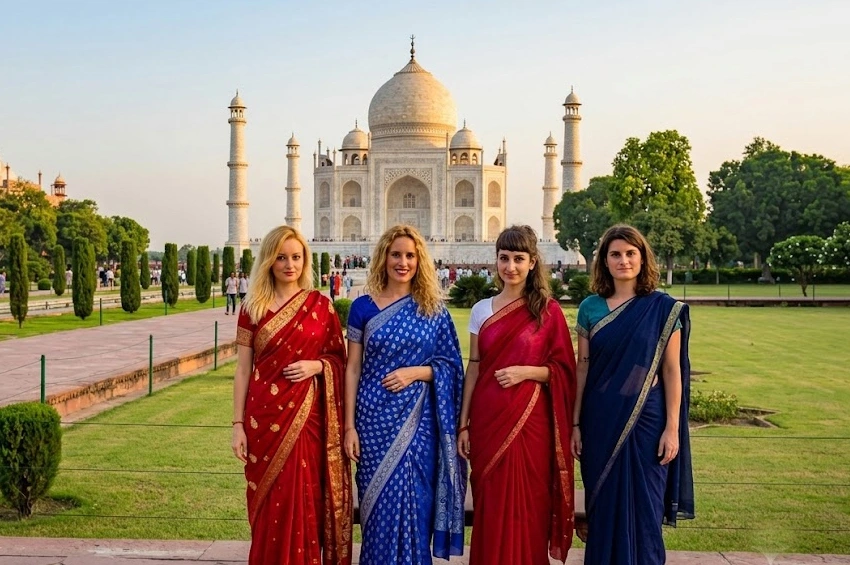
People often plan a Taj Mahal outfit as carefully as the ticket itself. That makes sense. The white marble, long reflecting pool, red sandstone gateway and soft early-morning light create one of the most photographed settings in India. But a beautiful outfit that is difficult to walk in, too hot for the season or awkward at security can make the visit less enjoyable.
This guide answers the practical questions travellers actually ask: What should women wear to the Taj Mahal? Can men wear shorts? Is a saree necessary? What shoes work best? Which colors photograph well? What should you wear in summer or winter? It also separates genuine visitor rules from internet myths so you can dress confidently without overthinking the visit.
What This Taj Mahal Dress Guide Covers
- Actual Dress Rules vs Internet Myths
- What Women Should Wear
- What Men Should Wear
- Couple Outfit Ideas
- What Children Can Wear
- Best Shoes & Footwear
- Best Colors for Taj Mahal Photos
- Summer Clothing
- Monsoon Clothing
- Winter Clothing
- What to Wear for Sunrise
- Photography Outfit Tips
- What Not to Wear or Carry
- Taj Mahal Packing Checklist
- Dress Code FAQs
Taj Mahal Dress Code: Actual Rules vs Internet Myths
The biggest misunderstanding is the phrase “Taj Mahal dress code.” Travellers sometimes expect rules similar to those at an active temple, mosque or other place of worship. The Taj Mahal complex includes a mosque, but the standard tourist visit is primarily a visit to a protected historic monument. Public visitor information focuses heavily on tickets, opening hours, security and prohibited objects rather than prescribing one compulsory tourist outfit.
What Works vs What You Do Not Need
Good Practical Choices
- Breathable cotton or linen
- Comfortable trousers, dresses or skirts
- Kurta, salwar suit or saree if you enjoy wearing them
- Secure sandals or walking shoes
- A light scarf or layer for sun or cool mornings
Things You Do Not Need
- A compulsory saree or kurta
- A specific “approved” Taj Mahal color
- A head covering for general sightseeing
- Expensive formal clothing
- A costume bought only to gain entry
What Should Women Wear to the Taj Mahal?
For most women, the best Taj Mahal outfit balances three things: comfort, movement and photographs. A loose midi or maxi dress, cotton trousers with a blouse, a kurta set, salwar-kameez, long skirt with a breathable top, or a saree you can comfortably walk in can all work well.
Easy Outfit Options for Women
Easy & Comfortable
- Loose cotton trousers or palazzo pants
- Breathable top or kurta
- Best for walking and warm weather
Photo-Friendly
- Kurta set, salwar suit or saree
- Flowing midi/maxi dress
- Choose lightweight fabric you can walk in
Can Women Wear Shorts or Sleeveless Tops?
Do not confuse a cultural recommendation with an entry rule. There is no standard visitor information saying every woman must wear sleeves or full-length trousers to enter. Still, many visitors prefer a less revealing outfit because it is comfortable in the setting, reduces sun exposure and avoids feeling underdressed around families and religious spaces. If you want an easy compromise, carry a lightweight scarf or overshirt.
What Should Men Wear to the Taj Mahal?
Men do not need formal clothing. A lightweight shirt, polo or plain T-shirt with chinos, cotton trousers or comfortable travel pants works well. A kurta with trousers is also an excellent option if you want an Indian look for photographs.
Can Men Wear Shorts?
Shorts are not generally presented as a blanket prohibited garment for ordinary tourists. If you prefer them in hot weather, choose a comfortable, neat pair suitable for a long heritage visit. Lightweight full-length trousers are often better for sun protection and can look more polished in photographs.
Best Taj Mahal Couple Outfit Ideas
Couples do not need identical clothing. In photographs, coordinated tones usually look more natural than perfectly matching outfits. One person can wear a stronger color while the other uses a neutral shade drawn from the same palette.
| Style | Partner 1 | Partner 2 | Photo Effect |
|---|---|---|---|
| Classic Indian | Red/maroon saree or kurta set | Ivory/beige kurta | Strong romantic contrast |
| Elegant Neutral | Dusty rose, beige or pastel | Stone, cream or navy | Soft, refined photographs |
| Bold Travel | Emerald or royal blue | White, tan or charcoal | Subject stands out from marble |
| Minimal | White/cream | Earth tone or light blue | Airy editorial look |
What Should Children Wear?
For children, comfort should win. Use breathable clothes, shoes they already know, and a layer that can be removed as the temperature changes. Avoid elaborate outfits that make toilet breaks, walking or security difficult. The Agra district's current visitor information says children below 15 have free entry, but ticket rules and ID requirements should always be checked before travel.
Best Shoes for Visiting the Taj Mahal
You will walk much more than the classic front-view photograph suggests. From parking and security to the main gateway, gardens, platform and return route, the visit involves substantial time on your feet. Wear shoes that are already broken in.
- Best all-round choice: comfortable walking shoes or trainers.
- Hot weather: secure, supportive sandals can work well.
- Avoid: new shoes, slippery soles, very high heels and footwear that causes blisters.
- Main mausoleum: follow current on-site shoe-cover or footwear instructions before entering the protected marble interior.
Best Colors to Wear at the Taj Mahal for Photos
The Taj Mahal's pale marble acts almost like a neutral studio background. That is why strong colors often look striking in photographs. There is no “correct” color; choose according to the mood you want.
| Color | How It Looks | Best For |
|---|---|---|
| Red / Maroon | Strong contrast with white marble | Couples, sarees, statement portraits |
| Emerald Green | Rich contrast and elegant tone | Traditional and modern outfits |
| Royal / Cobalt Blue | Clean, vivid separation from marble | Solo portraits and dresses |
| Mustard / Saffron | Warm, travel-editorial feel | Morning light and Indian wear |
| Pastel Pink / Lavender | Soft and romantic | Couple and honeymoon photographs |
| White / Cream | Minimal and elegant but lower contrast | Editorial, understated photos |
| Black | Dramatic contrast | Cooler months; can feel hot in strong sun |
Is Red the Best Color for the Taj Mahal?
Red is popular because it separates clearly from the white marble and green gardens, but it is not mandatory and it is not the only photogenic choice. Emerald, cobalt, mustard and deep pink can be equally effective. If your visit is mainly for memories rather than a planned shoot, wear the color you feel confident in.
What to Wear to the Taj Mahal in Summer
Agra's hot season can make a fashionable but heavy outfit miserable. Prioritize loose cotton or linen, lighter layers and comfortable footwear. Early morning is generally the easiest time for heat, walking and photography.
- Loose cotton/linen shirt, kurta, dress or trousers
- Breathable underlayers
- Sun hat or scarf
- Sunglasses and appropriate sun protection
- Comfortable shoes with breathable socks if needed
What to Wear During the Monsoon
During rainy periods, choose quick-drying fabrics and avoid hems that drag on wet ground. A compact weather layer is more practical than a heavy outfit. Footwear should have grip; smooth soles and long trailing garments can become inconvenient on damp surfaces.
What to Wear to the Taj Mahal in Winter
Winter mornings in Agra can feel surprisingly cool, especially if you arrive before sunrise. Use removable layers: a shirt or kurta underneath, then a sweater, light jacket or shawl. By late morning the temperature may feel much warmer. Fog can also affect early views, so a sunrise visit in winter is not guaranteed to produce a crystal-clear monument backdrop.
What to Wear for a Taj Mahal Sunrise Visit
Sunrise visitors often leave their hotel while it is still dark, wait at security and then spend the first hour outdoors. Prepare the outfit the night before. Wear layers in cool months and keep accessories simple so security is easy. Bright and medium-depth colors often remain visible in the softer early light.
Taj Mahal Photography Outfit Tips
- Use one visual focus: a strong dress, saree or jacket is usually enough; too many accessories compete with the architecture.
- Think about movement: fabric with gentle movement can photograph beautifully, but avoid anything so long that it becomes a tripping hazard.
- Check transparency: bright backlight can make thin fabrics more transparent than they look indoors.
- Plan for crowds: simple silhouettes are easier to separate visually from people in the background.
- Keep valuables controlled: do not put phones, wallets or passports down for a photograph.
- Respect barriers: never cross ropes, climb restricted structures or block visitor flow for a shot.
Traditional Indian Clothes: Do You Need to Rent an Outfit?
No. Renting a saree, lehenga or kurta is a style choice, not an admission requirement. If you want traditional clothing for photographs, choose something you can put on correctly, walk in safely and wear for several hours. For first-time saree wearers, a pre-draped saree or simple kurta set may be much easier than a heavy wedding-style outfit.
Can You Wear White at the Taj Mahal?
Yes. White, ivory and cream can create elegant photographs, especially with warm accessories or a contrasting scarf. The trade-off is that a pale outfit may visually blend into the marble from certain angles. If you want stronger separation, add a darker or brighter element.
Can You Wear Black at the Taj Mahal?
Yes, as a clothing choice. Black can create striking contrast, but it absorbs heat, so it may be uncomfortable during hot months or a midday visit. It is more practical in cooler weather or when used as one part of the outfit rather than a heavy all-black ensemble.
Do You Need to Cover Your Head?
There is no general head-covering requirement for an ordinary tourist walking through the Taj Mahal complex. A scarf can still be useful for sun, dust or personal preference. Remember that the complex contains a functioning mosque; behave respectfully around prayer activity and follow any instructions in religious-use areas.
What Not to Wear or Carry to the Taj Mahal
Clothing itself is rarely the main security problem; what you carry can be. The Archaeological Survey of India Agra Circle lists numerous prohibited items, including food products, smoking items, flags/banners, flowers/garlands and religious items, drones, weapons, explosives, intoxicants/liquor, inflammable products, helmets, large bags/briefcases, mats/carpets and several writing or tool items.
| Avoid | Why | Better Choice |
|---|---|---|
| Large backpack or briefcase | Can conflict with security restrictions and slow entry | Small essentials-only bag |
| Very high heels | Uncomfortable for long walking and marble areas | Walking shoes or secure sandals |
| Heavy ceremonial outfit in hot weather | Heat and movement become difficult | Lightweight traditional clothing |
| Long dragging hem | Can collect dust/water and become a trip risk | Ankle-length or manageable hem |
| Too many loose accessories | Easy to lose and inconvenient at security | Minimal jewellery/accessories |
Visitor Etiquette That Matters More Than Your Outfit
The Taj Mahal is both a globally visited monument and the mausoleum of Mumtaz Mahal and Shah Jahan. Quiet, considerate behaviour inside the mausoleum is more meaningful than obsessing over whether an outfit is “perfect.” Follow security staff, respect barriers, avoid disruptive photography, keep the site clean and give other visitors space to experience the monument.
Current Taj Mahal Visitor Information to Know Before Dressing
Current Agra district visitor information lists the Taj Mahal as open from 30 minutes before sunrise until 30 minutes before sunset and closed to regular sightseeing on Fridays. It also lists a separate ₹200 main-mausoleum charge in addition to the applicable entry ticket. Prices and operating rules can change, so verify the live official ticket information before travel.
Petrol and diesel vehicles are restricted within 500 metres of the monument, so your visit can involve walking plus a battery bus or golf-cart transfer from designated parking. That is another reason comfortable shoes matter more than dressy footwear.
Taj Mahal Clothing & Packing Checklist
- Breathable top, kurta, dress or shirt suited to the season
- Comfortable trousers, skirt, dress or other easy-to-walk-in lower layer
- Broken-in walking shoes or secure sandals
- Light scarf/shawl for sun, cool mornings or personal comfort
- Warm removable layer for winter sunrise visits
- Sunglasses and sun protection in hot/bright weather
- Small essentials-only bag that complies with security rules
- Ticket/booking confirmation and required identification
- Phone/camera only if permitted under current visitor rules
Best Outfit by Traveller Type
| Traveller | Easy Outfit | Photo Upgrade |
|---|---|---|
| Solo woman | Cotton kurta + trousers | Jewel-tone kurta or flowing midi dress |
| Solo man | Shirt/T-shirt + chinos | Solid-color kurta + trousers |
| Couple | Comfortable coordinated neutrals | One bold color + one complementary neutral |
| Family | Breathable everyday travel clothes | One shared accent color |
| Senior traveller | Loose layers + supportive shoes | Light scarf/jacket for color |
| Summer visitor | Cotton/linen + secure sandals | Bright lightweight solid color |
| Winter sunrise visitor | Layered shirt/kurta + jacket | Contrasting shawl or scarf |
Taj Mahal Dress Code for Instagram, Pre-Wedding & Couple Photos
For ordinary personal photographs, keep the setup simple and respectful. If you are planning a professional, commercial, elaborate or equipment-heavy shoot, do not assume normal tourist entry covers it. Check current permissions and equipment rules before arriving. Drones are listed as prohibited. A low-equipment personal shoot with clothing you can manage yourself is far less likely to disrupt your visit.
Common Taj Mahal Outfit Mistakes
- Buying a heavy outfit without testing whether you can walk in it.
- Choosing new shoes because they match the outfit.
- Arriving in winter before sunrise without a warm layer.
- Wearing dark, heavy fabric at midday in peak heat.
- Carrying a large “photo bag” full of unnecessary items.
- Assuming traditional Indian clothing is compulsory.
- Believing a viral social-media “dress code” without checking official visitor information.
- Planning an outfit for Friday without realizing regular Taj Mahal sightseeing is closed that day.
Frequently Asked Questions About the Taj Mahal Dress Code
Is there a strict dress code for the Taj Mahal?
There is no commonly published tourist rule requiring a specific garment, color or traditional outfit for general sightseeing. Comfortable, respectful clothing suitable for the weather is the practical choice.
Can women wear shorts to the Taj Mahal?
There is no standard visitor rule stating that all women must wear a particular trouser or skirt length. Many travellers choose clothing around knee length or longer for comfort, sun protection and a more conservative heritage-site look.
Can men wear shorts?
Yes, shorts are not generally presented as a blanket prohibited item for male tourists. Neat longer shorts can be comfortable in hot weather, while lightweight trousers provide better sun protection.
Do women have to cover their hair?
No general head covering is required for normal sightseeing. A scarf or hat is optional and can be useful in strong sun.
Do I need to wear Indian clothes?
No. Sarees, kurtas and salwar suits are popular because they look beautiful and can be comfortable, but western travel clothing is also fine.
What is the best outfit for women?
A breathable kurta set, loose trousers with a top, or a comfortable midi/maxi dress is easy for most visitors. Choose fabric according to the season.
What is the best outfit for men?
A breathable shirt or T-shirt with chinos or travel trousers works well. A lightweight kurta is a good photo-friendly alternative.
What color should I wear for Taj Mahal photos?
Red, maroon, emerald, royal blue and mustard create strong contrast. Pastels feel softer, while white and cream create a minimal look.
Can I wear a saree?
Yes. Choose a lightweight saree and comfortable footwear. If you are not used to wearing one, a pre-draped saree or kurta set may be easier for several hours of walking.
Can I wear a sleeveless dress?
There is no universal tourist rule requiring sleeves for ordinary sightseeing. If you prefer a more conservative look or want sun protection, carry a light scarf or overshirt.
What shoes are best?
Comfortable walking shoes or secure sandals are best. Avoid new shoes and high heels. Follow on-site footwear or shoe-cover instructions at protected interior areas.
Are shoe covers used at the Taj Mahal?
Shoe-cover arrangements are associated with access to the main mausoleum. Follow the current instructions given with your ticket and by staff on the day of your visit.
Can I carry a large backpack?
Large bags and briefcases are listed among prohibited items by ASI Agra Circle. Carry only essentials in a small bag and check current security guidance before arrival.
Is the Taj Mahal open on Friday?
No for regular sightseeing. Current official Agra visitor information says Friday access is for prayers at the mosque rather than normal tourist entry.
What should I wear in December or January?
Wear layers. Sunrise and early morning can be cool, while later hours may warm up. A sweater, shawl or light jacket over your main outfit is practical.
What should I wear in May or June?
Choose loose, lightweight, breathable fabric and minimize heavy accessories. An early visit is more comfortable than spending the hottest part of the day outdoors.
Can I wear black?
Yes. It photographs dramatically against the marble, but it can feel hotter in strong sunshine.
Can I wear white?
Yes. White and cream create an elegant look, although they provide less visual contrast against the Taj Mahal's marble.
Can I bring a drone for couple photos?
No. Drones are listed among prohibited items in the official ASI Agra Circle visitor information.
Related Taj Mahal & Agra Travel Guides
Continue planning your Agra visit with these related pages:
- What Is Inside the Taj Mahal?
- Taj Mahal Day Trip from Delhi
- Taj Mahal Day Trip from Jaipur
- Golden Triangle Tour Packages
Final Advice: Dress for the Visit You Actually Want
The best Taj Mahal outfit is not the one that follows the most internet “rules.” It is the one you can comfortably wear while walking, waiting at security, moving through the gardens and spending time with the monument. If photographs matter, add a strong color or traditional element. If comfort matters most, keep the outfit simple and breathable. If you are visiting at sunrise in winter, add layers; if you are visiting in summer, reduce weight and heat.
Most importantly, separate official security rules from personal style advice. Check live visitor information before your trip because opening arrangements, ticket prices, permitted items and security procedures can change.