Jaipur Day Tour by Tuk-Tuk Safari
Tour Overview
See Jaipur the way locals do on a full-day Jaipur tuk-tuk tour that combines famous sights, back lanes and bazaar stops in one easy plan. Instead of changing taxis all day, you keep the same friendly driver and three-wheeled tuk-tuk, slipping through traffic with ease and staying close to the city's colour, sound and life.
This day tour is designed for travellers who want to cover all the must-see landmarks — Amber Fort, Jal Mahal, City Palace, Jantar Mantar and Hawa Mahal — while also leaving room for street snacks, photo stops and short walks in the old city. With hotel pick-up and drop-off included, planning is simple and your time is spent exploring, not organising transport. Sitting in an open-sided tuk-tuk keeps you connected to Jaipur's atmosphere: you can hear temple bells, smell street food and call out to shopkeepers as you pass. It is a relaxed, budget-friendly way to experience the Pink City in a single full day.
| Key Fact | Details |
|---|---|
| Duration | 7–8 hours, private tuk-tuk |
| Suggested start | 8:30 AM |
| Core stops | Amber Fort, Jal Mahal, City Palace, Jantar Mantar, Hawa Mahal, old city bazaars |
| Optional stop | Birla Temple or Albert Hall Museum exterior |
| Pickup | Jaipur hotel, railway station or agreed meeting point |
| Vehicle | Open-sided private tuk-tuk (auto-rickshaw) with dedicated driver |
| Best season | October to March |
| Ideal for | Solo travellers, couples, small groups, budget travellers, culture enthusiasts |
What Is a Tuk-Tuk Safari, Exactly?
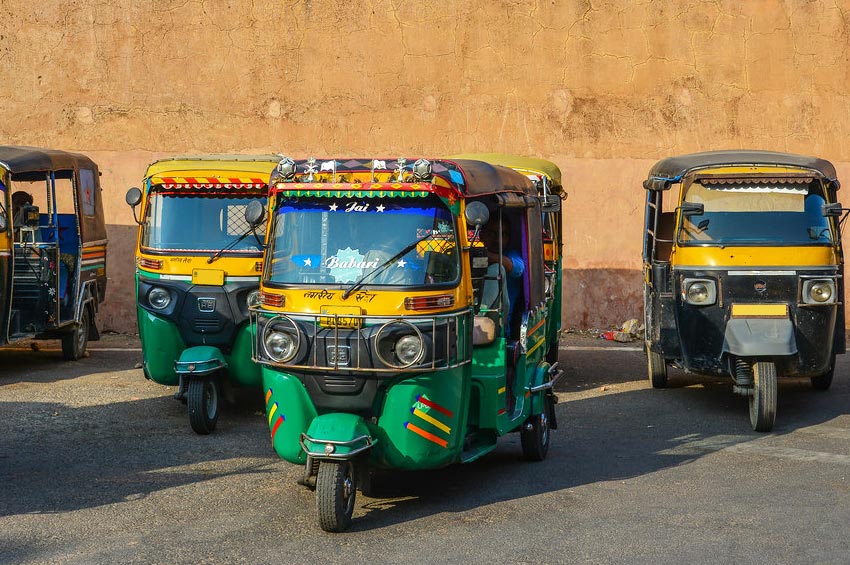
A tuk-tuk (also called an auto-rickshaw locally) is a small, open-sided three-wheeled vehicle that is the everyday mode of local transport across Jaipur and most Indian cities. A "tuk-tuk safari" simply means using a privately hired tuk-tuk, with the same driver for the whole day, as your dedicated sightseeing vehicle instead of a closed car. Because it is compact and open on the sides, it can weave through narrow old-city lanes, market alleys and heavier traffic that a car or coach would struggle with, which is exactly why it suits a walled-city destination like Jaipur so well.
The trade-off is comfort versus atmosphere: a tuk-tuk has less suspension and no air conditioning, but it keeps you at street level, close to the sounds, smells and everyday rhythm of the city — something a sealed, air-conditioned car naturally filters out. Many travellers choose this option specifically for that reason, alongside its lower cost compared with a private car tour.
A Quick History of Jaipur, the Pink City
Jaipur was founded in 1727 by Maharaja Sawai Jai Singh II, a Kachwaha Rajput ruler and keen astronomer, making it one of India's earliest planned cities, laid out on a grid according to classical town-planning principles. The city's famous pink colour dates to 1876, when the walled Old City was painted a warm terracotta shade to welcome the Prince of Wales on a royal visit — a tradition of hospitality that has been preserved by local building regulations ever since, which is why Hawa Mahal, City Palace and the bazaars around Jantar Mantar still carry the same rosy tone today. The Old City, together with its forts and gardens, was inscribed as a UNESCO World Heritage Site in 2019 under the name "Jaipur City, Rajasthan."
Jaipur Tuk-Tuk Day Tour Itinerary
8:30 AM – Hotel Pickup
Meet your tuk-tuk driver in the lobby of your Jaipur hotel or at an agreed central meeting point. Discuss any special interests — history, photography, food or markets — so the day can be adjusted to your preferences. Settle into your open-sided tuk-tuk and begin the city exploration.
9:00–11:00 AM – Amber Fort
Drive through the outskirts of Jaipur towards Amer, the former hilltop capital roughly 11 km from the city centre. Your tuk-tuk navigates the winding road with ease, dropping you at the fort entrance. Construction of Amber Fort began under Raja Man Singh I in the late 16th century and continued for two centuries, blending Rajput and Mughal architectural styles. Explore the main courtyards, gateways and the famous Sheesh Mahal (Mirror Palace), where thousands of tiny mirrors were set into the walls so a single candle flame could light the whole chamber. Take photos looking down over Maota Lake and the surrounding Aravalli hills. If you prefer not to climb, you can enjoy the exterior views and gardens at the base.
11:15–11:45 AM – Jal Mahal Photo Stop
On the return drive towards the city, pause at Man Sagar Lake to see Jal Mahal, the "Water Palace," sitting serenely in the middle of the water. Four of its five storeys sit submerged when the lake is at full level, leaving only the top floor and rooftop chhatris visible. This is a great spot for quick pictures and a short walk along the lakeside promenade. Your driver knows the best angles to capture the palace with the hills behind it.
12:15–1:30 PM – City Palace & Jantar Mantar
Head into the old city and visit the City Palace complex, the former seat of Jaipur's royal family since the city's founding and still partly a royal residence, where courtyards, audience halls, the Peacock Gate and small museums show how Jaipur's rulers lived and governed. Then walk to the nearby Jantar Mantar observatory, built by astronomer-king Sawai Jai Singh II between 1728 and 1734 — a UNESCO World Heritage Site since 2010 — where nineteen giant stone instruments, including the world's largest stone sundial, were used to measure time and track the movement of the sun, moon and planets to within seconds of accuracy. Both sites are within easy walking distance of each other.
1:30–2:30 PM – Lunch Break
Enjoy lunch at a recommended local restaurant or heritage café, where you can try authentic Rajasthani dishes such as dal baati churma, laal maas or lighter North Indian options. Your driver can suggest hygienic eateries based on your taste and budget.
2:45–3:15 PM – Hawa Mahal
Stop for an exterior view of Hawa Mahal, the "Palace of Winds," built in 1799 by Maharaja Sawai Pratap Singh with its iconic honeycomb of 953 small windows, originally designed so royal women could observe street life and processions below unseen, in keeping with the purdah tradition of the time. The lattice-work jharokhas also channelled air through the structure for natural cooling, which is how the palace got its name. From your tuk-tuk or a nearby rooftop café you can capture classic Pink City photographs. Your driver helps you navigate the busy traffic safely while finding the best vantage points.
3:30–4:30 PM – Bazaars and Optional Stop
Spend time exploring one or two old city markets such as Johari Bazaar for jewellery, Bapu Bazaar for textiles and handicrafts, or Tripolia Bazaar for spices and traditional wares. Your tuk-tuk can slip into narrower streets that larger vehicles cannot access, giving you a closer look at everyday market life. Alternatively, visit the white marble Birla Temple, dedicated to Lord Vishnu and Goddess Lakshmi, or take a quick exterior photo stop at the historic Albert Hall Museum, housed in a striking Indo-Saracenic building inside Ram Niwas Garden.
4:30–5:30 PM – Return to Hotel
Ride back to your hotel as the city begins to light up for the evening. Enjoy a last look at Jaipur's streets, temples and shopfronts from the open side of your tuk-tuk, finishing your safari with a genuine sense of the city's daily rhythm.
Duration & Location
Duration: Approximately 7–8 hours
Tour type: Private full-day city sightseeing tour by tuk-tuk
Location: Jaipur city and surrounding monuments, Rajasthan
Suggested start: Around 8:30 AM
Pickup: Jaipur hotel, railway station or agreed meeting point
Transport: Private tuk-tuk (auto-rickshaw) with dedicated driver
Walking level: Moderate; monument courtyards, bazaar lanes and some steps at Amber Fort
Best for: Solo travellers, couples, small groups, budget travellers and culture enthusiasts
Best season: October to March
Price: Available on request. Final cost depends on group size, optional guide service, monument combo tickets and any add-on experiences.
Tour Highlights
- Amber Fort: Explore courtyards, gateways and the famous Mirror Palace, with time for photos looking down over Maota Lake.
- Jal Mahal: Pause at Man Sagar Lake to see the Water Palace sitting in the middle of the water, framed by Aravalli hills.
- City Palace: Discover royal courtyards, audience halls and small museums showing how Jaipur's rulers lived and governed.
- Jantar Mantar: Visit the open-air observatory with giant stone instruments used to measure time and track celestial movements.
- Hawa Mahal: Admire the honeycomb façade of the Palace of Winds from street level and nearby rooftop viewpoints.
- Birla Temple or Albert Hall: Depending on time and interest, round off the day with a visit to the white marble temple or a museum photo stop.
- Old city bazaars: Slip into narrow lanes near Johari, Bapu and Tripolia bazaars for textiles, jewellery, spices and local crafts.
- Local flavour: Travel at street level in an open-sided tuk-tuk, closer to Jaipur's everyday sounds, colours and street food than a closed car allows.
Tuk-Tuk Tour vs. Other Ways to See Jaipur
Not sure whether a tuk-tuk is right for your Jaipur day? Here's how it compares with the alternatives.
| Option | Best For | Trade-off |
|---|---|---|
| Tuk-tuk safari (this tour) | Budget travellers, solo visitors, couples and anyone wanting a closer, more local, open-air feel of the city | Less shelter from sun, dust or rain; less comfortable than a car for a long 8–10 hour day |
| Private car tour | Families, senior travellers and anyone wanting air-conditioned comfort for a longer, deeper sightseeing day | Costs more than a tuk-tuk and can't access the narrowest old-city lanes as easily |
| Shared group bus tour | Solo budget travellers happy to follow a fixed group schedule | Less flexible timing, larger crowds at each stop, fixed lunch and shopping stops |
| Walking + local transport combination | Backpackers comfortable navigating independently within the Old City specifically | Amber Fort is roughly 11 km from the centre, so this isn't realistic for a full single-day itinerary |
Inclusions
- Hotel pick-up and drop-off within Jaipur city limits by private tuk-tuk.
- Use of a private tuk-tuk and driver for approximately 7–8 hours for city sightseeing.
- Basic bottled water in the vehicle for the duration of the tour.
- Fuel, parking charges, tolls and all standard local taxes related to the tuk-tuk and driver.
- Simple orientation and basic commentary from your driver about the main sights and neighbourhoods.
Exclusions
- Entrance tickets and official camera fees at monuments such as Amber Fort, City Palace, Jantar Mantar and museums.
- Meals, snacks and drinks purchased during the day, unless a specific package clearly includes lunch.
- Services of a professional, licensed tour guide inside the monuments (available on request at extra cost).
- Personal expenses such as shopping, additional activities or optional experiences not listed in the standard itinerary.
- Tips or gratuities for the driver and any local guides, which are voluntary and entirely at your discretion.
What to Eat on Your Jaipur Tuk-Tuk Day
Rajasthan's food traditions grew out of an arid climate, which historically favoured ingredients that kept well without refrigeration, alongside rich royal-kitchen dishes from the Rajput courts. A few things worth trying on your lunch break or from street stalls along the way:
- Dal Baati Churma: Rajasthan's signature dish — baked wheat rolls served with spiced lentils and a sweet crumbled wheat-and-jaggery accompaniment.
- Laal Maas: A fiery Rajput mutton curry made with dried red chillies, traditionally a royal hunting-camp dish.
- Gatte ki Sabzi: A gram-flour dumpling curry, a good vegetarian option in the same shelf-stable tradition.
- Pyaaz Kachori and Mirchi Bada: Popular Jaipur street-food snacks, widely sold near the old city bazaars your tuk-tuk passes through.
- Ghewar and Lassi: A honeycomb-textured sweet and a thick chilled yoghurt drink — both good for cooling down between stops.
Local Etiquette and Dress Code Tips
At Birla Temple and other active places of worship, shoulders and knees should be covered, footwear is removed before entering, and phones or bags are often left at a counter near the entrance. Photography inside some temple sanctums is restricted, so look for signage or ask staff before taking pictures. At forts and palaces such as Amber Fort and City Palace, photography is usually allowed in courtyards, though certain interior chambers or museum galleries may restrict cameras, tripods or flash photography.
It's polite to ask before photographing local people directly, particularly at markets, and a small tip or purchase is appreciated if someone poses for a photo. Bargaining is customary at bazaars like Johari and Bapu Bazaar, but is not appropriate at fixed-price shops or restaurants.
Best Time for a Jaipur Tuk-Tuk Tour
| Season | Months | What to Expect |
|---|---|---|
| Cool season | October to March | The most comfortable window for open-air tuk-tuk sightseeing; mornings and evenings can be chilly, so carry a light layer. |
| Summer | April to June | Daytime heat is intense and the open sides offer little shade; start early and prioritise Amber Fort before midday. |
| Monsoon | July to September | Humidity and occasional heavy showers can affect an open vehicle's comfort; keep a light rain cover handy. |
What to Pack
- Light, breathable cotton clothing suited to an open-air vehicle.
- A hat or scarf, sunglasses and sunscreen — there's no roof-level air conditioning to shield you.
- Sturdy, comfortable footwear for Amber Fort's slopes and stairs.
- A refillable water bottle, though bottled water is provided in the tuk-tuk.
- A scarf or stole to cover shoulders for temple visits.
- Small denomination cash for tickets, tips and market stalls.
- A light rain layer if travelling during the monsoon months.
Important Notes & Travel Tips
- Itinerary timings remain flexible. Your driver can shuffle the order to avoid peak crowds or heat, and shorter versions are possible if you have evening trains or flights.
- Wear light, comfortable cotton clothing, a hat or scarf for sun protection and footwear that is easy to remove at temples if you choose to enter.
- Carry sunglasses, sunscreen, a refillable water bottle and some cash for entry tickets, snacks and shopping.
- The tuk-tuk is open-sided, so morning and late afternoon are the most comfortable times; midday heat can be intense from April to June.
- Keep personal belongings secure while moving through crowded bazaar lanes and monument entrances.
- Amber Fort involves some walking and steps; seniors and those with mobility concerns can enjoy the views from the lower courtyards.
- Sharing your main interests — history, photography, markets or food — at the time of booking helps ensure the day feels personal and flexible.
- Monument entry fees change periodically; confirm current rates at the ticket counter on the day.
- Exact cancellation and refund terms should be confirmed before payment.
Frequently Asked Questions
How long does the Jaipur tuk-tuk day tour take?
The tour normally runs for 7 to 8 hours, starting around 8:30 AM and finishing by 4:30 or 5:30 PM depending on your pace, crowd levels and any extra stops you request.
Which monuments are covered in the Jaipur tuk-tuk tour?
The standard itinerary includes Amber Fort, Jal Mahal, City Palace, Jantar Mantar, Hawa Mahal and old city bazaars. Depending on time, you can also add Birla Temple or an exterior photo stop at Albert Hall Museum.
Is the tuk-tuk tour suitable for families with children or senior travellers?
Yes. The tuk-tuk is open-sided and easy to board, though it offers less suspension than a car. Families and seniors can adjust the pace, skip climbing sections at Amber Fort and focus on ground-level sights if preferred.
Are monument entry tickets included in the tuk-tuk tour price?
No. Monument entry tickets, official camera fees and any special access charges at Amber Fort, City Palace and Jantar Mantar are paid separately by the guest at each site.
Can I customise the itinerary or skip certain monuments?
Yes. The tour is private and flexible. You can shuffle the order, spend more time at favourite sites, add market stops or shorten the day if you have evening travel plans.
What should I wear and carry for the Jaipur tuk-tuk tour?
Wear light, comfortable cotton clothing, a hat or scarf for sun protection and sturdy footwear. Carry sunglasses, sunscreen, a refillable water bottle and some cash for entry tickets, snacks and shopping.
Is a professional guide included, or only the driver?
The standard package includes a friendly local driver who provides basic commentary about sights and neighbourhoods. A professional licensed tour guide for inside the monuments can be arranged at extra cost on request.
What is the best time of year for a Jaipur tuk-tuk tour?
October to March offers the most pleasant weather for open-air tuk-tuk sightseeing. April to June can be very hot, while July to September brings humidity and occasional rain that may affect comfort.
What is the difference between a tuk-tuk tour and a private car tour of Jaipur?
A tuk-tuk is open-sided, more affordable and better suited to slipping through narrow old-city lanes, giving a closer, more local feel to sightseeing. A private car offers more shelter from sun, dust and rain, more comfortable seating and is better suited to a full 8 to 10 hour day covering every attraction in depth.
Is a tuk-tuk safe for sightseeing in Jaipur traffic?
Yes, when driven by an experienced local driver who knows Jaipur's roads and traffic patterns. Tuk-tuks travel at lower speeds than cars and are commonly used across the city, though as an open vehicle they offer less physical protection than a car in the rare event of an accident.
Can the tuk-tuk tour be combined with an evening cultural show?
Yes, many travellers pair this day tour with an evening visit to a cultural village such as Chokhi Dhani for Rajasthani folk performances and a traditional dinner, which can be arranged as a separate add-on.
Related Jaipur Day Trips & Travel Guides
Continue planning your Jaipur stay with these useful day tours and Rajasthan travel resources.