Pushkar Fair 2026: The Complete Guide to the World's Most Photographed Camel Festival

Let me start with something honest that most Pushkar Fair guides won't tell you: your first hour at Pushkar Fair might feel like you've made a terrible mistake. You'll arrive in a town that's been swollen to roughly five times its normal population. Every road is a traffic jam of camels, motorcycles, autorickshaws, and tourists. The dust is fine and orange and gets into everything — your eyes, your camera lens, your teeth, the creases of your closed suitcase back at the hotel. Someone will try to sell you something within eleven seconds of stepping out of your vehicle. The noise is constant: camel grunts, temple bells, loudspeakers announcing events, folk music from three different directions simultaneously, and a guy on a PA system you can't locate who seems to be narrating something in Hindi at full volume.

And then, somewhere around hour two, something shifts. You climb up to a dune overlook and look out over the fairground — thousands of camels silhouetted against a Rajasthani sunset that turns the entire sky copper and magenta. A group of Kalbelia dancers in black skirts are spinning in a circle below you, and the rhythm of their movement matches the rhythm of the drums in a way that makes your chest vibrate. A sadhu with a three-foot trident and ash-smeared forehead walks past you without seeming to notice you exist. Two camel traders are arguing over a price in the distance, their voices carrying across the open sand. A hot air balloon drifts silently overhead. The lake behind you is ringed with oil lamps that are just starting to glow as the light fades.

That's the moment Pushkar Fair stops being chaotic and starts being one of the most extraordinary things you've ever witnessed. It's real — not staged for tourists, not manufactured for Instagram, not a cultural performance put on for an audience. It's a working livestock fair where actual camel trading happens alongside a religious pilgrimage that's been running for centuries, and you just happen to be standing in the middle of both of them at the same time. That overlap — commerce and devotion, animals and altars, dust and devotion — is what makes Pushkar unlike any other festival on Earth. There's nothing in Europe, nothing in Southeast Asia, nothing in South America that quite replicates this specific collision of the sacred and the mercantile.

This guide exists because most of what you'll find online about Pushkar Fair is either a 500-word listicle that tells you almost nothing useful, or a tour company's sales page dressed up as information. Neither is what you actually need. What you need is a real, detailed, honest guide that covers what the fair is, what happens on each day, what things actually cost, where to stay, how to get there, what to photograph (and what not to photograph), what to eat, what to avoid, and how to string the whole thing into a trip that feels worthwhile rather than overwhelming. That's what this is. It's long, because Pushkar Fair deserves long.

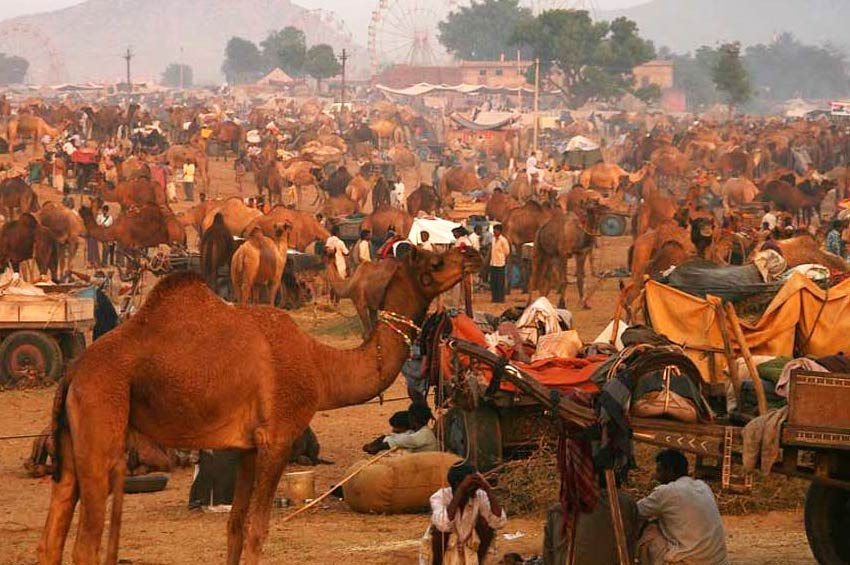
Pushkar Camel Fair Rajasthan 2026 – camels, traders, desert dunes and cultural performances at the world-famous Pushkar Mela
Pushkar Camel Fair — thousands of decorated camels gather on the desert fairground near Pushkar Lake in Rajasthan

Pushkar Fair 2026 Dates — Confirmed and Explained

Pushkar Fair follows the Hindu lunar calendar, specifically the month of Kartik. The fair begins on Kartik Shukla Ekadashi (the 11th day of the bright fortnight of Kartik) and culminates on Kartik Purnima (the full moon day). Because the Hindu calendar is lunar, the Gregorian dates shift each year. For 2026, the fair dates are:

Pushkar Fair 2026 day-by-day schedule with dates, Hindu calendar days, and events
Date (2026) Day Hindu Calendar Day What Happens
Sunday Kartik Ekadashi Fair officially begins. Camels and traders arrive en masse. Fairground activates.
Mon–Tue Dwadashi–Trayodashi Peak camel trading days. Stalls, tents and arenas being set up. Most authentic trading atmosphere.
Wed–Thu Chaturthi–Panchami Cultural programs begin. Folk performances and competitions start. Hot air balloons begin flights.
Friday Shashthi Camel races, horse races, major sporting events. Harmony Half Marathon typically held around this date.
Saturday Saptami Camel Beauty Contest, moustache competition, bridal competition. Peak tourist crowd day.
Sunday Ashtami Final day of major trading. Cultural finale performances. Evening desert concerts.
Monday Kartik Purnima The sacred climax. Holy dip in Pushkar Lake at sunrise. Temple ceremonies. Pilgrimage peak. Fair winds down by evening.

When should you actually be there? The ideal stay for a first-time visitor who wants a bit of everything is through — four to five nights that covers the cultural peak and the spiritual climax.

Where Exactly Is Pushkar? Understanding the Geography

Pushkar is a small town in Ajmer district of Rajasthan, about 15 km northwest of Ajmer city and 145 km southwest of Jaipur. It sits in a valley surrounded by low hills on three sides, with the Thar Desert beginning roughly 20–30 km to the west. The town is built around Pushkar Lake, a sacred body of water that according to Hindu mythology was created when Lord Brahma dropped a lotus petal from the sky. The lake is surrounded by 52 ghats (stepped embankments leading down to the water), and beyond the ghats, the town radiates outward in a maze of narrow lanes filled with temples, guesthouses, shops and cafes.

The fairground — where the camels, tents, arenas and main stage events happen — is on open desert ground to the west and southwest of the town proper, a 10–15 minute walk from the lake. During the fair, the town and the fairground effectively merge into one continuous zone of activity, connected by dirt tracks, temporary walkways and a constant flow of people and animals moving between the two.

The geography matters for your trip planning because it determines where you stay and how you navigate. Hotels and camps fall into three rough zones: lakeside (closest to the temples and ghats, quieter in the morning, more atmospheric but farther from the main fairground action), fairground-adjacent (closer to the camel trading area and event arenas, more convenient during the day but dustier and noisier), and on the hills above the town (some luxury camps and hotels are positioned on elevated ground with panoramic views over both the lake and the fairground — the best of both worlds if you can afford it).

The Real History — Why This Fair Exists at All

Pushkar Fair didn't start as a tourist attraction or a cultural festival. It started as a purely functional economic event — a livestock market timed to coincide with a religious pilgrimage, because that's when the maximum number of people would be in one place at one time. This combination of commerce and pilgrimage is actually a very old pattern in Indian economic life: religious gatherings have always been trading opportunities, because crowds mean customers.

The religious component — the Kartik Purnima pilgrimage to Pushkar Lake — has roots that go back at least a thousand years, possibly much further. The Brahma Temple at Pushkar is one of the very few temples in India dedicated to Brahma (the creator god in the Hindu trinity), and there's a specific theological reason for its rarity. According to the legend, Brahma was performing a yajna (fire ritual) at Pushkar and needed his wife Savitri present for the ceremony to be complete. When she didn't arrive on time, he married a local Gurjar girl named Gayatri so the ritual could proceed. Savitri, furious, cursed Brahma that he would never be worshipped anywhere else on Earth. Which is why, to this day, there's only one major Brahma temple in all of India — and it's here, at Pushkar.

The Brahma Temple at Pushkar is one of the very few temples in India dedicated to Brahma — there's only one major Brahma temple in all of India, and it's here, at Pushkar.

The livestock fair component grew organically around this pilgrimage. Pushkar sits at a geographic crossroads where the trade routes of Rajasthan, Gujarat, Haryana and Uttar Pradesh converge. Pastoral communities — Raika camel herders, Gujjar cattle breeders, horse traders from Marwar, sheep herders from the Aravalli foothills — would bring their animals to Pushkar during the pilgrimage period because that's when buyers (other pilgrims, traveling merchants, royal agents) would be present. Over centuries, this informal market became institutionalized into what we now call the Pushkar Fair or Pushkar Mela.

The transition from a regional livestock market to an international cultural festival is much more recent — really the last 30–40 years. Foreign backpackers started discovering Pushkar in the 1970s and 80s (it was already a stop on the hippie trail through Rajasthan), and their interest in the camel fair attracted media attention, which attracted more tourists, which attracted more infrastructure (tented camps, organized events, balloon operators), which attracted more tourists in a self-reinforcing cycle. By the 2000s, Pushkar Fair was firmly established on the global travel circuit. Today, it draws an estimated 200,000–300,000 visitors over the nine days, including several thousand international travelers.

What's remarkable — and what you should understand before you go — is that the modern tourist-facing festival exists alongside the original livestock trading and religious pilgrimage, not instead of them. The camel traders at Pushkar in 2026 are doing essentially the same thing their grandfathers did at Pushkar in 1960. The pilgrims bathing in the lake on Kartik Purnima are performing the same ritual their great-grandparents performed. The tourists, the balloon rides, the moustache competitions, the Instagram influencers — those are layers added on top of something that was already functioning for centuries. Understanding that the fair has a core that predates all of it changes how you experience it. You stop seeing it as a "show" and start seeing it as a living, working event that you're privileged to observe.

The Spiritual Core: Kartik Purnima, Brahma Temple & Pushkar Lake

Strip away the camels, the tourists, the balloon rides, and the loudspeakers, and what's left is one of the most sacred pilgrimage sites in Hinduism. Pushkar Lake is believed to have been created by divine intervention, and bathing in it during Kartik Purnima is considered spiritually equivalent to performing years of penance.

The merit earned by a single Kartik Purnima dip at Pushkar is said to be equivalent to performing 100 yajnas (fire sacrifices).

Whether or not you share this belief, the intensity of devotion you'll witness on is genuine and deeply moving, even for a non-religious observer.

The Brahma Temple: Located near the lake, this is the primary temple in Pushkar and the reason the town exists as a pilgrimage site. It's a relatively modest structure by Rajasthani temple standards — not enormous, not elaborately carved — but it has an intensity of atmosphere that's hard to describe. During the fair, the temple is crowded from early morning to late evening with devotees offering prayers, and the priests conduct special ceremonies throughout the Kartik period. Non-Hindus are generally allowed to enter the outer courtyard but not the inner sanctum. Dress modestly (covered shoulders and knees, shoes removed) and be respectful of the worship happening around you. This is not a tourist attraction — it's an active place of worship.

The 52 Ghats: The stepped embankments around Pushkar Lake are where the most visible religious activity happens. During the fair, the ghats are lined with pilgrims, priests conducting puja ceremonies, families performing rituals for deceased ancestors, and small groups of sadhus (holy men) who camp at specific ghats for the duration of the Kartik period. The evening aarti (ceremonial worship with fire and chanting) at the main ghat is one of the most beautiful and atmospheric experiences at the fair — oil lamps, incense, chanting priests, and the reflected lights on the lake surface. It's free to witness, genuinely spiritual rather than performative, and absolutely worth your time.

Kartik Purnima (): This is the spiritual peak of the entire fair. Pilgrims begin arriving at the lake before dawn — by 5:00 AM, the ghats are packed. The ritual bath is taken at or just before sunrise, and the belief is that the waters of Pushkar Lake on this specific morning are purified by the full moon in a way that doesn't happen on any other day. The atmosphere is intense: thousands of people in the water simultaneously, priests chanting mantras, temple bells ringing, families performing rituals together. After the bath, pilgrims visit the Brahma Temple and make offerings. By late morning, the formal rituals wind down, and by afternoon, a noticeable calm settles over the town as the fair effectively ends and traders begin packing up their camels.

If you're not Hindu: You're welcome to observe everything described above. The ghats are public spaces. You can sit on the steps and watch the aarti, the bathing, and the temple activities without participating. What you should not do: enter the lake water unless invited to do so by a priest (this is a sacred ritual, not a swimming pool), photograph people mid-prayer without asking, touch religious objects or offerings, or behave in any way that disrupts the devotional atmosphere. Quiet, respectful observation is always appropriate.

Day-by-Day Breakdown: What Happens When (2026 Schedule)

The fair has a natural rhythm that shifts from commercial to cultural to spiritual over the nine days. Understanding this rhythm helps you plan which days to be where.

Days 1–2 (): The Trading Days

This is when Pushkar feels most like a working livestock market and least like a festival. Camel herders from Rajasthan, Gujarat and beyond arrive with their animals — some having walked for days or weeks to get here. The fairground is a sea of camels, with traders inspecting animals, negotiating prices, and conducting business. There are very few organized events, no evening stage shows, and relatively few tourists. The atmosphere is dusty, busy, and authentically commercial. If you're a photographer seeking unvarnished documentary images, these are the golden days. If you're a casual tourist looking for entertainment, you'll find these days slow.

Days 3–4 (): The Transition

Cultural programming starts ramping up. You'll see the first folk dance performances, the first organized competitions, and the fairground infrastructure (stages, seating, food stalls, decoration) reaching completion. Camel trading continues at full intensity, but there's now a parallel track of tourist-oriented activity. Hot air balloon operators typically begin their flights around this point. The crowd starts getting noticeably larger.

Days 5–6 (): The Cultural Peak

This is when the fair feels most like what you've seen in photos. Camel races, horse races, the Harmony Half Marathon (usually around ), and major evening cultural shows with stage performances. The fairground is fully activated — every stall is open, every activity is running, every food vendor is cooking. The crowd is at its largest and most diverse: Indian domestic tourists, international visitors, photographers, journalists, VIPs, and locals all mixing together. These are the most visually spectacular days, and also the most crowded.

Day 7 (): The Contest Day

The Camel Beauty Contest, the Longest Moustache Competition, the Bridal Competition, and turban-tying contests typically happen on or around this day. These are the events that generate the most viral social media content and draw the biggest casual crowds. If you're at Pushkar primarily for the "fun" events and photo opportunities, this is your peak day. It's also the single most crowded day of the fair — expect difficulty moving through the fairground and long waits for activities.

Day 8 (): The Wind-Down

The last full day of fair activities. Final cultural performances in the evening, some closing ceremonies, and the beginning of the transition from festival mode back to pilgrimage mode. Camel traders who have completed their deals start packing up. The crowd thins slightly. The atmosphere is still festive but with a sense of things concluding.

Day 9 (): Kartik Purnima — The Sacred Finale

The festival energy has largely departed. What remains is the pilgrimage. Thousands of devotees arrive specifically for the Kartik Purnima rituals. The lake ghats are the center of all activity. The fairground is mostly empty — camels have been moved out, stalls are being dismantled. The contrast with the previous day's chaos is stark and meaningful. For many visitors, Kartik Purnima morning at Pushkar Lake is the most memorable single experience of the entire trip, precisely because it's so different from the camel-fair spectacle that preceded it.

The Camels — Trading, Grooming, and the Famous Beauty Contest

Let's talk about what's actually happening with the camels, because most coverage reduces it to "camels are decorated and paraded" and moves on. The reality is more interesting.

The trading: Pushkar remains one of the largest camel markets in the world.

In a typical year, anywhere from 20,000 to 50,000 camels are brought to the Pushkar Fair.

The traders are predominantly from the Raika and Rebari communities — traditional camel-herding castes of Rajasthan and Gujarat who have been breeding and trading camels for generations. The buyers come from across northern and western India: farmers who use camels for agricultural work in Gujarat and Rajasthan, transport operators in smaller towns where camels still pull carts, and increasingly, buyers representing tourism operations that offer camel rides at forts and desert camps.

The negotiation process is unhurried and social. A buyer inspects a camel — checking teeth, legs, hump condition, temperament — then sits down with the seller over chai. Prices are discussed obliquely, often through a middleman. A deal might take hours or even span two days. The atmosphere around the trading area in the early morning (6:00–9:00 AM) is the most authentic and photogenic part of the entire fair — just camels, traders, and soft golden light, with none of the tourist infrastructure that builds up later in the day.

The grooming: This is where the visual spectacle comes from. Each morning, camel owners groom their animals — washing them, clipping their fur into decorative patterns, painting their bodies and legs with natural dyes (usually orange, yellow, and red), and dressing them in embroidered cloth coverings, mirror-work blankets, pom-poms, bells and anklets. The level of ornamentation varies: some camels get minimal decoration (just a blanket and bells), while others — especially those entered in the beauty contest — get elaborate outfits that must take hours to apply. The grooming happens in the open, and watching it is fascinating: the camel standing placidly while its owner works, the tools spread out on the sand, the other camels nearby creating a living backdrop.

The Camel Beauty Contest: Usually held on , this is the single most famous event at Pushkar Fair and the one that appears in every photo essay, documentary, and travel article. Camels are paraded before a panel of judges (and a massive crowd) and evaluated on grooming, decoration, overall health and appearance, and — somewhat subjectively — "personality." The winning camel's owner receives a prize and significant prestige within the trading community. For visitors, it's a visually extraordinary scene: dozens of elaborately decorated camels in one arena, with the desert light and the crowd creating a tableau that genuinely looks like something from another century. Arrive early if you want a good viewing position — this event gets very crowded.

Camel Races, Horse Races & Traditional Sports

Camel races: Held on the fairground's designated race track (a long, straight or gently curved course marked out on the sand), camel races are high-energy events that draw enormous crowds. Camels are ridden by jockeys — often young men from the herding communities — and the races are short sprints (perhaps 200–500 meters) that are over in seconds. The start is chaotic (camels don't line up neatly like horses), the middle is a blur of sand and shouting, and the finish is celebrated explosively by whichever contingent's camel wins. There are usually multiple heats throughout the day, with a final race for the main prize.

Horse races: Less prominent than the camel races but taken very seriously by the participants. The Marwari horses of Rajasthan — distinctive for their inward-turning ear tips — are the primary breed on display. Horse trading happens alongside the racing, and the animals here are valued at significantly higher prices than the camels.

Traditional sports: Tug-of-war competitions (between villages, between tourist teams and local teams, between camel owner groups), kabaddi matches, matka (pot-balancing) races, and various other rural Rajasthani sports are organized throughout the fair. These are less polished than the main arena events but often more fun to watch because the participants are genuinely enjoying themselves rather than performing for an audience.

Hot Air Balloon Rides — Prices, Booking & What You Actually See

Hot air ballooning has become one of the most sought-after activities at Pushkar Fair, and the images of colorful balloons drifting over thousands of camels at sunrise have become the defining visual of the modern festival. Here's what you need to know before you book.

Who operates the balloons: Several companies run balloon flights during Pushkar Fair, including international operators (like Sky Waltz and Tiger Balloon Safari) and occasional visiting operators from other countries. The quality and safety standards vary — stick with established operators who have a track record at Pushkar specifically.

Flight timings: Flights operate at sunrise (typically 5:30–7:00 AM, depending on exact date and light conditions) and occasionally in the late afternoon. Sunrise flights are strongly preferred — the light is dramatically better for photography, the winds are calmer, and the visual of the fairground waking up below you is unforgettable. Afternoon flights are less common and less visually impressive.

Duration: Approximately 45–60 minutes of flight time, plus 30–45 minutes for inflation, briefing and post-flight packing/ceremony.

Prices (2026 estimates):
Standard shared flight
₹14,000₹18,000 ($160–$205) per person. You share the basket with 4–8 other passengers.
Premium/shared small basket
₹18,000₹22,000 ($205–$250) per person. Smaller basket (4–6 passengers), sometimes with a slightly longer flight or better positioning.
Private flight (2 passengers)
₹45,000₹70,000 ($510–$795) total for the basket. Just you and your companion (plus pilot).
Private flight (4 passengers)
₹55,000₹85,000 ($625–$965) total. For a family or small group.

What you actually see from up there: This is important, because expectations matter. You'll see the fairground from above — the camel herds, the tents, the arena — and the town of Pushkar with its lake and surrounding hills. On a clear morning, the Aravalli hills stretch in the distance. It's genuinely beautiful. What you should NOT expect: a close-up view of individual camels or people. You're at 300–600 meters altitude — everything below is in wide-angle, not close-up. If you want detailed camel portraits, you need to be on the ground. The balloon gives you the context — the scale of the fair, the geography of the place — that you can't get from anywhere else.

Booking: Book as early as possible. Balloon slots during Pushkar Fair sell out weeks or even months in advance, especially for the peak dates (). Book directly through the operator's website or through your tour operator/hotel. Avoid random "balloon ticket" sellers who approach you in the fairground — these are resellers who mark up prices and may not actually have confirmed slots.

Harmony Half Marathon — Running from Ajmer to Pushkar

The Harmony Half Marathon is a unique event that links the city of Ajmer (specifically, the area near the Dargah Ajmer Sharif) with Pushkar, covering approximately 14 km through the semi-arid countryside between the two towns. It's held annually during the fair and has become a notable draw for both Indian and international runners.

The route: Starts near the Dargah in Ajmer, runs through the outskirts of the city, then follows the Ajmer-Pushkar highway and connecting roads to finish at the Pushkar Stadium Ground. The terrain is mostly flat with gentle inclines, on paved and semi-paved roads. The landscape transitions from urban Ajmer to open countryside with views of the Aravalli hills — it's a scenic route by Indian running-event standards.

Categories: Typically includes a half marathon (~21 km with some route variations), a 10K, and occasionally a 5K fun run. Check the specific year's event registration for exact categories.

Registration: Usually opens 2–3 months before the event. Online registration through the event website or partner platforms. Fees typically range from ₹500–₹2,000 ($6–$23) depending on category and whether you want timing chips, event T-shirt, etc.

Practical tips for runners: November mornings in this region are cool (12–18°C / 54–64°F at 6:00 AM start time) — ideal running weather. The sun gets warm quickly, so the early start is a genuine advantage. Hydration stations are provided along the route, but carry your own water bottle as backup. The road surface is variable — some sections are smooth tarmac, others have rough patches. If you're coming from sea level, note that Pushkar/Ajmer is at roughly 500 meters elevation — not enough to affect performance noticeably, but worth knowing.

Folk Performances, Night Events & Desert Concerts

Every evening of the fair, the fairground transforms into an open-air entertainment venue. The main stage hosts organized cultural programs — typically 7:00–10:00 PM — featuring Rajasthani folk music and dance troupes. The quality varies: some performances are genuinely world-class (especially the Kalbelia dance, which is UNESCO Intangible Cultural Heritage), while others feel more like community talent shows. Either way, the atmosphere — open desert, stage lights against the dark sky, dust swirling in the beams, audience sitting on the ground or on low benches — is magical in a way that a theater never could be.

Key performances to look for:

Kalbelia Dance
Performed by women of the Kalbelia (snake-charmer) community. Black flowing skirts spin in spirals, accompanied by the distinctive pungi (snake-charmer's flute) and rhythmic handclaps. This is Rajasthan's most famous dance form and it's mesmerizing in person — far more powerful than any video can convey.
Ghoomar Dance
A circular community dance performed by women in colorful ghagras (long skirts), spinning in ever-faster concentric circles. Less dramatic than Kalbelia but beautiful in its communal energy.
Fire Dance
Performers manipulate burning torches, jump through fire rings, and dance on hot coals. More spectacle than art, but it draws enormous crowds.
Puppet Shows (Kathputli)
Traditional Rajasthani string puppetry — charming, funny, and surprisingly sophisticated once you watch for a few minutes.
Langas and Manganiyars
Two Muslim communities from western Rajasthan who are hereditary musicians. Their vocal and instrumental performances (using instruments like the kamaicha, khartal, and morchang) are hauntingly beautiful and represent some of the finest folk music traditions in the world.

Desert camp concerts: Many of the mid-range and luxury tented camps organize private evening performances for their guests — a bonfire, musicians playing in the firelight, perhaps a dancer, tea and snacks. These are more intimate than the main stage events and are often the highlight of a visitor's evening. If you're staying in a camp, ask what evening entertainment is included — it's a significant part of what you're paying for.

The Quirky Contests: Moustache, Bridal, Turban & More

Pushkar Fair's novelty contests have become its most shareable moments, and for good reason — they're genuinely funny, visually striking, and they create the kind of images that end up in every "world's weirdest festivals" listicle ever written.

Longest Moustache Competition: Rajasthani men take their moustaches seriously — they're markers of pride, masculinity, and in some communities, social status. Contestants line up on stage, moustaches measured and photographed, and the winner is the man with the longest verified moustache (often 3–4 feet, sometimes longer). The visual of a line of Rajasthani men with magnificent moustaches, against the backdrop of the desert, is one of the most iconic Pushkar images. It usually happens on .

Bridal Competition: Women (both local and sometimes tourist volunteers) dress in full Rajasthani bridal attire — heavy lehenga, ornate jewellery, elaborate headpiece — and are judged on their appearance. It's light-hearted and the participants clearly enjoy themselves. The visual spectacle of the bridal outfits alone makes this worth attending even if you have no interest in the competitive aspect.

Turban-Tying Competition: Contestants race to tie a Rajasthani pagri (turban) correctly and quickly. It's harder than it looks — a proper pagri involves specific folds, angles and techniques that vary by region and community within Rajasthan. Watching skilled turban-tyers work is genuinely impressive.

Matka (Pot-Balancing) Race: Women carry water-filled pots on their heads while racing. It's a traditional skill — Rajasthani village women walk miles with stacked water pots balanced perfectly — turned into a competitive event. Fun to watch, and the skill on display is real.

"Mr. Pushkar" and similar titles: Various informal beauty and personality contests happen around the margins of the fair, some organized, some spontaneous. The exact roster of novelty contests varies each year — check the fair's daily schedule notice board (usually posted near the main stage) for what's happening on any given day.

Camel Safaris & Desert Excursions

A camel safari is the most "Pushkar" thing you can do beyond simply walking around the fair. Options range from a 15-minute tourist ride around the fairground perimeter to multi-day desert expeditions into the Thar.

Short rides (15–30 minutes)
Available throughout the fairground, typically ₹100–₹300 ($1–$3.50) per person. You sit on a saddle blanket atop the camel while a handler leads the animal on a fixed circuit around the fairground perimeter. It's a gentle introduction to camel riding and perfectly adequate if you just want the experience and a photo.
Medium rides (1–2 hours)
These take you out of the fairground and into the surrounding dunes and villages. Prices range from ₹500–₹1,500 ($6–$17) per person depending on duration and negotiation. You'll see more authentic rural life — farmers in the fields, women collecting water, children waving from village paths — than you would staying inside the fair.
Half-day and full-day safaris
Usually ₹2,000–₹5,000 ($23–$57) for a half day, ₹4,000–₹8,000 ($46–$92) for a full day including a meal. These go deeper into the desert, often to remote dune areas where you can watch the sunset in complete silence, far from the fair's noise.
Multi-day expeditions
Typically ₹3,000–₹8,000 ($34–$92) per person per day, including camel, guide, meals and basic camping. These are serious desert journeys into the Thar — 2–5 days traversing sand dunes, remote villages, and open desert with no other tourists in sight. Not for everyone, but genuinely transformative if you're the type of traveler who wants to get away from the fair's crowds entirely. Book through reputable operators in Pushkar town, not through random touts in the fairground.

Adventure Activities: Quad Biking, Paramotoring & More

Beyond camels and balloons, a handful of adventure operators set up at the fairground each year offering motorized and aerial activities. These aren't traditional Pushkar Fair elements — they're relatively new additions driven by tourist demand — but they exist and some visitors enjoy them.

Quad biking (ATV rides): Usually ₹500–₹1,500 ($6–$17) for a 15–30 minute ride on a marked circuit through the dunes near the fairground. Fun but not particularly scenic — you're close to the fair noise and the circuits are short. If you've never been on a quad bike, it's a decent introduction. If you have, you'll find it underwhelming.

Paramotoring / parasailing: Occasionally available, typically ₹2,000–₹4,000 ($23–$46) for a short flight (10–15 minutes). Availability is inconsistent — some years operators show up, other years they don't. Don't plan your trip around this activity.

Zip-lining: Has been set up in some years over the fairground area. Again, inconsistent availability. If it's there and you want a quick thrill, it's usually ₹300–₹800 ($3–$9).

Shopping at Pushkar Fair — What to Buy and What to Pay

Pushkar is already a well-known shopping destination (the town's main market operates year-round), and the fair amplifies this dramatically with hundreds of additional temporary stalls. Here's what's actually worth buying and what you should expect to pay. Everything is negotiable. The first price quoted is typically 2–4x what the seller will actually accept. Negotiate firmly but politely — this is expected, not rude.

Rajasthani textiles
Bandhani (tie-dye), block-printed bedspreads, mirror-work cushion covers, embroidered wall hangings. Quality varies enormously. A good block-printed double bedspread: ₹400–₹1,200 ($5–$14). A mirror-work cushion cover: ₹100–₹300 ($1–$3.50). Check stitching quality before buying — some items look great but fall apart after two washes.
Jewellery
Silver jewellery is Pushkar's specialty — earrings, rings, anklets, toe rings, necklaces. Also semi-precious stone jewellery (lapis lazuli, turquoise, amethyst). Silver prices are reasonable: small earrings ₹200–₹500 ($2–$6), a silver anklet set ₹800–₹2,000 ($9–$23). Verify that it's actually silver (look for the 925 stamp) — some stalls sell silver-plated items at silver prices.
Leather goods
Mojaris (traditional Rajasthani embroidered leather shoes), leather bags, journals, belts. Pushkar's leather is generally good quality. Mojaris: ₹300–₹1,000 ($3–$11). Leather journal: ₹200–₹600 ($2–$7). Try before buying — mojaris stretch with wear, so buy slightly snug.
Camel-related souvenirs
Miniature camel figurines (wood, brass, cloth), camel-hair blankets and shawls, camel leather items. A good brass camel figurine: ₹500–₹2,000 ($6–$23). Camel-hair shawl: ₹1,500–₹4,000 ($17–$46) — genuinely warm and distinctive.
Puppets (Kathputli)
Traditional Rajasthani string puppets — colorful, handmade, and a great gift. ₹100–₹400 ($1–$5) depending on size and quality. These are genuinely handmade by puppeteer families, not factory-produced.
Music instruments
Small morchangs (jaw harps), khartals (clappers), ektaras (one-stringed instruments), small drums. ₹200–₹1,000 ($2–$11). Fun souvenirs if you can figure out how to play them (the sellers will usually give you a quick lesson).
Essential oils and incense
Pushkar has several shops selling essential oils (rose, sandalwood, jasmine) and incense. Quality is variable — some are genuine, some are synthetic. A small bottle of rose attar: ₹200–₹800 ($2–$9). Buy from established shops in the main bazaar, not from fairground stalls, if quality matters to you.

Rule of thumb for negotiation: Start at 40–50% of the quoted price and meet somewhere around 60–70%. If the seller accepts your first offer immediately, you offered too much.

Food at Pushkar Fair — What to Eat, What to Avoid

Pushkar is a vegetarian town — by law and tradition, no meat or eggs are sold within the town boundaries. (The law is a local municipal regulation tied to Pushkar's sacred status.) This means all food at the fair and in town is vegetarian. For non-vegetarian travelers, this is actually fine — Rajasthani vegetarian food is excellent and hearty — but you should know in advance so you're not surprised.

Must-try foods:
  • Dal baati churma — The signature Rajasthani dish. Hard wheat balls (baati) baked in coals or fried, served with lentil curry (dal) and a sweet crumbled wheat dessert (churma). It's heavy, filling, and delicious. ₹80–₹200 ($1–$2.30) at fair stalls.
  • Mirchi bada — Large green chillies stuffed with spiced potato, dipped in gram flour batter, and deep-fried. A Pushkar/Ajmer specialty. ₹20–₹50 ($0.25–$0.60) each. Addictive but very spicy — ask for a milder version if you're sensitive.
  • Malpua — Sweet, deep-fried pancakes soaked in sugar syrup, often served with rabdi (thickened sweet milk). A breakfast or dessert item. ₹30–₹80 ($0.35–$0.90) a plate.
  • Kachori — Flaky, deep-fried pastry filled with spiced lentils or onions. A classic North Indian breakfast snack. ₹20–₹50 ($0.25–$0.60).
  • Lassi — Thick yogurt drink, available sweet or salted. At the fair, look for the vendors with the big brass or clay pots. ₹30–₹80 ($0.35–$0.90).
  • Chai — Indian tea with milk, cardamom, and sometimes ginger. At the fair, it's often made in massive pots over open fires and served in small clay cups (kulhad). ₹10–₹20 ($0.12–$0.25). The best chai at the fair comes from the small stalls near the camel trading area, not the main food court.
Where to eat:
  • Fairground food stalls: Cheap, authentic, but hygiene is questionable. Good for chai, snacks, and dal baati churma. Avoid anything with raw ingredients (salads, chutneys that look like they've been sitting out).
  • Town restaurants: Pushkar's main bazaar has dozens of restaurants catering to both Indian and international tourists. Hygiene is better than the fairground. Many offer " Continental" and "Israeli" menus alongside Indian food. Quality varies — check recent Google reviews.
  • Your camp/hotel restaurant: If you're staying in a tented camp, meals are usually included and are generally the safest and most reliable food option. Quality ranges from adequate to surprisingly good.
What to avoid:
  • Ice in drinks — it's often made from untreated water.
  • Fruit juices from street vendors — same water issue.
  • Anything that looks like it's been sitting in the sun for hours.
  • Pre-cut fruit from fairground stalls.
  • Tap water — always drink bottled water (check the seal is intact when you buy it).

Accommodation Guide: Tents, Hotels, Guesthouses & Prices

Accommodation is the single biggest logistical challenge of Pushkar Fair. The town's normal capacity is roughly 2,000–3,000 beds. During the fair, demand is for 20,000–30,000 beds. The math doesn't work, which is why temporary tented camps spring up everywhere and prices multiply by 3–10x compared to the rest of the year. Book 2–3 months in advance minimum. Walking in and hoping to find something is a strategy that will end with you sleeping in your car or paying absurd last-minute prices.

Luxury tented camps
₹8,000₹25,000 ($92–$285) per night. These are proper luxury tents — proper beds, attached bathrooms with running water, electricity, often air conditioning or heating, included meals, evening entertainment, and sometimes a pool. Companies like Royal Desert Camp, Pushkar Palace Tent Camp, and several others operate at this level. Location is usually on the hills above the town with lake and fairground views. Book through the operator directly or via a luxury travel agent. These sell out earliest.
Mid-range tented camps
₹3,000₹8,000 ($34–$92) per night. Tents with beds, shared or attached bathrooms (running water, usually hot water available in the morning), included breakfast or all meals. Clean and functional but not luxurious. Many are located on the fairground periphery. This is the sweet spot for most travelers — comfortable enough, not ruinously expensive. Dozens of operators at this level — read reviews carefully before booking, as quality varies significantly.
Budget guesthouses and hotels in Pushkar town
₹800₹3,000 ($9–$34) per night. Small hotels and guesthouses in the town's narrow lanes. Basic rooms — clean bed, attached bathroom (usually), fan or AC. Some have rooftop terraces with lake views. The advantage is being in the heart of the town, close to the lake and temples. The disadvantage is that you'll need to walk 10–15 minutes to reach the fairground each day, and the lanes can be crowded and noisy during the fair.
Hotels in Ajmer (alternative base)
₹1,000₹5,000 ($11–$57) per night. Ajmer, 15 km away, has far more hotel capacity and doesn't experience the same price inflation as Pushkar during the fair. You can take a shared taxi or bus to Pushkar each morning (30–45 minutes, ₹50–₹100 / $0.60–$1.15) and return in the evening. This is the budget-conscious option, but you lose the atmosphere of being in Pushkar during the evening and early morning — which are arguably the best times.

When to book: Luxury camps start filling up 4–6 months in advance. Mid-range camps: 2–3 months. Budget guesthouses: 1–2 months. If you're reading this less than 6 weeks before the fair and haven't booked, look at Ajmer hotels immediately — Pushkar options will be very limited.

Full Budget Breakdown — What a Pushkar Fair Trip Actually Costs

Here are realistic budget ranges for a 4-night / 5-day Pushkar Fair trip for one person, covering the peak period (4–9 November). These are honest numbers, not aspirational "budget travel" fantasies.

Pushkar Fair 2026 budget breakdown for 4-night / 5-day trip per person
Expense Budget Mid-Range Comfortable / Luxury
Accommodation (4 nights) ₹3,200–₹12,000 ($37–$137) ₹12,000–₹32,000 ($137–$365) ₹32,000–₹1,00,000 ($365–$1,140)
Transport (from Jaipur, return) ₹800–₹1,500 ($9–$17) ₹2,000–₹4,000 ($23–$46) ₹5,000–₹10,000 ($57–$114) private car
Food (5 days) ₹1,500–₹3,000 ($17–$34) ₹3,000–₹6,000 ($34–$69) Included in camp package
Hot air balloon (optional) ₹14,000–₹18,000 ($160–$205) ₹18,000–₹70,000 ($205–$795)
Camel safari, activities, shopping ₹500–₹1,500 ($6–$17) ₹2,000–₹5,000 ($23–$57) ₹5,000–₹15,000 ($57–$171)
Local transport (autos, etc.) ₹300–₹600 ($3–$7) ₹600–₹1,500 ($7–$17) ₹1,500–₹3,000 ($17–$34)
Miscellaneous (water, tips, etc.) ₹500–₹1,000 ($6–$11) ₹1,000–₹2,000 ($11–$23) ₹2,000–₹5,000 ($23–$57)
TOTAL (approx.) ₹6,800–₹19,600 ($78–$224) ₹34,600–₹69,500 ($395–$793) ₹63,500–₹2,03,000 ($725–$2,311)

For international travelers: Add your international flight to Delhi or Jaipur, plus any India domestic flights, visas, and travel insurance. A typical international visitor's total trip cost (including flights from Europe/US, visa, the fair itself, and a few days in Jaipur or Delhi) runs roughly $1,500–$3,500 depending on origin, accommodation level, and whether you do the balloon ride.

How to Reach Pushkar — By Air, Train & Road

By Air

The nearest airport is Jaipur International Airport (JAI), 145 km from Pushkar (2.5–3 hours by road). Jaipur has direct flights from Delhi, Mumbai, Bangalore, Hyderabad, Kolkata, Chennai, and several international destinations (including Dubai, Sharjah, Bangkok, and Singapore).

From Jaipur Airport to Pushkar:

  • Pre-paid taxi: ₹2,500–₹4,000 ($29–$46), 2.5–3 hours. Available at the airport.
  • Private car hire: ₹3,000–₹5,000 ($34–$57). Book through your hotel or a ride-hailing app.
  • Budget option: Take a taxi/auto to Jaipur Railway Station (20–30 min), then a train to Ajmer (see below), then a taxi/bus to Pushkar.

Alternative airport: Delhi Indira Gandhi International Airport (DEL), ~400 km from Pushkar (7–8 hours by road, or 5–6 hours by train via Ajmer). More flight options but a much longer ground journey.

By Train

The nearest railway station is Ajmer Junction (AII), 15 km from Pushkar. Ajmer is well-connected by rail to all major Indian cities.

Train connections to Ajmer Junction from major Indian cities
From Distance Travel Time Train Type
Jaipur ~135 km 1.5–2 hours Multiple daily trains (Shatabdi, Express)
Delhi ~390 km 5–6 hours Shatabdi Express, Rajdhani (to Ajmer), multiple others
Mumbai ~900 km 12–16 hours Overnight trains (Aravali Express, etc.)
Ahmedabad ~500 km 9–11 hours Multiple daily/overnight trains
Udaipur ~300 km 6–7 hours Express trains

From Ajmer Junction to Pushkar: Shared taxis (₹50–₹80 / $0.60–$0.90 per person, 30 minutes), private taxi (₹300–₹500 / $3–$6), or local bus (₹20–₹30 / $0.25–$0.35, 40–50 minutes). Shared taxis leave from just outside the railway station whenever full (every 10–15 minutes during the fair).

Train booking tip: Book train tickets on IRCTC (irctc.co.in) as early as possible — Indian railway tickets for popular routes sell out 60–120 days in advance. During the fair period, Ajmer-bound trains from Delhi and Jaipur are extremely crowded. If you can't get a confirmed ticket, use Tatkal (emergency quota, opens 1 day before travel) or consider a bus.

By Road

Pushkar is connected by road to all major Rajasthan cities. During the fair, additional state transport buses run from Jaipur, Ajmer, Jodhpur, and Udaipur.

  • From Jaipur: NH48 to Kishangarh, then state highway to Ajmer/Pushkar. 2.5–3 hours.
  • From Delhi: NH48 via Jaipur or NH8 via Ajmer. 7–8 hours.
  • From Jodhpur: Via Pali and Ajmer. 4–5 hours.
  • From Udaipur: Via Nathdwara and Rajsamand. 5–6 hours.

During the fair: Private vehicles are not allowed into the fairground area or the immediate vicinity of Pushkar Lake during peak days. You'll be directed to a parking area 1–2 km from the town center and will need to walk or take an auto from there. Plan accordingly — don't arrive in a rush thinking you'll drive right up to your hotel.

Weather in November — What to Expect and How to Dress

November is one of the best months to visit Rajasthan weather-wise, but the temperature range is wider than many visitors expect. Pushkar's desert location means significant day-night temperature variation.

Daytime: 25–32°C (77–90°F). Sunny, dry, pleasant. You'll be comfortable in a t-shirt during the hottest part of the day (1:00–3:00 PM).

Evening: 15–22°C (59–72°F). Cool enough for a light jacket or sweater by 7:00 PM.

Early morning / night: 8–15°C (46–59°F). Genuinely cold before sunrise — especially if you're out for the balloon ride at 5:30 AM or at the lake for Kartik Purnima at 5:00 AM. You need a proper warm layer.

Rainfall: Essentially zero. November is firmly in the dry season. You will not need rain gear.

Dust: This is the weather factor that nobody warns you about adequately. The fine desert dust at Pushkar Fair is pervasive and relentless. It gets in your eyes, nose, mouth, hair, camera, phone, bag, and every crevice of your clothing. On windy days (which happen 2–3 days out of 9 on average), the dust can be thick enough to reduce visibility to 100–200 meters in the fairground. A buff/scarf worn over your nose and mouth is not optional — it's essential. So are wrap-around sunglasses or prescription glasses.

How to dress: Layering is the strategy. T-shirt + light long-sleeve shirt + fleece/sweater + light jacket. You'll shed layers during the day and add them back in the evening. For women: modest dress is advisable (covered shoulders and knees) both for cultural sensitivity and sun protection. Loose, lightweight, full-length clothing in light colors is ideal. For men: same principle — light trousers and a shirt work better than shorts. Closed-toe shoes or sturdy sandals are essential — the ground is sandy and dusty, and you'll be walking several kilometers per day.

Photography Guide — Gear, Tips, Ethics & Best Spots

Pushkar Fair is one of the most photogenic events on Earth, and it attracts serious photographers from every continent. Here's what you need to know to come back with images that do justice to the experience.

Recommended Gear
  • Camera body: Any interchangeable-lens camera will work. You don't need the latest model — a 5-year-old DSLR or mirrorless body is perfectly adequate.
  • Wide-angle lens (16–35mm or equivalent): For the broader landscape shots — fairground panoramas, balloon over camels at sunrise, lake ghats with pilgrims. This is your "context" lens.
  • Telephoto lens (70–200mm or 100–400mm): Your workhorse lens at Pushkar. For camel trading close-ups, portraits of traders, detail shots of grooming, candid shots of performances without being in people's faces. If you can only bring one lens, make it this one.
  • Standard zoom (24–70mm or equivalent): For general walkaround shooting when you don't want to change lenses in the dust.
  • Dust protection: This is critical. Bring a rain cover for your camera (used here as a dust cover), multiple clean microfiber cloths, a blower brush, and zip-lock bags for when you're not shooting. The dust at Pushkar will get inside your camera if you change lenses in the open — change lenses inside your hotel room or inside a vehicle, never in the fairground.
Best Photography Spots and Times
Camel trading area at sunrise (6:00–8:00 AM)
The single best photography opportunity at the fair. Golden light, camels silhouetted against the dawn sky, traders sitting by small fires, minimal tourist presence. Be in position by 6:00 AM — the light window is short.
Dune overlooks (west of fairground) at sunset
The classic Pushkar panorama — fairground below, sun setting over the desert, balloons in the air if conditions allow. Walk 10–15 minutes west from the fairground edge to find elevated dune positions.
Pushkar Lake ghats at evening aarti (6:00–7:00 PM)
Oil lamps, reflections on water, priests in silhouette, pilgrims. Low-light photography — bring a fast lens or accept higher ISO. Tripods are technically allowed but can be awkward in the crowd.
Camel grooming area (early morning)
Watch for owners grooming and decorating their camels in the early morning. The concentration, the colors, the tools spread on the sand — intimate, detailed images.
Folk performances (evening, 7:00–10:00 PM)
Challenging light conditions (stage lights against dark sky, moving subjects) but spectacular results if you nail the exposure. High ISO, fast shutter speed, and willingness to shoot a lot of frames.
Photography Ethics — Read This Carefully

This matters more than any gear recommendation. Pushkar is not a zoo. The people you're photographing are not exhibits. Many are engaged in their livelihood (trading camels) or their devotion (worshipping at the lake). Photography ethics at Pushkar come down to these principles:

  • Ask before photographing people close-up. A simple gesture — pointing to your camera, raising your eyebrows — works even without a shared language. Most people will say yes. Some will say no or turn away. Respect the no immediately.
  • Don't photograph people during private religious rituals. This includes the holy bath at Kartik Purnima — these are intimate spiritual moments, not photo ops. Wide shots of the ghats from a distance are fine; sticking a lens in someone's face while they're praying is not.
  • Don't photograph sadhus without permission. Some sadhus expect and welcome photography (and may ask for baksheesh/tips afterward). Others find it deeply offensive. Always ask.
  • Be prepared to pay small tips (₹10–₹50) for portraits. Many camel traders and performers at Pushkar have learned that their photograph has commercial value and will expect something in return. This is reasonable — treat it as a small modeling fee and don't haggle over it.
  • Don't block pathways or disrupt activities for a photo. The fairground is a working space. Don't position yourself in the middle of a camel trading negotiation or a dance performance in a way that interferes with what's happening.

What to Pack — The Complete List

Clothing
T-shirts (3–4), light long-sleeve shirts (2), lightweight full-length trousers (2–3), fleece or warm sweater (1), light jacket or windbreaker (1), sleepwear, underwear (enough for 5 days or plan to wash), scarf/buff (essential for dust), comfortable closed-toe walking shoes (1 pair — you'll wear these 90% of the time), sandals or flip-flops (for hotel/camp use).
Health & Hygiene
Sunscreen (SPF 50+, you'll need it), lip balm with SPF, moisturizer (the desert air dries your skin aggressively), hand sanitizer, wet wipes, toilet paper (carry a small roll — many public toilets don't supply it), ORS packets, Imodium or equivalent anti-diarrheal, any personal medications, dust mask or N95 mask (for high-dust days), small first-aid kit (band-aids, antiseptic cream, pain reliever).
Photography
Camera, lenses, extra batteries (cold mornings drain batteries faster), memory cards (bring more than you think you need — you'll shoot thousands of frames), charger, dust protection gear (rain cover, cloths, blower, zip-lock bags).
Documents
Passport (for international travelers), visa, hotel/camp booking confirmations (printed), train/flight tickets (printed or downloaded), travel insurance details, emergency contact numbers, photocopies of key documents (kept separately from originals).
Practical Items
Small daypack (for carrying water, camera, layers during the day), reusable water bottle, headlamp or small flashlight (useful for early morning and evening navigation), power bank (phone battery drains fast with camera use), universal power adapter (India uses Type C and Type D plugs), pen and small notebook.
What NOT to Pack
Expensive jewellery, anything you can't afford to get dusty, high heels, formal clothing, excessive cash (ATMs are available in Pushkar town), drone (banned at Pushkar Fair without special permits that are almost impossible to get).

Sample Itineraries: 1-Day, 2-Day, 3-Day & Combined Trips

1-Day Itinerary (for those based in Jaipur or Ajmer)

Leave Jaipur by 5:00 AM or Ajmer by 7:00 AM. Arrive at Pushkar fairground by 8:00–8:30 AM. Spend the morning in the camel trading area and watching grooming. Walk to the lake ghats around 11:00 AM, visit the Brahma Temple, have lunch in town. Return to the fairground at 2:00–3:00 PM for afternoon events (races, contests depending on the day). Stay through the evening cultural program (7:00–10:00 PM). Drive back to Jaipur/Ajmer after the show. This is exhausting but doable — you'll see the highlights but miss the atmosphere that comes from being there over multiple days.

2-Day Itinerary

Day 1: Arrive by noon. Afternoon at the fairground — camel area, shopping stalls, food. Evening cultural show. Dinner at your camp/hotel.

Day 2: Sunrise at the camel trading area (6:00 AM). Breakfast. Morning at the lake — ghats, Brahma Temple, town exploration. Lunch. Afternoon at the fairground for whatever events are scheduled. Evening cultural show or camp concert. Depart after dinner or next morning.

3-Day Itinerary (recommended minimum)

Day 1: Arrive by late morning. Settle into accommodation. Afternoon: fairground orientation walk — camel trading area, arena, food stalls, shopping. Evening: main stage cultural program.

Day 2: Sunrise photography at the camel area. Breakfast. Late morning: lake ghats and Brahma Temple. Lunch in town. Afternoon: camel safari (1–2 hours) into the dunes. Sunset from a dune overlook. Evening: camp concert or return to main stage.

Day 3: If it's a contest day (7 November): spend the full day at the fairground for the beauty contest, moustache competition, etc. If it's Kartik Purnima (9 November): wake up at 4:30 AM for the lake rituals — this is a once-in-a-lifetime experience and worth prioritizing over everything else. Depart after lunch or in the evening.

Combined Rajasthan Trip (7–10 days with Pushkar Fair)

Many international visitors combine Pushkar Fair with a broader Rajasthan itinerary. A common pattern:

  1. Jaipur (2 days): Amber Fort, City Palace, Hawa Mahal, Jantar Mantar. Arrive at Jaipur airport, recover from jet lag, explore the Pink City.
  2. Pushkar Fair (3–4 days): Drive from Jaipur to Pushkar (2.5–3 hours). Full fair experience as described above.
  3. Jodhpur (2 days): Mehrangarh Fort, Jaswant Thada, Clock Tower market. Drive from Pushkar to Jodhpur (4–5 hours).
  4. Udaipur (2 days): City Palace, Lake Pichola, Jag Mandir. Drive or fly from Jodhpur.
  5. Departure: Fly out of Udaipur or return to Jaipur/Delhi for international flight.

This gives you a comprehensive Rajasthan experience with the Pushkar Fair as the centerpiece. Adjust based on available time and interests.

Cultural Etiquette — What's Acceptable and What's Not

  • Dress modestly: Covered shoulders and knees for both men and women, especially at the lake and temples. This isn't a legal requirement (except inside temples) but it's basic respect. You'll feel more comfortable and receive more respectful treatment when you dress appropriately.
  • Remove shoes before entering temples: This is non-negotiable. You can leave them at the designated area outside the Brahma Temple and other temples.
  • Don't touch religious idols or offerings: This includes the flowers, coconuts, and other items placed at temples and ghats.
  • Don't point your feet at people or religious objects: In Indian culture, feet are considered the least clean part of the body. Pointing the soles of your feet at a person, a deity, or a religious item is offensive.
  • Use your right hand for eating, giving, and receiving: The left hand is traditionally associated with toilet hygiene. Use your right hand for passing objects, eating, and any social interaction involving physical contact.
  • Don't display public affection: Kissing, hugging, and hand-holding between couples are not culturally normative in rural Rajasthan and will draw uncomfortable attention. Save it for private spaces.
  • Bargaining is expected, but don't bargain over tiny amounts: Negotiating over a ₹10 difference on a ₹200 item is considered petty. Once you've agreed on a price, don't re-negotiate.
  • Tipping: Small tips (₹10–₹50) for porters, auto drivers who help with luggage, and guides are appreciated but not mandatory. At restaurants, a 5–10% tip is fine if service charge isn't included.
  • Don't photograph the Naga sadhus without explicit permission: The Naga sadhus (naked ash-smeared holy men) who sometimes appear at Pushkar are the most photographed subjects at the fair. Many demand — and some aggressively demand — payment for photos. Ask clearly before shooting, and agree on the amount beforehand if they ask for money.

Safety, Scams & Things That Go Wrong

Pushkar Fair is generally safe — violent crime against tourists is extremely rare. But there are hassles and minor scams that you should be prepared for.

Common Scams and Hassles
"Free" puja at the lake
A priest at one of the ghats will invite you to participate in a puja ceremony, tell you it's free, perform the ceremony, and then demand a large "donation" (₹500–₹2,000 or more). This is the single most common scam at Pushkar. If you want to participate in a puja, agree on the price beforehand. If you just want to observe, say "no thank you" firmly and walk away. Don't feel guilty — this is a business, not a spiritual service.
Overpriced everything in the fairground
Water bottles at ₹50 when they should be ₹20, chai at ₹50 when it should be ₹15, auto rides at ₹200 when they should be ₹50. The fairground premium is real — either accept it as a "convenience tax" or walk 10 minutes to the town where prices are normal.
Fake balloon ticket sellers
People in the fairground selling "balloon ride tickets" at marked-up prices with no guarantee of an actual flight. Book only through your hotel/camp or directly with the operator.
"Special fair price" accommodation
If you arrive without a booking, touts will offer to take you to a "very good hotel" — which will be overpriced and substandard. Always book in advance.
Photography baksheesh escalation
You photograph someone, they ask for ₹50, you pay, their friend appears and demands ₹100 for a photo you took of them in the background. Be clear about who you're paying and for what. Or just shoot with a longer lens from a distance to avoid the interaction entirely.
Physical Safety
  • Dust in eyes: Extremely common. Carry eye drops and flush with clean water. Don't rub.
  • Camel kicks and bites: Camels are generally docile but can kick sideways with devastating force. Don't walk directly behind a camel. Don't approach camels that are being traded or are agitated. Keep children at a safe distance.
  • Crowd crush risk: On peak days (especially 7 November — contest day), the crowd around the main arena can be extremely dense. If you feel uncomfortable, move away from the center. There are no organized crowd-control barriers in most areas.
  • Fire risk: The evening performances involve fire, and the fairground has many open-flame cooking stalls. Be aware of your surroundings, especially in crowded areas.
  • Dehydration and heat: Even in November, the midday sun is strong. Drink water constantly — carry a bottle and refill it throughout the day.
Emergency Contacts
Police
100
Ambulance
108
Pushkar Police Station
+91-145-2770222
Nearest hospital
PBM Hospital, Ajmer — 15 km from Pushkar (the main government hospital for the region). For minor issues, there are small clinics in Pushkar town.
Tourist helpline (Rajasthan)
1363 or +91-141-5110598

Special Notes for International Travelers

Pushkar Fair attracts thousands of international visitors each year, and the town is well-equipped to handle them compared to most small Indian towns. But there are things you should know that Indian domestic visitors don't need to worry about.

Visa
Most foreign nationals need an Indian visa. Apply for an e-Visa at indianvisaonline.gov.in at least 4 weeks before travel. The e-Visa is available for tourism purposes for citizens of most countries. It's valid for 60 days from the date of arrival.
Money
Indian rupees (INR, symbol ₹). ATMs are available in Pushkar town but can run out of cash during the fair — withdraw what you need in Jaipur or Ajmer before arriving. International cards (Visa, Mastercard) are accepted at some hotels and larger shops but not at fairground stalls or small vendors. Carry cash. Currency exchange is available in Pushkar town (rates are less favorable than in Jaipur or Delhi — exchange major amounts in bigger cities).
SIM Card
Buy an Indian SIM card at the airport on arrival (Airtel, Jio, and Vodafone have counters at Jaipur and Delhi airports). You'll need your passport, a passport photo, and a local address (your hotel). A data plan (4–5 GB) costs roughly ₹300–₹500 ($3–$6). You need a working phone for Google Maps, UPI payments (if you set up PhonePe or Google Pay), and communication with drivers/hotels.
Health
No special vaccinations are required for Rajasthan, but consult a travel health advisor. Recommended: Hepatitis A, Typhoid, Tetanus (booster if needed). Malaria risk in Pushkar in November is very low (it's too dry and cool for mosquitoes). Tap water is not safe — drink only bottled water. Avoid ice. See the food section above for detailed food safety advice.
Language
Hindi and Rajasthani are the local languages. English is widely understood in Pushkar's tourist-facing businesses (hotels, restaurants, shops, guides). In the fairground, among camel traders and rural visitors, English is rare — but hand gestures, smiles, and a few Hindi words go a long way. Useful phrases: Namaste (hello), Shukriya (thank you), Kitna? (how much?), Bahut accha (very good), Nahin (no).
Time Zone
India Standard Time (IST) = UTC+5:30. No daylight saving.

Visiting Pushkar Fair with Kids

Pushkar Fair can be a magical experience for children — camels, balloons, fireworks, puppets, desert sand to play in — but it's also exhausting, dusty, and logistically challenging with young kids in tow.

Best age range: 6–14 is the sweet spot. Younger children may find the noise, crowds, and dust overwhelming. Teenagers will either love it or hate it — there's no middle ground.

Practical tips for families:

  • Stay in a mid-range or luxury camp rather than a budget guesthouse — the included meals, clean facilities, and evening entertainment make family logistics much easier.
  • Plan one main activity per day (morning or afternoon), not both. Kids melt down in the heat and dust faster than adults.
  • The hot air balloon ride has minimum age restrictions (usually 6+ years) — check with the operator before booking.
  • Camel rides (short, 15-minute ones) are usually the highlight for kids. Go in the morning when it's cooler and less crowded.
  • Puppet shows, the moustache competition, and the matka race are the most kid-friendly events.
  • Bring a dust mask that fits your child properly. Adult buff/scarves don't work well on small faces.
  • Carry snacks and water at all times — kids dehydrate faster, and fairground food may not appeal to picky eaters.
  • Agree on a meeting point if you get separated (the fairground is crowded and disorienting). Take a photo of your child each morning so you have a current image showing exactly what they're wearing.
  • Pushkar town has a few rooftop cafes with play areas and Western food options — useful as a midday reset.

Solo Female Travelers at Pushkar Fair

Pushkar is one of the more solo-female-friendly small towns in India, primarily because it's been hosting international travelers for decades and has a well-established tourist infrastructure. That said, it's still rural Rajasthan, and the usual India caveats apply.

What's generally fine: Walking around the fairground during the day, exploring the town, visiting the lake ghats, eating at established restaurants, staying at well-reviewed guesthouses or camps, taking shared taxis between Ajmer and Pushkar.

What to be cautious about:

  • Avoid walking alone in the fairground after 10:00 PM when the crowds thin and lighting is poor. Take an auto back to your accommodation.
  • Don't accept invitations to "come see my village" or "drink chai at my home" from strangers in the fairground — these are sometimes genuine but sometimes not. If you're interested, go through a registered guide or your hotel.
  • The "free puja" scam at the lake (described in the safety section) often targets solo female travelers, who may feel more pressured to comply. Be firm in your refusal.
  • Dress modestly — this significantly reduces unwanted attention. Loose, full-length clothing in muted colors is ideal.
  • Staring is common and not necessarily hostile, but it can be uncomfortable. You'll experience less of it in Pushkar than in most Indian towns because locals are accustomed to foreign visitors, but it won't be zero.
  • Choose well-reviewed, tourist-facing accommodation. A camp or hotel where other international travelers are staying provides a natural social safety net.

Connect with other travelers: Pushkar's cafes and camps are social hubs where solo travelers naturally meet. The rooftop cafes along the main bazaar are particularly good for this. You'll rarely be the only solo female traveler at Pushkar during the fair — there are always others.

Pushkar Fair vs. Other Indian Festivals

If you're choosing between Pushkar and other major Indian festivals (or trying to decide if Pushkar is worth the trip), here's how it compares:

Comparison of Pushkar Fair with other major Indian festivals
Feature Pushkar Fair Kumbh Mela Rann of Kutch Festival Hornbill Festival (Nagaland)
Scale 200K–300K visitors 10M–150M visitors 100K–200K visitors 50K–100K visitors
Duration 9 days 30–45 days 3 months (peak: Dec) 10 days (Dec)
Primary Character Livestock trading + pilgrimage + cultural festival Pure pilgrimage + bathing ritual Cultural festival + desert tourism Tribal cultural showcase
Visual Spectacle ★★★★★ (camels, balloons, sunsets, decorations) ★★★☆☆ (scale is staggering but visually repetitive) ★★★★☆ (white desert, full moon, tent city) ★★★★☆ (tribal costumes, performances)
Photography ★★★★★ (arguably India's best) ★★★★☆ (powerful but restricted areas) ★★★★☆ (landscapes, portraits) ★★★★☆ (portraits, performances)
International Accessibility Easy (near Jaipur) Moderate (varies by location) Moderate (near Bhuj) Difficult (Kohima, Northeast India)
Crowd Intensity High but manageable Extreme Moderate Low–Moderate
Unique Selling Point The camel-lake-pilgrimage overlap exists nowhere else Scale and spiritual intensity are unmatched White salt desert under full moon Access to Northeast tribal cultures

Frequently Asked Questions

Is Pushkar Fair worth visiting?

Yes, genuinely. It's one of the most visually extraordinary and culturally unique events you can attend anywhere in the world. It's not a manufactured tourist experience — it's a real working fair layered with tourism infrastructure. If you have any interest in photography, culture, or witnessing something that exists nowhere else, it's absolutely worth the effort to get there.

Can I visit Pushkar Fair for just one day?

You can, and you'll see a lot, but you'll miss the atmosphere that comes from being there over multiple days — the sunrise trading sessions, the evening transitions, the sense of the fair's rhythm. If one day is all you have, make it a contest day (7 November) for maximum visual spectacle, or Kartik Purnima (9 November) for the spiritual experience.

Is Pushkar Fair suitable for elderly visitors?

With caveats. The walking is significant — several kilometers per day on sandy, uneven ground. The dust can be problematic for anyone with respiratory issues. The crowds can be physically challenging to navigate. However, if you stay in a lakeside hotel (minimizing walking), visit the fairground during less crowded morning hours, and avoid the densest contest-day crowds, it's very doable. Many elderly visitors come every year.

Is there alcohol at Pushkar Fair?

No. Pushkar is a dry town — sale and consumption of alcohol are prohibited within the town limits. This is strictly enforced during the fair. Don't bring alcohol with you — if found, it will be confiscated and you could face fines. If this is a dealbreaker, consider staying in Ajmer (where alcohol is available) and visiting Pushkar as a day trip.

Can I buy a camel at Pushkar Fair?

Technically yes, but practically it's complicated for a foreigner. You'd need to navigate the trading process (ideally with a local intermediary who speaks the language and understands the market), arrange transport for the animal, and deal with the paperwork of livestock ownership. A few eccentric foreigners have done it over the years, but it's not a casual purchase. If you're serious, talk to a local guide or your hotel — they can connect you with the right people.

Is there WiFi at Pushkar Fair?

Most hotels and camps have WiFi, but the quality is variable and the speed is often slow — the town's internet infrastructure is not designed for a sudden 5x population increase. Mobile data (Jio and Airtel) generally works better than WiFi. Don't expect to upload large photo files or do video calls from Pushkar during the fair.

Are there ATMs at Pushkar Fair?

There are ATMs in Pushkar town (SBI, PNB, and a few private banks), but during the fair they frequently run out of cash. Withdraw what you need in Ajmer or Jaipur before arriving. Carry enough cash for 2–3 days as a buffer.

What if I get sick at Pushkar Fair?

For minor issues (stomach upset, headache, mild dehydration), most camps have a first-aid kit and the town has pharmacies. For anything serious, the nearest proper hospital is PBM Hospital in Ajmer (15 km, 30 minutes by taxi). If you have travel insurance (you should), call their emergency helpline — they can arrange medical assistance. Carry your insurance details with you at all times.

Is it possible to volunteer at Pushkar Fair?

There's no formal international volunteer program for Pushkar Fair. Some local NGOs in the Ajmer-Pushkar area accept volunteers for longer-term projects (education, animal welfare, environmental), but these aren't specific to the fair period. If you're interested, research and contact organizations well before the fair — don't arrive expecting to find volunteer opportunities on the spot.

Will Pushkar Fair 2026 be different from previous years?

The core elements — camel trading, religious rituals, folk performances — remain remarkably consistent year to year. What changes: the specific event schedule (shifts by a day or two each year), the number of tourists (generally increasing), the range of commercial activities (more adventure sports, more food options each year), and the infrastructure (improving gradually). The essence of the fair is stable. If you've seen photos from 2019 or 2023, what you'll see in 2026 will be recognizably the same experience.

Pre-Trip Checklist

  • Book accommodation (2–3 months in advance minimum)
  • Book hot air balloon flight (if desired) — as early as possible
  • Book train/flight tickets to Jaipur or Ajmer
  • Apply for Indian e-Visa (international travelers) — 4 weeks in advance
  • Buy travel insurance
  • Check if your passport has 6+ months validity
  • Get recommended vaccinations (Hepatitis A, Typhoid)
  • Pack dust protection (scarf/buff, sunglasses, mask)
  • Pack layered clothing (25°C days, 8°C nights)
  • Pack camera dust protection (rain cover, cloths, zip-lock bags)
  • Download offline Google Maps for Pushkar and Ajmer
  • Save hotel/camp contact number in phone
  • Carry printed copies of bookings and passport
  • Withdraw sufficient cash in Jaipur/Ajmer before arriving
  • Buy Indian SIM card at airport
  • Pack ORS, Imodium, sunscreen, hand sanitizer
  • Check final event schedule (released 4–6 weeks before fair) on Rajasthan Tourism website

A Quick Glossary of Hindi/Rajasthani Terms You'll Hear

Aarti
Ceremonial worship with fire, usually performed at dusk at a ghat or temple. Involves lit oil lamps, incense, chanting, and sometimes bells and drums.
Baksheesh
A tip or small gratuity. Used broadly in India for everything from thanking a helpful porter to paying for a photo.
Baati
Hard wheat balls, a core component of dal baati churma — the signature Rajasthani dish.
Ghat
A stepped embankment leading down to a body of water, used for bathing, rituals, and ceremonies. Pushkar Lake has 52 ghats.
Ghagra
A long, full skirt worn by Rajasthani women, often brightly colored and embroidered.
Kalbelia
A community of traditional snake-charmers in Rajasthan, also the name of their famous dance form (UNESCO Intangible Cultural Heritage).
Kartik Purnima
The full moon day in the Hindu month of Kartik — the sacred climax of Pushkar Fair. Falls on 9 November 2026.
Kulhad
A small, unglazed clay cup used for serving chai. The clay imparts an earthy flavor. Disposable and eco-friendly.
Mela
A fair or festival. Pushkar Mela = Pushkar Fair.
Mojari
Traditional Rajasthani embroidered leather footwear — pointy-toed, colorful, and surprisingly comfortable once broken in.
Pagri
A Rajasthani turban. The style of tying varies by region, community, and occasion. Can be 5–30 meters of cloth.
Puja
A Hindu worship ritual, involving prayers, offerings (flowers, coconuts, incense), and sometimes fire.
Raika / Rebari
Traditional camel-herding communities of Rajasthan and Gujarat — the primary camel traders at Pushkar Fair.
Sadhu
A Hindu holy man / ascetic. Identified by saffron or white clothing, matted hair or shaved head, ash markings on the forehead, and often a trident or begging bowl.
Yajna
A Vedic fire ritual/sacrifice. The legend of Brahma's yajna is central to Pushkar's origin story.

One Last Thing

Every travel guide ends with some version of "this will change your life" or "you'll never forget it," and most of the time it's marketing fluff. With Pushkar Fair, it's closer to the truth than with most destinations. Not because it's luxurious or comfortable or Instagram-perfect — it's none of those things. But because there is genuinely nothing else like it on Earth. The specific combination of scale, authenticity, visual power, spiritual intensity, and organized chaos that Pushkar produces over those nine days in November doesn't exist anywhere else. You can read about it, look at photos, watch documentaries — none of it prepares you for actually being there. The dust, the sound, the heat, the cold, the camels, the traders, the pilgrims, the balloons, the drums, the fires, the lake at dawn — it's overwhelming in the best possible way.

Go. Plan well, manage your expectations about comfort, bring your patience and your camera, and go.

Popular Car Rental Location in Rajasthan.

Explore Rajasthan's Top Car Rental Destinations: Discover iconic cities and sights with our convenient and reliable car rental services.