Birla Mandir Jaipur Complete Guide: Latest Timings, Free Entry, Aarti, History, Museum & Best Time to Visit
Birla Mandir Jaipur: Quick Visitor Facts
- Also known as: Lakshmi Narayan Temple.
- Location: base of Moti Dungri Hill in Jaipur.
- Built: 1988, commissioned by the Birla family.
- Main deities: Lord Vishnu/Narayan and Goddess Lakshmi.
- Official current timings: 8:00 AM–12:00 PM and 4:00 PM–8:00 PM on the current Incredible India page.
- General entry: free; no OBMS monument ticket required.
- Known for: white marble, carvings, sculptures, three domes and evening illumination.
- Museum: Rajasthan Tourism confirms a museum with earlier Birla-family belongings.
- Best time: late afternoon through evening for darshan, cooler weather and illuminated views.
- Time needed: around 45–60 minutes for most visitors.
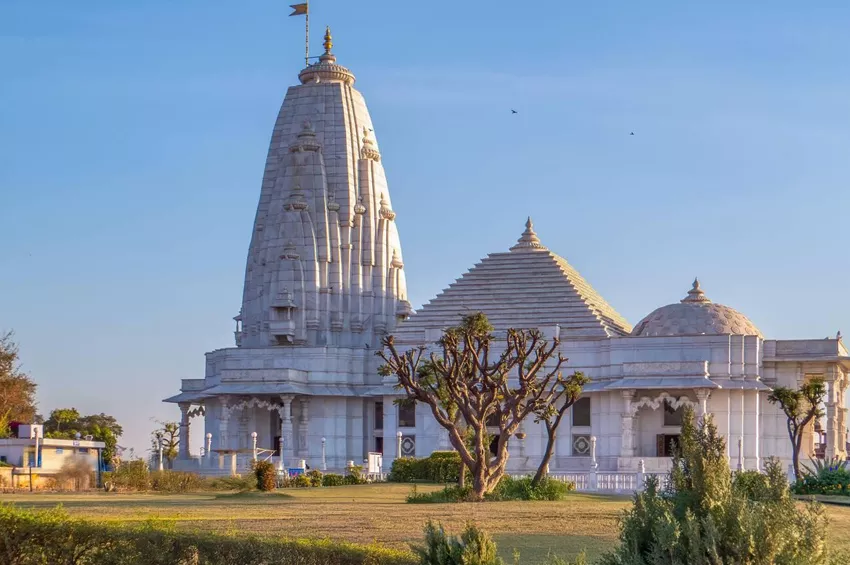
Jaipur is famous for pink sandstone, painted facades and old royal architecture. Birla Mandir breaks that pattern immediately.
It rises in white marble at the base of Moti Dungri Hill, and because it is comparatively modern, many travellers underestimate it. That is a mistake.
Rajasthan Tourism's current official page, last updated on 30 July 2026, identifies Birla Mandir as the Lakshmi-Narayan Temple, built by the Birla family in 1988. It is dedicated to Lord Vishnu—Narayan—and Goddess Lakshmi, and the tourism department describes the temple as a modern marble marvel with extensive carvings, mythological sculpture and three prominent domes.
The most practical reason to include it is timing. After Jaipur's government monuments begin closing, Birla Mandir can still fit comfortably into the late afternoon or evening. There is no complicated ticket queue, the temple is centrally located and the white marble looks its best as daylight softens.
Birla Mandir Jaipur Guide Contents
Birla Mandir Jaipur Timings: Latest Government Reference
The current Government of India Incredible India listing gives two daily visitor windows:
| Session | Current Timing |
|---|---|
| Morning Darshan | 8:00 AM–12:00 PM |
| Afternoon Closure | 12:00 PM–4:00 PM |
| Evening Darshan | 4:00 PM–8:00 PM |
Best Time to Visit
If you only have one slot, choose approximately 5:00 PM–7:30 PM. The marble is easier on the eyes than under harsh midday sun, the weather is generally more comfortable and you can stay long enough to see the temple illuminated after dark.
Birla Mandir Jaipur Entry Fee
Normal darshan is free.
| Visitor | Entry |
|---|---|
| Indian visitor | Free |
| Foreign / international visitor | Free |
| Children | Free |
| OBMS ticket | Not required |
| Donation | Voluntary |
If you encounter a paid service, ask what it covers. Donation, prasad, puja and entry are not the same thing.
Birla Mandir Jaipur History
Rajasthan Tourism states that the Birla family commissioned and built the temple in 1988. Unlike many Jaipur attractions, this is not a medieval or eighteenth-century monument.
That modern date is part of its identity. The temple shows how Jaipur continued building major religious architecture in the late twentieth century while using materials and visual references familiar from older Indian sacred architecture.
Why the Moti Dungri Location Matters
Birla Mandir sits at the base of Moti Dungri. The white marble temple and the historic hill create an interesting visual contrast: a modern religious structure below one of Jaipur's older hill landmarks.
Architecture: White Marble, Three Domes & Detailed Carving
Rajasthan Tourism describes Birla Mandir as being built entirely of white marble. It highlights intricate carvings and sculptures depicting mythological themes.
The department also says the temple has three domes, designed to pay homage to the secular character of India and symbolically represent religious harmony.
What to Look For
- white-marble exterior changing colour with the light;
- three domes above the temple;
- mythological carvings and reliefs;
- sculpted surfaces around the walls;
- colourful glass windows described by Incredible India;
- contrast between temple marble and Moti Dungri Hill;
- night illumination after sunset.
Lakshmi & Narayan: The Main Deities
The temple is dedicated to Lord Vishnu, also called Narayan, and Goddess Lakshmi, the goddess of wealth and good fortune.
Rajasthan Tourism draws particular attention to the images of Lakshmi and Narayan and says they are carved from one piece of marble.
This is a detail worth noticing slowly rather than entering, taking one photograph and leaving.
Birla Family Museum
Rajasthan Tourism confirms that the temple complex includes a museum exhibiting earlier belongings of the Birla family.
Incredible India also highlights the museum within the complex. The museum is not the main reason most people visit, but it adds context for anyone interested in the family behind the temple.
Do not assume the museum's internal operating hours always match every minute of temple darshan. If the museum matters to you, visit earlier in the session rather than arriving just before closing.
Birla Mandir Aarti: What Should You Plan For?
Private travel pages publish different aarti times. Some mention morning and evening aarti around 6 AM/6 PM, while others simply recommend sunset. The current Rajasthan Tourism and Incredible India pages we checked do not publish a fixed daily aarti clock time.
For that reason, do not build an SEO page around one unverified “official aarti time.”
Best Practical Plan
Arrive in the evening session before sunset. This gives you enough time for darshan and increases your chance of experiencing the temple's evening worship atmosphere without relying on a copied minute-by-minute timetable.
On major festivals, special pujas and aarti times can change.
Best Festivals to Experience at Birla Mandir
As a Lakshmi-Narayan temple, the complex becomes particularly meaningful around Hindu festivals associated with Vishnu, Lakshmi and the broader devotional calendar.
Festival periods can also mean:
- larger queues;
- altered darshan timings;
- special decoration;
- additional security;
- less freedom for photography;
- parking pressure.
If you are visiting specifically on Diwali, Janmashtami or another major festival, verify current temple arrangements the same day.
Dress Code, Shoes & Temple Etiquette
Dress
Wear respectful clothing. Cover shoulders and knees where possible. Traditional Indian dress is welcome but not required for ordinary darshan.
Footwear
Remove footwear where instructed before entering the sacred area.
Inside the Temple
- keep voices low;
- do not push during darshan;
- follow photography signs;
- do not block devotees while taking pictures;
- avoid food inside restricted sacred areas;
- follow staff/security instructions during festivals.
Birla Mandir Photography Guide
Best Light
Late afternoon and blue hour are the strongest times. White marble can look harsh at midday, while the softer evening sky gives more balanced photographs.
Night Photography
Rajasthan Tourism specifically notes that the temple looks spectacular at night when illuminated. If you are already visiting for evening darshan, wait long enough to see the marble after the lights come on.
Inside Photography
Do not assume photography is permitted everywhere just because exterior photography is common. Follow current signs around the sanctum and museum.
Commercial / Pre-Wedding Shoots
A normal temple visit is not permission for a commercial production. Large crews, costume changes, lights and professional setups should be cleared with temple management.
Birla Mandir for Foreign & International Tourists
Birla Mandir is one of Jaipur's easiest religious sites for international visitors because the complex is centrally located, visually accessible and does not require a separate foreigner ticket.
What matters more than ticketing is etiquette:
- remove shoes where required;
- dress modestly;
- stay quiet during worship;
- ask before photographing people closely;
- do not treat the sanctum as a photo studio;
- remember that it is first a functioning temple, second a tourist attraction.
Birla Mandir for Families & Senior Citizens
Families
The visit is compact enough for children and does not require a hill climb like Amber or Nahargarh. Keep children close during busier evening worship periods.
Senior Citizens
Birla Mandir is generally easier than Jaipur's hill forts. The main challenge can be standing during busy darshan or negotiating steps, so visit outside the busiest festival window where possible.
How to Reach Birla Mandir Jaipur
Rajasthan Tourism says the temple is located in the middle of the city and can be reached by local bus, auto-rickshaw or taxi.
From Jaipur Airport
Taxi/app cab is the easiest option. Birla Mandir fits naturally into a south/central Jaipur route with Jawahar Kala Kendra or Central Park.
From Jaipur Railway Station
Auto, taxi or app cab is straightforward. It is much closer to central Jaipur than Amber Fort.
From Hawa Mahal / City Palace
Use road transport toward Moti Dungri. This works well as a late-day stop after the old-city monuments.
Best Places to Visit Near Birla Mandir
| Place | Why Combine It |
|---|---|
| Moti Dungri | Immediate hill/temple context |
| Central Park | Green-space evening combination |
| Jawahar Kala Kendra | Modern Jaipur art and architecture |
| Albert Hall | Museum + temple contrast |
| Ram Niwas Garden | Easy central Jaipur continuation |
| Patrika Gate / Jawahar Circle | Useful if travelling toward airport side |
Best Birla Mandir Evening Itinerary
Option 1: Albert Hall → Central Park → Birla Mandir before sunset → evening darshan and illumination.
Option 2: Jawahar Kala Kendra → Birla Mandir → dinner in central Jaipur.
Airport-side route: Patrika Gate → Jawahar Circle → Birla Mandir → hotel.
12 Mistakes to Avoid
- Looking for an OBMS monument ticket.
- Calling a donation an entry fee.
- Using random 6 AM/9 PM private-site timings as the latest official schedule.
- Ignoring the current 8 AM–12 PM and 4 PM–8 PM Government of India timing.
- Visiting only at midday when the temple is closed.
- Expecting the temple to be centuries old.
- Calling it only a tourist photo stop.
- Missing the three-dome symbolism highlighted by Rajasthan Tourism.
- Skipping the museum if the Birla family's history interests you.
- Photographing inside restricted sacred areas.
- Planning commercial photography without permission.
- Leaving before evening illumination when you are already there near sunset.
Official & Reliable Sources
- Rajasthan Tourism — Birla Temple Jaipur
- Incredible India — Birla Temple Jaipur
- Rajasthan Tourism — Jaipur
Related Jaipur Guides
- Central Park & Amar Jawan Jyoti Jaipur
- Jawahar Kala Kendra Jaipur
- Ram Niwas Garden & Albert Hall Jaipur
- Patrika Gate & Jawahar Circle Jaipur
- Jaipur Complete Travel Guide
Birla Mandir Jaipur FAQs
What are Birla Mandir Jaipur timings?
The current Incredible India page lists 8:00 AM–12:00 PM and 4:00 PM–8:00 PM.
Is Birla Mandir Jaipur free?
Yes. Normal darshan is free.
Do foreign tourists pay extra?
No separate foreigner general-entry fee is required for normal darshan.
Do I need an OBMS ticket?
No. Birla Mandir is a living temple, not a standard Rajasthan Government monument ticket attraction.
Who built Birla Mandir Jaipur?
Rajasthan Tourism says the Birla family commissioned and built it in 1988.
Which deities are worshipped?
Lord Vishnu/Narayan and Goddess Lakshmi.
Where is Birla Mandir?
At the base of Moti Dungri Hill in Jaipur.
What is special about the architecture?
The temple is made of white marble, has detailed mythological carvings and three prominent domes associated with religious harmony.
Is there a museum?
Yes. Rajasthan Tourism says the complex has a museum displaying earlier Birla-family belongings.
What is the best time to visit?
Late afternoon through evening is ideal for comfortable weather, darshan and night illumination.
What time is aarti?
Private websites publish different aarti times. The current government tourism pages checked do not give one fixed official clock time, so confirm locally if aarti is your main reason for visiting.
Can I visit at 2 PM?
No, not under the current Incredible India schedule. The temple is listed as closed between 12 PM and 4 PM.
How much time do I need?
About 45–60 minutes for most visitors.
Can children visit?
Yes. It is an easy family stop compared with Jaipur's hill forts.
Is it wheelchair accessible?
Accessibility can vary across temple steps and facilities. Ask staff for the easiest current route if mobility assistance is needed.
Can I take photographs?
Exterior photography is common, but follow current signs and instructions inside the sacred areas and museum.
Is it good at night?
Yes. Rajasthan Tourism specifically highlights how striking the white-marble temple looks when illuminated.
Can I combine it with Central Park?
Yes. It is one of the easiest central Jaipur evening combinations.
Is Moti Dungri nearby?
Yes. Birla Mandir stands at the base of Moti Dungri Hill.
Is Birla Mandir worth visiting if I already saw Govind Dev Ji?
Yes. Govind Dev Ji is a historic royal Krishna temple with a jhanki-based worship rhythm; Birla Mandir is a modern Lakshmi-Narayan marble temple with a completely different architecture and atmosphere.
Final Advice
Birla Mandir is not important because it is old. It is important because it shows a different Jaipur.
Its white-marble exterior, modern 1988 construction, three domes, Lakshmi-Narayan devotion and evening lighting make it visually and spiritually distinct from the forts and palaces that dominate most itineraries.
For a first visit, use the current Government of India timing—8 AM to noon and 4 PM to 8 PM—and choose the evening session if possible. General darshan is free, there is no OBMS ticket and the museum adds another layer for travellers interested in the Birla family's history.