Indian Wedding Experience Tour in Jaipur for International Guests
The Direct Answer
Yes, international travellers can experience an Indian wedding in Jaipur, either as invited guests at a real celebration hosted by a participating family, or through a curated wedding-culture experience when no wedding matches your dates. Real weddings depend on the wedding calendar, the host family's consent and the venue, so no operator can honestly promise a specific ceremony months ahead. The safest approach is to book through an operator who explains in writing which format you are getting, what you will attend, what you will wear, what is included in the price and what happens if the wedding date changes.
Three things matter most: go as a welcomed guest (never uninvited), dress respectfully in Indian outfits, and follow the family's lead on photography, food and timing.
| Key Fact | Details |
|---|---|
| Where | Jaipur and nearby heritage venues, Rajasthan, India |
| Two formats | Attend a real wedding as an invited guest, or a curated wedding-culture experience (mehndi, outfits, dance, ceremony walk-through) |
| Typical wedding season | Roughly late autumn to early spring; exact auspicious dates change every year |
| Wedding length | Often two to three days of events; the main ceremony night can run late |
| Dress code | Colourful Indian formal wear; avoid all-white, all-black and bridal red |
| Gift custom | A cash gift in an envelope (shagun), flowers or sweets; ask the host |
| Price | Depends on format, outfits, transport, guide and number of events; ask for an itemised quote |
| Best for | Culture-focused travellers, couples, families, photographers and repeat visitors to India |
Who Is This Guide For?
Travellers: Visitors from the UK, USA, Canada, Australia, Europe and elsewhere who want to see an Indian wedding up close, plus friends and relatives invited to a wedding in Jaipur who are visiting India for the first time.
Goal: To explain what an Indian wedding experience in Jaipur really involves, how to take part respectfully, what to wear and what to ask an operator before you pay.
Note: Wedding traditions vary by religion, community and family. This guide describes common practices in Jaipur and Rajasthan; your host family's own customs always come first.
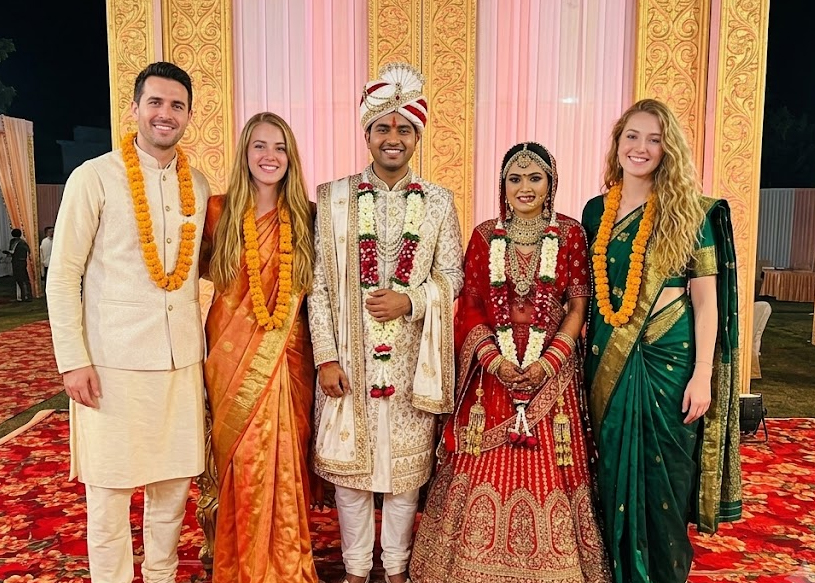
An Indian wedding is not a single event. It is a sequence of ceremonies, meals, music and family rituals that can stretch across several days, with hundreds of guests, live drummers, horses, colour, food and dancing. For many international visitors it becomes the most vivid memory of their trip to India, precisely because it is not designed as a tourist attraction. It is a family occasion, and being welcomed into it is a privilege.
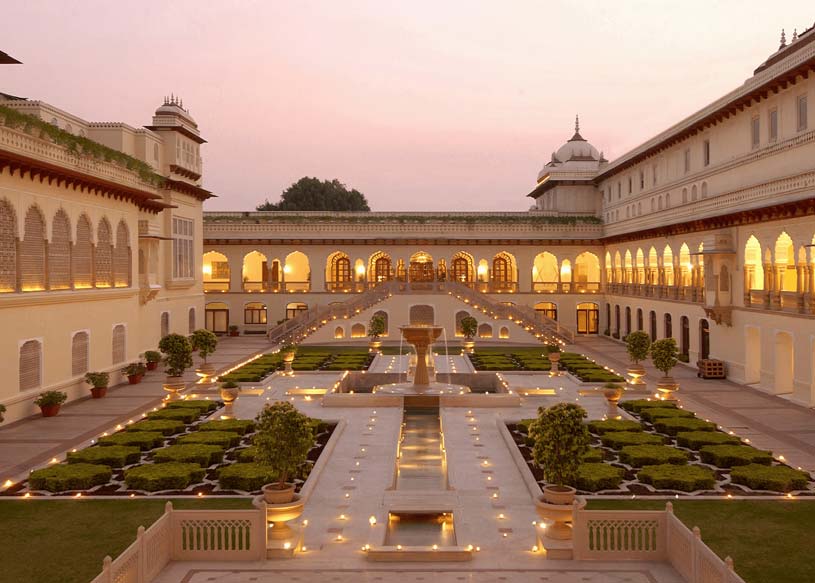
Jaipur is one of the best places in India to experience this. The city's palace hotels, fort resorts and garden venues make it a leading destination for weddings, and Rajasthani wedding customs are known for their pageantry: turbans, processions, folk music and elaborate hospitality. This guide explains how to experience one properly, from the difference between a real wedding and a curated cultural experience to dress codes, etiquette, gifts, food, safety and the questions to ask before booking.
What's in This Guide
- 1. What an Indian Wedding Experience Tour Is (and Is Not)
- 2. Real Wedding vs Curated Experience
- 3. Why Jaipur Is a Wedding Destination
- 4. Wedding Season and Auspicious Dates
- 5. Ceremonies Explained
- 6. Sample Itineraries
- 7. What to Wear
- 8. Etiquette: Dos and Don'ts
- 9. Gifts and Shagun
- 10. Food and Drink
- 11. Music and Dance
- 12. Photography and Social Media
- 13. Health, Safety and Comfort
- 14. Responsible and Ethical Participation
- 15. Pricing: What Changes the Cost
- 16. Inclusions and Exclusions
- 17. Booking Timeline, Visa and Logistics
- 18. Packing List
- Glossary of Wedding Terms
- Other Wedding Traditions in Jaipur
- 19. Common Mistakes
- 20. Questions to Ask Before Booking
- 21. Ready-to-Send Enquiry Message
- Frequently Asked Questions
- Final Advice
1. What an Indian Wedding Experience Tour Is (and Is Not)
An Indian wedding experience tour is a guided cultural experience that lets international visitors see, learn about and, where the host family agrees, take part in wedding celebrations. Your operator handles the practical side: outfits, transport, introductions, explanations and timing. The family hosting the wedding decides who is welcome, and that decision is never automatic.
It is worth being clear about what the experience is not. It is not a way to walk into a stranger's wedding uninvited. It is not a staged tourist show pretending to be real. And it is not a guarantee that a wedding will take place on your exact travel dates. A responsible operator explains all of this at the start, in plain language.
What a good experience gives you
- Context: a guide or host explains what each ritual means, so you are not just watching noise and colour.
- Preparation: help choosing and fitting outfits, learning greetings and knowing what to do when the procession arrives.
- Access: a clear, consented invitation to specific events rather than a vague promise.
- Comfort: transport, a place to sit, drinking water and someone to ask when you are unsure.
- Respect: a relationship with the family that leaves both sides happy, not exploited.
2. Real Wedding vs Curated Experience: Choose the Right Format
Two formats are common. Understanding the difference before you book avoids disappointment and helps you compare quotes honestly.
| Format | What You Do | Strength | Limitation |
|---|---|---|---|
| Attend a real wedding as an invited guest | Join one or more events (mehndi, sangeet, baraat, ceremony, dinner) hosted by a participating family | Authentic, spontaneous and emotionally memorable | Depends on the wedding calendar, host consent and family plans; schedules can shift at short notice |
| Curated wedding-culture experience | Try mehndi, saree or turban dressing, a dance lesson and a guided walk-through of ceremonies | Available year-round; predictable timing; easy to fit into a day | Explains a wedding rather than being one; less spontaneous |
| Combination | A curated preparation day followed by a real event when a family and date are available | You arrive informed and confident | Needs more days and careful scheduling |
A useful test of an operator's honesty: ask, "If no wedding is available on my dates, what exactly will I get instead, and what will I pay?" A clear answer suggests a well-run service. A vague answer suggests you may be sold a promise that cannot be kept.
3. Why Jaipur Is a Popular Wedding Destination
Jaipur has become one of India's best-known cities for weddings for good reasons. The old capital of the Kachwaha Rajput dynasty offers palace hotels, fort resorts, havelis, lakeside gardens and open lawns that suit large gatherings. Many families from other Indian cities and from abroad choose Jaipur as a destination wedding location because of that setting, and because Rajasthani hospitality and cuisine are part of the appeal.
For a visitor, the setting adds to the experience. You may find yourself in a courtyard lit by lamps under an arched gateway, watching a groom arrive on a decorated horse to the beat of a dhol, with the pink-toned walls of the old city or the outline of a hill fort behind. Rajasthani touches such as colourful turbans, folk musicians and Rajasthani thali dinners are often part of the celebration.
Jaipur is also easy to combine with sightseeing. Amber Fort, City Palace, Jantar Mantar and Hawa Mahal are within a short drive of most wedding venues, so a wedding experience fits naturally around a broader trip. See our Jaipur full-day sightseeing tour for the classic city route.
4. Wedding Season and Auspicious Dates
Hindu weddings are traditionally scheduled on auspicious dates (muhurat) chosen by family priests using the Hindu almanac, the panchang. Because the panchang follows the lunar calendar, the exact dates change every year. That is why an operator cannot give you a fixed "wedding date" a year in advance, and why your travel dates matter so much.
General seasonal pattern
- Main season: roughly from late autumn through winter and into early spring. The period after the monsoon-season fast period known as Chaturmas, which ends with the festival of Dev Uthani Ekadashi, is widely regarded as the start of the wedding season.
- Quieter periods: Chaturmas itself (roughly July to early November) and the short inauspicious windows known as Kharmas, which fall around mid-December to mid-January and mid-March to mid-April, are generally avoided by many Hindu families for weddings.
- Summer: April to June can be very hot in Jaipur. Some weddings still take place, often with events moved to the evening and night.
- Other communities: Muslim, Jain, Sikh and Christian weddings follow their own calendars and traditions, so dates may differ.
Treat this as a general guide, not a calendar. Ask your operator which wedding dates are actually confirmed for your travel window, and remember that even confirmed dates can move if the family changes plans. If your dates are flexible, shifting your trip by a few days can make the difference between a real wedding and a curated experience.
Weather and comfort by season
Winter weddings in Jaipur are comfortable in daytime but can be cold late at night, especially at open-air ceremonies. A shawl or jacket that matches your outfit is useful. Summer events are hot, so lightweight fabrics and plenty of water matter. Monsoon weather can bring rain to outdoor venues, though good families plan covered alternatives.
5. Ceremonies Explained: What You Will See
Understanding the sequence helps you enjoy it. Not every wedding includes every event, and names and details vary by family and community. The table gives a general outline of a Hindu wedding in Rajasthan.
| Event | What It Is | What You Will See |
|---|---|---|
| Roka / engagement | An early ceremony formalising the match | Family exchange of gifts and blessings; usually smaller and earlier than the wedding |
| Haldi (pithi) | Turmeric paste applied to the bride and groom for blessing and glow | Yellow outfits, laughter, playful smearing of turmeric, songs |
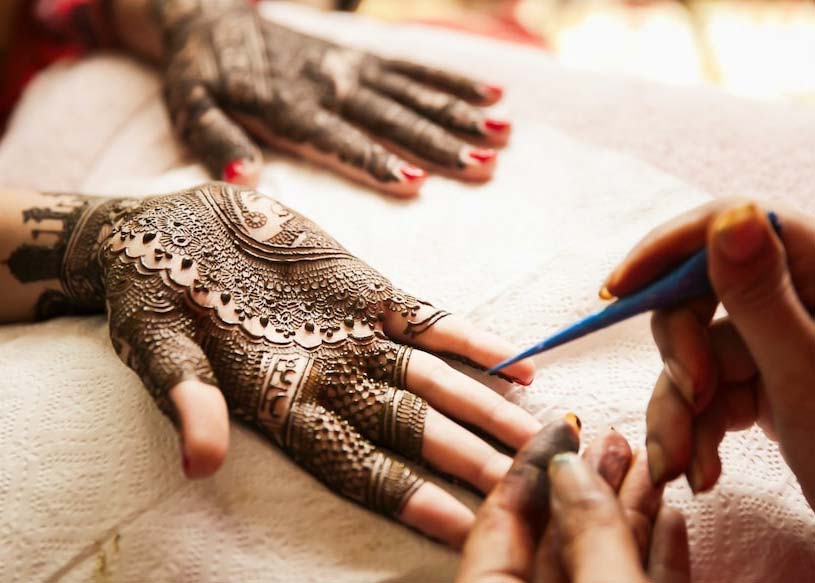
| Mehndi | Henna designs applied to the bride's hands and feet, often to guests too | Women's gathering with music; artists apply intricate patterns |
| Sangeet | An evening of music, dance and performances by both families | Choreographed dances, singing, speeches, dinner |
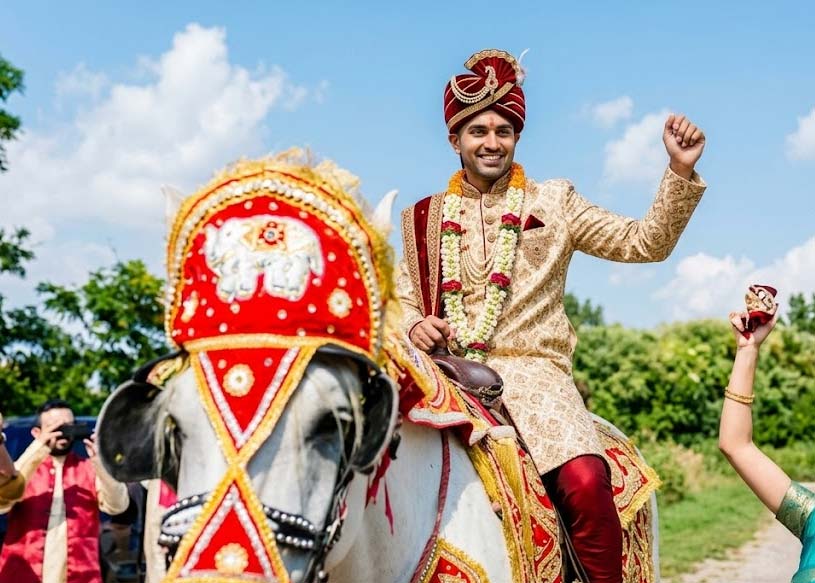
| Ghudchadi and baraat | The groom is seated on a decorated horse and leads a procession to the venue | Drummers, brass band, dancing relatives, the groom in a sherwani and turban |
| Milni | The two families formally greet each other at the venue entrance | Garlands, exchange of greetings between counterparts |
| Jaimala (varmala) | The couple exchange flower garlands | Photographs, friendly lifting of the bride or groom by relatives |
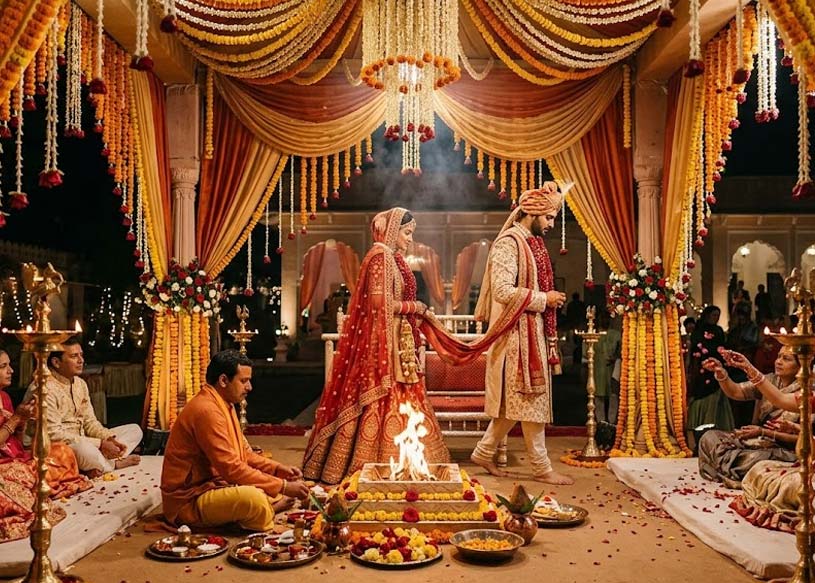
| Pheras | The couple circle the sacred fire, taking vows, with a priest chanting | Fire at the centre of the mandap, chanting, family members close by |
| Sindoor and mangalsutra | Marks of marriage applied to the bride | A quiet, emotional moment in the main ceremony |
| Vidaai | The bride's farewell as she leaves her parental home | Often tearful; rice or petals thrown; family embraces |
| Reception | A celebration dinner, sometimes on a separate day | Stage greetings with the couple, buffet dinner, music |
Mehndi and haldi
Mehndi is often the easiest and most welcoming entry point for international guests. Henna artists work on the bride first and then on relatives and friends, and guests are frequently invited to have a small design applied. The paste takes time to dry and must be kept on for several hours, so plan your evening around it and avoid rubbing it off. Haldi is playful and messy. If you are invited, wear something you do not mind staining yellow, and expect to be touched with turmeric on the cheek or forehead as a sign of blessing.
Sangeet
Sangeet is an evening of music and dance, usually held before the wedding day. Both families perform, often with rehearsed group dances to Hindi film songs. Guests are welcome to join in on the dance floor, and international guests are often cheerfully pulled up to dance. You do not need to know the steps; enthusiasm matters more than technique.
Baraat, milni and jaimala
The baraat is the groom's wedding procession. In Rajasthan the groom is often seated on a decorated mare (ghudchadi) and led towards the venue by dhol drummers, a brass band and dancing relatives. Guests from the groom's side often dance in the street. At the venue entrance, the two families greet each other in a ceremony called milni, and the couple then exchange garlands in the jaimala. It is loud, bright and full of photographs, and it is usually the point where visitors feel the whole atmosphere arrive at once.
The main ceremony: pheras and vows
The central Hindu ceremony takes place under a canopy called the mandap, around a sacred fire. A priest chants Sanskrit verses, the couple's garments are tied together and they walk around the fire, taking vows with each round. Seating at this stage is limited and usually reserved for close family. International guests are often placed to one side or invited to watch from a respectful distance. Be quiet, keep your phone away unless the family says it is fine, and do not step into the ritual space.
The ceremony often takes place late at night or in the early hours, following the muhurat set by the priest. If you are an early sleeper, tell your host at the start; many guests attend the earlier events and leave before the pheras, and that is generally understood.
6. Sample Itineraries
Every experience is different, so treat these as examples of how a day can be structured, not fixed programmes. Real events follow the family's schedule, so timings can move.
Option A: Half-day curated wedding-culture experience
- Morning or afternoon: Meet your host or guide in Jaipur and visit a bazaar or boutique to choose outfits.
- Mid-session: Have mehndi applied by a henna artist and learn what the patterns mean.
- Later: Try saree draping or turban tying, then a short guided walk-through of the ceremonies with a simple dance lesson.
- End: Photographs in your outfits and a Rajasthani snack or tea.
This format works year-round and suits travellers with a tight schedule or no wedding on their dates.
Option B: One-day real wedding evening
- Afternoon: Outfit preparation and a briefing on greetings, seating and etiquette.
- Early evening: Arrive with your host for the baraat and join the procession if invited.
- Night: Milni, jaimala, dinner and, if you wish to stay, the start of the main ceremony.
- Late night: Private transfer back to your hotel.
Option C: Two-day wedding experience
- Day one, daytime: Outfit shopping and fitting, then mehndi or haldi with the family.
- Day one, evening: Sangeet with music, dance and dinner.
- Day two, daytime: Rest, sightseeing or preparation for the wedding evening.
- Day two, evening: Turban tying, baraat, jaimala, dinner and the main ceremony for as long as you choose to stay.
Whichever option you choose, build in rest. A wedding day can run from afternoon to after midnight, and jet lag, heat and unfamiliar food add to the effort. Do not schedule a very early sightseeing start the following morning.
7. What to Wear to an Indian Wedding in Jaipur
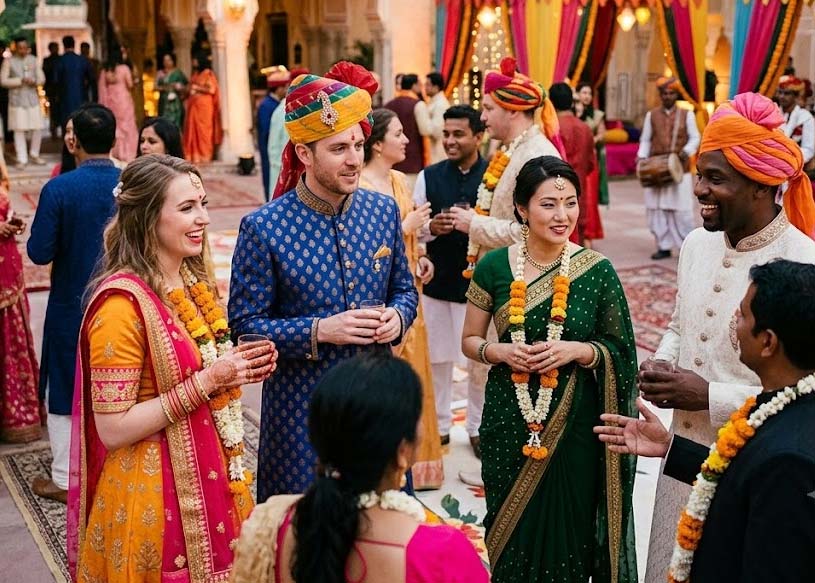
Wearing Indian outfits is one of the most enjoyable parts of the experience, and it is also a sign of respect. Guests in local dress are warmly appreciated and photographed more than any other visitors.
For women
- Saree: elegant and traditional; ask an expert to drape it, as pleating is tricky for beginners.
- Lehenga: a long embroidered skirt with a blouse and scarf (dupatta), suited to sangeet and wedding events.
- Anarkali or salwar suit: a comfortable long tunic set that is easier to move in, especially for dancing.
- Jewellery: bangles, earrings and a small bindi add polish; avoid overloading with valuables.
For men
- Sherwani or bandhgala: a long formal coat, suited to the main ceremony.
- Kurta with churidar or trousers: a lighter, more comfortable option for mehndi and sangeet.
- Turban (safa): a Rajasthani turban tied by an expert is a highlight for many male guests; ask your host whether it is offered.
Colours and cautions
- Choose bright, celebratory colours such as pink, orange, green, blue, gold and jewel tones.
- Avoid all-white and all-black outfits, which many Indian communities associate with mourning or ill omen at weddings.
- Avoid bridal red, which is generally reserved for the bride, and avoid outshining the couple.
- Cover shoulders and knees in temple or ceremony spaces, and keep necklines and hemlines modest.
- Wear comfortable shoes you can slip off easily, since footwear is removed near sacred spaces and the mandap.
Buying or renting in Jaipur
Jaipur's old-city bazaars, including Johari Bazaar and Bapu Bazaar, are well known for textiles, jewellery and ready-to-wear outfits. Guests can buy, rent or borrow outfits, and tailors can adjust fit, though quick alterations depend on the tailor's workload, so ask early rather than on the wedding day. If you prefer not to shop, your operator can arrange outfits in advance. See our guide on how to avoid unplanned shopping stops if you want to decide your own shopping time.
8. Etiquette: Dos and Don'ts for International Guests
Indian families are generally generous and forgiving with visitors, but a few habits make you a better guest.
Do
- Greet with a namaste. Palms together and a small nod is a warm greeting, and it is appreciated even if you are still learning.
- Arrive with your host. Enter with the person who invited you and introduce yourself to the family.
- Accept hospitality politely. Refusing food or a drink too firmly can seem rude; take a small portion and say thank you.
- Use your right hand to give, receive and eat, which is the customary hand in India.
- Remove shoes when entering the mandap area or any space where others do so.
- Follow the family's lead on when to stand, sit, dance or leave.
- Join in. Dancing, clapping and tasting food are welcomed and usually the point of your invitation.
Don't
- Don't arrive uninvited or bring extra people without asking the host.
- Don't step into or across the sacred fire area or interrupt the priest.
- Don't point your feet at the couple, the fire or elders, and do not touch someone's head.
- Don't upstage the couple with a very expensive or attention-seeking outfit.
- Don't drink to excess. Alcohol rules vary widely by family and venue; ask beforehand.
- Don't leave abruptly without thanking the host, if you can.
Time is relaxed at Indian weddings. Events often begin later than the printed invitation, and the baraat may arrive an hour or more after the planned time. Bring patience, and a phone charger.
9. Gifts and Shagun: What to Give
Gifting is a normal part of attending an Indian wedding, though there is no fixed rule for international guests. The most common gift is money in an envelope, called shagun, given as a blessing to the couple. Many families prefer amounts that end in the digit one (for example, 101 or 501 rupees) because it is considered auspicious; the amount depends on your relationship to the family and your comfort level.
Practical guidance for visiting guests:
- Ask your host what is appropriate. Your operator or the family will usually tell you if you are unsure.
- A cash envelope, a box of good sweets or a bouquet of flowers is generally welcome.
- If you bring a gift from your home country, keep it thoughtful rather than expensive, and consider something that reflects your culture.
- Present gifts with your right hand or both hands, and do not expect them to be opened in front of you; this is normal.
- Avoid gifts that could be inappropriate for the family, such as leather goods for some communities, or alcohol unless you know it is welcome.
If you are attending as part of a paid experience, ask whether a gift is expected or included, so that you do not double-pay or offend anyone by giving nothing at all.
10. Food and Drink at a Jaipur Wedding
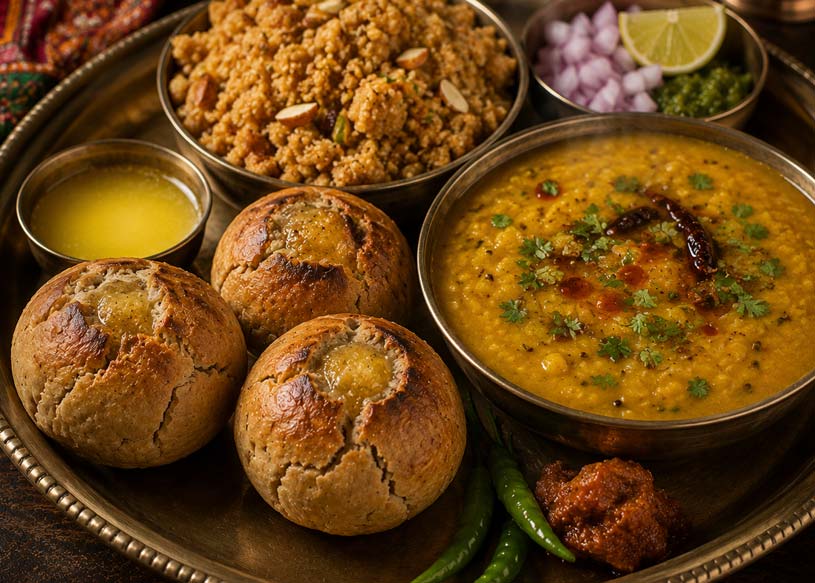
Food is a major part of the celebration, and hosts are proud of it. Wedding meals in Rajasthan are often served as a large buffet, with live counters for hot snacks and freshly made breads, followed by desserts.
| Food | What It Is | Note for Guests |
|---|---|---|
| Dal baati churma | Baked wheat rolls with lentils and a sweet crumbled dessert | Rich and filling; take a small portion first |
| Gatte ki sabzi | Gram-flour dumplings in spiced gravy | A common vegetarian main dish |
| Chaat and live counters | Crisp, tangy street-style snacks made to order | Delicious but can be spicy; ask for mild if needed |
| Paneer and vegetable dishes | Cottage-cheese and vegetable curries | Most weddings offer plenty of vegetarian choice |
| Ghewar, jalebi, kulfi | Rajasthani and North Indian sweets | Very sweet; share with others |
Dietary needs
Many Rajasthani wedding menus are vegetarian, and some Jain families avoid onion and garlic entirely. If you are vegetarian, vegan, gluten-free or have allergies, tell your operator well in advance so they can check with the family and caterer. Do not assume that staff will know about allergies; ask about ingredients directly, and carry any medication you need.
Water and street-food caution
Stick to bottled or filtered water, and be cautious with raw salads and ice if your stomach is sensitive. Wedding caterers generally cook for large numbers and are careful about hygiene, but a change of diet can upset visitors anyway. Pace yourself across a long event.
Alcohol
Whether alcohol is served depends on the family, community and venue. Some weddings have full bars; others are entirely dry. Follow the host's lead, and if in doubt, ask your operator rather than assuming.
11. Music and Dance
Music defines the mood of an Indian wedding. The dhol, a two-headed drum, sets the rhythm of the baraat, and a brass band plays popular film songs. Rajasthani folk musicians sometimes perform at the venue. At sangeet and reception events a DJ often plays Hindi film hits and Punjabi dance music.
Guests are invited to dance, and you do not need to be good. A few simple moves are all you need: raise your arms, clap on the beat and follow the person next to you. Rajasthani folk dance such as ghoomar, a graceful spinning dance traditionally performed by women, may be shown at some events, and hosts sometimes teach visitors a few steps. Bring comfortable shoes for the dance floor and a positive attitude.
12. Photography, Video and Social Media
Photography is welcome at most wedding events, but it is a private family occasion, so ask before you photograph individuals, especially older relatives and the bride. Some families hire professional photographers and prefer that guests avoid blocking the view or using flash during ceremonies.
- Main ceremony: photography may be restricted; ask the family or priest before taking pictures.
- Drones and tripods: get explicit permission first; venues often have rules.
- Social media: do not post pictures of the couple or family without their consent, and be sensitive about tagging and location details.
- Professional shoots: if you want a portrait session in your outfit, ask your operator whether one can be arranged separately from the wedding itself.
Enjoy the moment. Some of the best memories come from putting the phone away and joining the dance.
13. Health, Safety and Comfort
Long, crowded, late-night events call for basic preparation.
- Sleep and jet lag: avoid arriving in India on the day of a wedding event if possible.
- Heat and hydration: carry water in summer and take breaks from the sun during daytime rituals.
- Crowds and noise: processions can be loud, so consider ear protection if you are sensitive, and stay with your host or guide.
- Valuables: keep your passport, cash and phone secure, and avoid wearing expensive jewellery you cannot replace.
- Transport: arrange a return ride in advance, since late-night transport can be hard to find; a private driver removes that worry.
- Accessibility: tell your operator about mobility needs, since venues may involve steps, lawns and long walking distances.
- Insurance: carry travel insurance covering medical care and cancellation.
14. Responsible and Ethical Participation
A wedding is one of the most personal events in a family's life, so responsible tourism principles matter more here than almost anywhere else.
- Consent first. The host family should know you are coming and agree to it. A good operator can tell you how that agreement was made.
- Transparency about money. Ask whether the host family is compensated, how the arrangement works and what your fee covers, so that the experience is fair to everyone.
- Respect for privacy. Follow the family's rules on photography, posting online and access to private events.
- Animal welfare. Weddings sometimes use horses, and occasionally other animals, in processions. Ask how animals are treated, and do not encourage practices that appear stressful or unsafe.
- Cultural humility. Ask questions, listen and accept that customs differ. You are a guest, not an audience.
- No exploitation. Avoid any operator who treats a family's celebration as a product or pressures the family to perform for tourists.
15. Pricing: What Changes the Cost
Prices vary a great deal between operators and formats, and no single figure is reliable. Rather than quote an average that may not match your situation, it is more useful to understand what drives the cost so you can compare quotes properly.
| Factor | Why It Matters |
|---|---|
| Format | A curated half-day costs differently from a real multi-day wedding experience |
| Number of events | Each additional event adds time, transport and preparation |
| Outfits | Renting, buying or tailoring adds cost; quality varies widely |
| Group size | Per-person cost often falls as the group grows, but hosts may limit numbers |
| Guide and hosting | A dedicated English-speaking guide or host adds to the price but improves the experience |
| Transport | Private car or tempo traveller for late-night returns and multiple venues |
| Season and date | Peak wedding dates increase demand for outfits, artists and vehicles |
| Extras | Henna artists, turban experts, photographers and meals may be separate |
Ask for a written, itemised quote that shows what is included, what is extra and how many events you will attend. Compare like with like: a low price that covers only one event is not a bargain compared with a higher price covering three. Our guide to what a private driver quote includes explains how to read transport line items.
16. Inclusions and Exclusions to Confirm
Every operator packages this differently, so treat the lists below as a checklist rather than a promise. Confirm each item in writing.
Often included
- A briefing on etiquette, greetings and the event schedule.
- Help choosing or fitting outfits, and turban tying or saree draping where offered.
- A guide or host to accompany you and explain rituals.
- Transport to and from the venue with a private car and driver.
- Mehndi or a similar cultural activity in the curated format.
Often extra
- Hotel accommodation and other meals.
- Outfit purchases beyond what is included, and jewellery.
- Gifts or shagun for the couple.
- Professional photography or video.
- Monument tickets if you add sightseeing.
- Tips and personal expenses.
- Travel insurance and visa fees.
17. Booking Timeline, Visa and Logistics
How far ahead to book
Book as early as your plans allow, especially if you want to travel in the main wedding season. Outfits, henna artists, drivers and hotels are in higher demand on popular dates, and a real wedding experience needs time to confirm with a host family. Last-minute options usually mean the curated format rather than a real wedding.
Visa and entry
Most international visitors need a visa for India, and the type and rules can change. Check the official Indian visa website for current requirements, processing times and permitted activities before you book flights. Attending a wedding as a guest is a normal tourism activity, but confirm your visa category with official sources rather than relying on any operator's summary. The official portal is indianvisaonline.gov.in.
Where to stay
Choose a hotel in or near central Jaipur, so late-night returns are short. If the wedding is held at a resort outside the city, ask whether rooms are available at the venue or nearby. Check whether your hotel allows early arrival for dressing and storing outfits.
Combining a wedding with a wider trip
A wedding pairs well with sightseeing. Consider a Jaipur tuk-tuk day tour before the event for a relaxed look at the old city, or plan a longer route across Rajasthan afterwards. Leave a rest day after a late wedding night.
18. Packing List for a Jaipur Wedding Experience
- Two or three celebration outfits, or arrange rentals in advance.
- Comfortable, slip-on shoes and a spare pair for dancing.
- A shawl or light jacket for winter nights, and sun protection for summer days.
- A small bag with tissues, hand sanitiser, water and basic medication.
- A portable charger, since long events drain phones quickly.
- An envelope and small gift for the hosts, if you plan to give one.
- A photocopy of your passport and hotel details, with valuables left safely at the hotel.
- Ear plugs if you are sensitive to loud drums and speakers.
Glossary of Indian Wedding Terms
Hearing unfamiliar words all evening is part of the fun, but a short glossary helps you follow what is happening and join the conversation.
| Term | Meaning |
|---|---|
| Baraat | The groom's wedding procession, with music and dancing |
| Mandap | The decorated canopy where the main ceremony is held |
| Pheras | The rounds the couple take around the sacred fire |
| Jaimala or varmala | The garlands exchanged by the couple |
| Milni | The formal greeting between the two families |
| Shagun | A blessing, often given as a gift of money in an envelope |
| Sehra and safa | The groom's headwear: a floral veil and a turban |
| Dupatta | The long scarf worn with a lehenga or salwar suit |
| Muhurat | An auspicious time chosen for the ceremony by a priest |
| Vidaai | The bride's emotional farewell from her family home |
| Panchang | The Hindu almanac used to select auspicious dates |
| Dhol | The large double-headed drum that drives the baraat |
Other Wedding Traditions You May Encounter in Jaipur
Jaipur is home to many communities, and each has its own wedding customs. If you attend a wedding that is not a typical Hindu Rajasthani one, the structure will differ, though the spirit of hospitality is similar.
- Marwari and Rajput weddings: Known for grand processions, colourful turbans, family blessings and lavish hospitality. Rajput weddings often stress ceremony and royal-style pageantry.
- Jain weddings: Often follow strict vegetarian food rules, commonly avoiding onion and garlic, and include Jain rituals and prayers alongside familiar celebrations.
- Sikh weddings: Usually held in a gurdwara in the morning, where the couple walk around the holy book, with a shared meal (langar) afterwards. Head covering and removing shoes are expected.
- Muslim weddings: The nikah is the formal marriage contract, followed by a feast and a reception. Mehndi and music events may be part of the celebration, though customs differ between families.
- Christian weddings: Usually a church ceremony with a reception, often blending Indian and Western customs.
Ask your operator which tradition your event follows so you can dress and behave appropriately, and be ready for differences in timing, food rules and dress. If you are unsure about a custom, watch what the family does and follow their example.
A sample wedding-day timeline for a guest
Wedding timelines shift, but a typical evening for an invited international guest might look like this. Late afternoon: dress with help from your host, have a light snack and drink water. Early evening: travel to the venue, join the family and greet your hosts. Evening: the baraat arrives with music and dancing, followed by milni and jaimala. Night: dinner is served, often in a large buffet, and guests greet the couple on stage. Late night: the main ceremony begins at the auspicious time, and you may stay for part of it or return to your hotel, depending on your energy. Whatever you choose, tell your driver in advance so the ride home is ready.
19. Common Mistakes to Avoid
- Assuming a wedding is guaranteed. Dates and families can change. Ask what the fallback is.
- Wearing white, black or bridal red. Choose bright colours instead.
- Arriving without an invitation or bringing extra guests. Always ask your host first.
- Overpacking the day. A late wedding night followed by an early tour leads to exhaustion.
- Ignoring photography rules. Ask before posting or using a drone.
- Not tasting the food. Refusing everything can offend; try small portions.
- Leaving without saying thank you. A short farewell and thanks go a long way.
- Booking on price alone. The cheapest quote may not include outfits, transport or a guide.
- Leaving outfits to the last minute. Tailoring takes time, so plan early.
- Forgetting travel logistics. Confirm your late-night ride back before you leave the hotel.
20. Questions to Ask Before Booking
Copy this list and ask for written answers.
- Is this a real wedding, a curated experience, or a combination?
- What happens if no wedding is available on my dates?
- How do you confirm the host family's consent?
- Which events will I attend, and how long is each?
- What will I wear, and who provides and fits the outfits?
- Is a guide included, and do they speak English?
- How many other guests will be in the group?
- Is transport included, including the late-night return?
- Are meals included, and can you cater to my dietary needs?
- What are the photography rules?
- Is a gift expected, and is any amount included?
- What is included in the price, and what is extra?
- What is your cancellation and date-change policy?
- What deposit is required, and is it refundable?
- How are animals treated in the procession?
- What accessibility options are available?
- Who is my contact on the day if something changes?
- Can you send a written itinerary before I pay?
21. Ready-to-Send Enquiry Message
Copy the template, fill in your details and send it to your shortlisted operators. You can also contact Rajasthan Tour Trip directly.
Subject: Enquiry - Indian wedding experience in Jaipur - [Your Name]

Dear Team,

We would like to experience an Indian wedding in Jaipur. Please send a written, itemised proposal.

Travel dates: [Start] to [End]
Number of adults: [Number]
Number of children (with ages): [Number]
Preferred format: [Real wedding / Curated experience / Combination]
Events of interest: [Mehndi / Haldi / Sangeet / Baraat / Ceremony / Reception]
Dietary needs or allergies: [Details]
Accessibility needs: [Details]
Hotel: [Booked / To be confirmed]

Please confirm in writing:
  1. Is a real wedding confirmed for our dates, or is this a curated experience?
  2. How is the host family's consent arranged?
  3. What outfits are included and who fits them?
  4. Is a guide and private transport included, including the late-night return?
  5. What is included in the price, and what is extra?
  6. What are the cancellation and date-change terms?

Thank you.
Frequently Asked Questions
Can tourists attend an Indian wedding in Jaipur?
Yes, if the host family invites them. International visitors can attend a real wedding as invited guests through a participating family, or join a curated wedding-culture experience. Attending uninvited is not appropriate, and availability depends on the wedding calendar and the family's consent.
Is it appropriate for foreigners to attend an Indian wedding?
Yes. Indian families are generally proud to welcome international guests, and many find it a compliment. The key is to be invited, dress respectfully, follow the family's lead and ask before photographing people.
How much does an Indian wedding experience in Jaipur cost?
It varies by format, number of events, outfits, guide, transport and season, so no single figure is reliable. Ask for a written, itemised quote and compare what is included, such as outfits, transport, guide and events attended.
What should I wear to an Indian wedding in Jaipur?
Wear bright, celebratory Indian formal wear such as a saree, lehenga, anarkali, sherwani or kurta. Avoid all-white, all-black and bridal red, cover shoulders and knees, and wear comfortable shoes that are easy to remove.
Can I wear white or black to an Indian wedding?
It is best not to. Many Indian communities associate white with mourning and black with ill omen at weddings. Choose bright colours such as pink, orange, green, blue or gold instead.
Do I need to bring a gift to an Indian wedding?
A gift is customary but not compulsory for visitors. A cash envelope (shagun), sweets or flowers are common. Ask your host what is appropriate, and check whether a gift is already included in any paid experience.
How long does an Indian wedding last?
Celebrations often run for two to three days, with separate events such as mehndi, haldi, sangeet, the baraat and the main ceremony. The main ceremony night can continue late, sometimes after midnight, depending on the auspicious time.
When is the wedding season in Jaipur?
The main season runs roughly from late autumn to early spring, after the Chaturmas period ends. Exact auspicious dates change every year, and some periods such as Kharmas are generally avoided by many Hindu families.
Can I be sure a real wedding will happen on my travel dates?
No operator can honestly guarantee that months in advance. Wedding dates depend on the family and the auspicious calendar. Ask what the fallback is, such as a curated wedding-culture experience, and get it in writing.
What is a baraat?
The baraat is the groom's wedding procession. The groom, often on a decorated horse, is led to the venue by drummers, a band and dancing relatives. It is usually one of the most energetic and photogenic parts of the wedding.
What is mehndi, and can guests have it done?
Mehndi is henna applied in intricate designs, especially on the bride's hands and feet. Guests are often invited to have a small design applied by a henna artist. The paste needs several hours to dry, so plan accordingly.
Will I be expected to dance?
You will likely be invited to, but you are never obliged. Sangeet and baraat events are lively and welcoming, and enthusiasm matters more than skill. You can always watch and clap instead.
Is the food vegetarian at Rajasthani weddings?
Many Rajasthani wedding menus are largely or entirely vegetarian, and some Jain families avoid onion and garlic. Tell your operator about dietary needs and allergies well in advance so they can check with the family and caterer.
Is alcohol served at Indian weddings?
It depends on the family, community and venue. Some weddings have bars and others are dry. Ask your operator beforehand, and follow the host's lead rather than assuming.
Can I take photos and videos at the wedding?
Usually yes at most events, but ask before photographing individuals and check the rules for the main ceremony. Get permission before using drones or tripods, and do not post pictures of the family online without consent.
Do I need a visa to attend a wedding in India?
Most international visitors need a visa for India, and the rules can change. Check the official Indian visa website for current requirements and permitted activities, and confirm your category before you book flights.
How far in advance should I book?
Book as early as your plans allow, especially in the main wedding season, when outfits, artists, drivers and hotels are in high demand. A real wedding experience needs time to confirm with a host family.
Is a guide included in a wedding experience tour?
It depends on the operator and package. A guide who explains the rituals greatly improves the experience, so ask whether one is included, whether they speak English and whether they stay with you throughout.
Is it safe for solo female travellers to attend an Indian wedding?
Weddings hosted by welcoming families are generally friendly settings, but sensible precautions still apply. Go with your host or guide, arrange a reliable late-night ride, keep valuables secure and tell someone your plans.
Can children attend Indian wedding events?
Yes. Children are welcome at most events and often enjoy the music and dancing. Plan for late nights, noise and heat, bring snacks and a quiet break option, and tell your operator about any dietary or safety needs.
What happens if the wedding date or plans change?
Dates can shift at short notice. Ask your operator about their date-change and cancellation policy before paying, and what alternative experience they can offer if the original wedding is not available.
Can I combine a wedding experience with sightseeing in Jaipur?
Yes. Amber Fort, City Palace, Jantar Mantar and Hawa Mahal are within a short drive of most venues. Many guests do sightseeing by day and attend wedding events in the evening, with a rest day after a late night.
Final Advice
The best Indian wedding experiences share the same qualities: a family that genuinely welcomes you, an operator who is honest about what can and cannot be promised, and a guest who arrives curious, well dressed and relaxed about timing. Ask for written details, dress in colour, ask before photographing and let the family lead. If you do these things, you are likely to be welcomed with extraordinary warmth.
If you would like help planning, share your travel dates and interests with our Jaipur-based team. We can explain which format suits your dates, what is confirmed and what depends on the host family, and put it all in writing before you pay. You can also explore our Rajasthan tour packages to build the wedding into a longer trip.
Editorial Note and Sources
This guide gives general information about common Hindu and Rajasthani wedding customs and practical advice for visitors. Customs differ between families, religions and communities, and auspicious dates change every year, so treat dates and details as a planning guide and confirm specifics with your host and operator. Visa rules and entry requirements change; check official sources before you travel.
- Rajasthan Tourism for official destination information.
- Incredible India for national travel information.
- Indian Visa Online for current visa requirements.