Rajasthan for Senior Citizens: Comfortable Itinerary, Transport & Travel Tips
Quick Answer
Rajasthan suits senior citizens very well when the trip is slow, car-based and built around comfort rather than a checklist of forts. Travel between October and March. Keep drives to 4–5 hours. Stay two nights in each city. Choose hotels with a lift and ground-floor options. Book an Innova Crysta or Ertiga with an experienced driver. Skip steep climbs, and see the big monuments in the cool of the morning. A relaxed 8-day route (Jaipur, Pushkar, Jodhpur, Udaipur) is the easiest first plan. Carry medicines, a doctor's note and insurance, and save 112, 108 and 14567.
Key Facts at a Glance
- Best season: October to March
- Ideal trip length: 8–10 days
- Maximum comfortable drive: 4–5 hours a day
- Best vehicle: Innova Crysta, Ertiga or Tempo Traveller for larger families
- Easiest cities: Udaipur, Jaipur, Pushkar
- Helplines: 112 (emergency), 108 (ambulance), 14567 (Elderline)
Every family has the same quiet conversation. Papa wants to see the palaces, Mummy would like some temples, the kids worry about the heat, the stairs and what happens if blood pressure misbehaves on a highway. Somebody says, "Maybe next year."
Don't wait for next year. Rajasthan was built for kings who liked their comforts, and a good tour can be built for grandparents who like theirs. What matters is how you plan: fewer places, longer rests, a car that is easy to enter and a hotel where the lift works. This guide lays that out step by step.
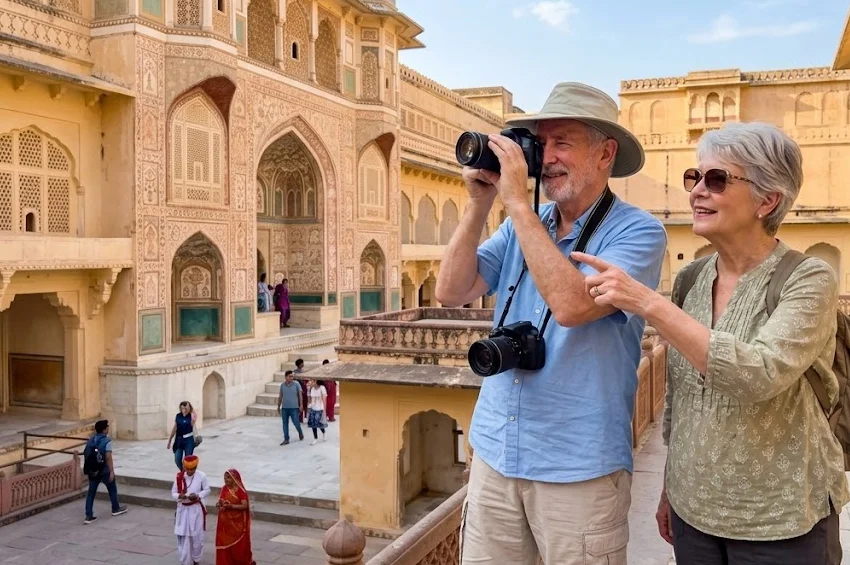
What's in This Guide
- Why Rajasthan works for seniors
- Six principles of a senior-friendly trip
- Best season and month-by-month view
- 8-day relaxed itinerary
- City-by-city comfort guide
- Forts and palaces: easy vs hard
- Transport: car, train, flight
- Hotels and what to check
- Health and medicine checklist
- Food, water and diet
- Temples and pilgrimage trips
- Packing list
- Emergency numbers and insurance
- A senior-friendly day, hour by hour
- Mobility and wheelchair guide
- Jaipur for seniors
- Udaipur for seniors
- Jodhpur and Pushkar for seniors
- Multi-generation family trips
- What to tell your driver
- Common worries answered
- If someone falls ill
- Extended 10-day itinerary
- Booking tips
- Cost guide
- Frequently asked questions
Why Rajasthan Works for Senior Citizens
Three reasons. First, distances are manageable and highways between major cities are good. Second, heritage hotels offer large rooms, courtyards, attentive staff and quiet. Third, so much of Rajasthan can be enjoyed seated: palace courtyards, lake views, folk music at dinner, a rooftop thali. You do not need to run up a hill to feel you have seen the state.
The caveats are real too: heat in summer, steps in old forts, crowds at popular temples and long days if you try to fit too much. Almost all of those are solved by planning, not by skipping the trip.
Six Principles of a Senior-Friendly Rajasthan Trip
- Fewer cities, longer stays. Two nights per city beats one. Moving hotels every day tires everyone.
- Short drives. Stay within 4–5 hours a day, with a chai break every 90 minutes.
- Mornings for sights, afternoons for rest. Visit monuments from 9 AM, return for a siesta, and go out again at 5 PM.
- One main activity per day. A fort, a palace, or a market, not all three.
- Private car with a patient driver. Stops on demand, no queues for buses, no dragging luggage.
- Buffer day. Leave one free day for illness, weather or simply wanting to stay put.
Best Season and Month-by-Month View
| Month | Weather | Comfort for seniors |
|---|---|---|
| October | Warm days (25–35°C), cool evenings | Very good; busy around Navratri and Diwali |
| November | Pleasant (14–28°C) | Excellent; ideal season |
| December | Cool (8–24°C) | Excellent; busiest at New Year, so book early |
| January | Cold mornings (6–22°C) | Very good with warm layers; fog may delay trains |
| February | Mild (12–27°C) | Excellent |
| March | Warming (18–33°C) | Good; start early |
| April–June | Hot (up to 45°C) | Not recommended for seniors |
| July–September | Humid, green, occasional rain | Fair; fewer crowds but uncomfortable humidity |
8-Day Relaxed Itinerary for Senior Citizens
| Day | Plan | Drive | Comfort note |
|---|---|---|---|
| 1 | Arrive Jaipur; hotel rest, short evening at a nearby market or hotel garden | Airport transfer | No sightseeing on arrival day |
| 2 | Amber Fort in the morning; City Palace after lunch | Local | Ask the driver to drop you close to the gate |
| 3 | Hawa Mahal photo stop, Jantar Mantar, easy bazaar visit | Local | Light day, long rest |
| 4 | Jaipur to Pushkar via Ajmer; lake and temple visit | Approx. 145 km, 3 hrs | Visit the lake in the evening |
| 5 | Pushkar to Jodhpur; rest in the afternoon | Approx. 190 km, 3.5 hrs | Stay at a hotel with a lift |
| 6 | Mehrangarh Fort (use the lift), Jaswant Thada | Local | Morning visit; afternoon rest |
| 7 | Jodhpur to Udaipur via Ranakpur (optional) | Approx. 250 km, 5 hrs | Skip Ranakpur if tired |
| 8 | Udaipur City Palace, lake boat ride, depart | Local | Boat ride is easy and restful |
Shorter on time? Do Jaipur (2 nights), Pushkar (1) and Udaipur (2) for five days. More time? Add a buffer day in Jaipur or Udaipur.
City-by-City Comfort Guide
Jaipur
Easy by car and rich in sights that need little walking: Hawa Mahal (photo stop), Jal Mahal (view from the road), City Palace (mostly flat courtyards), Jantar Mantar. Amber Fort involves a climb; ask your hotel or driver about current vehicle access and assistance options.
Pushkar
Small and calm. The lake ghats are flat, but the town is crowded with narrow lanes. Visit the Brahma Temple early. Be firm with touts offering paid puja.
Jodhpur
Mehrangarh is one of the best forts for seniors because it has a lift to the upper levels. The museum is large, so pace yourself and use the seating areas. The old city lanes are busy and best seen from the car or a short guided walk.
Udaipur
Probably the easiest city for seniors: lake views, boat rides, restful hotels. The City Palace has many steps and slopes; ask about the best entry and route, and use the rest areas.
Jaisalmer and Bikaner
Better for confident travellers. Jaisalmer fort is a living fort with cobbled lanes; desert camps involve sand, low beds and basic facilities. Consider a hotel stay with a dune-view dinner instead of a night in a camp.
Forts and Palaces: Easy vs Hard
| Place | Effort level | Tip |
|---|---|---|
| Hawa Mahal (outside view) | Very easy | Photo stop from the road or a cafe opposite |
| Jal Mahal (view) | Very easy | View from the lakeside promenade |
| City Palace, Jaipur | Easy–moderate | Mostly level courtyards; some stairs |
| Amber Fort | Moderate–hard | Climb or ramp involved; check vehicle options before arriving |
| Mehrangarh, Jodhpur | Easy–moderate | Lift available; large museum, so rest often |
| City Palace, Udaipur | Moderate | Many steps; take the easiest route and rest |
| Kumbhalgarh, Chittorgarh | Hard | Long walking and slopes; consider skipping |
| Jaisalmer Fort | Moderate | Cobbled lanes; stay near the entrance |
Facilities change, so confirm wheelchair access, lifts and vehicle entry with the monument or your operator before the trip.
Transport: Car, Train or Flight?
Private car with driver — the best choice
For seniors, a car beats everything else. You can stop for a washroom, take a nap, avoid crowded stations and carry luggage without fuss. Choose a higher-seat vehicle such as an Innova Crysta or Ertiga, since sedans have a lower seat that many older people find harder to enter. Tell the driver about medical needs and ask him to drive gently. See our Jaipur car rental guide for current rates.
Trains
Good for long hops (for example Delhi to Jaipur). Prefer AC classes, book early, and request a lower berth where it is available for senior citizens. Verify the current rules on senior quotas and concessions when you book. Station stairs and long platforms are the hard part, so arrange porter help.
Flights
Jaipur, Jodhpur and Udaipur have airports. A flight between cities saves a full day on longer legs. Ask the airline for wheelchair assistance at booking.
Buses and rickshaws
Not recommended for seniors except for very short trips.
Hotels and What to Check
- Lift or ground-floor rooms: ask directly, don't assume.
- Western toilet and grab bars, where possible.
- Few steps at the entrance and a car-accessible drop point.
- Lighting and non-slip floors, especially in old heritage buildings.
- Heating or good blankets in winter; strong AC in October and March.
- Vegetarian or Jain meal options, and willingness to cook with less oil and spice.
- Distance to a hospital or clinic and a 24-hour front desk.
- Reviews from older guests. They say what the star rating does not.
Health and Medicine Checklist
- Visit your doctor before you travel and carry a short summary of conditions and medicines.
- Carry all regular medicines in hand luggage, plus 3–5 days extra, in original strips.
- Keep a printed prescription with generic names.
- Pack a BP monitor and glucometer if you use them.
- Keep a basic kit: ORS, paracetamol (only if your doctor agrees), antacid, anti-diarrhoeal, bandages, hand sanitiser.
- Do not skip meals or medicine times because of sightseeing.
- Ask your hotel for the nearest hospital before the first outing.
- Avoid midday sun. Take shade, hat and water in every outing.
This section is general guidance, not medical advice. Check with your doctor, especially for heart, diabetes, kidney, breathing or mobility conditions.
Food, Water and Diet
Rajasthani food is rich: ghee, dal baati churma, spicy curries. Most hotels will happily prepare lighter meals if you ask. Drink bottled or filtered water, eat freshly cooked food, and avoid raw salads and cut fruit from street stalls. Sweet shops are tempting; go easy if you are diabetic. Carry dry fruits and simple biscuits for the road.
Temples and Pilgrimage Trips for Seniors
Many seniors travel to Rajasthan for darshan: Pushkar's Brahma Temple, Ajmer Sharif, Khatu Shyam, Salasar Balaji, Mehandipur Balaji and Eklingji or Nathdwara near Udaipur. A few tips:
- Go on weekdays, avoid Tuesdays, Saturdays and major festivals.
- Start early; queues are shortest in the first hour after opening.
- Ask the temple about senior citizen or special-assistance queues.
- Wear easy-to-remove footwear and carry a small bag, since many temples need you to leave bags outside.
- Respect each temple's own rules. For example, see our Mehandipur Balaji taxi guide for its prasad and conduct rules.
Packing List
- Medicines, prescriptions, doctor's note, insurance papers
- ID cards (Aadhaar, passport) and photocopies
- Light cotton clothes, a warm jacket and a shawl for evenings
- Sun hat, sunglasses, sunscreen
- Comfortable, non-slip shoes and slip-ons for temples
- Walking stick or foldable cane if used
- Neck cushion and a small blanket for car rides
- Power bank and a phone with emergency contacts
- Reading glasses, spare glasses and a torch
Emergency Numbers and Insurance
| Service | Number |
|---|---|
| National emergency | 112 |
| Ambulance (widely used) | 108 |
| Elderline (senior citizens) | 14567 |
| Tourist helpline | 1363 |
Buy travel insurance that covers hospitalisation, emergency evacuation and trip cancellation, and read the age limits and pre-existing condition rules carefully. Share your itinerary, hotel names and driver details with a family member at home.
A Typical Senior-Friendly Day, Hour by Hour
Itineraries on paper look easy. What makes them work is the rhythm of a real day. This is the pattern our drivers and guests settle into on a good trip.
| Time | What happens | Why it works |
|---|---|---|
| 7:00 AM | Medicines, light tea, no rush | Many older travellers wake early anyway; a calm start sets the mood |
| 8:00 AM | Hotel breakfast, hydrate | Never sightsee on an empty stomach if you take morning tablets |
| 9:00 AM | Leave for the main sight | Cool air, thin crowds, soft light for photos |
| 11:30 AM | Tea or lime-soda break, washroom stop | Breaks every 90 minutes prevent fatigue and dizziness |
| 1:00 PM | Lunch near the sight or back at the hotel | Heavy food after noon is best eaten sitting down in shade |
| 2:00–4:30 PM | Rest, nap, call family | The hottest hours are for recovery, not touring |
| 5:00 PM | Short outing: lake view, market from the car, temple aarti | Golden light, comfortable temperature |
| 7:30 PM | Early dinner, light food | Better digestion and sleep |
| 9:30 PM | Medicines, lights out | Sleep protects the next day |
If one day goes wrong (a headache, a tired knee, a grumpy stomach), cancel the afternoon and keep the buffer day. A trip that bends is a trip that finishes.
Mobility, Wheelchair and Walking Support Guide
"Can my father with a knee problem come?" is the most common question we hear. The honest answer is usually yes, with the right plan.
Before you book
- Tell the operator exactly how far the traveller can walk without a break (50 m, 200 m, 500 m).
- Ask whether they can manage stairs, and how many steps.
- Say if a wheelchair, walker or stick will be used, and whether it folds.
- Choose a vehicle with enough boot space for a folding wheelchair plus luggage; an Innova Crysta, Ertiga or Tempo Traveller usually works.
At monuments
- Ask the driver to drop you at the nearest permitted point, not the main parking lot.
- Some monuments rent wheelchairs or offer assisted vehicles. Availability changes, so confirm in advance.
- Use seating areas. Most large forts and palaces have benches in courtyards.
- Pick the one section that matters most and skip the rest, for example a single palace wing and not the entire complex.
- Hire a licensed guide who understands pace; a good guide shortens the route without shortening the story.
At hotels and airports
- Request a ground-floor or lift-access room in writing.
- Ask for a shower chair or grab bar where the property has them.
- Request airport wheelchair assistance when you book your flight, and again at check-in.
Jaipur for Seniors: A Closer Look
Jaipur is the usual first stop, and it can overwhelm even confident travellers. Traffic is thick and the bazaars are loud. The trick is to treat it as three gentle half-days, not one frantic dash.
Half-day 1 (morning): Amber Fort. Arrive when it opens. The walk from the drop point to the courtyards is gradual but long, and the interiors involve staircases. If climbing is hard, view the fort from the road, and then spend your energy on Jal Mahal's lakeside promenade just below it, which is flat and breezy.
Half-day 2 (morning): City Palace and Jantar Mantar. They sit next to each other, so one drop covers both. City Palace's courtyards are mostly level, and the museum rooms have seating. Jantar Mantar is outdoors; go early, because stone gets hot by noon.
Half-day 3 (evening): Hawa Mahal and a gentle bazaar run. Hawa Mahal is best admired from the street or from a first-floor cafe opposite. For shopping, ask the driver to stop outside one or two well-known shops and wait. Avoid wandering the walled city on foot.
For a quiet evening: a short drive to a temple aarti, or dinner at a hotel garden with live folk music. These are restful and still feel special.
Udaipur for Seniors: A Closer Look
Udaipur is often the favourite stop of senior travellers, and not by accident. It is set around lakes, so the best views are seated ones.
- Lake Pichola boat ride: the easiest and most restful activity in the city. Go at sunset. Note that boarding involves a few steps, so ask your hotel which jetty is most manageable.
- City Palace: beautiful, but with many levels. Plan one hour, not three, and ask staff about the easiest route.
- Sajjangarh (Monsoon Palace): reached by car; the sunset view is lovely, but crowds and steps at the top need care.
- Saheliyon ki Bari: a flat garden with fountains, easy and shaded in the morning.
- Shilpgram and Fateh Sagar: relaxing lakeside stops with seating.
- Eklingji and Nathdwara: short drives for darshan. Go early on a weekday.
Jodhpur and Pushkar for Seniors
Jodhpur. Mehrangarh towers over the city, and it looks daunting, but the lift makes the upper levels reachable. Inside, the museum is large with long corridors, so use the benches. Jaswant Thada, a white marble memorial nearby, is flat, quiet and lovely in late-afternoon light. The old Blue City is best seen from a rooftop restaurant with the fort in view, not on foot.
Pushkar. The sacred lake is the heart of the town. Ghats have steps, but some stretches are level. Visit in the early morning or at sunset. Shoes must come off near the water, and hot stone in the afternoon is uncomfortable, so carry socks if you are allowed and have thick-soled slippers for the walk. Politely refuse anyone who offers a puja at the ghat and then asks for a large donation.
Ajmer Sharif. Extremely crowded, especially on Thursdays and Fridays. If a visit is important, go early on a weekday with an escort, travel light and keep valuables in the hotel.
Planning a Multi-Generation Family Trip
Many of our senior guests travel with children and grandchildren. This is lovely, but different ages want different things. A few rules keep everyone happy.
- Pick one anchor activity per day that suits the eldest, and add optional extras for the rest.
- Split the group at certain points: grandparents rest at the hotel while young adults climb Nahargarh, and then everyone meets for dinner.
- Use a larger vehicle: a Tempo Traveller or two cars keep luggage and wheelchairs from squeezing everyone.
- Book adjoining rooms so help is close at night.
- Agree the rest schedule before the trip, and don't treat rest as laziness.
- Plan one shared treat: a family dinner with folk music, a lake boat ride or a spice market stroll.
What to Tell Your Driver Before Day One
A good driver can make or break a senior trip. Share these points at the start so he knows how to look after you.
- Who has medical conditions, and what to do in an emergency.
- That you want frequent washroom and tea breaks, and will say when.
- That the car should start gently, brake smoothly and avoid overtaking on blind curves.
- The preferred AC temperature, since older travellers are often more sensitive to cold air.
- That luggage should be carried by the driver or porter, not the guests.
- That shopping stops are only if you ask.
- The names of your hotels and exact check-in times.
Common Worries, Answered Honestly
| The worry | The honest answer |
|---|---|
| "It will be too hot." | Only if you go between April and June. October to March is comfortable for most older people. |
| "The roads are bad." | Highways between major cities are good. Smaller roads can be bumpy, so a comfortable SUV helps. |
| "What if my BP spikes?" | Carry a monitor, keep medicines handy and note the nearest hospital each day. Most mid-size cities have well-equipped private hospitals. |
| "The food will upset my stomach." | Eat freshly cooked hotel food, drink bottled water and carry ORS. Most problems come from street snacks and ice. |
| "Is it safe?" | Tourist areas are generally safe. Keep valuables hidden, avoid touts and use a vetted driver. |
| "I get tired quickly." | Plan one activity a day and use the afternoon rest. Tiredness is a signal to slow down, not to push through. |
| "I cannot manage stairs." | Choose lift-access hotels, skip steep forts and focus on courtyards, lakes and temples near the road. |
If Someone Falls Ill: A Simple Plan
- Stay calm and stop the activity. Seat the person in shade or in the car with AC.
- Call 108 or 112 if it is serious: chest pain, trouble breathing, fainting, severe bleeding, sudden weakness.
- Tell your hotel and driver. Local staff know the nearest hospital fastest.
- Carry the medical summary and insurance papers to the hospital.
- Inform the insurer as soon as possible, because some policies require early notice.
- Call family at home and share the hospital name and location.
- Rebuild the itinerary after recovery; don't try to make up lost days.
This is general guidance, not a substitute for medical care.
Extended 10-Day Itinerary with Rest Built In
| Day | Place | Highlights | Rest rule |
|---|---|---|---|
| 1 | Jaipur | Arrival, hotel garden evening | No sightseeing |
| 2 | Jaipur | Amber Fort or Jal Mahal, City Palace | Back to hotel by 1 PM |
| 3 | Jaipur | Hawa Mahal, Jantar Mantar, bazaar from the car | Light day |
| 4 | Pushkar | Lake and Brahma Temple | Evening visit only |
| 5 | Jodhpur | Drive, rooftop dinner with fort view | Afternoon rest |
| 6 | Jodhpur | Mehrangarh by lift, Jaswant Thada | Morning visit; afternoon free |
| 7 | Udaipur | Drive, optional Ranakpur Jain temple stop | Skip Ranakpur if tired |
| 8 | Udaipur | City Palace, Saheliyon ki Bari | Siesta after lunch |
| 9 | Udaipur | Lake Pichola boat ride, Eklingji or Nathdwara | Early start, early return |
| 10 | Udaipur | Departure | Leave generous time for the airport |
Booking Tips That Save Stress
- Book hotels and cars at least 4–6 weeks ahead for peak months (November to February).
- Ask for the same driver for the entire trip so he learns your pace and needs.
- Confirm vegetarian, Jain or diabetic meals in writing at each hotel.
- Keep printed copies of bookings, since phone batteries run out.
- Pay advances only against a written quote that lists inclusions, extra-km rates and parking.
- Reconfirm every hotel and pickup the day before.
Cost Guide for a Comfortable Senior Trip
| Item | Indicative cost |
|---|---|
| Private car with driver (Innova Crysta, per day, all-in average) | ₹6,000 – ₹9,000 |
| Comfortable heritage or 4-star hotel (per room, per night) | ₹4,000 – ₹9,000 |
| Meals (per person, per day) | ₹800 – ₹2,000 |
| Monument tickets (per person, per day) | ₹200 – ₹1,500 |
These ranges are indicative and vary by season; always confirm current prices before booking.
Frequently Asked Questions — Rajasthan for Senior Citizens
Is Rajasthan good for senior citizens?
Yes, when paced slowly. Choose October to March, keep drives short, stay two nights in each city and avoid steep fort climbs without help.
What is the best time to visit?
October to March. Avoid April to June because of extreme heat.
How many days are enough?
Eight to ten days for four cities, or five days for Jaipur, Pushkar and Udaipur.
Which car is best?
Innova Crysta or Ertiga for easy entry and luggage space. A Tempo Traveller suits larger families.
Are Rajasthan forts accessible?
Partly. Mehrangarh has a lift, but many forts have steps and slopes. Confirm current access with the monument or your operator.
What if someone falls ill on the trip?
Call 108 or 112, go to the nearest hospital and inform your insurer and family. Keep medical papers and a medicine list handy.
Can seniors visit Khatu Shyam, Salasar and Mehandipur?
Yes, on a quiet weekday with an early start and a private car. Avoid festival days.
What helpline can senior citizens call?
Elderline 14567, and 112 for emergencies.
Is travel insurance necessary?
Strongly recommended. Check age limits and cover for pre-existing conditions.
Is vegetarian or Jain food easy to find?
Yes. Most hotels and restaurants offer vegetarian options and can adjust for Jain or low-oil meals if asked in advance.
Should seniors take the desert camp trip?
Only if mobility and health allow. A hotel stay in Jaisalmer with a dune-side dinner is gentler.
Can I arrange a wheelchair?
Yes. Ask the airline and your hotel in advance, and tell your operator so the vehicle has space for a folding wheelchair.
Final Word
A good senior trip to Rajasthan does not try to see everything. It sees enough: a sunrise at a palace window, chai on a lakeside terrace, a temple bell heard from a quiet courtyard. Slow down, book well and let the state come to you. Some of the best journeys happen at the pace of a grandparent's walk.
Research and Editorial Note
This guide offers general travel information, not medical advice. Access facilities, timings, prices, rail rules and helpline numbers can change, so verify current details with official sources and your doctor before you travel.