Rajasthan Wildlife Guide: 3 National Parks, 26 Sanctuaries, Jhalana, Jawai & Safari Planning
Rajasthan Wildlife at a Glance
- Official National Parks: 3
- Official Wildlife Sanctuaries: 26
- Best tiger safari: Ranthambore
- Best tiger safari from Delhi/Jaipur: Sariska landscape
- Best Jaipur leopard safari: Jhalana
- Another Jaipur leopard landscape: Amagarh
- Best famous rural leopard landscape: Jawai, Pali
- Best birding: Keoladeo National Park
- Best blackbuck + grassland birds: Tal Chhapar
- Best desert wildlife: Desert National Park Sanctuary
- Official booking source: Rajasthan Forest Department / Rajasthan SSO where applicable
First Understand the Categories: National Park, Sanctuary and Conservation Reserve Are Not the Same
The current Rajasthan Forest Department statistics page lists exactly 3 National Parks and 26 Wildlife Sanctuaries. Jhalana and Jawai are important wildlife tourism names, but they should not be forced into that 3+26 table.
Instead, the current Forest Department protected-area information separately lists Jhalana-Amagarh Conservation Reserve (Jaipur), Jawai Bandh Conservation Reserve (Pali) and Jawai Bandh Leopard Conservation Reserve-II (Pali). That is why this guide keeps the official 3+26 list intact and then adds a separate conservation-reserve/leopard-safari chapter.
This distinction makes the page factually stronger than copied lists that call every Rajasthan wildlife destination a “national park” or “sanctuary.”
Government list checked: 22 August 2026
Complete Rajasthan Wildlife Guide
- Official 3 National Parks + 26 Sanctuaries
- Conservation Reserves: Jhalana, Amagarh & Jawai
- Ranthambore
- Sariska
- Keoladeo
- Jhalana Leopard Safari
- Amagarh Leopard Safari
- Jawai Leopard Safari
- Desert National Park Sanctuary
- Tal Chhapar
- Kumbhalgarh Sanctuary
- Train, Bus, Cab & Airport Guide
- Foreign Visitor Guide
- Indian Visitor Guide
- Safari Fees & Price Strategy
- Wildlife Itineraries
- Official Government Links
- FAQs
Official Rajasthan Forest Department List: 3 National Parks
| # | National Park | District | Official Area (sq km) |
|---|---|---|---|
| 1 | Keoladeo National Park | Bharatpur | 28.73 |
| 2 | Ranthambore National Park | Sawai Madhopur | 282.03 |
| 3 | Mukundara Hills National Park | Kota, Chittorgarh | 199.55 |
| National Parks Subtotal | 510.31 | ||
Official Rajasthan Forest Department List: 26 Wildlife Sanctuaries
| # | Wildlife Sanctuary | District(s) | Official Area (sq km) |
|---|---|---|---|
| 1 | Band Baretha Wildlife Sanctuary | Bharatpur | 368.5048 |
| 2 | Bassi Wildlife Sanctuary | Chittorgarh | 138.69 |
| 3 | Bhensrodgarh Wildlife Sanctuary | Chittorgarh | 201.40 |
| 4 | Darrah Sanctuary | Kota, Jhalawar | 227.63 |
| 5 | Desert National Park Sanctuary | Barmer, Jaisalmer | 3162 |
| 6 | Phulwari ki Naal Wildlife Sanctuary | Udaipur | 511.41 |
| 7 | Jaisamand Wildlife Sanctuary | Udaipur | 52.34 |
| 8 | Jamwa Ramgarh Wildlife Sanctuary | Jaipur | 300 |
| 9 | Jawahar Sagar Wildlife Sanctuary | Kota, Bundi, Chittorgarh | 194.6 |
| 10 | Kailadevi Wildlife Sanctuary | Karauli, Sawai Madhopur | 676.82 |
| 11 | Kesarbagh Wildlife Sanctuary | Dholpur | 14.76 |
| 12 | Kumbalgarh Wildlife Sanctuary | Udaipur, Rajsamand, Pali | 610.53 |
| 13 | Mount Abu Wildlife Sanctuary | Sirohi | 326.1 |
| 14 | Nahargarh Wildlife Sanctuary | Jaipur | 52.40 |
| 15 | National Ghariyal Sanctuary | Kota, Sawai Madhopur, Bundi, Dholpur, Karauli | 564.03 |
| 16 | Ramgarh Vishdhari Wildlife Sanctuary | Bundi | 303.05 |
| 17 | Ramsagar Wildlife Sanctuary | Dholpur | 34.40 |
| 18 | Sajjangarh Wildlife Sanctuary | Udaipur | 5.19 |
| 19 | Sariska Wildlife Sanctuary | Alwar | 544.22 |
| 20 | Sawai Manshingh Wildlife Sanctuary | Sawai Madhopur | 113.07 |
| 21 | Shergarh Wildlife Sanctuary | Baran | 81.67 |
| 22 | Sitamata Wildlife Sanctuary | Chittorgarh, Udaipur | 422.94 |
| 23 | TalChappar Wildlife Sanctuary | Churu | 7.19 |
| 24 | Todgarh Raoli Wildlife Sanctuary | Ajmer, Pali, Rajsamand | 495.27 |
| 25 | Van Vihar Wildlife Sanctuary | Dholpur | 25.60 |
| 26 | Sawai Madhopur Sanctuary | Sawai Madhopur | 131.30 |
Conservation Reserves & Popular Safari Landscapes Outside the 3+26 Table
Rajasthan's wildlife map does not stop at national parks and sanctuaries. The current Forest Department protected-area information separately includes conservation reserves, several of which are highly relevant to wildlife tourism.
| Conservation Reserve / Landscape | District | Official Area | Why Travellers Know It |
|---|---|---|---|
| Jhalana-Amagarh Conservation Reserve | Jaipur | 35.07169 sq km | Urban leopard landscape and organised Jaipur leopard safaris |
| Jawai Bandh Conservation Reserve | Pali | 19.79 sq km | Jawai lake/rocky landscape, birds and leopard country |
| Jawai Bandh Leopard Conservation Reserve-II | Pali | 61.98 sq km | Expanded leopard conservation landscape around Jawai |
This is the correct place to discuss Jhalana, Amagarh and Jawai. They are important wildlife experiences, but they should not be falsely inserted into the official list of 26 sanctuaries.
Ranthambore National Park & Tiger Safari
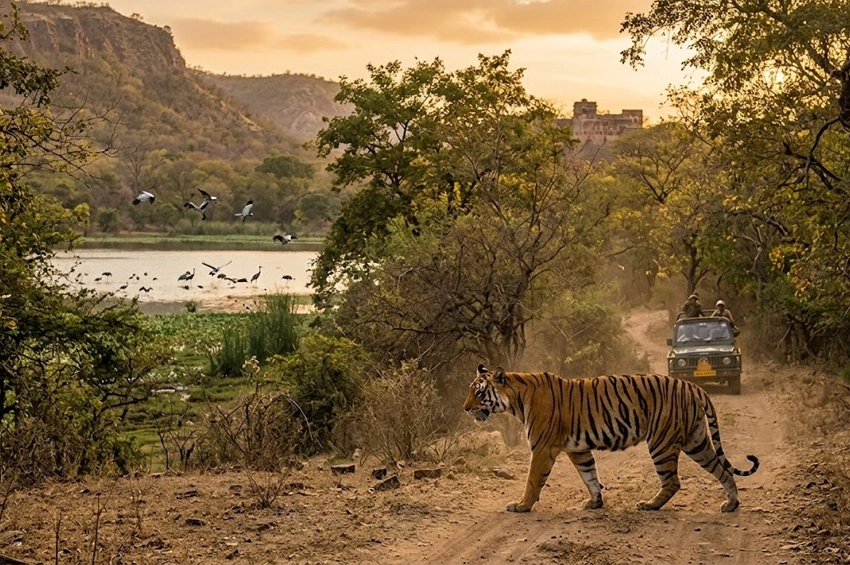
Ranthambore remains Rajasthan's most established tiger tourism destination. It combines dry deciduous forest, lakes, old ruins and the dramatic Ranthambore Fort landscape with one of India's best-known tiger safari systems.
What Travellers Want to Know
- Nearest railway station: Sawai Madhopur Junction (SWM)
- Best stay: 2–3 nights for a wildlife-focused trip
- Safari vehicle: Gypsy or Canter
- Gypsy capacity: up to 6 visitors under current official procedure
- Canter capacity: up to 20 visitors under current official procedure
- Best booking order: safari first, hotel second
- Best first-timer plan: one morning + one afternoon safari
What Can You See?
Tiger, leopard, sloth bear, sambar, chital, nilgai, wild boar, marsh crocodile, langur, jackal and a wide variety of birds.
How Many Safaris?
One drive gives you a taste of the park. Two is a sensible minimum if wildlife is the reason for the trip. Three or four suits photographers and tiger enthusiasts. No number of drives guarantees a tiger sighting.
Sariska Wildlife Sanctuary / Tiger Landscape
Sariska is one of Rajasthan's most useful wildlife additions because it sits naturally between Delhi, Alwar and Jaipur. It is particularly attractive for Indian weekend travellers and international visitors who want a tiger-reserve experience without travelling all the way to Sawai Madhopur.
Best For
- Delhi NCR road trip
- Jaipur wildlife extension
- Aravalli scenery
- Short tiger safari trip
- Families who want less intercity travel
Transport
Alwar is the practical rail gateway; private car is the easiest option from Delhi or Jaipur. Confirm your safari entry/reporting gate before selecting the hotel.
Keoladeo National Park, Bharatpur
Keoladeo is Rajasthan's essential birding stop and a completely different experience from a tiger safari. The official national-park area is only 28.73 sq km, but the compact wetland format is exactly what makes it so rewarding for walking, cycling, bird photography and slow observation.
Best For
- Bird watchers
- Families
- Senior travellers
- Photographers
- Delhi–Agra–Jaipur itineraries
How to Reach
Bharatpur is on major road and rail routes and fits naturally between Agra and Jaipur. For foreign visitors with limited wildlife time, Keoladeo is one of the easiest high-value additions to a Golden Triangle route.
Jhalana Leopard Safari, Jaipur
Jhalana is one of Jaipur's most unusual experiences: an active leopard habitat directly beside a major Indian city. Rajasthan Tourism describes the Jhalana forest block at about 1,978 hectares, while the Forest Department's dedicated Jhalana brochure describes the reserve at about 20 sq km and the broader current Jhalana-Amagarh Conservation Reserve at 35.07169 sq km.
What Can You See?
- Leopard
- Striped hyena
- Desert fox
- Golden jackal
- Chital
- Nilgai
- Jungle cat
- Palm civet
- Peafowl
- Raptors, owls and many other birds
Official Safari Information
The Rajasthan Forest Department brochure states that the department organises safaris in two shifts: early morning and evening. A limited number of vehicles are allowed. The brochure also says there is a ticket window at the safari entrance opening one hour before safari and that advance booking can be made through Rajasthan SSO.
Jhalana Zones
The official brochure describes Jhalana as divided into 3 zones and says valid ticket holders are not restricted to a single zone in the same way as some tiger-reserve systems.
Safari Vehicles
The Forest Department brochure mentions comfortable gypsies and silent electric vehicles. Vehicle availability can change, so confirm the current booking product on the official system.
How to Reach Jhalana
| Arrival Point | Official Brochure Distance to Jhalana |
|---|---|
| Jaipur Sanganer Airport | 6.8 km |
| Jaipur Main Railway Station | 13 km |
| Jaipur Sindhi Camp Bus Stand | 11 km |
The ticket window and safari gate are described in the Malviya Industrial Area / RIICO side of Malviya Nagar, near Apex Circle.
You do not need to add two extra travel days to get a wildlife experience. A client can do an early Jhalana safari, return for breakfast and still visit Hawa Mahal, City Palace or Jaipur markets later the same day.
Amagarh Leopard Safari, Jaipur
Amagarh forms the northern part of the wider Jaipur leopard landscape and is associated with the current Jhalana-Amagarh Conservation Reserve. The official Jhalana brochure itself notes that Jhalana's northern side is divided from Amagarh by NH11 and settlements.
For SEO and client planning, Amagarh should be presented as a separate Jaipur leopard safari option within the broader Jhalana-Amagarh conservation landscape, not incorrectly labelled as one of Rajasthan's 26 wildlife sanctuaries.
Who Should Consider Amagarh?
- Repeat Jaipur visitors who have already done Jhalana
- Leopard-focused photographers
- Travellers staying on the eastern/northern Jaipur side
- Wildlife lovers who want to compare two urban leopard landscapes
Booking & Fees
Use the current Rajasthan Forest Department / official safari booking route for the live safari product and payable amount. Do not use a private operator package price as the government entry fee.
Jawai Leopard Safari, Pali
Jawai is one of Rajasthan's most famous leopard landscapes, but it is very different from Jhalana. Instead of an urban forest, Jawai is a broad granite-hill, scrub and reservoir landscape shaped by villages, pastoral life and wildlife moving through a lived-in countryside.
The current Rajasthan Forest Department protected-area information separately lists Jawai Bandh Conservation Reserve (19.79 sq km) and Jawai Bandh Leopard Conservation Reserve-II (61.98 sq km) in Pali district.
Why Jawai Is Famous
- Leopard sightings around granite hills
- Strong landscape photography
- Rabari pastoral culture
- Birding around Jawai Bandh
- Luxury safari camps and boutique wildlife lodges
- Natural addition to Udaipur–Jodhpur routes
Is Jawai the Same as Jhalana?
No. Jhalana is an organised urban leopard safari in Jaipur with Forest Department safari operations. Jawai is a much broader rural leopard landscape where safari experiences can involve local/private lodge arrangements depending on the exact zone and current official access rules.
Where to Stay
Jawai has everything from simple local stays to premium safari camps. Choose accommodation based on whether the lodge includes safari drives, what area it operates in, vehicle type, naturalist quality and whether the quoted price includes meals and activities.
How to Reach Jawai
Jawai fits naturally between Udaipur and Jodhpur. For rail travellers, the useful station depends on the exact lodge location; Jawai Bandh and nearby regional stations can be relevant. Private car is usually the easiest way to combine Jawai with a wider Rajasthan route.
How Many Nights?
Two nights is a good minimum. Three nights suits serious photographers, birders and travellers who want the landscape and local culture rather than treating Jawai as a one-drive leopard stop.
Desert National Park Sanctuary, Jaisalmer–Barmer
The official Forest Department list gives Desert National Park Sanctuary an area of 3,162 sq km, making it the largest sanctuary in the 26-sanctuary table.
Best For
- Great Indian Bustard conservation landscape
- Desert fox and arid mammals
- Raptors
- Sandgrouse and desert birds
- Landscape and wildlife photography
This is not a Ranthambore-style tiger safari. Use a knowledgeable local naturalist and responsible access rather than assuming every desert jeep excursion is a wildlife safari.
Tal Chhapar Wildlife Sanctuary
At only 7.19 sq km on the official list, Tal Chhapar is tiny but extremely useful for wildlife lovers who value open-country viewing.
Come for
- Blackbuck
- Raptors
- Grassland birds
- Open habitat photography
Kumbhalgarh Wildlife Sanctuary
The official list gives Kumbalgarh Wildlife Sanctuary an area of 610.53 sq km across Udaipur, Rajsamand and Pali. It is a natural wildlife extension for travellers already visiting Udaipur, Ranakpur or Kumbhalgarh Fort.
Good For
- Aravalli forest
- Leopard habitat
- Birding
- Nature-focused stays
- Fort + wildlife combination
Other Sanctuaries from the Official 26 Worth Matching to an Itinerary
Mount Abu Wildlife Sanctuary
Choose it for a cooler hill ecosystem, vegetation and birding rather than a big-cat safari.
Sitamata Wildlife Sanctuary
A southern Rajasthan forest landscape for travellers who want nature beyond the main tourism circuit.
Phulwari ki Naal Wildlife Sanctuary
One of the larger official sanctuaries at 511.41 sq km and a useful Udaipur-region conservation landscape.
National Ghariyal Sanctuary
For river ecology and crocodilian conservation rather than jeep safari tourism.
Band Baretha Wildlife Sanctuary
Useful for birding-focused eastern Rajasthan itineraries around Bharatpur.
Jamwa Ramgarh & Nahargarh Wildlife Sanctuaries
Both are officially listed in Jaipur district and are relevant to understanding Jaipur's broader Aravalli wildlife landscape. Do not confuse them with Jhalana-Amagarh, which appears separately as a conservation reserve.
Rajasthan Wildlife: Train, Bus, Cab & Airport Guide
| Destination | Useful Rail/Air Gateway | Best Final Transfer |
|---|---|---|
| Ranthambore | Sawai Madhopur (SWM); Jaipur for flights | Hotel taxi / local cab |
| Sariska | Alwar; Delhi/Jaipur airports | Private car |
| Keoladeo | Bharatpur; Agra/Delhi airports | Local taxi/auto |
| Jhalana | Jaipur Airport / Jaipur Junction | Cab to safari gate |
| Amagarh | Jaipur Airport / Jaipur Junction | Cab to official reporting point |
| Jawai | Regional rail stations; Udaipur/Jodhpur airports | Private car / lodge pickup |
| Desert National Park | Jaisalmer | Private wildlife vehicle/naturalist |
| Tal Chhapar | Regional rail + road | Private car |
By Train
Train is best for Ranthambore, Bharatpur and many larger Rajasthan cities. Wildlife areas still require a final road transfer.
By Bus
Bus can reduce cost, but it is less suitable when a safari starts before sunrise. Use buses for intercity travel only when the reporting time gives a safe buffer.
By Private Cab
Private car is the easiest way to combine multiple wildlife and heritage destinations. For a Golden Triangle + wildlife client, this often creates the cleanest itinerary.
For Foreign & International Visitors
- Use passport details exactly when required for permits.
- Carry the original passport/ID required by the booking conditions.
- Do not buy “guaranteed tiger” or “guaranteed leopard” claims.
- Ask whether a quote is government permit only or full safari package.
- Keep safari, hotel and driver details offline.
- Arrive at the wildlife destination the previous day for early-morning safaris.
- Use a warm layer in winter open vehicles.
- For Jawai, understand whether you are booking a lodge-led private safari or an official protected-area activity.
For Indian Travellers
Delhi NCR
Sariska is the easiest short wildlife road trip. Ranthambore is better for a 2–3 night tiger holiday.
Jaipur Residents
Jhalana and Amagarh are the obvious leopard experiences without leaving the city region. Sariska works for an overnight tiger trip, while Ranthambore deserves more time.
Udaipur / Jodhpur Route
Jawai is the natural leopard addition between the two regions, while Kumbhalgarh Sanctuary adds an Aravalli forest element.
Safari Prices: How to Read Them Correctly
Wildlife “price” can mean several different things:
- Entry/visitor permit
- Per-seat safari charge
- Full vehicle charge
- Guide/naturalist
- Vehicle hire
- Booking fee
- Hotel pickup
- Private operator service fee
Jhalana Price
The official brochure confirms advance booking and gate ticketing, but live prices can be revised through government orders. Use the official booking result rather than an old brochure/third-party amount.
Ranthambore Price
Use the official permit system because nationality, gypsy/canter selection, shared/full-vehicle arrangement and current fee notifications affect the final total.
Jawai Price
Commonly quoted as a lodge/private jeep safari package. Compare duration, vehicle, naturalist, pickup and whether conservation/entry charges are included.
Best Time for Rajasthan Wildlife
| Season | Best For | Notes |
|---|---|---|
| October–November | Tiger safaris, leopards, general wildlife | Pleasant temperatures |
| December–February | Birding + comfortable safaris | Cold mornings in open vehicles |
| March–April | Mammals + photography | Warmer, often productive |
| May–June | Serious big-cat watching | Very hot; check park operation |
| Monsoon | Selected sites only | Access varies substantially |
Rajasthan Wildlife Itineraries
Jaipur Wildlife Day
Early Jhalana leopard safari → breakfast → Hawa Mahal / City Palace / Jantar Mantar → evening market.
2 Nights: Jawai Leopard Escape
Day 1 arrive from Udaipur/Jodhpur → evening landscape drive. Day 2 morning + evening safari/nature activity. Day 3 departure.
3 Days: Ranthambore Tiger Trip
Day 1 arrive Sawai Madhopur. Day 2 morning + afternoon safari. Day 3 optional fort/third safari and departure.
5 Days: Agra + Bharatpur + Ranthambore
Agra → Keoladeo → Sawai Madhopur → two Ranthambore drives → onward Jaipur.
7 Days: Jaipur + Jhalana + Sariska + Ranthambore
Jaipur city + Jhalana → Sariska → Ranthambore. Excellent for clients who specifically want multiple big-cat landscapes.
10–12 Days: Rajasthan Wildlife & Heritage
Delhi → Sariska → Jaipur/Jhalana → Ranthambore → Bundi/Kota region → Udaipur/Kumbhalgarh → Jawai → Jodhpur.
Official Government & Useful Links
- Rajasthan Forest Department — Official National Parks & Wildlife Sanctuaries List
- Rajasthan Forest Department — Protected Areas & Conservation Reserves
- Rajasthan Forest Department Home
- Rajasthan SSO — Official Login for Applicable Safari Booking Services
- Rajasthan Tourism — Jaipur / Jhalana Information
- IRCTC — Official Train Booking
Related Rajasthan Wildlife Guides
- Delhi to Ranthambore by Train
- Jaipur Airport to Ranthambore
- Madhya Pradesh Wildlife Safari Guide
- Jaipur UNESCO World Heritage Sites
- What to Pack for India
Frequently Asked Questions
How many official national parks are in Rajasthan?
Three: Keoladeo, Ranthambore and Mukundara Hills.
How many official wildlife sanctuaries are in Rajasthan?
Twenty-six on the current Forest Department statistics page.
Is Jhalana included in those 26 sanctuaries?
No. Jhalana-Amagarh is separately listed as a conservation reserve.
Is Jawai included in the 26 sanctuaries?
No. Jawai Bandh Conservation Reserve and Jawai Bandh Leopard Conservation Reserve-II are listed separately under conservation reserves.
Is Jhalana good for leopard sightings?
Yes. Rajasthan Tourism specifically promotes Jhalana as a leopard safari destination, and the Forest Department operates morning and evening safari shifts.
How many zones does Jhalana have?
The official Forest Department brochure describes three zones.
How far is Jhalana from Jaipur Airport?
The official brochure lists 6.8 km from Jaipur Sanganer Airport.
How far is Jhalana from Jaipur Railway Station?
The official brochure lists 13 km.
Where can I book Jhalana?
The official brochure states advance booking can be made through Rajasthan SSO; live booking routes can change, so start from the Forest Department/SSO system.
Is Amagarh a leopard safari?
Yes, it is part of the broader Jaipur leopard landscape associated with the Jhalana-Amagarh Conservation Reserve. Verify current safari inventory and reporting details through the official system.
Is Jawai famous for leopards?
Yes. Jawai is one of Rajasthan's most famous leopard landscapes, especially around the granite hills and Jawai Bandh region.
How many nights should I stay at Jawai?
Two nights is a good minimum; three nights is better for photographers and birders.
Which is better: Jhalana or Jawai?
Jhalana is easier and more structured for a Jaipur safari. Jawai is better for a longer rural landscape experience with leopard viewing, birding and local culture.
Which is better: Ranthambore or Jhalana?
Ranthambore for tiger safari and a full wildlife holiday; Jhalana for a compact Jaipur leopard experience.
Which Rajasthan park is best for birds?
Keoladeo National Park is the first choice for wetland birding.
Which place is best for blackbuck?
Tal Chhapar Wildlife Sanctuary.
Which place is best for Great Indian Bustard habitat?
Desert National Park Sanctuary in the Jaisalmer–Barmer region.
Can foreign tourists book safaris?
Yes, subject to the booking system and required identity/passport details for the selected site.
Can Indian tourists book a private gypsy?
Where full-vehicle inventory is offered, yes, subject to current official booking rules and vehicle capacity.
Are leopard or tiger sightings guaranteed?
No. All sightings involve wild animals and cannot be honestly guaranteed.
Should I book the hotel before safari?
If the safari is the main reason for travel, book or confirm safari availability first.
Final Advice
Use the official Rajasthan Forest Department list as the backbone, but do not stop there. A client searching for “Rajasthan wildlife” also wants Jhalana, Amagarh and Jawai because those are real, popular wildlife experiences. The correct way to include them is to label them accurately as conservation-reserve/leopard landscapes rather than falsely changing the government's national-park or sanctuary list.
For a first wildlife holiday, choose Ranthambore. For a half-day wildlife experience inside Jaipur, choose Jhalana or check current Amagarh safari availability. For a two- or three-night leopard trip between Udaipur and Jodhpur, choose Jawai. For birds, choose Keoladeo. For desert ecology, choose Desert National Park Sanctuary.