Famous Jain Temples in Rajasthan: Complete Pilgrimage Travel Guide
What This Guide Covers
- Ranakpur and Dilwara in depth — timings, the noon-opening rule, photography, dress and how to combine both with Mount Abu
- Eight practical circuits connecting Rajasthan's Jain tirths by geography, not by a generic list
- Nakoda, Kesariyaji, Jaisalmer Fort temples, Shri Mahavirji, Soniji Ki Nasiyan, Bhandasar, Osian and Tijara, each with distance, access and "is it worth a detour" guidance
- Jain food, senior-citizen pacing, and international-visitor planning covered specifically, not generically
- Honest verification notes — temple charges are set by individual trusts and do get revised, so figures here are flagged as needing reconfirmation where they can change
Rajasthan Jain Pilgrimage: Quick Answer
Rajasthan's most significant Jain pilgrimage sites cluster into a few geographic groups. Ranakpur, in Pali district between Udaipur and Jodhpur, and the Dilwara Temples at Mount Abu are the two most visited, both celebrated for marble carving and both commonly combined into a single Udaipur–Ranakpur–Mount Abu route. Nakoda, west of Jodhpur near Balotra, and the Sachiya Mata Jain temple at Osian form the Marwar cluster. The seven interconnected Jain temples inside Jaisalmer Fort, plus the smaller Lodhurva temple nearby, sit further west. Kesariyaji (Rishabhdeo) is a short trip south of Udaipur. Shri Mahavirji in Karauli district and Tijara near Alwar sit apart from this western belt, closer to the Jaipur–Delhi corridor. Soniji Ki Nasiyan in Ajmer and Bhandasar in Bikaner are notable city temples that fit naturally into a broader Rajasthan itinerary rather than requiring a dedicated detour.
A focused Ranakpur–Mount Abu trip from Udaipur works in 2 to 3 days. A fuller circuit adding Jodhpur, Nakoda and Jaisalmer's fort temples typically needs 6 to 8 days by private car, since several of these towns aren't efficiently linked by train. Extending to Shri Mahavirji or Tijara, which sit in a different direction entirely, generally means a separate leg rather than folding them into the same trip.
Important: Ranakpur and Dilwara are both commonly reported as open to non-Jain tourists only in an afternoon window — roughly 12 noon to 5 PM — because mornings are reserved for Jain puja and abhishek. This is one of the most consistently reported rules across current sources and the single most common planning mistake: arriving in the morning expecting entry. Confirm current timings with the respective temple trust before travelling.
Rajasthan is home to some of Jainism's most significant pilgrimage architecture — Ranakpur's forest of carved marble pillars, Dilwara's ceiling work at Mount Abu, and the sandstone temple cluster inside Jaisalmer's living fort among them. This guide is built around how these sites actually connect on a map, not around a ranked list, because the geography genuinely determines what a realistic trip looks like. For a broader look at planning a Rajasthan trip, see our heritage Rajasthan tour packages.
It's written for a mixed readership — Jain pilgrims from India and overseas, first-time Rajasthan visitors of any background, heritage and architecture travellers, and families planning around elderly parents. It doesn't assume every reader is Jain, and it explains religious context respectfully throughout, separating documented history from Jain tradition and local belief.
What's in This Guide
- Famous Jain Temples in Rajasthan at a Glance
- Ranakpur Jain Temple
- Dilwara Jain Temples, Mount Abu
- Kesariyaji / Rishabhdeo
- Nakoda Jain Temple
- Jaisalmer Fort Jain Temples & Lodhurva
- Shri Mahavirji, Soniji Ki Nasiyan, Bhandasar, Osian & Tijara
- Jain Pilgrimage Circuits by Private Car
- Suggested Itineraries: 3, 5, 7 and 10 Days
- Best Time to Visit
- Jain Food on the Road
- Temple Etiquette & Photography
- Senior Citizen Planning
- International & Overseas Jain Travellers
- Private Car vs Train and Bus
- Golden Triangle + Jain Pilgrimage
- Common Planning Mistakes
- Frequently Asked Questions
Famous Jain Temples in Rajasthan at a Glance
Rajasthan's Jain heritage spans both major Śvētāmbara and Digambara traditions, built across roughly a thousand years by merchant patrons and royal grants alike. The table below is a planning reference, not a ranking — each site's importance depends on your route and priorities.
| Temple / Tirth | District | Nearest Major City | Approx. Distance | Primary Deity |
|---|---|---|---|---|
| Ranakpur Jain Temple | Pali | Udaipur | ~90–95 km | Adinath (Rishabhanatha) |
| Dilwara Temples | Sirohi (Mount Abu) | Udaipur | ~185 km | Multiple Tirthankaras (5 temples) |
| Kesariyaji (Rishabhdeo) | Udaipur | Udaipur | ~60–65 km | Rishabhanatha |
| Nakoda Jain Temple | Balotra | Jodhpur | ~110 km | Parshvanatha |
| Jaisalmer Fort Jain Temples | Jaisalmer | Jaisalmer city | Inside the fort | 7 temples, multiple Tirthankaras |
| Lodhurva Jain Temple | Jaisalmer | Jaisalmer city | ~15 km | Parshvanatha |
| Shri Mahavirji | Karauli | Jaipur | ~140–150 km | Mahavira (24th Tirthankara) |
| Soniji Ki Nasiyan | Ajmer | Ajmer city | Central Ajmer | Adinath (Rishabhanatha) |
| Bhandasar Jain Temple | Bikaner | Bikaner city | ~2.5 km from Bikaner Jn. | Sumatinatha |
| Osian (Sachiya Mata complex) | Jodhpur | Jodhpur | ~65 km | Mahavira / Chamunda (Jain-venerated) |
| Tijara Jain Temple | Khairthal-Tijara | Alwar | ~55 km from Alwar | Chandraprabhu |
Distances are commonly reported road-distance approximations from multiple current sources and can vary with the exact route taken. Confirm with your driver or navigation tool before finalising timing.
Ranakpur Jain Temple
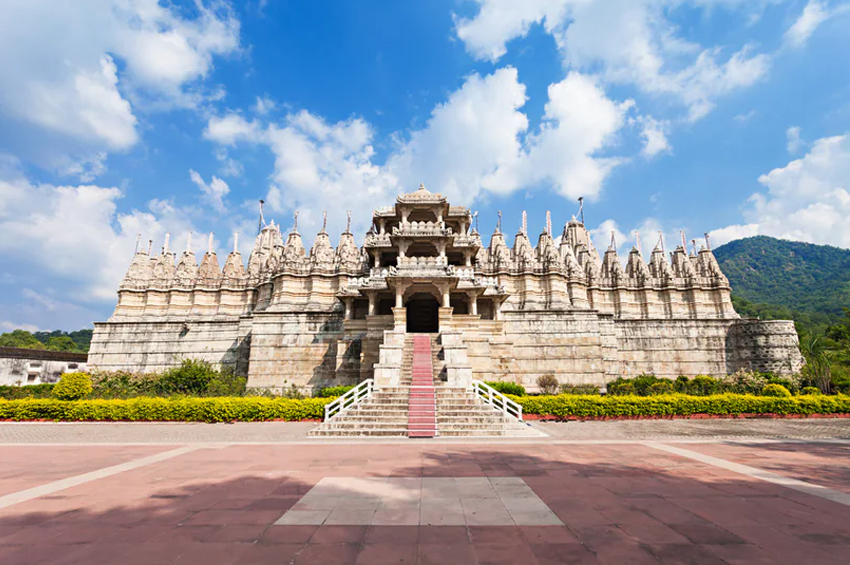
Ranakpur, officially the Chaturmukha Dharana Vihara, sits in a forested valley of the Aravalli hills near Sadri town in Pali district, roughly between Udaipur and Jodhpur. It's dedicated to Adinath (Rishabhanatha), the first Tirthankara, and is widely regarded as one of Jainism's most significant pilgrimage and architectural sites, known for a reported 1,444 individually carved marble pillars, no two said to be identical.
History and the Chaumukha Temple
Tradition credits a Jain merchant, Dhanna Shah (also written Dharna Shah), with commissioning the temple in the 15th century after a vision of a celestial vehicle, and with securing land from the Mewar ruler Rana Kumbha to build it — the surrounding area takes its name from him. The main Chaumukha ("four-faced") temple is the centrepiece of a wider complex that also includes the Surya (sun) temple, the Parshvanatha temple, and other smaller shrines within the same walled premises. This origin account is Jain tradition passed down through temple history rather than an independently documented historical record, and is presented here as such.
Timings and Access
Ranakpur's single most important visitor rule, reported consistently across current sources, is that mornings are reserved for Jain puja and abhishek, and non-Jain tourists and sightseers are generally admitted only in the afternoon, roughly between 12 noon and 5 PM. Devotee worship can begin considerably earlier. If your priority is simply seeing the temple as a visitor rather than a devotee, plan to arrive after noon — arriving at 9 or 10 AM expecting entry is one of the most common and avoidable Ranakpur mistakes.
Entry Fee and Photography
General darshan entry is commonly reported as free for Indian visitors. A separate charge, commonly cited around ₹100 for a still camera, applies for photography, and sources note that photography of the temple itself is permitted with this ticket, though flash and photography of worshippers should be avoided out of basic courtesy. Reported figures for foreign visitors vary by source; confirm the current rate at the counter on arrival.
Etiquette, Footwear and Belongings
As with most active Jain temples, shoes, leather items, cigarettes and food are not permitted inside the premises. A locker facility is commonly available at the entrance for a small fee (reported around ₹10) to store belongings. Dress modestly, with shoulders and knees covered. Some sources note that menstruating women are traditionally asked not to enter the inner sanctum, in keeping with practice at several Jain temples — this is a matter of temple tradition rather than a universal rule, and can be confirmed locally if relevant to your visit.
How Much Time to Allow
Most visitors spend 2 to 3 hours at Ranakpur once inside — the scale of the carving genuinely rewards unhurried viewing, and the complex is larger than a quick walk-through suggests. Add travel time on either side; this is not a 20-minute stop.
Getting There: Udaipur and Jodhpur Routes
From Udaipur, Ranakpur is commonly reported at 90–95 km, a drive of roughly 2 to 3 hours depending on route and traffic. From Jodhpur, it's reported at around 160 km, closer to 3 hours. There's no railway station in Ranakpur village itself, so travel is by road, and a private car is by far the most practical way to reach it — public transport options are limited. The nearest airport is Udaipur's Maharana Pratap Airport.
Combining Ranakpur with Kumbhalgarh and Mount Abu
Ranakpur is commonly combined with Kumbhalgarh Fort, roughly on the same route from Udaipur, making a single day trip cover both a major Jain temple and a major Mewar heritage fort. It's also a natural stop on the way to Mount Abu, since the road toward Abu Road passes reasonably close by — though the fuller Udaipur–Ranakpur–Mount Abu drive is better treated as an overnight route than a rushed same-day return (see Circuit 1 below).
Since sightseeing entry only opens around noon, a Ranakpur day trip pairs naturally with a Kumbhalgarh Fort visit in the morning — Kumbhalgarh doesn't share Ranakpur's afternoon-only restriction — before continuing to Ranakpur once it opens to tourists.
Dilwara Jain Temples, Mount Abu
The Dilwara (also spelled Delwara) Temples sit about 2.5 km from Nakki Lake in Mount Abu, Rajasthan's only major hill station, in Sirohi district. The complex comprises five separate temples enclosed within a single walled compound, each dedicated to a different Tirthankara, built across several centuries starting in the 11th century.
The Five Temples and Their Patrons
The oldest and most celebrated is the Vimala Vasahi, dedicated to Adinath, built in 1031 CE under Vimal Shah, a minister of the Solanki king Bhima I, known for its open courtyard and intricately carved corridors. The other four temples within the complex were built by later patrons, including ministers Vastupal and Tejpal, across the following centuries. Together, the group is considered among the finest examples of Jain marble architecture in India, with domed ceilings carved to a level of detail that several sources describe as taking many years and enormous expense to complete.
Timings
Dilwara is commonly reported as open to non-Jain tourists daily from 12 noon to 5 PM, mirroring the Ranakpur pattern — mornings are reserved for Jain devotees, who can typically enter earlier. Some sources describe a wider daily window (as early as 6 AM to 6 PM with a midday break) specifically for worship purposes; the 12–5 tourist window is the figure to plan sightseeing around. Confirm current timings with the temple management ahead of your visit, since sources do vary slightly and schedules can be adjusted.
Entry Fee and Photography Rules
Entry to Dilwara is consistently reported as free. Photography and mobile phones are not permitted anywhere inside the temple complex — this is one of the most strictly and consistently enforced rules at any Rajasthan temple. Phones, cameras and bags are deposited at a locker counter near the entrance, commonly for a small fee (reported around ₹50 per person). Plan to leave devices behind before entering rather than expecting any exception.
Dress Code and Etiquette
Modest dress is expected — full-length trousers or skirts, and tops covering the shoulders; sleeveless or revealing clothing is discouraged. Footwear is removed before entering the marble halls. Large bags are commonly not allowed inside, so carry only small essential items.
How Much Time to Allow
Most visitors spend 1 to 2 hours at Dilwara. Arriving soon after the 12 noon opening is commonly recommended for a quieter visit and better light on the marble carving, before tour groups build up through the afternoon.
Getting to Mount Abu
The nearest railway station is Abu Road, commonly reported at around 28 km from the Dilwara complex, with taxis covering the final stretch up the hill in roughly 45 minutes. The nearest airport is Udaipur, reported at around 185 km, connected by regular flights to major Indian cities. From Udaipur by road, Mount Abu is typically reached via Ranakpur, making the combined route a natural one rather than two separate trips.
Combining Dilwara with Other Jain Sites
Mount Abu's Jain heritage doesn't end at Dilwara — nearby Mirpur, in Sirohi district, holds a significant older marble Jain temple complex (established 9th century) for travellers with time for a wider regional detour, though it's a specialist addition rather than a standard stop for most itineraries.
Kesariyaji (Rishabhdeo) Temple
South of Udaipur, in Rishabhdeo town (also called Dhulev), the Kesariyaji Tirth is dedicated to Rishabhanatha (Adinath), the first Tirthankara, and is considered one of the four principal pilgrimage centres of the Mewar region — alongside Shrinathji, Eklingji and Charbhujaji, which belong to the broader Rajasthan pilgrimage tradition rather than specifically Jain sites.
What makes Kesariyaji distinctive is that it's revered not only by Jains of both the Digambara and Śvētāmbara traditions but also by Hindus and by the local Bhil community, who call the deity "Kalaji," the black god, after the idol's dark stone. This shared veneration across communities is a well-documented and notable feature of the site rather than a minor curiosity. The temple's name — Kesariyaji — comes from the large quantities of saffron (kesar) traditionally offered during rituals here.
Kesariyaji is commonly reported at roughly 60–65 km south of Udaipur, generally visited as a half-day or full-day trip depending on what else is combined with it. The nearest railway station is Udaipur, and boarding and lodging facilities, including dharamshalas, are available at the site itself.
Nakoda Jain Temple (Nakoda Tirth)
West of Jodhpur, near Balotra in what is now Balotra district (formerly part of Barmer district), Nakoda Ji is a major Śvētāmbara pilgrimage site dedicated to Parshvanatha, and is also closely associated with the worship of Bhairav (Bhaironji), described in several sources as the temple's custodian deity, whose presence draws devotees seeking specific blessings alongside standard darshan.
The temple's origins are traditionally dated to the 3rd century, with the site's name derived from Nakorsen, one of two brothers credited with founding villages in the area; the current Parshvanatha idol installation is documented to around 1224 CE. Nakoda is managed by the Shri Jain Shwetambar Nakoda Parshwanath Tirth Trust and includes a dharamshala with lodging and a large dining hall (bhojanshala) serving vegetarian meals to pilgrims.
Nakoda is commonly reported at around 110 km from Jodhpur (roughly 1.5 to 2 hours by road via Balotra) and a similar distance from Barmer. The nearest railway station, on the Jodhpur–Samdari–Barmer line, is reported at roughly 12–14 km away, near Balotra. Photography inside the temple has been reported as restricted in visitor accounts — confirm current rules on arrival. The site sits in an isolated, hill-surrounded location, which several visitors note adds to its pilgrimage character but also means it's most practically reached by private vehicle.
Jaisalmer Fort Jain Temples and Lodhurva
Inside the still-inhabited Jaisalmer Fort, part of the UNESCO World Heritage "Hill Forts of Rajasthan" listing, a cluster of seven interconnected Śvētāmbara Jain temples was built primarily between the 12th and 16th centuries, constructed from the golden-yellow sandstone characteristic of the city. They're dedicated to several different Tirthankaras — Parshvanatha, Sambhavanatha, Rishabhanatha, Chandraprabha, Shitalanatha, Shantinatha and Kunthunatha — connected by a network of corridors that can be genuinely confusing to navigate independently, which is where a guide adds real value.
The Individual Temples
The Parshvanath temple is generally regarded as the oldest and most architecturally significant, with an especially ornate entrance. The Sambhavnath temple, built in the 16th century by the merchant Askaran Chopra, is notable for housing several hundred additional Sambhavnath idols and an underground manuscript library. The Chandraprabhu temple, built in 1509, is typically the first encountered on a walk-through and features finely sculpted mandapa pillars.
Timings and Entry
Reported visitor timings vary somewhat by source, with a commonly cited morning window of roughly 8 AM to 12 noon; some listings describe a wider 5 AM–12 PM range for worship access. Entry is commonly reported as free for Indian residents. Given the source variation, confirm the current schedule locally, ideally through your Jaisalmer hotel or a local guide, before planning your visit time.
Lodhurva Jain Temple
Roughly 15 km from Jaisalmer city, Lodhurva was the ancient capital of the Bhati rulers before Jaisalmer itself was founded, and its Parshvanatha temple, dating from around the 9th century, is a smaller but historically significant stop, often combined with a Jaisalmer sand dune excursion given the shared direction out of the city.
Because the seven fort temples interconnect through a maze of corridors, hire a guide at the entrance rather than attempting to distinguish each shrine independently on a first visit — it substantially improves the experience for a modest cost.
Other Important Jain Pilgrimage and Heritage Sites
Shri Mahavirji
In Chandanpur village, Karauli district (in the Hindaun subdivision), on the banks of the Gambhir river, Shri Mahavirji is a major Digambara pilgrimage site — the Digambar Jain Atishaya Kshetra — dedicated to Mahavira, the 24th and final Tirthankara. The temple's idol is traditionally described as having been unearthed from the site roughly two centuries ago, and a large annual fair coinciding with Mahavir Jayanti draws pilgrims from across India.
Shri Mahavirji is commonly reported at around 140–150 km from Jaipur and roughly 175 km from Agra, making it more naturally combined with a Karauli, Ranthambore or Bharatpur-region trip than a short Jaipur day loop. It has its own dedicated railway station (Shri Mahaveer Ji, on the Delhi–Mumbai line) roughly 7 km away, useful for travellers arriving by train rather than road.
Soniji Ki Nasiyan, Ajmer
In central Ajmer, close to the Akbar Fort, Soniji Ki Nasiyan — also called the Ajmer Jain Temple or the "golden temple" — is dedicated to Adinath (Rishabhanatha) and is renowned less for being an active large-scale pilgrimage tirth and more for its extraordinary Swarna Nagri ("City of Gold") hall: a gilded, room-sized three-dimensional depiction of Jain cosmology, built by the Soni family of Ajmer between 1870 and 1895, using a reported quantity of gold running into hundreds of kilograms.
Timings are commonly reported as roughly 8:30 AM to 4:30 or 6 PM, with a modest entry fee (reported variously between roughly ₹10 and ₹30 for Indian visitors, with a higher rate for foreign visitors). A visit typically takes 30 minutes to an hour. This is worth distinguishing from a full pilgrimage tirth: it functions more as an architectural and devotional showpiece maintained by the Soni family, and is easily combined with a Pushkar–Ajmer day trip given its central location.
Bhandasar Jain Temple, Bikaner
About 2.5 km from Bikaner Junction, Bhandasar is dedicated to Sumatinatha, the fifth Tirthankara, commissioned by the Jain merchant Bhanda Shah Oswal and completed after his death, generally dated to the late 15th/early 16th century. It's a three-storey red sandstone structure known for wall frescoes, gold-leaf painting and mirror work depicting the lives of the 24 Tirthankaras — a local tradition holds that the foundation used substantial quantities of ghee rather than water in the mortar, giving the temple its local nickname. It's a protected monument, notified by the Archaeological Survey of India while remaining under active religious use by a Jain trust. Entry is commonly reported as free, and it's naturally combined with Bikaner's forts and havelis rather than visited as a standalone trip.
Osian: Sachiya Mata and Jain Heritage
North-west of Jodhpur, at the edge of the Thar Desert, Osian holds one of Rajasthan's oldest surviving Hindu and Jain temple clusters, dating back over a thousand years. The Sachiya Mata temple here is a notable point of overlap between traditions: it's dedicated to the goddess Chamunda, but Jain tradition holds that the goddess became a protector of Jain worshippers and a vegetarian deity following the intervention of the Jain teacher Ratnaprabhasuri, and the site is closely tied to the historical origins of the Oswal Jain community. Osian is commonly visited as a half-day trip from Jodhpur, roughly 65 km away, and pairs naturally with Nakoda for a fuller Marwar Jain circuit.
Tijara Jain Temple
Near Alwar, in the Khairthal-Tijara district, the Tijara Jain Temple is a Digambara site dedicated to Chandraprabhu, the eighth Tirthankara, whose main marble idol installation is documented to 1497 CE (per temple inscription) even though the present temple structure is comparatively more recent. It's designated an Atishaya Kshetra — a site associated with miraculous events in Jain tradition. Tijara sits roughly 55 km from Alwar and around 110 km from Delhi, making it a realistic stop for travellers routing between Delhi and Jaipur rather than a dedicated Rajasthan-interior detour (see Circuit 8 below).
Chittorgarh Jain Heritage
Chittorgarh Fort holds Jain heritage of a different character — most notably the Kirti Stambh (Tower of Fame), a 22-metre 12th-century tower dedicated to Adinath and considered one of Jain architecture's significant standing monuments, along with several Jain temples within the fort complex. These sites are primarily of architectural and historical interest within a broader fort visit rather than functioning as an active pilgrimage tirth in the way Ranakpur or Nakoda do, and are best treated as part of a Chittorgarh heritage stop rather than a dedicated Jain pilgrimage trip.
Jain Pilgrimage Circuits by Private Car
Rajasthan's Jain tirths cluster geographically more than a flat list suggests. Understanding these clusters — rather than trying to connect every temple in one trip — is the single most useful planning step.
Eight Practical Jain Pilgrimage Circuits
| Circuit | Route | Typical Duration |
|---|---|---|
| 1. Udaipur → Ranakpur → Mount Abu | North-west from Udaipur to Ranakpur, continuing south-west to Mount Abu | Overnight route rather than a same-day return |
| 2. Udaipur → Kesariyaji (Rishabhdeo) | South of Udaipur | Half-day to full-day trip |
| 3. Jodhpur → Osian → Nakoda | North-west then south-west of Jodhpur, via Balotra for Nakoda | Best as a full day or a 2-day loop, given Nakoda's distance |
| 4. Jodhpur → Ranakpur → Udaipur | South-east from Jodhpur through the Aravallis, continuing to Udaipur | Full-day transfer with a temple stop, or overnight en route |
| 5. Jodhpur → Jaisalmer → Lodhurva → Jaisalmer Fort Temples | West to Jaisalmer, with Lodhurva as a short detour | 2–3 day circuit given the Jodhpur-Jaisalmer distance |
| 6. Jaipur → Ajmer (Soniji Ki Nasiyan) → Pushkar | South-west of Jaipur; a mixed heritage/pilgrimage day | Full-day trip from Jaipur |
| 7. Jaipur → Shri Mahavirji | South-east of Jaipur, toward Karauli | Full-day trip, or combined with Ranthambore/Karauli sightseeing |
| 8. Delhi → Tijara → Jaipur | South from Delhi via Alwar district, continuing to Jaipur | Practical as a routing stop for Delhi-to-Jaipur travel, not a dedicated round trip |
Suggested Rajasthan Jain Pilgrimage Itineraries
These are editorial route suggestions built around realistic geography and the Ranakpur/Dilwara afternoon-entry rule — not an official pilgrimage sequence. Adjust based on which sites matter most to you.
3-Day Jain Pilgrimage Tour: Udaipur, Ranakpur and Mount Abu
- Day 1 (Udaipur): City sightseeing; overnight in Udaipur.
- Day 2 (Udaipur → Ranakpur → Mount Abu): Depart Udaipur in the morning, visit Kumbhalgarh Fort en route, reach Ranakpur after 12 noon for temple darshan, then continue to Mount Abu for an overnight stay.
- Day 3 (Mount Abu): Visit Dilwara Temples after the noon opening, explore Nakki Lake, depart in the afternoon or stay a further night.
5-Day Jain Temple Tour: Adding Jodhpur and Nakoda
- Day 1: Udaipur city sightseeing.
- Day 2: Udaipur → Kesariyaji (Rishabhdeo) half-day trip, return to Udaipur, or continue toward Ranakpur direction.
- Day 3: Udaipur → Ranakpur (afternoon darshan) → Mount Abu, overnight.
- Day 4: Dilwara Temples in Mount Abu, then travel toward Jodhpur, overnight.
- Day 5: Jodhpur → Osian half-day trip, or Jodhpur → Nakoda if Nakoda is the higher priority (both in one day is a long stretch — choose based on interest).
7-Day Jain Pilgrimage Itinerary: Extending to Jaisalmer
- Days 1–5: as the 5-day itinerary above.
- Day 6: Jodhpur → Jaisalmer (a genuinely long desert drive; consider a night stop or an early departure), city sightseeing on arrival.
- Day 7: Jaisalmer Fort Jain Temples in the morning, Lodhurva Jain Temple as an afternoon detour, before departure.
10-Day Extended Itinerary: Adding Jaipur-Region Sites
- Days 1–7: as the 7-day itinerary above.
- Day 8: Travel from Jaisalmer or Jodhpur toward Jaipur (a long transfer day; flying Jodhpur–Jaipur is worth considering to save driving time).
- Day 9: Jaipur → Ajmer (Soniji Ki Nasiyan) → Pushkar day trip, returning to Jaipur.
- Day 10: Jaipur → Shri Mahavirji day trip, or, for travellers heading toward Delhi, a Jaipur → Tijara → Delhi routing instead.
Best Time to Visit Jain Temples in Rajasthan
October to March offers the most comfortable conditions for temple visits and multi-day driving, and is consistently recommended across current sources for Ranakpur, Dilwara and the wider circuit. Summer heat across the Marwar and desert regions — Jodhpur, Nakoda, Jaisalmer — can make midday travel genuinely difficult, and given that both Ranakpur and Dilwara only open to tourists from around noon, summer visits mean standing and walking through marble courtyards during the hottest part of the day. Monsoon months bring seasonal greenery, notably around Ranakpur's Maghai river valley, but can also affect road conditions in more remote stretches.
Major Jain festival periods — including Mahavir Jayanti, observed with particular significance at Shri Mahavirji, Nakoda and other Digambara and Śvētāmbara sites, and Paryushan for the wider Jain community — bring the fullest devotional atmosphere along with the largest crowds and busiest accommodation. These dates follow the Jain religious calendar and vary by year; do not rely on a fixed Gregorian date from an old source. Confirm the specific year's dates with the relevant temple trust or Rajasthan Tourism before planning travel around any festival.
Jain Food on the Road
Vegetarian food is widely available throughout Rajasthan, and pilgrimage towns with an active Jain trade — Ranakpur, Nakoda, Shri Mahavirji and Mount Abu among them — commonly have dedicated Jain food options nearby, including temple-run dharamshala dining halls. Nakoda's own bhojanshala, for instance, is reported to serve large numbers of pilgrims meals including rotis, vegetable curries, rice and dessert at a modest cost, with the option to request rotis without ghee.
Stricter Jain dietary practice — avoiding onion, garlic and root vegetables — is a personal or family-level observance that varies among Jain travellers rather than a universal requirement, so this guide doesn't assume every Jain visitor follows it. If this matters to your trip, the most reliable approach is to communicate your requirements directly with your hotel or driver in advance, particularly outside major pilgrimage towns, since not every restaurant along a route will be able to accommodate strict Jain food on short notice. We haven't independently verified which specific hotels or restaurants offer Jain food as standard, so confirm directly rather than assuming availability.
Temple Etiquette and Photography
Specific, verified rules matter more here than generic "be respectful" advice:
- Footwear: removed before entering the temple premises at every site in this guide. Wear shoes that are easy to slip off.
- Leather items: commonly restricted inside Jain temple premises, consistent with the principle of non-violence (ahimsa) — belts, wallets, bags and shoes are typically left at a locker counter, usually for a small fee.
- Food: not permitted inside temple premises at Ranakpur and similar sites.
- Photography and mobile phones: strictly prohibited inside the Dilwara complex, with devices deposited at the entrance. At Ranakpur, photography is generally permitted with a separate camera ticket, though photographing worshippers during active ritual should be avoided regardless of the formal rule. At the Jaisalmer Fort temples and Nakoda, restrictions have been reported in some visitor accounts — check current signage or ask on arrival.
- Dress: shoulders and knees covered is a safe standard everywhere in this guide; full-length trousers or skirts are specifically expected at Dilwara.
- Silence and conduct: these remain active places of worship, not only heritage sites — keep voices low near sanctum areas and follow instructions from temple staff without argument.
- Menstruating women: traditionally asked not to enter the inner sanctum at several Jain temples, reflecting temple-specific tradition rather than a single codified rule across all sites.
These patterns are consistently reported but can differ by individual temple and can be updated by the relevant trust. Where a specific rule matters to your visit, confirm it with temple staff on arrival rather than assuming this guide's general pattern applies exactly everywhere.
Senior Citizen Planning
Several of these temples involve genuine walking and, at multi-storey sites such as Soniji Ki Nasiyan, stairs — one visitor account specifically notes the museum's stairs "may be a bit difficult for elderly people," though a lift has also been reported as available there for easier access. Ranakpur and Dilwara both involve walking across stone courtyards and temple floors without consistent shade.
- Avoid stacking more than one major temple visit into a single day when travelling with seniors, particularly given Ranakpur and Dilwara's afternoon-only opening, which already compresses the visiting window.
- Build in rest breaks and carry water, especially for the Ranakpur/Dilwara/Mount Abu leg, where midday heat outside the cooler hill-station climate of Abu itself can be significant.
- We have not independently verified wheelchair accessibility at any of these temples, so if mobility is a specific concern, contact the relevant temple trust or your tour operator directly before travel rather than assuming step-free access.
- Choose accommodation with minimal walking distance from parking or drop-off points where possible, particularly in Mount Abu's hillier terrain.
International and Overseas Jain Travellers
Most temples in this guide explicitly welcome visitors of all backgrounds within visiting hours, provided dress code and conduct expectations are respected — Ranakpur and Dilwara both describe open access for international and non-Jain visitors in their visitor information. A few points matter specifically for travellers arriving from the USA, UK, Canada, Australia or elsewhere in Europe, and for overseas Indian Jain families.
- Arriving via Delhi or Jaipur: both work as entry points. Delhi arrivals commonly combine a Jain pilgrimage extension with the Golden Triangle route through Agra and Jaipur (see below); Jaipur is the more direct base for Shri Mahavirji and Ajmer's Soniji Ki Nasiyan.
- Traveling with elderly parents: plan around the Ranakpur/Dilwara noon-opening window rather than fighting it, and don't schedule a long drive immediately after a temple visit on the same day.
- Comfortable daily driving limits: the Jodhpur–Jaisalmer leg in particular is a genuinely long desert drive; consider breaking it with a night stop or flying one direction if time is limited.
- Hotel location: choosing accommodation in Udaipur or Jodhpur city centres, rather than only near a specific temple, generally gives more flexibility for combining pilgrimage stops with wider sightseeing.
- Cash: carry cash in small denominations for temple donations, camera tickets, locker fees and smaller-town transport, since digital payment isn't uniformly reliable at every site, particularly at smaller tirths outside major cities.
- Footwear management: carry a small bag for shoes at temples without a locker, or use the locker facility where offered.
- Non-Jain companions: family members or travel companions who aren't Jain are generally welcome at the sites covered here during standard visiting hours, consistent with how these temples describe their own visitor access.
- Heat and hydration: particularly relevant for the Marwar and desert legs (Jodhpur, Nakoda, Jaisalmer) outside the October–March window.
- Avoiding overpacked itineraries: the noon-opening restriction at Ranakpur and Dilwara means these two sites alone can anchor a full day each — don't assume you can add a third major stop on the same day without a genuinely early start and a long day on the road.
Private Car vs Public Transport
A private car and driver is generally the most practical way to cover a multi-temple Rajasthan Jain circuit. Several of the sites in this guide — Ranakpur, Nakoda, Kesariyaji, Osian and Tijara among them — either have no direct railway station or require a further local taxi leg from the nearest station, and Ranakpur specifically has been described as having limited public transport options, making private travel the practical default.
- Private car and driver: the most flexible way to link temples across a multi-day route, particularly useful for timing arrivals around the Ranakpur/Dilwara noon-opening rule.
- Trains: useful for the longer city-to-city legs — Udaipur to Jodhpur, Jodhpur to Jaisalmer — with a local taxi then covering the final approach to individual temples. Shri Mahavirji has its own dedicated railway station on the Delhi–Mumbai line, useful for travellers arriving by rail specifically for that site.
- Buses: a lower-cost option connecting major towns to smaller pilgrimage sites like Nakoda, though schedules are fixed and less convenient for combining several temple stops in a single day.
- Nearest airports: Udaipur (Maharana Pratap Airport) serves the Ranakpur/Dilwara/Kesariyaji cluster; Jodhpur Airport serves Nakoda and Osian; Jaisalmer has its own airport; Jaipur Airport is the practical gateway for Shri Mahavirji, Ajmer and Tijara.
Golden Triangle India + Jain Pilgrimage
International and overseas travellers combining a Jain pilgrimage extension with the classic Delhi → Agra → Jaipur Golden Triangle route have a genuinely practical option: continuing from Jaipur to Udaipur → Ranakpur → Mount Abu extends a standard Golden Triangle trip into Rajasthan's most significant Jain heritage sites without requiring a separate journey later.
- Best transition point: Jaipur is the natural hinge — most Golden Triangle itineraries already end there, making it a logical point to continue south-west toward Udaipur rather than returning to Delhi.
- Realistic duration: Delhi–Agra–Jaipur typically takes 4–6 days on its own; adding Udaipur, Ranakpur and Mount Abu realistically adds another 4–5 days, for a combined trip of roughly 9–11 days.
- Where flights save time: flying Jaipur to Udaipur, rather than driving the full distance by road, is commonly used to preserve time for temple visits rather than transit.
- Tijara as a routing stop: for travellers specifically interested in Digambara heritage, Tijara sits close enough to the Delhi–Jaipur road (via Alwar) to work as a brief stop on that leg rather than a dedicated side trip — see Circuit 8 above.
- Legs not to force into a single day: Jaipur to Udaipur by road is a substantial full-day drive on its own; do not plan a temple visit at either end of that specific travel day.
- Fatehpur Sikri: fits naturally on the standard Delhi–Agra–Jaipur leg for travellers with an interest in Mughal heritage, but has no direct connection to the Jain pilgrimage extension described here.
See our Golden Triangle tour packages for the Delhi–Agra–Jaipur portion of this combined route.
Common Jain Pilgrimage Planning Mistakes
- Arriving at Ranakpur or Dilwara in the morning expecting tourist entry, when both are commonly reported as opening to non-Jain visitors only around noon.
- Trying to visit Nakoda and Osian in the same short day from Jodhpur without accounting for the real driving distance between them and back.
- Assuming photography is allowed everywhere — Dilwara in particular enforces a strict no-camera, no-phone rule.
- Underestimating the Jodhpur–Jaisalmer drive and scheduling a temple visit immediately on arrival with no buffer.
- Not carrying cash for camera tickets, locker fees and small-town donations, particularly outside major cities.
- Assuming every hotel or restaurant along a route can accommodate strict Jain dietary requirements without advance notice.
- Booking travel during a major Jain festival period without checking that year's actual dates, then encountering unexpectedly full dharamshalas and long queues.
- Treating Soniji Ki Nasiyan as equivalent in scale to a major tirth like Ranakpur, rather than the smaller architectural showpiece it actually is.
Frequently Asked Questions About Jain Temples in Rajasthan
Which are the most famous Jain temples in Rajasthan?
Ranakpur and the Dilwara Temples at Mount Abu are the two most visited for their marble architecture. Nakoda, Kesariyaji (Rishabhdeo), the Jaisalmer Fort Jain temples, Shri Mahavirji, Soniji Ki Nasiyan in Ajmer and Bhandasar in Bikaner are also significant pilgrimage and heritage sites.
Which is the most famous Jain pilgrimage place in Rajasthan?
Ranakpur is generally regarded as the most significant single pilgrimage and architectural site, followed closely by the Dilwara Temples. Nakoda and Shri Mahavirji are also major active pilgrimage centres, particularly for specific Jain communities and sects.
Where is Ranakpur Jain Temple and how far is it from Udaipur?
Ranakpur is in Pali district, in the Aravalli hills between Udaipur and Jodhpur. It's commonly reported at around 90–95 km from Udaipur, roughly a 2 to 3 hour drive, and around 160 km from Jodhpur.
What are the timings of Ranakpur Jain Temple?
Ranakpur is commonly reported as open to non-Jain visitors and tourists only in the afternoon, roughly 12 noon to 5 PM, since mornings are reserved for Jain puja and abhishek. Confirm current timings with the Anandji Kalyanji Trust before travelling, especially around festival dates.
Is there an entry fee at Ranakpur Jain Temple?
General darshan entry is commonly reported as free. A separate charge, commonly cited around ₹100, applies for still-camera photography. Confirm current charges at the counter, since the temple trust sets and revises these independently.
Can Ranakpur and Mount Abu be combined?
Yes. Ranakpur sits on a natural route between Udaipur and Mount Abu, and is commonly visited on the way to or from Abu, though the fuller drive is better planned as an overnight route rather than a rushed same-day trip.
Where are the Dilwara Jain Temples?
The Dilwara Temples are about 2.5 km from Nakki Lake in Mount Abu, Sirohi district, Rajasthan.
What are the timings of Dilwara Jain Temples?
Commonly reported as 12 noon to 5 PM daily for non-Jain tourists, with earlier access for Jain devotees. Confirm current timings locally, as they can be adjusted.
Is photography allowed at Dilwara Jain Temples?
No. Photography, mobile phones and bags are not permitted inside the complex and are commonly deposited at a locker counter near the entrance for a small fee.
Which Jain temples are near Udaipur?
Ranakpur (~90–95 km) and Kesariyaji/Rishabhdeo (~60–65 km) are the two main Jain pilgrimage sites reachable from Udaipur, with Mount Abu's Dilwara Temples a further extension beyond Ranakpur.
Which Jain temples are near Jodhpur?
Nakoda Jain Temple, roughly 110 km from Jodhpur via Balotra, and the Sachiya Mata temple complex at Osian, roughly 65 km from Jodhpur, are the two main Jain pilgrimage sites reachable from the city.
Which Jain temples can be visited from Jaipur?
Soniji Ki Nasiyan in Ajmer (combinable with a Pushkar day trip) and Shri Mahavirji in Karauli district, roughly 140–150 km away, are the two most practical Jain sites from a Jaipur base.
What is the best Rajasthan Jain pilgrimage route?
There isn't a single best route — it depends on your starting city. An Udaipur-based traveller typically prioritises Ranakpur and Dilwara; a Jodhpur-based traveller prioritises Nakoda and Osian; a Jaipur-based traveller is better served by Soniji Ki Nasiyan and Shri Mahavirji.
How many days are needed for a Rajasthan Jain pilgrimage tour?
A focused Ranakpur–Mount Abu trip from Udaipur works in 2 to 3 days. A fuller circuit adding Jodhpur, Nakoda and Jaisalmer's fort temples typically needs 6 to 8 days by private car.
What is the best time to visit Jain temples in Rajasthan?
October to March offers the most comfortable conditions. Summer heat across the Marwar and desert regions can make midday visits difficult, particularly given the noon-opening rule at Ranakpur and Dilwara.
Can senior citizens comfortably visit Rajasthan Jain temples?
Yes, with reasonable pacing. Several sites involve walking and, at Soniji Ki Nasiyan, stairs (a lift has been reported as available there). Avoid stacking more than one major temple into a single day, and confirm accessibility directly with the temple trust if mobility is a specific concern.
Is Jain food available during a Rajasthan pilgrimage trip?
Vegetarian food is widely available, and pilgrimage towns such as Ranakpur, Nakoda and Shri Mahavirji commonly have dedicated Jain food options, including temple-run dining halls. For stricter dietary requirements, communicate directly with your hotel or driver in advance rather than assuming availability everywhere.
Is a private car useful for a Rajasthan Jain pilgrimage tour?
Yes, for most multi-temple routes. Several important tirths, including Ranakpur, Nakoda and Kesariyaji, sit in smaller towns without convenient direct train service, so a private car with driver is generally the most practical way to link them.
Can I combine Golden Triangle India with a Jain pilgrimage tour?
Yes. Delhi → Agra → Jaipur → Udaipur → Ranakpur → Mount Abu is a practical extension for international and overseas travellers, typically adding 4–5 days to a standard Golden Triangle trip.
Can international tourists visit Jain temples in Rajasthan?
Yes. Most major temples in this guide, including Dilwara and Ranakpur, explicitly welcome visitors of all faiths and nationalities within visiting hours, provided dress code and temple rules are followed.
What should visitors wear at Jain temples in Rajasthan?
Modest clothing covering shoulders and knees is expected. Footwear, leather items and food are commonly not allowed inside the premises at Ranakpur and Dilwara, with locker facilities usually available at the entrance.
Sources and Verification Notes
- Temple timings, entry conditions and camera charges in this guide reflect current visitor-reported information from multiple sources describing Ranakpur, Dilwara, Nakoda, Kesariyaji, the Jaisalmer Fort temples, Shri Mahavirji, Soniji Ki Nasiyan and Bhandasar, cross-checked for consistency across sources where possible.
- Where sources disagreed on a specific figure (such as exact foreign-visitor camera charges, or the precise Dilwara worship-hours window), this guide reports the most consistently cited figure and flags it for reconfirmation rather than presenting a single number as certain.
- Individual temple trusts — the Anandji Kalyanji Trust at Ranakpur, the Dilwara temple management, the Shri Jain Shwetambar Nakoda Parshwanath Tirth Trust, and others — set and periodically revise their own visitor rules independently of any single government authority. Contact the relevant trust directly, or confirm through Rajasthan Tourism, before finalising travel plans.
- Historical dates and patronage details are drawn from a combination of temple-trust accounts, Wikipedia's documented entries for individual temples, and established heritage/travel references; where an account is rooted in Jain tradition or local legend rather than independently verified history, this is noted in the text.
This guide separates confirmed geographic and historical information from religious tradition, local belief and typical visitor practice throughout. Darshan timings, entry and camera charges, and festival dates can all change; confirm anything that matters to your specific trip with the relevant temple trust close to your travel date.
Related Rajasthan Travel Guides
Continue planning with these related guides and tours from Rajasthan Tour Trip:
Final Planning Advice
The most useful way to plan a Rajasthan Jain pilgrimage tour is to start from your base city and work outward geographically, rather than trying to connect every famous name on a single trip. Ranakpur and Dilwara anchor an Udaipur-based route; Nakoda and Osian anchor a Jodhpur-based one; Shri Mahavirji and Soniji Ki Nasiyan suit a Jaipur-based trip. Build your schedule around the Ranakpur/Dilwara noon-opening rule specifically, since it's the single detail most likely to disrupt a poorly planned day, and confirm current timings, fees and any festival-period changes with the relevant temple trust shortly before you travel.