Rajasthan Pilgrimage Tour: Famous Temples & Sacred Places to Visit
What This Guide Covers
- Route-first, not list-first: which temples geographically belong together, so you're not zig-zagging across the state
- Seven realistic circuits built around Jaipur, Pushkar-Ajmer, Udaipur-Mewar, Mount Abu, Jodhpur and Bikaner
- Hindu, Jain and Sufi sites covered with respectful, neutral language — this is not a single-tradition itinerary
- Practical planning for international visitors, overseas Indian families, seniors and first-time visitors
- Honest verification notes — timings, fees and festival dates change, and are flagged rather than guessed
Rajasthan Pilgrimage Tour: Quick Answer
Rajasthan's pilgrimage geography roughly splits into five clusters: the Jaipur-Shekhawati belt (Khatu Shyam Ji, Salasar Balaji, Mehandipur Balaji, Jeen Mata, Rani Sati Jhunjhunu, plus Jaipur's own Govind Dev Ji, Galta Ji and Birla Mandir); the Pushkar-Ajmer cluster (Brahma Temple and Ajmer Sharif Dargah, close enough for a single day); the Udaipur-Mewar belt (Shrinathji at Nathdwara, Eklingji, Jagdish Temple and Ranakpur Jain Temple); Mount Abu (Dilwara Jain Temples), reachable from Udaipur; and the Marwar-Bikaner belt (Osian near Jodhpur, and Karni Mata at Deshnok near Bikaner).
A short Jaipur-based trip covering Khatu Shyam Ji and Salasar Balaji works as one long day by private car. A fuller circuit through Jaipur, Pushkar, Ajmer, Udaipur and Ranakpur generally needs 5 to 7 days. Adding Mount Abu, Jodhpur or Bikaner extends a trip toward 10 days. Most of these places are not efficiently linked by train, so a private car and driver is the most practical way to cover more than two or three sites in one trip.
Important: temple darshan timings, aarti schedules, entry rules and festival dates can change, and some vary seasonally or during major fairs. This guide gives typical patterns and planning windows rather than fixed daily schedules — always confirm the specific day's timing with the temple trust or Rajasthan Tourism close to your travel date, and treat any date given here as approximate unless stated otherwise.
Rajasthan's pilgrimage circuit is bigger and more varied than most temple lists suggest. It spans a Krishna devotional tradition centred on Khatu Shyam Ji and Salasar Balaji, a Vaishnav pilgrimage centre at Nathdwara that draws devotees from across India, some of the most intricately carved Jain marble temples in the country at Ranakpur and Mount Abu, the Sufi shrine of Khwaja Moinuddin Chishti at Ajmer, and the distinctive rat temple tradition at Deshnok. Planning it well is less about deciding which temples matter and more about understanding which ones sit near each other. For a broader look at the state, see our heritage Rajasthan tour packages.
This guide is written for a genuinely mixed readership — Hindu and Jain pilgrims, travellers interested in Sufi heritage, overseas Indian families, first-time international visitors, and anyone building a culturally focused Rajasthan trip. It doesn't assume you belong to one tradition, and it separates confirmed practical information from religious tradition and local belief throughout.
What's in This Guide
- How Many Days Do You Need?
- Realistic Pilgrimage Circuits
- Jaipur and Nearby Pilgrimage Places
- Pushkar and Ajmer
- Udaipur and the Mewar Temples
- Mount Abu: Dilwara Jain Temples
- Jodhpur, Osian and Bikaner
- Other Important Pilgrimage Places
- Best Time to Visit & Festival Crowds
- Temple Etiquette, Dress and Photography
- Advice for International & Overseas Travellers
- Private Car vs Train and Bus
- Suggested Itineraries: 3, 5, 7 and 10 Days
- Common Planning Mistakes
- Frequently Asked Questions
How Many Days Do You Need for a Rajasthan Pilgrimage Tour?
The honest answer depends entirely on which cluster of temples matters to you, not on trying to cover the whole state. Three rough tiers work for most travellers:
| Scope | Typical Duration | Covers |
|---|---|---|
| Jaipur-area circuit only | 1–2 days | Govind Dev Ji, Galta Ji, Birla Mandir plus a day trip to Khatu Shyam Ji and Salasar Balaji |
| Core Rajasthan pilgrimage route | 5–7 days | Jaipur area, Pushkar-Ajmer, and the Udaipur-Mewar temples including Ranakpur |
| Extended pilgrimage + heritage circuit | 9–10 days | All of the above plus Mount Abu, Jodhpur/Osian and Bikaner/Karni Mata |
Trying to compress the extended circuit into under a week generally means long driving days with very little time actually spent at each site — workable for a focused pilgrimage-only trip with a fit traveller, but tiring for families, seniors or anyone wanting to also see the forts and havelis along the way.
Realistic Pilgrimage Circuits by Private Car
Rajasthan's pilgrimage sites are not evenly spread — they cluster around a handful of towns. Understanding these clusters is more useful than any single list of "top temples," because it tells you what can realistically share a day and what needs its own overnight stop.
Seven Practical Pilgrimage Circuits
| Circuit | Route | Typical Duration |
|---|---|---|
| 1. Jaipur → Khatu Shyam Ji → Salasar Balaji → Jaipur | North-east of Jaipur, both temples in the same general direction | Full day, return to Jaipur |
| 2. Jaipur → Pushkar → Ajmer → Jaipur | South-west of Jaipur; Pushkar and Ajmer sit close together | Full day trip, or overnight in Pushkar for a relaxed pace |
| 3. Jaipur → Mehandipur Balaji → Jaipur | South-east of Jaipur, toward the Rajasthan-UP border area; can sometimes be paired with a heritage stop such as Abhaneri depending on route and time available | Full day trip |
| 4. Udaipur → Eklingji → Nathdwara → Udaipur | North of Udaipur, both temples on the same road | Half to full day trip |
| 5. Udaipur → Ranakpur → Mount Abu | North-west from Udaipur to Ranakpur, then continuing south to Mount Abu | Best as an overnight route rather than a same-day return |
| 6. Jodhpur → Osian → Jodhpur | North-west of Jodhpur, into the Thar desert fringe | Half-day trip |
| 7. Bikaner → Deshnok (Karni Mata) → Bikaner | South of Bikaner city | Half-day trip |
Jaipur and Nearby Pilgrimage Places
Jaipur works well as a pilgrimage base because it sits within a day's drive of several of Rajasthan's most visited temples, and it has its own significant sacred sites inside the city.
Govind Dev Ji Temple
Located within the City Palace complex in the old city, Govind Dev Ji is one of Jaipur's most important Krishna temples and is closely tied to the city's royal history — tradition holds that the temple's idol was brought from Vrindavan. Multiple daily aarti ceremonies draw large crowds, and it's easily combined with a City Palace or Jantar Mantar visit since they're within walking distance of each other. Read our complete Jaipur travel guide for planning the old city on foot.
Galta Ji
Known popularly as the "Monkey Temple," Galta Ji sits in a narrow gorge in the hills east of Jaipur, built around natural spring-fed water tanks considered sacred. It's a working pilgrimage site rather than only a tourist stop, with resident langurs and macaques throughout the complex — keep food and loose items secured, and expect some walking on uneven stone paths.
Birla Mandir and Moti Dungri Ganesh Temple
Birla Mandir is a white marble temple dedicated to Lakshmi-Narayan, built in a more modern style than Jaipur's older temples, and is a common stop for its architecture and hilltop setting near Moti Dungri. The adjacent Moti Dungri Ganesh Temple, at the base of a private palace hill, is a frequently visited Ganesh shrine, especially busy on Wednesdays according to local tradition.
Khole Ke Hanuman Ji
A Hanuman temple in the Aravalli hills near Jaipur, set beside a small stream, popular with local devotees particularly on Tuesdays and Saturdays, days traditionally associated with Hanuman worship.
Mehandipur Balaji Temple
Located toward the Rajasthan–Uttar Pradesh border area, south-east of Jaipur, Mehandipur Balaji is a Hanuman temple known for a distinctive tradition of exorcism-related rituals performed on the temple premises, which some visitors find intense to witness. It draws large numbers of pilgrims, particularly on Tuesdays and Saturdays and during festival periods. Travellers uncomfortable with these rituals may prefer to visit other Balaji temples in the region instead; there is no obligation to participate in or observe any specific ritual.
Khatu Shyam Ji
Located in Sikar district, north-east of Jaipur, the Khatu Shyam Ji temple is dedicated to Barbarika, worshipped here as Shyam Baba, an incarnation associated with Krishna devotion. It's one of the most heavily visited pilgrimage sites in the state, with especially large crowds during its major annual fair. Queues can be substantial on weekends and festival dates; arriving early morning generally means a shorter wait.
Salasar Balaji
Also in the Shekhawati region, in Churu district, Salasar Balaji is a major Hanuman temple and is frequently paired with Khatu Shyam Ji as both sit in the same general direction from Jaipur. Salasar's Balaji murti is distinctive for its flowing beard and moustache, a form specific to this temple's tradition.
Jeen Mata and Rani Sati Temple
Jeen Mata, in Sikar district, is a hilltop Shakti temple with a significant annual fair drawing large crowds, especially during Navratri periods. Rani Sati Temple in Jhunjhunu town is one of the most visited temples in the Shekhawati region, though it remains a subject of some social debate given its historical association with sati; it's included here for search-relevance and completeness, and visitors interested in Shekhawati's painted havelis often combine it with a broader regional trip.
Pushkar and Ajmer
Pushkar and Ajmer sit close enough together that they're almost always visited as a single trip, typically as a day trip from Jaipur or as an overnight stop on a longer circuit.
Brahma Temple, Pushkar
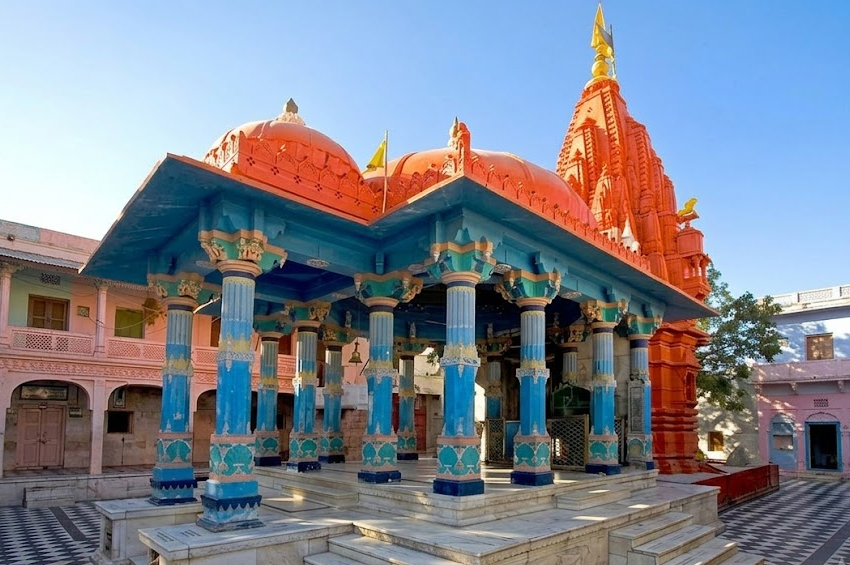
Pushkar's Brahma Temple is widely cited as one of the very few temples in India dedicated specifically to Brahma, the creator deity in Hindu tradition, which gives the town particular religious significance beyond its lake. The temple sits close to Pushkar Lake, considered sacred and ringed by ghats used for ritual bathing.
Pushkar Lake, Ghats and Savitri Temple
Pushkar Lake itself, with its series of ghats, is central to the town's pilgrimage identity, and many visitors combine a lake walk with the Brahma Temple visit. The Savitri Temple, on a hilltop reachable by a ropeway or a walking trail, offers a wider view over the town and lake and is dedicated to Brahma's consort.
Ajmer Sharif Dargah
The Dargah of Khwaja Moinuddin Chishti in Ajmer is one of the most significant Sufi shrines in India, drawing pilgrims of multiple faiths, not only Muslims. It becomes especially crowded during the annual Urs festival. Visitors should dress modestly, and head covering is expected for women inside the shrine area; men are also commonly expected to cover their heads within the inner sanctum area. Footwear is removed before entering, and photography inside the inner shrine is generally restricted — check current signage on arrival.
Ajmer and Pushkar are separated by a hill range with a short drive between them, making the pairing straightforward for a single day. Ajmer additionally has its own significant Jain temple, the Soniji Ki Nasiyan, known for its gilded interior depicting Jain cosmology, worth a stop for architecture-focused travellers.
Udaipur and the Mewar Temples
Udaipur is the natural base for the Mewar region's most significant pilgrimage sites, several of which sit on the same road north of the city.
Shrinathji Temple, Nathdwara
Nathdwara, north of Udaipur, is home to the Shrinathji Temple, one of the most important Vaishnav pilgrimage centres in India, dedicated to a form of Krishna within the Pushtimarg tradition. The temple follows a distinctive schedule of multiple daily darshan sessions, and photography inside the temple is generally not permitted — this is a long-standing and strictly enforced rule at Shrinathji specifically, unlike at many other Rajasthan temples, so plan to leave cameras and phones with your vehicle or a designated area before entering.
Eklingji Temple
A short distance from Nathdwara, Eklingji is an ancient Shiva temple complex historically associated with the Mewar royal family as their family deity. Its striking silver-faced Shiva idol and its position within a walled temple courtyard make it a distinct visit from Shrinathji, and both are commonly combined in a single half-day trip from Udaipur.
Jagdish Temple
Inside Udaipur city itself, close to the City Palace, the Jagdish Temple is a large Vishnu temple known for its detailed stone carving, convenient to combine with Udaipur's lake and palace sightseeing without requiring a separate trip out of the city.
Ranakpur Jain Temple
North-west of Udaipur, on the route toward Mount Abu, Ranakpur is widely regarded as one of the most significant Jain marble temples in India, dedicated to Adinath and known for its more than a thousand intricately carved pillars, each reportedly distinct in detail. It sits within a forested valley setting that adds to the visit. Ranakpur is commonly visited as a day trip from Udaipur or as a stop on the way to Mount Abu.
Charbhuja Temple
Located in Rajsamand district, Charbhuja is a Vishnu temple of regional significance, generally visited by pilgrims with a specific interest in this deity or those extending their Mewar circuit rather than as a default stop for first-time visitors.
Mount Abu: Dilwara Jain Temples
Mount Abu, Rajasthan's only major hill station, is best known for the Dilwara Temples, a group of Jain temples dating across several centuries, celebrated for marble carving of exceptional detail, particularly in the domed ceilings. Photography is generally not permitted inside the temples, and visitors may be asked to deposit leather items such as belts, wallets and bags before entering, consistent with Jain temple practice more broadly. Modest dress is expected.
Mount Abu is roughly a half-day's drive from Udaipur via Ranakpur, which makes Circuit 5 above (Udaipur → Ranakpur → Mount Abu) a natural overnight route rather than a rushed same-day return. Combining the drive with an overnight stay in Mount Abu also allows time for Nakki Lake and the town's cooler hill-station atmosphere, a contrast to the desert heat elsewhere on a Rajasthan pilgrimage circuit.
Jodhpur, Osian and Bikaner
Osian Temples
North-west of Jodhpur, on the edge of the Thar Desert, Osian is a small town with a notable cluster of ancient Hindu and Jain temples dating back over a thousand years, including the Sachiya Mata Temple, a significant regional Shakti shrine. Osian works well as a half-day trip from Jodhpur and can be combined with the desert landscape and dune areas nearby for travellers wanting both pilgrimage and scenery in one outing.
Nakoda Jain Temple
West of Jodhpur, in Barmer district, Nakoda is a significant Jain pilgrimage site dedicated to Parshvanath, drawing pilgrims from across the Jain community, particularly during specific fair periods. It sits further from Jodhpur than Osian and is generally a dedicated trip rather than an add-on to another itinerary.
Karni Mata Temple, Deshnok
South of Bikaner, the Karni Mata Temple at Deshnok is distinctive for its resident population of rats, considered sacred within the temple's tradition and believed by devotees to be reincarnated family members of Karni Mata's lineage. It draws pilgrims and curious visitors alike. Footwear is removed before entering, as is standard, and visitors should be prepared for what can be, for some, an unusual sensory experience walking through the temple floor area — this is a genuine and central part of the site's character, not an incidental detail.
Bhandasar Jain Temple, Bikaner
Within Bikaner city, Bhandasar is a notable Jain temple known for its detailed wall paintings and multi-storey structure, a convenient stop when combined with Bikaner's forts and havelis rather than a dedicated day trip on its own.
Other Important Pilgrimage Places
Shri Mahavirji
In Karauli district, south-east Rajasthan, Shri Mahavirji is one of the most significant Jain (Digambar) pilgrimage sites in the state, with a large annual fair drawing pilgrims from across India. It sits somewhat apart from the main Jaipur-Udaipur circuit, generally suiting travellers heading toward Ranthambore or the Karauli-Sawai Madhopur region rather than a short Jaipur loop.
Kaila Devi Temple
Also in Karauli district, Kaila Devi is a hilltop Shakti temple with a significant fair period, commonly combined with a Ranthambore trip given the geographic proximity, rather than treated as a standalone Jaipur pilgrimage stop.
Best Time for a Rajasthan Pilgrimage Tour
Rajasthan's climate is the main practical driver of timing. Broadly, October to March offers cooler, more comfortable conditions for temple queues, walking and multi-day driving, which is why this remains the most commonly recommended window for pilgrimage travel across the state. Summer months bring intense heat, particularly across the Marwar and Shekhawati regions, which can make midday temple visits and long drives genuinely difficult, especially for seniors and young children.
Major festival periods — including Navratri, and the significant fairs held at Khatu Shyam Ji, Jeen Mata, Shri Mahavirji and Ajmer's Urs — bring the largest crowds of the year at their respective temples, along with the fullest devotional atmosphere. These periods reward travellers who want to witness a major fair, but they also mean longer queues, fuller accommodation, and less predictable timing overall. If your priority is a calmer, more manageable visit rather than the festival experience itself, ask your tour operator or the temple trust about the specific fair dates for your travel year and plan around them rather than into them.
Temple Etiquette, Dress Code and Photography
Expectations vary somewhat by temple and tradition, but a consistent general standard covers most of Rajasthan's pilgrimage sites:
- Dress: shoulders and knees covered, for both men and women, is a safe default at almost every site in this guide. Some temples are stricter than others; when in doubt, dress more conservatively rather than less.
- Footwear: removed before entering the sanctum or main temple area at all Hindu and Jain temples covered here, and at the inner area of Ajmer Sharif Dargah. Wear shoes that are easy to remove and carry a small bag if you'd rather not leave them at a temple counter.
- Head covering: expected for women, and often for men too, inside the Ajmer Sharif Dargah's inner sanctum. Not generally required at most Hindu or Jain temples in this guide, though carrying a scarf is a reasonable precaution at any unfamiliar site.
- Photography: strictly restricted inside the Shrinathji Temple at Nathdwara and generally restricted or discouraged inside the Dilwara Jain Temples and inside the Ajmer Sharif Dargah's inner shrine. Rules at other temples vary and can change; look for posted signage or ask temple staff before photographing any deity or sanctum area.
- Leather items: some Jain temples, including Dilwara, ask visitors to deposit leather belts, wallets and bags before entering. Carrying a small cloth bag as backup is useful.
- Mobile phones: commonly required to be switched to silent, and sometimes restricted from the innermost sanctum area at busier temples. Follow posted instructions.
- Cash for donations: useful in small denominations; digital payment is increasingly available at larger temple trusts but isn't guaranteed everywhere, particularly at smaller regional shrines.
These are general patterns rather than guarantees at every specific temple — rules can differ by site and can be updated by the relevant temple trust at any time. Where a rule genuinely matters to your visit, confirm it on arrival rather than assuming this guide's general pattern applies exactly as described.
Early morning visits, generally before mid-morning, tend to mean shorter queues at Rajasthan's busiest temples — Khatu Shyam Ji, Salasar Balaji, Mehandipur Balaji and Shrinathji among them. Weekends, Tuesdays and Saturdays (traditionally associated with Hanuman worship at Balaji temples), and any date near a major fair, are consistently the busiest.
Advice for International Visitors and Overseas Indian Families
Most of Rajasthan's major pilgrimage temples welcome visitors regardless of background, provided dress and conduct expectations are respected. A handful of practical points matter more for travellers arriving from outside India, or overseas Indian families visiting with elderly relatives.
- Arriving via Delhi or Jaipur: both work as entry points; Jaipur is the closer base for the Shekhawati and Pushkar-Ajmer clusters, while Delhi arrivals commonly combine a pilgrimage circuit with the Golden Triangle route through Agra. See our Golden Triangle tour packages for combining both.
- Traveling with elderly parents: several major temples involve walking on stone floors, some stairs, and standing in queues without much shade. Build in rest points and avoid stacking more than two major temple visits into a single day when travelling with seniors.
- Accessibility: hillside or hilltop sites such as Galta Ji, Jeen Mata and Savitri Temple in Pushkar involve genuine walking or steps; check current accessibility with the temple or your tour operator if mobility is a concern, since ramps and lift access are not consistently available across these older sites.
- Vegetarian and Jain food: widely available across Rajasthan's pilgrimage towns, and Jain-specific food (without onion and garlic) can generally be requested at hotels and restaurants in towns with an active Jain pilgrimage trade, such as around Ranakpur and Mount Abu, though it's worth confirming with your accommodation in advance.
- Cash: carry cash in small denominations for temple donations, parking and smaller regional stops, since digital payment isn't uniformly reliable at every site, particularly smaller shrines outside major towns.
- Heat and hydration: carry water on any temple circuit, particularly across the Shekhawati and Marwar regions where shade can be limited around temple courtyards.
- Avoid overpacked days: two temple clusters in a single day, such as Khatu Shyam Ji and Salasar Balaji, is a reasonable maximum for most travellers; stacking three or more distant sites into one day usually means rushed darshan and long stretches in the car.
- Festival-period planning: book accommodation and private car transport well in advance around major fairs such as Khatu Shyam Ji's annual mela or Ajmer's Urs, when demand rises sharply in the surrounding towns.
Private Car and Driver vs Trains and Buses
A private car with driver is generally the most practical way to cover a multi-temple Rajasthan pilgrimage circuit, for a straightforward reason: most of the temples in this guide are not directly served by convenient train connections, and several — Khatu Shyam Ji, Salasar Balaji, Ranakpur, Eklingji, Osian and Deshnok among them — require a further local taxi leg even from the nearest railway station or bus stand.
- Private car and driver: the most flexible option for linking two or more temples in a day, adjusting timing around darshan queues, and reaching sites without convenient public transport. This is the practical default for most of the circuits described above.
- Trains: useful for the longer city-to-city legs of an extended trip — Jaipur to Udaipur, Udaipur to Jodhpur, Jodhpur to Bikaner — where a local taxi or hotel transfer can then cover the final approach to individual temples.
- Buses: a lower-cost option between major towns, including RTDC's state tourism services, though schedules are fixed and less convenient for a multi-stop pilgrimage day involving several temple visits.
For travellers starting from Jaipur without their own arrangements, our heritage Rajasthan tour packages and private car options can be adapted around a pilgrimage-focused route.
Suggested Rajasthan Pilgrimage Itineraries
3-Day Itinerary: Jaipur-Centred Pilgrimage
- Day 1: Jaipur city temples — Govind Dev Ji, Galta Ji, Birla Mandir and Moti Dungri Ganesh Temple.
- Day 2: Full-day circuit to Khatu Shyam Ji and Salasar Balaji, returning to Jaipur.
- Day 3: Full-day circuit to Pushkar and Ajmer, returning to Jaipur (or continuing onward if extending the trip).
5-Day Itinerary: Jaipur to Udaipur Pilgrimage Route
- Day 1: Jaipur city temples.
- Day 2: Khatu Shyam Ji and Salasar Balaji day trip from Jaipur.
- Day 3: Drive from Jaipur toward Pushkar and Ajmer, overnight in Pushkar.
- Day 4: Drive to Udaipur; visit Jagdish Temple and explore the city.
- Day 5: Half-day trip to Eklingji and Nathdwara, returning to Udaipur.
7-Day Itinerary: Adding Ranakpur and Mount Abu
- Days 1–5: as the 5-day itinerary above.
- Day 6: Drive from Udaipur to Ranakpur, visit the Jain temple, continue to Mount Abu for an overnight stay.
- Day 7: Visit the Dilwara Temples and Nakki Lake in Mount Abu before departing.
10-Day Itinerary: Extended Rajasthan Pilgrimage and Heritage Circuit
- Days 1–7: as the 7-day itinerary above.
- Day 8: Travel from Mount Abu toward Jodhpur; visit Jodhpur's forts in the afternoon.
- Day 9: Half-day trip to Osian temples from Jodhpur; travel toward Bikaner.
- Day 10: Half-day trip to Karni Mata Temple at Deshnok, combined with Bikaner's forts and havelis before departure.
Common Rajasthan Pilgrimage Planning Mistakes
- Treating every temple as reachable from Jaipur in a single day — several major sites, including Nathdwara, Ranakpur and Dilwara, are genuinely part of the Udaipur cluster, not Jaipur's.
- Underestimating driving time between clusters and stacking too many distant stops into one day.
- Assuming photography is allowed everywhere — Shrinathji and Dilwara in particular restrict it.
- Booking travel during a major fair without checking that year's actual dates, then encountering unexpectedly full accommodation and long queues.
- Not carrying cash for smaller temple donations and local transport, particularly outside major towns.
- Overlooking that some Jain temples restrict leather items on the premises.
- Assuming a train covers the full journey to a temple, when a further local taxi leg is actually required.
Frequently Asked Questions About Rajasthan Pilgrimage Tours
What are the most famous pilgrimage places in Rajasthan?
Widely visited sites include Khatu Shyam Ji, Salasar Balaji and Mehandipur Balaji near Jaipur; the Brahma Temple at Pushkar and the Ajmer Sharif Dargah; Shrinathji at Nathdwara and Eklingji near Udaipur; the Ranakpur and Dilwara Jain temples; and the Karni Mata Temple at Deshnok near Bikaner.
Which are the most famous temples in Rajasthan?
Among Hindu temples, Khatu Shyam Ji, Salasar Balaji, Shrinathji at Nathdwara, Eklingji and the Brahma Temple at Pushkar are the most consistently visited. Among Jain temples, Ranakpur and the Dilwara Temples at Mount Abu are the most significant for their architecture and pilgrimage importance.
What is the best Rajasthan pilgrimage route?
There isn't a single "best" route — it depends on your starting city and priorities. A Jaipur-based traveller typically starts with the Khatu Shyam Ji–Salasar Balaji circuit and the Pushkar-Ajmer circuit, then continues toward Udaipur for the Mewar temples if time allows.
How many days are needed for a Rajasthan temple tour?
A short Jaipur-area circuit fits into 2–3 days. A fuller route through Jaipur, Pushkar-Ajmer and Udaipur's temples including Ranakpur typically needs 5–7 days. Extending to Mount Abu, Jodhpur and Bikaner pushes this toward 10 days.
Which temples can I visit from Jaipur?
As day trips from Jaipur: Khatu Shyam Ji, Salasar Balaji, Mehandipur Balaji, Jeen Mata, and Pushkar-Ajmer. Jaipur's own city temples — Govind Dev Ji, Galta Ji, Birla Mandir — don't require leaving the city at all.
Can Khatu Shyam Ji and Salasar Balaji be visited in one day?
Yes, they're commonly combined into one long day trip from Jaipur by private car, since both sit in a similar direction north-east of the city. Expect a full day given the driving time involved plus temple visits.
How far is Khatu Shyam Ji from Jaipur?
Khatu Shyam Ji is in Sikar district, north-east of Jaipur. Exact driving distance and time vary by route and traffic conditions — confirm current distance and drive time with your driver or tour operator when planning, rather than relying on a fixed figure.
Can Pushkar and Ajmer be visited on the same day?
Yes. They sit close together separated by a short hill drive, and are almost always visited together, either as a day trip from Jaipur or as a stop on a longer route.
Which Jain temples should I visit in Rajasthan?
Ranakpur, near Udaipur, and the Dilwara Temples at Mount Abu are the two most visited for their marble carving and pilgrimage significance. Shri Mahavirji, Nakoda and Bhandasar are also important for travellers with a specific interest in a broader Jain circuit.
How do I visit Ranakpur Jain Temple from Udaipur?
Ranakpur is most commonly visited by private car from Udaipur, either as a day trip or as a stop on the way toward Mount Abu. Public transport options exist but are less direct.
Can Nathdwara and Eklingji be visited together?
Yes, they sit on the same road north of Udaipur and are commonly combined into a single half-day trip.
What should international tourists wear inside Rajasthan temples?
Modest, fully covered clothing — shoulders and knees covered — is the safe general standard. Footwear is removed before entering most sanctums, and head covering is expected inside the Ajmer Sharif Dargah's inner area.
Are foreigners allowed inside Rajasthan temples?
Most major temples in this guide welcome visitors of all backgrounds who follow dress and conduct expectations. Specific rules can vary by temple and may change; confirm current entry conditions on arrival if uncertain.
Can senior citizens comfortably do a Rajasthan pilgrimage tour?
Yes, with reasonable pacing. Several temples involve walking, stairs or standing in queues without much shade, so avoid stacking too many distant sites into one day, build in rest breaks, and check accessibility at hillside sites such as Galta Ji, Jeen Mata or Savitri Temple in advance.
Is a private car useful for a Rajasthan pilgrimage trip?
Yes, for most multi-temple circuits, since many pilgrimage sites aren't directly served by convenient train connections and need a further local taxi leg regardless. A private car and driver is generally the most flexible way to link several temples in a trip.
What is the best time of year for a Rajasthan pilgrimage tour?
October to March offers cooler, more comfortable conditions for temple visits and multi-day driving. Summer heat, particularly across the Shekhawati and Marwar regions, can make midday visits and long drives difficult.
Can a Rajasthan pilgrimage tour be combined with Delhi, Agra and Jaipur?
Yes. Travellers arriving via Delhi commonly combine a Rajasthan pilgrimage circuit with the Golden Triangle route through Agra and Jaipur, extending the trip with the Khatu Shyam Ji–Salasar Balaji and Pushkar-Ajmer circuits before continuing further into Rajasthan.
Official Sources to Check Before You Travel
- Rajasthan Tourism — official destination information and general visitor guidance for temples and heritage sites across the state.
- Individual temple trust websites and notice boards, where available, for current darshan timings, aarti schedules and photography rules.
- District tourism offices for the most current local information on fairs and festival dates.
This guide separates confirmed factual information (locations, districts, general historical and religious context) from typical visitor practice and practical recommendations throughout. Darshan timings, aarti schedules, entry conditions, photography rules and festival or fair dates can all change and can vary by source; treat any specific figure in this guide as a planning reference and confirm it with the relevant temple trust or official tourism source close to your travel date.
Related Rajasthan Travel Guides
Continue planning with these related guides and tours from Rajasthan Tour Trip:
Final Planning Advice
The most useful way to plan a Rajasthan pilgrimage tour isn't to start with a list of famous temples — it's to start with geography. Decide which cluster matters most to you, whether that's the Shekhawati Balaji temples, the Pushkar-Ajmer pairing, the Mewar temples around Udaipur, or the Jain circuit through Ranakpur and Mount Abu, and build outward from there with a private car that can handle the connecting drives. Layer in etiquette expectations, realistic daily pacing for seniors or families, and a buffer around any major festival date, and the trip stays manageable rather than rushed.
Because temple timings, entry conditions and festival dates genuinely do change, treat this guide as a route-planning foundation and confirm the specific details that matter to your trip — darshan hours, photography rules, fair dates — with the relevant temple trust or Rajasthan Tourism shortly before you travel.