Jaipur Complete Travel Guide: What to See, Eat, Buy, Where to Stay & How to Plan
Jaipur in 60 Seconds
- Ideal first trip: 2 full sightseeing days / 3 nights
- Must-see: Amber Palace, Hawa Mahal, City Palace, Jantar Mantar, old-city bazaars
- Best viewpoint: Nahargarh for the city panorama
- Best photo stop: Hawa Mahal facade early in the day
- Best market experience: Johari Bazaar + Bapu Bazaar + smaller old-city lanes
- Best wildlife add-on: Jhalana Leopard Safari
- Best months for comfortable sightseeing: October–March
- Best first-time transport: private cab for fort day; walk/auto for compact old-city sections
- Do not do: squeeze Amber, City Palace, Jantar Mantar, shopping and Nahargarh sunset into a rushed half-day
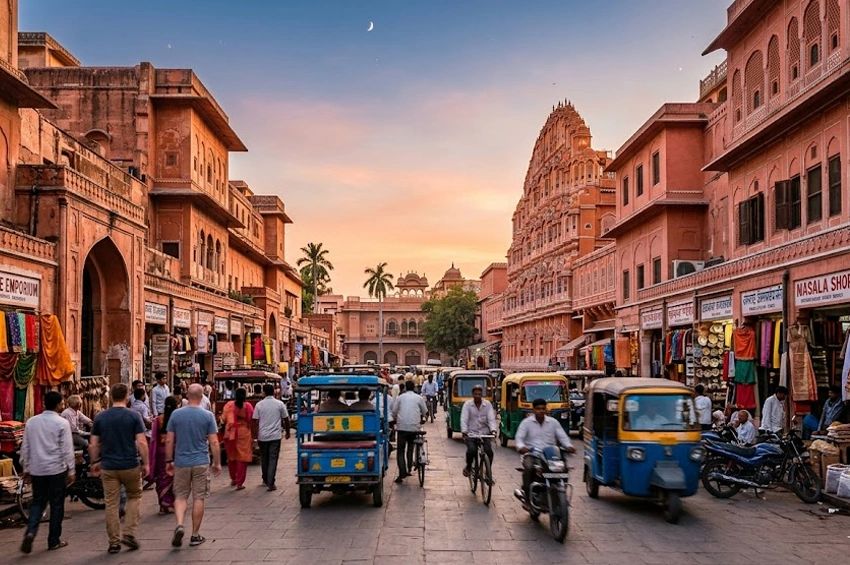
Most Jaipur itineraries fail in one of two ways. They either treat the city as a checklist—Hawa Mahal, Amber Fort, City Palace, done—or they try to fit so much into a day that the traveller remembers traffic more clearly than the places.
Jaipur deserves a better plan. It is not simply a collection of pink buildings. The old city was conceived as a commercial city, its streets were designed around markets, its royal centre grew around astronomy and court life, and its northern hills still hold the forts that protected the earlier capital at Amer. The craft traditions are not museum pieces either: textiles, jewellery, pottery, lac work, stone and hand-made goods remain part of everyday commerce.
This guide is built around the questions travellers actually ask after booking a ticket: How many days do I need? Which fort comes first? Is Hawa Mahal worth going inside? Where should I stay? What can I walk? How much time should I allow for Amber? Where should I shop without wasting half a day? Is Jaipur comfortable for foreign visitors? Can I add a leopard safari? What should I skip if I only have one day?
Jaipur Travel Guide Contents
- Why Jaipur Is Different
- How Many Days Do You Need?
- Best Time to Visit
- How to Reach Jaipur
- Getting Around Jaipur
- Best Places to Visit
- Amber Palace
- Hawa Mahal, City Palace & Jantar Mantar
- Nahargarh & Jaigarh
- Beyond the Main Monuments
- Jhalana Leopard Safari
- 1, 2, 3 & 4 Day Itineraries
- What to Eat
- What to Buy & Where to Shop
- Where to Stay
- Jaipur Trip Budget
- Guide for International Visitors
- Families, Couples, Solo & Seniors
- Best Day Trips
- Mistakes to Avoid
- Jaipur FAQs
Why Jaipur Is More Than the “Pink City”
Jaipur was founded in 1727 by Sawai Jai Singh II. Unlike many older cities that expanded organically, the new city was deliberately planned on the plains. UNESCO describes its grid-based plan, broad commercial streets, chaupars, temples, residences and continuous market facades as an exceptional example of South Asian urban planning.
The walled city was inscribed on the UNESCO World Heritage List in 2019. Jantar Mantar is independently UNESCO-listed, while Amber is part of the Hill Forts of Rajasthan World Heritage property. That gives Jaipur an unusual concentration of living urban heritage, royal architecture, scientific history and hill-fort landscapes.
But UNESCO status is only half the story. Jaipur still behaves like the commercial city it was designed to be. The old avenues remain shopping streets. Wedding buyers still come for jewellery and textiles. Artisans still print cloth, make lac bangles and shape blue pottery. Temples, food stalls, scooters, wedding processions, wholesalers, residents and tourists all share the same urban space.
How Many Days Are Enough for Jaipur?
| Time | What You Can Realistically Do | Who It Suits |
|---|---|---|
| 1 day | Amber + Jal Mahal photo stop + Hawa Mahal + City Palace/Jantar Mantar | Very short Golden Triangle visit |
| 2 days | Main forts, old city, markets and one sunset viewpoint | Most first-time visitors |
| 3 days | Add crafts, food, Jhalana, museums or slower shopping | Best overall first trip |
| 4 days | Add a day trip, resort time or deeper neighbourhood exploration | Couples, families, photographers |
Two full days is the practical minimum we recommend to someone who has travelled a long way to see Jaipur. Three days feels noticeably better because you can stop treating every meal, market and photograph as something stealing time from the next monument.
Best Time to Visit Jaipur
October to March: Easiest for Sightseeing
These are the most comfortable months for long fort walks and old-city exploration. December and January mornings can be cool, especially at hill forts and on open safari vehicles.
April to June: Hot, Quieter, Needs a Different Schedule
Jaipur heat can be severe. If you travel in late spring or early summer, start at opening time, rest through the harshest afternoon hours and return outdoors later. A cheap hotel without reliable air-conditioning is a false economy in this season.
July to September: Monsoon Character
Clouds can transform the Aravalli views and the city often photographs beautifully after rain, but humidity rises and outdoor plans need flexibility.
Festival Periods
Festivals can make Jaipur memorable but also affect traffic, hotel demand and access around busy temples or processional routes. Book important stays early if your dates coincide with a major event.
How to Reach Jaipur
By Air
Jaipur International Airport is the city's air gateway. For a first arrival, a pre-arranged hotel transfer or app-based/private cab is the simplest option, especially with luggage or a late flight.
By Train
Jaipur Junction connects the city with Delhi and many major Indian destinations. Train works particularly well on a Delhi–Jaipur or wider Rajasthan itinerary. If you are arriving on an early train, confirm hotel luggage storage rather than losing half a sightseeing day waiting for check-in.
By Road from Delhi
A private car gives flexibility and works well when Jaipur is part of a chauffeur-driven Golden Triangle. Train can be more relaxing when Jaipur is the only destination.
From Agra
Agra–Jaipur is one of the classic Golden Triangle legs. A private road transfer lets you add stops such as Fatehpur Sikri or Abhaneri depending on your route and available time.
From Udaipur, Jodhpur or Pushkar
Rail, road and bus options vary by route. A private vehicle becomes increasingly useful when your Rajasthan trip includes smaller heritage towns or rural stops between the big cities.
How to Get Around Jaipur Without Wasting Time
Private Cab
Best for Amber, Jaigarh, Nahargarh and other sights spread away from the compact old-city core. For a family or 3–4 travellers, the time saved can matter more than the price difference.
Auto-Rickshaw
Useful for shorter hops and flexible old-city travel. Agree on the fare or use a clearly understood pricing method before starting if there is no meter/app fare.
Walking
Walking is excellent around Hawa Mahal, City Palace, Jantar Mantar and selected bazaar stretches. It is not the right solution for an entire fort day.
Metro
Jaipur Metro can help on routes near its stations, but it does not replace a sightseeing car for Amber and the hill forts. Use it when the route matches your actual origin and destination, not simply because a city has a metro.
Local Bus
Budget-friendly and useful for confident independent travellers. Rajasthan Tourism notes that buses to Amber leave from central areas such as Ajmeri Gate/MI Road, while auto-rickshaw or car is more convenient for most tourists.
Use a car for the spread-out northern fort circuit. Use your feet and short auto rides once you are inside the compact heritage core. Trying to use one transport style for everything usually wastes time.
Best Places to Visit in Jaipur: What Is Actually Worth Your Time?
| Place | Why Go | Time to Allow | Priority |
|---|---|---|---|
| Amber Palace | Grand palace-fort interiors, courtyards, Sheesh Mahal | 2–3 hours | Essential |
| Hawa Mahal | Jaipur's iconic facade and old-city context | 30–60 min | Essential |
| City Palace | Royal collections, courtyards, architecture | 1.5–2.5 hours | Essential |
| Jantar Mantar | UNESCO astronomical instruments | 45–75 min | Essential |
| Jal Mahal | Lake-side photo stop | 15–30 min | Easy add-on |
| Jaigarh Fort | Military fort, ridge views, fort context | 1–1.5 hours | Good with Amber |
| Nahargarh Fort | City panorama and sunset atmosphere | 1.5–2 hours | Strong if time allows |
| Albert Hall Museum | Collections + Indo-Saracenic architecture | 1–2 hours | Good museum stop |
| Gaitore | Royal cenotaphs and quieter architecture | 45–60 min | Excellent repeat/slow trip |
Amber Palace: Give It a Morning, Not a Rush
Amber—often written Amer—is about 11 km from Jaipur according to Rajasthan Tourism. The palace complex rises above Maota Lake and mixes Rajput and Mughal architectural influences. The official tourism description highlights its four principal courtyard sections, royal quarters, zenana, gardens, temples and Sheesh Mahal.
Arrive early. The reward is not only cooler weather and softer light; the courtyards make more sense before they are full of tour groups.
What Not to Miss Inside Amber
- Jaleb Chowk
- Diwan-i-Aam
- Ganesh Pol
- Sheesh Mahal
- Royal courtyards and zenana areas
- Views toward Maota Lake
Amber + Jaigarh?
Yes if you enjoy forts, military history and ridge views. No if you only have one Jaipur day and still need to see the old city properly.
Amber + Nahargarh?
Possible, but do not assume they sit beside each other simply because all three are hill forts. Build realistic driving time into the day.
The Old-City Core: Hawa Mahal, City Palace & Jantar Mantar
This is the part of Jaipur where walking pays off. Hawa Mahal, City Palace and Jantar Mantar sit close enough to form one logical heritage cluster, with bazaars and street life around them.
Hawa Mahal
Built in 1799 under Sawai Pratap Singh, Hawa Mahal is the five-storey landmark that defines Jaipur visually. Rajasthan Tourism explains that its jharokhas allowed women of the royal household to observe street life while remaining unseen.
The famous facade is best understood from across the road, but going inside gives a completely different perspective—ramps, windows, city views and the relationship between the screen-like facade and the streets below.
City Palace
City Palace is not just “another palace after Amber.” It tells a different story: Jaipur as a royal capital inside the planned city. The complex includes courtyards, museum collections, royal costumes, arms and architectural spaces, while part of the palace remains associated with the former ruling family.
Jantar Mantar
If you walk through Jantar Mantar without an explanation, it can look like a garden of giant abstract sculptures. With a good guide, it becomes one of Jaipur's most intelligent experiences. UNESCO calls it the most significant, comprehensive and best-preserved collection of India's historic fixed monumental astronomical instruments.
Allow enough time to understand what several major instruments actually do rather than photographing each one and leaving.
Jal Mahal: A Photo Stop, Not a Half-Day Attraction
Jal Mahal sits in Man Sagar Lake and is one of Jaipur's most recognisable views. Rajasthan Tourism currently notes that it is not open to the majority of the public, so for most travellers it is a roadside/lakeside viewpoint rather than a palace visit.
That makes it perfect between the old city and Amber: stop, photograph, look at the lake and continue. Do not allocate two hours because a generic itinerary labels it a “major palace tour.”
Nahargarh or Jaigarh: Which Should You Choose?
Choose Nahargarh If...
You want the broad Jaipur city view, late-afternoon atmosphere and a fort that feels tied to the skyline of modern Jaipur. Rajasthan Tourism places it on an Aravalli ridge and notes that a taxi/car is the practical access option.
Choose Jaigarh If...
You are more interested in Amber's defence system, military architecture and the ridge above the old capital.
Have Time for Both?
Do both only if forts are a genuine interest. A first-time visitor with two days should not sacrifice all market, food and old-city time merely to say they visited three forts.
Albert Hall Museum
Albert Hall is useful when you want a museum rather than another palace. Rajasthan Tourism describes collections including metalwork, wood crafts, carpets, sculptures, arms, natural stones and miniature paintings. The building itself, set in Ram Niwas Garden, is part of the experience.
Jaipur Beyond the Famous Five
Gaitore Ki Chhatriyan
Royal cenotaphs on the Jaipur–Amber side. This is one of the best additions for architecture lovers who want a quieter stop after the major monuments.
Patrika Gate
Popular for colourful photography. Treat it as a visual stop rather than a substitute for the old city's deeper heritage.
Galta Ji
A historic temple landscape in the hills. Dress respectfully and remember it is an active religious site, not a staged photo set.
Govind Dev Ji Temple
One of the places that helps visitors understand Jaipur as a living sacred city. Check current darshan timings before going because temple rhythms do not follow museum-style opening hours.
Flower & Vegetable Markets
Early markets show a completely different Jaipur. Go with respect for vendors who are working, not performing for cameras.
Craft Workshops
Block printing, blue pottery and other craft visits are worthwhile when the workshop is genuine and educational. A “factory tour” that turns into an hour-long sales pitch is not the same thing.
Jhalana Leopard Safari: Jaipur's Wild Side
One of Jaipur's most surprising add-ons is a leopard safari at Jhalana. It works particularly well for travellers who want wildlife but cannot add two or three nights at Ranthambore.
A morning safari can be followed by breakfast and city sightseeing. An evening safari can replace a monument sunset if wildlife is a bigger priority.
Leopards are wild animals. Do not book anyone promising a guaranteed sighting. Use the current official Rajasthan Forest Department booking route and check reporting time, identification requirements and vehicle arrangements before the safari date.
Jaipur Itinerary: 1, 2, 3 and 4 Days
Jaipur in 1 Day
Morning: Amber Palace early → Jal Mahal photo stop. Midday: Hawa Mahal exterior/visit → City Palace. Afternoon: Jantar Mantar → short bazaar walk. Evening: dinner or a viewpoint if energy and traffic allow.
This is a highlights day, not a complete Jaipur experience.
Jaipur in 2 Days — Best First-Time Plan
Day 1: Forts & Northern Jaipur
Amber Palace → optional Jaigarh → Jal Mahal → Gaitore or rest → Nahargarh toward late afternoon.
Day 2: Walled City
Hawa Mahal early → City Palace → Jantar Mantar → lunch → Johari/Bapu Bazaar and old-city lanes → Albert Hall exterior/evening or relaxed dinner.
Jaipur in 3 Days — Recommended
Day 1: Amber + Jaigarh + Jal Mahal + Nahargarh.
Day 2: Hawa Mahal + City Palace + Jantar Mantar + bazaars + food.
Day 3: Jhalana morning safari, craft experience, Albert Hall/Gaitore/Galta Ji depending interest, then an unhurried final dinner.
Jaipur in 4 Days — Slow & Better
Use the first three days above and reserve Day 4 for a day trip to Abhaneri, Sambhar, Pushkar/Ajmer or a resort/craft-focused day. Four days also works well for families who do not want children in a car from sunrise to sunset.
Jaipur for Photography
| Photo Interest | Good Choice | Planning Tip |
|---|---|---|
| Iconic facade | Hawa Mahal | Go early for softer light and less traffic |
| Palace detail | Amber | Opening-time visit |
| City panorama | Nahargarh | Allow traffic time before sunset |
| Lake view | Jal Mahal | Quick stop; conditions vary |
| Architecture | Gaitore | Quieter than headline monuments |
| Street colour | Old city bazaars | Ask before close portraits |
| Wildlife | Jhalana | Telephoto lens useful |
What to Eat in Jaipur
Do not turn Jaipur food into a single “dal baati churma” checkbox. The city has royal-style Rajasthani cooking, everyday vegetarian meals, kachori shops, sweets, lassi, snacks and modern cafes.
Foods Worth Trying
- Dal baati churma
- Pyaaz kachori
- Mirchi bada
- Ghevar when seasonally available
- Mawa kachori
- Ker sangri
- Gatte ki sabzi
- Laal maas for non-vegetarians
- Rajasthani thali
- Lassi and local sweets
Street Food Safety
Choose busy stalls with high turnover, eat freshly cooked hot food, be cautious with raw garnishes if your stomach is not accustomed to local conditions and carry drinking water from a source you trust.
What to Buy in Jaipur
Shopping is not an optional side activity in Jaipur's history—the city was planned as a trade centre, and UNESCO specifically notes that its commercial and artisanal traditions continue today.
Popular Jaipur Purchases
- Block-printed cotton textiles
- Blue pottery
- Lac bangles
- Silver and gemstone jewellery
- Mojari/jutti
- Quilts and home textiles
- Miniature paintings
- Handmade decor
- Traditional garments
Johari Bazaar
Best known for jewellery and the old-city shopping atmosphere. High-value gemstone purchases require more care than buying a scarf or pottery piece.
Bapu Bazaar
Convenient for textiles, footwear, souvenirs and general browsing.
How to Shop Without Getting Frustrated
Decide what you actually want before entering ten shops. Compare workmanship, not just price. Ask whether fixed pricing applies. Bargain politely where bargaining is normal. For expensive jewellery, prioritise reputation, documentation and return terms over a dramatic discount.
For a dedicated shopping plan, read our What to Buy in Jaipur Shopping Guide.
Where to Stay in Jaipur
Old City / Heritage Core
Best for: atmosphere, early Hawa Mahal access, heritage feel.
Trade-off: traffic, noise and vehicle access can be less convenient.
C-Scheme / Central Jaipur
Best for: restaurants, modern comfort, balanced city access.
Trade-off: less “inside the old city” atmosphere.
Bani Park
Best for: railway access, guesthouses and a wide range of hotels.
Trade-off: you still need transport to major sights.
Amer / Kukas Side
Best for: luxury resorts, weddings, quieter resort stays, Amber access.
Trade-off: inconvenient if most of your plan is old-city shopping and restaurants.
Luxury Palace or Resort?
A heritage palace-style hotel gives Jaipur character; a large resort gives space, pools and retreat. Choose based on what you will actually do. Paying for a distant resort makes little sense if you plan to spend 12 hours a day sightseeing in the old city.
See our Jaipur Luxury Hotels & Resorts Guide for a more detailed stay comparison.
How Much Does a Jaipur Trip Cost?
There is no useful single “Jaipur cost” because travellers mix very different hotel and transport styles. A better method is to budget by category.
| Expense | Budget Style | Comfort Style | Luxury Style |
|---|---|---|---|
| Stay | Hostel/guesthouse | Quality 3–4 star/heritage hotel | Palace/luxury resort |
| Transport | Bus/metro/auto | Mix of cab + auto | Private chauffeur |
| Sightseeing | Selected monuments | Major paid attractions | Private guide + premium experiences |
| Food | Local eateries | Mix of local + restaurants | Fine dining/hotel dining |
| Shopping | Souvenirs | Crafts/textiles | Fine jewellery/art |
Jaipur for Foreign & International Visitors
Jaipur Is Easy to Love, but Do Not Underestimate Its Intensity
The city is tourist-friendly, but the old centre is busy: traffic, horns, sales pitches, animals, pedestrians and market activity can all occupy the same street. First-time India visitors often enjoy Jaipur more once they stop expecting a quiet museum city.
Use a Guide Where Explanation Adds Value
Jantar Mantar benefits enormously from explanation. Amber and City Palace also become richer when the guide explains how spaces were used rather than reciting dates.
Carry Small Practical Essentials
- Water
- Sun protection
- Small cash for minor purchases
- Phone power bank
- Copy/access to travel documents
- Modest layer/scarf for religious sites
Shopping Commissions
If a driver or guide insists that a particular shop is “government,” “fixed price” or “the only authentic factory,” make your own decision. A good private tour should not become a sequence of commission stops you never requested.
Money & Payments
Cards and digital payments are widespread in formal businesses, but small cash remains useful. Foreign cards can occasionally fail, so do not rely on one payment method.
SIM & Connectivity
Mobile data makes cab booking, maps and communication far easier. Complete any tourist-SIM formalities through legitimate telecom channels.
Jaipur for First-Time India Visitors
A strong first visit combines structure with free time. Have transport organised for Amber day, know your major monument order, then leave one or two hours unscheduled for a market, tea, photography or simply sitting somewhere without checking the next attraction.
The mistake is not “missing a monument.” The mistake is seeing twelve places and experiencing none of them.
Jaipur for Families, Couples, Solo Travellers & Seniors
Families with Children
Alternate architecture with something interactive: Jantar Mantar explanation, Jhalana safari, craft workshop or hotel pool time. Three forts in one day rarely wins with children.
Couples
Choose one good sunset, one unhurried dinner and a hotel you actually enjoy. Gaitore, Amber early, old-city photography and a resort day can feel more personal than racing through every “romantic Jaipur” list.
Solo Travellers
Jaipur has hostels, tours and busy public areas, but normal city precautions still matter. Keep late-night transport planned, especially when leaving isolated hill viewpoints.
Senior Travellers
Amber and hill forts involve slopes, steps and uneven surfaces. Use vehicles as close to entrances as permitted, avoid midday heat and reduce the number of monuments per day.
What to Wear in Jaipur
There is no special tourist dress code for walking around Jaipur, but lightweight, comfortable and relatively modest clothing works across monuments, markets and religious places. Carry sun protection and comfortable footwear. Winter mornings may require a jacket.
For more detail, see our India Packing Guide.
Jaipur Safety & Common Tourist Problems
- Use normal precautions with phones, wallets and bags in crowded markets.
- Confirm cab/auto price or app booking before starting.
- Do not let unsolicited “guides” redirect you from an attraction because it is supposedly closed.
- Be cautious with high-value gemstone purchases.
- Do not photograph people at close range without permission.
- Keep enough time for airport/station traffic.
- Avoid isolated hill areas after dark without reliable transport.
- Keep original documents secure and carry only what the activity requires.
Jaipur with a Private Guide: Worth It?
For a first visit, a good guide can be worth the cost at Amber, City Palace and especially Jantar Mantar. The test is whether the guide improves understanding—not whether they know the fastest route to a textile showroom.
If shopping is not part of your plan, say so clearly at the beginning.
Jaipur Heritage Walk
A heritage walk is one of the best ways to see the city as something other than monuments. Look at street facades, gates, temples, craftsmen, courtyards, old shops, food businesses and the logic of the chaupars. Early morning is particularly good when the city is waking up rather than fully congested.
Jaipur at Night
Jaipur's illuminated monuments can be attractive after dark, but night planning should be simple. Choose one dinner area or one approved evening experience rather than driving back and forth across the city. Confirm current opening hours for any night-entry attraction rather than assuming daytime tickets cover it.
Best Day Trips from Jaipur
Abhaneri
Best for travellers interested in stepwell architecture and a road-trip stop toward Agra.
Pushkar & Ajmer
Possible as a full-day trip, though each deserves more time if religious/cultural exploration is the goal.
Sambhar Lake
Interesting for landscape, salt-lake context and photography when conditions suit. Do not expect the same experience in every season.
Sariska
Better as an overnight wildlife extension than a rushed Jaipur sightseeing day if a safari is the main goal.
Ranthambore
Do not reduce Ranthambore to a casual same-day Jaipur excursion if tiger safari matters. Stay at least one night; two is better.
Jaipur + Agra + Delhi: Golden Triangle Planning
Jaipur is one corner of India's classic Golden Triangle. A comfortable first trip usually gives Delhi, Agra and Jaipur enough nights to avoid spending every day in transit.
When adding Rajasthan after Jaipur, continue toward Pushkar/Jodhpur/Udaipur depending your interests rather than returning to Delhi unnecessarily.
Jaipur + Udaipur
This is a strong pairing for couples and first-time Rajasthan travellers: Jaipur brings markets, forts and planned-city heritage; Udaipur brings lakes and a different palace landscape. Rail, road and air options should be compared for your actual dates.
Jaipur + Ranthambore
A natural combination for heritage + wildlife. Secure the Ranthambore safari before finalising the wildlife-night sequence. Read our Jaipur to Ranthambore Travel Guide.
15 Jaipur Mistakes That Waste Time or Money
- Trying to see all major forts and the old city in half a day.
- Reaching Amber at the busiest/hottest part of the day without reason.
- Treating Jal Mahal as a long palace visit.
- Skipping Jantar Mantar because it “looks like structures” without hearing an explanation.
- Scheduling Nahargarh sunset without allowing traffic time.
- Booking a far-away resort when the whole trip is old-city sightseeing.
- Spending hours in unwanted commission shops.
- Buying expensive gemstones without documentation or comparison.
- Assuming every monument has the same ticket/opening rules.
- Wearing uncomfortable shoes for fort steps and market walking.
- Not carrying water in warm weather.
- Using a full-day car inside every tiny old-city lane instead of walking short sections.
- Planning Ranthambore as an afterthought after safari inventory is gone.
- Photographing working people without asking.
- Leaving no unscheduled time to actually experience Jaipur.
Our Ideal First Jaipur Trip
If we were planning Jaipur for someone who may visit only once, we would give them three nights. They would reach Amber early on the first full day, add Jaigarh only if interested, stop at Jal Mahal and end the day with a hill view. The second day would belong to the old city: Hawa Mahal, City Palace, Jantar Mantar, lunch and markets on foot. The third morning would be Jhalana, a craft experience or a slower heritage walk, followed by whatever they discovered they liked most during the first two days.
That final point matters. The best Jaipur itinerary leaves room for Jaipur to change the itinerary.
Official & Reliable Planning Sources
- Rajasthan Tourism — Jaipur
- Rajasthan Tourism — Amber Palace
- UNESCO — Jaipur City, Rajasthan
- UNESCO — Jantar Mantar, Jaipur
- IRCTC — Official Train Booking
Related Jaipur Guides
- Jaipur Monument Timings & Entry Fees
- What to Buy in Jaipur
- Jaipur UNESCO World Heritage Sites
- Jaipur Luxury Hotels & Resorts
- What to Pack for India
- India Travel Handbook for Overseas Visitors
- Jaipur Airport to Ranthambore
Frequently Asked Questions About Jaipur
How many days are enough for Jaipur?
Two full days cover the major sights. Three days is better if you want shopping, food, crafts, Jhalana or a slower pace.
Can I see Jaipur in one day?
Yes, but only as a highlights trip. Prioritise Amber, the old-city heritage cluster and a short market walk.
What are the top five places in Jaipur?
For most first-time visitors: Amber Palace, Hawa Mahal, City Palace, Jantar Mantar and one hill-fort/viewpoint experience. Jal Mahal is an easy photo stop on the Amber route.
Is Jaipur a UNESCO World Heritage City?
Yes. Jaipur City was inscribed in 2019.
Is Jantar Mantar UNESCO listed?
Yes. It is a separate UNESCO World Heritage Site.
Is Amber Fort UNESCO listed?
Amber is part of the UNESCO-listed Hill Forts of Rajasthan serial property.
Is Jal Mahal open inside?
Rajasthan Tourism currently states that it is not open to the majority of the public, so most travellers view it from the lakefront.
Which is better, Nahargarh or Jaigarh?
Nahargarh for the city panorama; Jaigarh for military-fort context and pairing with Amber.
What is the best month for Jaipur?
November through February is especially comfortable, but October and March are also strong sightseeing months.
Is Jaipur too hot in May?
It can be extremely hot. Sightsee early, rest at midday and choose reliable air-conditioning.
Where should I stay for my first Jaipur trip?
C-Scheme/central Jaipur is convenient, the old city is atmospheric, Bani Park works well for railway access, and Amer/Kukas is better for resort stays.
Is Jaipur expensive?
It can be very affordable or extremely luxurious. Hotel choice, private transport, premium palace access, dining and shopping create the biggest differences.
What is Jaipur famous for shopping?
Textiles, jewellery, blue pottery, lac bangles, mojari, quilts, miniature art and handicrafts.
Which market is best in Jaipur?
Johari Bazaar is a classic choice for jewellery and old-city atmosphere; Bapu Bazaar is convenient for textiles, footwear and souvenirs. The best market depends on what you want to buy.
What food is Jaipur famous for?
Pyaaz kachori, dal baati churma, ghevar, Rajasthani thali, ker sangri, gatte ki sabzi and laal maas are among the commonly sought dishes.
Is Jaipur good for couples?
Yes. Palace hotels, Amber, quieter cenotaphs, viewpoints, shopping, restaurants and resort stays make it easy to build a couple-focused trip without turning it into a sightseeing race.
Is Jaipur good for children?
Yes, especially when forts are mixed with Jantar Mantar, a wildlife safari, crafts and downtime.
Is Jaipur safe for solo travellers?
Many solo travellers visit Jaipur. Use normal big-city precautions, plan transport after dark and be cautious with unsolicited sales pitches.
Can foreigners use auto-rickshaws in Jaipur?
Yes. Agree on the fare/pricing method before the ride when needed and keep your destination clear.
Do I need a guide in Jaipur?
No, but a knowledgeable guide adds significant value at Jantar Mantar, Amber and City Palace.
Can I visit Jhalana and Jaipur monuments on the same day?
Yes. A morning Jhalana safari can be combined with city sightseeing later, provided current safari timing and transport are planned properly.
Can Jaipur be combined with Ranthambore?
Yes. It is one of Rajasthan's strongest heritage-and-wildlife combinations. Confirm safari availability before fixing the Ranthambore dates.
Can Jaipur be combined with Agra?
Yes. Jaipur–Agra is a core Golden Triangle route and can also include Fatehpur Sikri depending on the road plan.
Can I do Pushkar from Jaipur in a day?
Yes, although an overnight stay is better if you want a slower Pushkar experience.
What should I not miss if I have only six hours?
Choose either Amber + Jal Mahal + Hawa Mahal exterior, or focus on Hawa Mahal + City Palace + Jantar Mantar. Trying to do both clusters properly in six hours can become rushed.
Should I book monument tickets in advance?
For high-demand dates and any official online-ticket option, advance planning can save time. Check the current official ticket rules before travel because prices and systems change.
Final Jaipur Advice
Jaipur is easiest to enjoy once you stop asking how many attractions you can fit into a day and start grouping the city geographically. Put Amber and the hill forts together. Put Hawa Mahal, City Palace, Jantar Mantar and the bazaars together. Give shopping its own time if shopping matters. Add Jhalana because you genuinely want wildlife, not because another itinerary says it is “must-do.”
And leave some space. Jaipur's strongest memory may be Sheesh Mahal, but it may just as easily be a quiet courtyard, a block printer at work, morning flowers arriving in the old city, a cup of chai after a fort climb or the moment the pink facades change colour near sunset.