Galtaji Monkey Temple Jaipur Complete Guide: Entry, Holy Kunds, Surya Mandir, Monkeys, Timings & Route
Galtaji Jaipur: Quick Answers
- What is it? Rajasthan Tourism calls Galtaji an ancient pilgrimage centre in Jaipur.
- Normal entry: treat ordinary religious access as temple darshan, not as an OBMS monument ticket.
- Main features: temples, pavilions, natural springs and sacred kunds.
- Monkey Temple: the Ramgopalji temple complex, locally called Galwar Bagh, is nicknamed Monkey Temple because of resident monkeys.
- Surya Mandir: hilltop Sun Temple, built by Diwan Kriparam according to Rajasthan Tourism.
- Religious association: Rajasthan Tourism's Hindi material identifies Galta Ji as the tapasya site of Galav Rishi.
- Time needed: about 1.5–2.5 hours for a meaningful main-complex visit.
- Best combination: Galtaji + Sisodia Rani Garden + Vidyadhar Garden.
- Latest development context: Rajasthan Devasthan Department currently lists development/DPR work related to Shri Galta Ji, Jaipur.
- Monkey rule: do not hand-feed, touch, tease or corner monkeys.
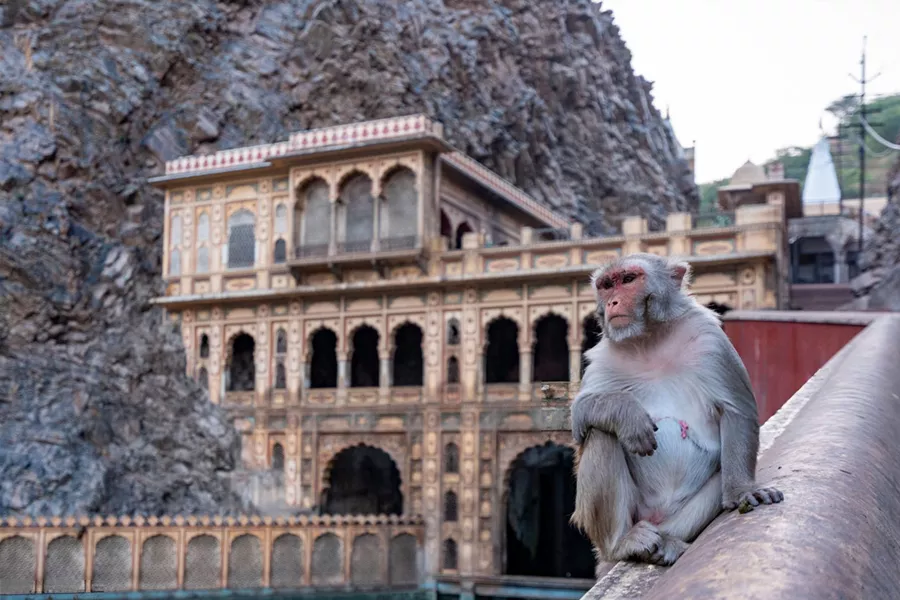
Calling Galtaji “the Monkey Temple” is useful for finding it on a map. It is also the fastest way to misunderstand the place.
The monkeys are real, and there are plenty of them. But pilgrims were coming here long before Jaipur travel blogs began using monkeys as the headline.
Rajasthan Tourism describes Galtaji as an ancient pilgrimage centre set between low hills, filled with temples, pavilions and holy kunds supplied by natural springs. Its Hindi tourism description goes further and identifies the site with Galav Rishi, describing the area as his tapasya or meditation place and highlighting the religious importance of bathing in the kund.
The popular “Monkey Temple” is actually the Ramgopalji temple complex, locally called Galwar Bagh. Above the main valley, a separate hilltop temple dedicated to the Sun God—Surya Mandir—looks over Jaipur.
So a good Galtaji visit has three layers: sacred water, living temples and the hill landscape. The monkeys are simply part of the environment.
How This Galtaji Guide Was Checked
This guide separates government-confirmed information from visitor reports and repeated travel-blog claims. Rajasthan Tourism and Rajasthan Devasthan Department are used for core facts such as Galtaji's pilgrimage importance, holy kunds, Surya Mandir, Galav Rishi association and current development context.
Entry-fee note: because no current Rajasthan Tourism or OBMS tariff was found for normal Galtaji religious access, this page does not present unverified ₹50/₹100/₹200 figures as an official government ticket.
Complete Galtaji Guide
- Entry Fee & OBMS Reality
- Timings & Best Time
- Galav Rishi & Pilgrimage History
- Holy Kunds & Bathing
- Monkey Temple & Safety
- Surya Mandir / Sun Temple
- Temples Inside Galtaji
- Latest Government Development Context
- Foreign Visitor Guide
- Dress, Photography & Etiquette
- How to Reach
- Which Entrance / Route?
- Nearby Places
- FAQs
Galtaji Entry Fee: What Is Actually Official?
Normal access to Galtaji should be understood as a religious pilgrimage/temple visit, not as a standard Rajasthan Archaeology monument ticket.
We did not find a current Rajasthan Tourism page publishing an Indian/foreigner monument tariff for Galtaji, and the site should not be priced using the Rajasthan OBMS rates applicable to Amber, Hawa Mahal or Jantar Mantar.
| Item | How to Treat It |
|---|---|
| Normal temple/pilgrimage access | Do not treat it as an OBMS monument ticket |
| Donation | Voluntary unless you choose a specific religious service |
| Guide | Optional; agree price before starting |
| Photography / professional shoot | Follow current on-site rules |
| Parking / transport | Separate local cost |
| Special facility charge | Pay only at an authorised counter against receipt |
What About the ₹50 / ₹100 / ₹200 Figures Online?
They are inconsistent. Some are described as camera charges, some as donations, some as foreign-tourist charges and some simply repeat another blog. Without an official current tariff supporting one number, they should not be presented as a government entry fee.
If someone asks you for money, ask what the payment is for. A temple donation, private guide service, parking charge and official entry ticket are four different things.
Galtaji Timings: Why One Fixed Table Can Mislead
Galtaji is a complex of active temples, kunds and hill paths rather than one museum building with a single shutter. Different temples can follow their own worship timings, and sunrise/sunset access to hill paths can be affected by season and local management.
Recent visitor sources commonly use a broad daytime window from early morning until early evening. For practical planning:
| Visit | Best Planning Window | Why |
|---|---|---|
| Main Galtaji complex | Morning to late afternoon | Daylight, temple activity and safer walking |
| Pilgrimage / kund visit | Morning | Strongest religious atmosphere |
| Photography | Morning or late afternoon | Softer light |
| Surya Mandir hill walk | Daylight | Uneven paths and animal activity |
If you are going specifically for a ritual, festival, sunrise or sunset, confirm the current gate/temple situation locally rather than relying on an old 5:00 AM–9:00 PM-style table.
Galtaji, Galav Rishi & the Sacred Landscape
Rajasthan Tourism's Hindi Jaipur material identifies Galtaji as the tapasya place of Galav Rishi. The pilgrimage site's name is traditionally connected with the sage.
The site is built around something more fundamental than architecture: water.
Natural springs emerge in this enclosed hill landscape and feed sacred kunds. The presence of reliable water in Rajasthan naturally gave the valley both practical and spiritual importance, and over time temples, pavilions and bathing places developed around it.
How Old Is Galtaji?
The pilgrimage tradition is ancient, but individual temples within the wider complex belong to different periods. Do not assign one single construction year to “Galtaji” as though the entire valley were built in one project.
Rajasthan Devasthan Department's official temple profile for Mandir Shri Sita Ram Ji at Galta Dhaam records that particular temple's establishment in 1504 by Shri Krishna Das Maharaj and notes later remodelling in the period of Mirza Raja Jai Singh of Amer.
That official record is useful precisely because it shows how the larger pilgrimage complex contains individual institutions with their own histories.
Galtaji Holy Kunds: What Visitors Should Understand
Rajasthan Tourism explicitly describes Galtaji's holy kunds as natural springs and water tanks and notes the religious importance of sacred bathing.
A kund is not a decorative swimming pool. For pilgrims, taking a dip can be part of worship and purification.
Should Tourists Bathe?
You should not enter simply because other people are in the water. Observe local practice, signage, water condition, your own health and the sacred nature of the place.
- do not use soap, shampoo or detergent;
- do not throw food, plastic or offerings wrapped in non-biodegradable material into the water;
- do not jump or behave like it is a resort pool;
- respect gender/privacy norms around bathing pilgrims;
- avoid photographing people bathing without explicit permission.
Water Quality
Sacred status does not automatically mean water is microbiologically safe for drinking. Do not drink untreated kund water unless an authorised local source specifically confirms potable water.
Why Is Galtaji Called the Monkey Temple?
Rajasthan Tourism says visitors encounter the Ramgopalji temple complex, locally called the Monkey Temple or Galwar Bagh, because a large group of monkeys lives in the area.
The nickname is therefore real—but it refers to part of the wider Galtaji pilgrimage landscape.
Monkey Safety: What Actually Works
- Keep food hidden. Do not carry fruit or snack packets visibly.
- Do not hand-feed. Feeding encourages grabbing and close contact.
- Do not tease or touch. A monkey posing near you is still a wild animal.
- Secure sunglasses and loose items.
- Do not stare aggressively or corner an animal.
- Give mothers with babies extra space.
- Keep children close.
If a Monkey Takes Something
Do not chase, hit or grab it. Ask a local staff member or experienced authorised guide for help. Protect yourself first; a replaceable object is not worth a bite.
If You Are Bitten or Scratched
Wash the wound thoroughly with soap and running water and seek prompt medical care. Monkey bites and scratches can carry serious infection risks. Do not rely on a temple remedy or wait to see whether the wound becomes painful.
Surya Mandir: The Sun Temple Above Galtaji
Rajasthan Tourism states that a small temple dedicated to the Sun God stands on top of the hill above Galtaji and identifies Diwan Kriparam as its builder.
The Hindi tourism page notes that the temple is revered by Jaipur residents.
Is Surya Mandir the Same as the Monkey Temple?
No. This is one of the biggest naming mistakes online.
- Monkey Temple: popular nickname for the Ramgopalji/Galwar Bagh complex.
- Surya Mandir: the separate hilltop Sun Temple.
- Galtaji: the broader pilgrimage valley/complex.
Should You Walk to the Sun Temple?
Yes if you are comfortable with uphill walking and have enough daylight. The hill gives broader views and helps you understand the geography of Galtaji.
Skip the climb if the temperature is extreme, your mobility is limited or you are carrying small children who are uncomfortable around monkeys.
Temples & Religious Sites Around Galta Dhaam
Galtaji is not one temple. Rajasthan Tourism highlights the Ramgopalji complex and Surya Mandir, while Devasthan Department records numerous temples in the Galta/Galta Ghati area.
Its official Jaipur temple list includes multiple shrines around Galta Ghati, and the Devasthan profile for Shri Sita Ram Ji places that temple at Galta Dhaam, about 8 km by road from Jaipur.
Shri Sita Ram Ji
The Rajasthan Devasthan Department profile associates this temple with the Ramanuja Vaishnava tradition and records an establishment date of 1504 under Shri Krishna Das Maharaj, with later remodelling under Acharya Narayan Dev Ji Maharaj during the period of Mirza Raja Jai Singh of Amer.
This is a good example of why Galtaji deserves more than a “monkeys and selfies” description.
Latest Government Development Context
Rajasthan's current Devasthan Department website lists tender/DPR activity for development works at Temple Shri Galta Ji, Jaipur under the Assistant Commissioner (First), Jaipur.
Rajasthan's Tourism Policy also identifies Galta Ji as one of the state's major spiritual destinations and says spiritual-tourism development should focus on pilgrim waiting areas, parking, pathways, facilities and amenities around important temples.
Best Time of Year to Visit
October–March
Best for comfortable walking and climbing toward Surya Mandir.
July–September
The surrounding hills can become greener and the site visually striking, but rain makes paths slippery.
April–June
Visit early. The hill route can become punishing in midday heat.
Yes, foreign tourists can visit Galtaji. Plan a daytime visit of about 1.5–2.5 hours, dress modestly, keep food hidden from monkeys, treat the kunds as sacred bathing places, and do not assume there is a special foreigner monument ticket unless an authorised counter displays one and provides a receipt.
Galtaji for Foreign & International Tourists
Galtaji can be one of Jaipur's most memorable visits for an international traveller because it is not a staged heritage attraction. It is an active place where worship, bathing, animals and everyday local life overlap.
Foreigner Entry Fee
Do not assume there is a special foreign monument rate simply because Amber and Jantar Mantar have one. We found no current Rajasthan Tourism tariff establishing a standard foreign Galtaji admission.
What International Visitors Should Know
- dress modestly;
- remove shoes where instructed;
- do not photograph bathing pilgrims without consent;
- keep food away from monkeys;
- decline unwanted guide/ritual offers politely;
- agree optional guide fees before starting;
- pay formal charges only against an authorised receipt.
Dress Code, Photography & Respect
Dress
Shoulders and knees should be covered. You are entering active sacred spaces rather than a purely archaeological site.
Footwear
Remove shoes wherever the temple requires it. Carry socks if hot stone or hygiene is a concern, but follow local temple rules.
Photography
Landscape and architecture photography is common, but sacred interiors and bathing areas require more sensitivity. Always follow signs and staff instructions.
Women Travellers
Solo women visit Galtaji, but a daytime visit is preferable. Use a reliable taxi/auto arrangement and avoid isolated hill paths after dark.
Donation & “Blessing” Scams: How to Handle Them Politely
Like many busy pilgrimage places, you may encounter people offering blessings, threads, tilak, food for monkeys or guide services.
The safe approach is simple:
- ask the price before accepting an optional service;
- if you do not want it, say no before the ritual starts;
- do not hand over a wallet or large notes;
- make temple donations at recognised donation boxes/counters where available;
- do not assume pressure from an individual represents the temple authority.
How to Reach Galtaji Jaipur
Galtaji lies on Jaipur's eastern side among the hills. Rajasthan Devasthan Department's Shri Sita Ram Ji profile gives Galta Dhaam a road distance of about 8 km from Jaipur.
From Hawa Mahal / Badi Chaupar
Auto-rickshaw or taxi is the easiest practical option. Galtaji combines naturally with Sisodia Rani Garden and Vidyadhar Garden.
From Jaipur Railway Station
Use a taxi/auto. Devasthan Department's temple profile places Jaipur railway station roughly 10 km from the Galta Dhaam temple area.
From Jaipur Airport
Taxi is easiest. Devasthan Department's profile gives Sanganer/Jaipur airport roughly 20 km from the Galta Dhaam Sita Ram Ji temple.
By Metro
Jaipur Metro does not take you to Galtaji. Badi Chaupar is useful for reaching the old-city side before continuing by auto/taxi.
Which Galtaji Route Should You Take?
Visitors often discover that “Galtaji” and “Sun Temple” map pins can lead to different approaches.
Main Pilgrimage / Kund Side
Use this if your priority is the sacred kunds, temple complex and Ramgopalji/Monkey Temple.
Hill / Surya Mandir Side
Useful if you specifically want the Sun Temple and hill views, but walking connections and gradients should be considered.
Say whether you want Galta Ji main kund/Monkey Temple complex or Surya Mandir hilltop. Do not assume every driver will use the same map pin.
Parking & Return Transport
Parking/access arrangements can shift with pilgrim crowds and development work. If arriving by auto or taxi, consider arranging a waiting/return plan rather than assuming a vehicle will be immediately available at every exit.
Places to Visit Near Galtaji
| Place | Why Combine It | Typical Time |
|---|---|---|
| Sisodia Rani Garden | Same eastern Jaipur route | 45–90 minutes |
| Vidyadhar Garden | Near Sisodia Garden / Ghat Ki Guni | 45–75 minutes |
| Hawa Mahal | Easy return to old city | Photo stop or paid interior |
| City Palace | Royal history after spiritual visit | 2–3 hours |
| Jantar Mantar | Old-city UNESCO observatory | 60–90 minutes |
Best Galtaji Half-Day Itinerary
Option 1: Best Morning Route
| Time | Plan |
|---|---|
| 7:30/8:00 AM | Galtaji main complex and kunds |
| 9:30 AM | Surya Mandir if weather and mobility allow |
| 10:30/11:00 AM | Sisodia Rani Garden |
| 12:00 PM | Vidyadhar Garden or return to old Jaipur |
Option 2: Spiritual + Old City
Galtaji early → return to Badi Chaupar → Govind Dev Ji → Jantar Mantar / City Palace.
Is Galtaji Worth Visiting?
Yes, if you want a Jaipur experience beyond palaces and fort tickets.
Come for:
- living religious culture;
- sacred-water traditions;
- hill architecture;
- photography;
- the Surya Mandir walk;
- an eastern-Jaipur half day;
- a place that feels very different from Amber or City Palace.
Skip or shorten it if you are uncomfortable around monkeys, have serious mobility limitations or only have a very rushed single day in Jaipur.
18 Galtaji Mistakes to Avoid
- Calling the entire site only “Monkey Temple”.
- Looking for an Amber-style OBMS ticket.
- Publishing donations or camera charges as official admission.
- Hand-feeding monkeys.
- Carrying visible food near monkeys.
- Trying to pet a baby monkey.
- Chasing a monkey that takes an object.
- Ignoring a bite or scratch.
- Drinking untreated kund water.
- Using soap in sacred kunds.
- Photographing bathing pilgrims without permission.
- Walking isolated hill paths after dark.
- Wearing poor footwear on the Surya Mandir climb.
- Arriving in midday May heat.
- Accepting an optional ritual without first understanding it.
- Confusing Surya Mandir with Ramgopalji Monkey Temple.
- Using one construction date for the entire pilgrimage complex.
- Assuming current development works automatically create a new entry fee.
Official & Reliable Sources
- Rajasthan Tourism — Jaipur / Galtaji
- Rajasthan Tourism — Religious Places / Galtaji
- Rajasthan Devasthan Department
- Devasthan Department — Shri Sita Ram Ji, Galta Dhaam
- Rajasthan OBMS — for ticketed monuments, not normal Galtaji darshan
Related Jaipur Guides
- Sisodia Rani Garden Jaipur Complete Guide
- Vidyadhar Garden Jaipur Complete Guide
- Govind Dev Ji Temple Jaipur Guide
- Jaipur Complete Travel Guide
- Jaipur Monument Tickets & Timings
Galtaji Jaipur FAQs
Is Galtaji entry free?
Galtaji is an active pilgrimage complex, not a standard OBMS-ticketed monument. Normal religious access should not be confused with optional donations, guide fees or other services. Pay any formal charge only at an authorised counter against a receipt.
Is there a foreigner ticket?
We found no current Rajasthan Tourism tariff establishing a standard foreign monument admission for Galtaji. Do not accept a random “foreigner entry fee” as official without a receipt.
What is the Monkey Temple?
Rajasthan Tourism says the Ramgopalji temple complex, locally known as Galwar Bagh, is popularly called the Monkey Temple because of the resident monkeys.
Is the Sun Temple the Monkey Temple?
No. Surya Mandir is a separate small Sun Temple on top of the hill. The Monkey Temple nickname refers to the Ramgopalji complex.
Who built Surya Mandir?
Rajasthan Tourism identifies Diwan Kriparam as its builder.
Who was Galav Rishi?
Rajasthan Tourism's Hindi material describes Galtaji as the sage Galav's place of tapasya.
Are the kunds natural?
Rajasthan Tourism describes the site as having holy kunds fed by natural springs.
Can I swim in the kunds?
Treat them as sacred pilgrimage tanks, not recreational swimming pools. Follow current local rules and do not contaminate the water.
Can I drink the kund water?
Do not drink untreated water unless an authorised local source confirms it is potable.
Are monkeys dangerous?
They are wild animals. Most visits are fine when visitors keep food hidden, avoid touching/feeding them and give them space.
What if a monkey bites me?
Wash the wound thoroughly with soap and running water and seek prompt medical attention.
How much time do I need?
About 1.5–2.5 hours for the main complex; more if climbing to Surya Mandir.
What are Galtaji timings?
It is best planned as a daytime temple visit. Individual temple timings and hill access can vary, so check locally for a specific sunrise, sunset or festival visit.
What is the best time of day?
Morning is best for pilgrimage atmosphere, cooler walking and lower heat.
Can foreign tourists visit?
Yes. Dress modestly and behave respectfully because it is an active religious site.
Is Galtaji safe for women travellers?
Daytime visits are preferable. Use reliable transport and avoid isolated hill routes after dark.
Can I visit with children?
Yes, but keep young children close around monkeys, steps and kunds.
Can senior citizens visit?
The main complex can be visited selectively, but the hilltop Surya Mandir climb may be unsuitable for people with limited mobility.
How far is Galtaji from Jaipur?
Rajasthan Devasthan Department's Shri Sita Ram Ji profile lists Galta Dhaam at about 8 km road distance from Jaipur.
What is the nearest metro?
There is no metro station at Galtaji. Badi Chaupar is useful for the old-city side, followed by auto/taxi.
Can I combine Galtaji with Sisodia Rani Garden?
Yes. They are one of Jaipur's most logical eastern-side combinations.
Is Galtaji being developed by the government?
Rajasthan Devasthan Department currently lists DPR/development-related work for Temple Shri Galta Ji Jaipur, while Rajasthan Tourism policy identifies Galta Ji as a major spiritual destination for improved pilgrim infrastructure.
Official Information & Last-Minute Verification
Temple access, hill routes, local charges, festival-day arrangements and development works can change. Before a special sunrise, sunset or festival visit, verify current conditions with Rajasthan Tourism, Rajasthan Devasthan Department or authorised on-site management. Treat informal guide fees, donations, parking and photography charges separately from any official admission.
Final Advice
If you visit Galtaji only to photograph monkeys, you will miss the place.
Look at the valley first. Natural springs. Sacred kunds. Temples gathered around water. Pilgrims bathing. A hilltop Sun Temple. Centuries of religious institutions in and around Galta Dhaam. The monkeys belong to that landscape; they are not the reason it exists.
For current practical planning, do not force Galtaji into an OBMS monument template. Normal temple access is not the same as a Rajasthan Archaeology ticket. Treat donations and optional services separately, visit in daylight, keep food away from monkeys, respect people using the kunds for worship and give yourself enough time to see more than the first courtyard.