Jantar Mantar Jaipur Complete Guide 2026: Latest Ticket Price, Timings, 19 Instruments, UNESCO & Visitor Tips
Jantar Mantar Jaipur: Quick Answers
- Indian Adult ticket: ₹100 under the revised 2026 tariff.
- Indian Student: ₹50.
- Foreign Adult: ₹600.
- Foreign Student: ₹300.
- Official Rajasthan Tourism timing: 9:00 AM–7:00 PM.
- Last ticket: 6:30 PM.
- UNESCO: World Heritage Site.
- Number of instruments: Rajasthan Tourism lists 19.
- Known for: monumental naked-eye astronomical instruments and the giant Samrat Yantra sundial.
- Best combination: City Palace + Jantar Mantar + Hawa Mahal.
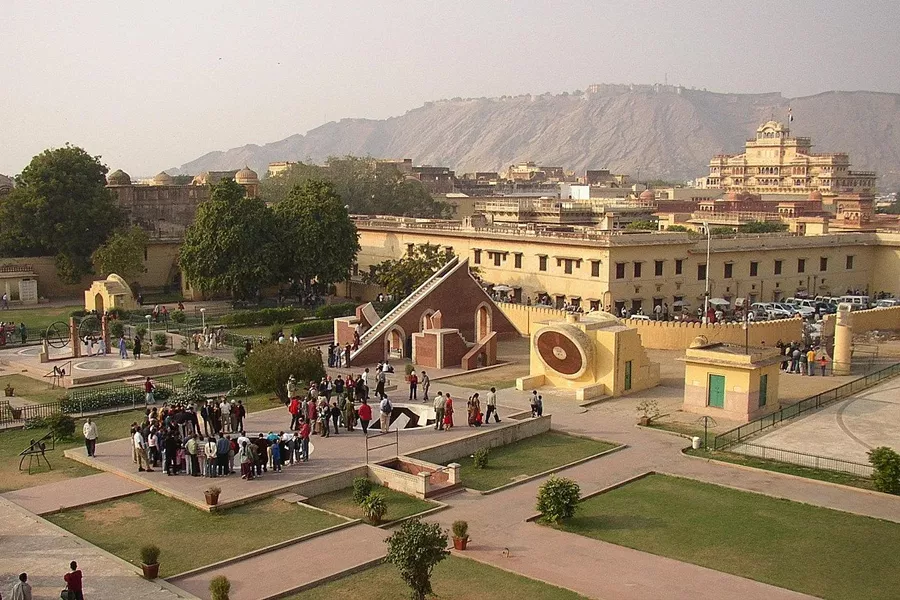
Jantar Mantar is probably Jaipur's most misunderstood major monument.
Visitors walk in, see giant geometric walls and ramps, take a few photographs, and leave wondering why the place is UNESCO-listed. That happens because Jantar Mantar is not designed to impress you in the same way as Amber's Sheesh Mahal or Hawa Mahal's facade. It was designed to measure.
Time. The position of the sun. The coordinates of celestial bodies. The movement of the heavens across a mathematical framework built in stone.
UNESCO calls Jaipur's Jantar Mantar the most significant, most comprehensive and best-preserved of India's historic observatories. Rajasthan Tourism says its collection contains 19 astronomical instruments, designed to interpret celestial positions and calculate local time.
That is why the worst way to visit is to rush through in 20 minutes. The best way is to understand three or four instruments properly. Once one makes sense, the whole site changes.
Jantar Mantar Jaipur Guide Contents
Jantar Mantar Jaipur Ticket Price 2026
Rajasthan revised entry charges for state-run monuments from 1 January 2026. For Jantar Mantar, use the following current planning tariff:
| Visitor Category | 2026 Ticket | What to Carry |
|---|---|---|
| Indian Adult | ₹100 | Valid ID if requested |
| Indian Student | ₹50 | Valid student ID |
| Foreign Adult | ₹600 | Passport / travel ID if requested |
| Foreign Student | ₹300 | Valid student and travel ID |
Why Does Rajasthan Tourism Still Show ₹50 / ₹200?
The Rajasthan Tourism Jantar Mantar page currently shows the previous adult tariff of ₹50 Indian and ₹200 foreign. Its history, timing and monument description are still useful, but its displayed ticket field has not caught up with the 2026 fee revision.
This is exactly why monument articles should not blindly copy one government webpage forever. For the final payment amount, use the Rajasthan Government OBMS Tourist Portal.
Jaipur Composite Ticket vs Individual Jantar Mantar Ticket
If Jantar Mantar is the only state monument you are entering, the individual ticket is straightforward. If you are also visiting several government-managed attractions, compare the current composite products first.
Rajasthan introduced revised composite and statewide combined ticket structures in 2026. Because validity and inclusions can differ, read the exact OBMS product rather than assuming every “Jaipur composite ticket” mentioned online is the same pass.
Jantar Mantar Jaipur Timings 2026 — Official Rajasthan Tourism
Rajasthan Tourism's current page lists:
| Visitor Information | Official Published Time |
|---|---|
| Opening | 9:00 AM |
| Closing | 7:00 PM |
| Last Ticket | 6:30 PM |
Best Time to Visit
Morning is the easiest time to understand the instruments because the site is cooler and large groups are generally lighter. It is also useful to have visible sunlight—many instruments are fundamentally easier to explain when you can see what the sun and shadows are doing.
How Long Should You Keep?
| Time | Experience |
|---|---|
| 30 minutes | Quick visual visit; not ideal for understanding |
| 60 minutes | Good first visit with main instruments |
| 90 minutes | Best for guide/audio interpretation and photography |
| 2 hours | For astronomy/history enthusiasts |
Why Is Jantar Mantar Jaipur a UNESCO World Heritage Site?
UNESCO describes the Jaipur observatory as an early eighteenth-century astronomical observation site with around twenty major fixed instruments, built for naked-eye observations of astronomical positions.
More importantly, UNESCO says it is the most significant, most comprehensive and best-preserved set of historic observatory instruments in India.
UNESCO Criteria
The property is recognised under criteria (iii) and (iv). UNESCO emphasises the meeting of scientific traditions, cosmology, observation of the universe and monumental architectural innovation.
It also highlights the role of Sawai Jai Singh II's court as a meeting point for different scientific cultures.
Protected Monument Status
UNESCO records that Jantar Mantar is protected under Rajasthan's monuments legislation and was designated a monument of national importance in 1968.
Who Built Jantar Mantar Jaipur?
The observatory is associated with Maharaja Sawai Jai Singh II, Jaipur's founder and one of early eighteenth-century India's best-known royal patrons of astronomy.
Rajasthan Tourism describes Jaipur's Jantar Mantar as completed in 1734. UNESCO places its construction broadly in the early eighteenth century.
Jai Singh was interested in improving astronomical calculations. Instead of relying only on small metal instruments, his observatories scaled astronomical geometry into large masonry structures. Larger instruments allowed graduations and shadows to be read more precisely under the observational methods of the period.
Was Jaipur the Only Jantar Mantar?
No. Jai Singh established observatories at several locations. Jaipur is the most complete and best preserved, which is one reason UNESCO significance is so strong here.
Samrat Yantra: The Giant Sundial
Samrat Yantra is the instrument most visitors remember. Rajasthan Tourism describes Jantar Mantar as home to the world's largest stone sundial, and UNESCO notes that some Jaipur instruments are the largest ever built in their categories.
The large triangular gnomon casts a shadow on calibrated curved surfaces, allowing observers to estimate local solar time.
Why Bigger Helps
A larger instrument spreads a measurement over a longer physical scale. In simple terms, a tiny change in the sky produces a larger visible change on the instrument, making fine readings easier.
Do Not Expect Your Watch and Sundial to Match Exactly
A sundial measures local apparent solar time. Modern Indian Standard Time is a standardised clock system based on a national reference longitude. Seasonal astronomical effects also matter. A guide can explain why the difference is scientifically interesting rather than an “error”.
Important Jantar Mantar Instruments to Understand
1. Samrat Yantra
The monumental sundial and one of the observatory's most recognisable structures.
2. Laghu Samrat Yantra
A smaller sundial useful for understanding the basic principle before confronting the scale of the larger Samrat Yantra.
3. Jai Prakash Yantra
A bowl-like instrument with marked surfaces designed to map celestial coordinates. It is one of the most visually unusual instruments in the complex.
4. Ram Yantra
Cylindrical structures used for measuring altitude and azimuth of celestial objects.
5. Chakra Yantra
Rajasthan Tourism describes it as a ring instrument used to measure coordinates and the hour angle of the sun.
6. Digamsa
Rajasthan Tourism describes Digamsa as a pillar within concentric circular structures used in relation to sunrise and sunset direction/timing observations.
7. Nadivalaya
A paired circular instrument facing north and south, representing the two hemispheres and used in solar observation.
8. Kranti Vritta
An instrument associated with measuring solar position and celestial coordinates.
9. Rashi Valaya
A group of instruments connected with zodiacal measurements. These are particularly interesting because the observatory intersects astronomy, calendrical practice and astrology as understood in Jai Singh's period.
Do All 19 Instruments Still Work?
Jantar Mantar is maintained as a monument rather than a modern research observatory. However, its instruments were designed around real astronomical geometry, and demonstrations can still show how shadows, angles and sight lines relate to celestial observation.
UNESCO also notes that authenticity of the astronomical function remains strong even though individual surfaces, plaster, graduations and some components have undergone restoration over time.
Should You Hire a Guide at Jantar Mantar?
If you are going to hire a guide at only one old-city Jaipur attraction, Jantar Mantar is a strong candidate.
Rajasthan Tourism explicitly notes that visitors can hire a guide and that audio guides are also available.
Without a Guide
The site can look like abstract architecture.
With Good Interpretation
You begin to see each structure as a measuring device: this edge aligns with a direction, this curved surface records an angle, this shadow represents time.
Ask the Guide to Demonstrate, Not Lecture
The most useful question is not “tell me the history.” Ask:
- What exactly does this instrument measure?
- Where should I stand?
- What do I look at?
- What would the observer record?
- Why did Jai Singh build this so large?
Jantar Mantar for Foreign & International Tourists
The revised 2026 rate is ₹600 for Foreign Adult and ₹300 for Foreign Student.
For an international visitor, Jantar Mantar is often more rewarding with explanation because the scientific and cultural context is unfamiliar even when the geometry looks intuitive.
Carry
- passport / accepted travel ID;
- student card if using the ₹300 student category;
- water in warm weather;
- sun protection;
- comfortable shoes.
Best Foreign-Visitor Combination
City Palace → Jantar Mantar → Hawa Mahal works exceptionally well because the sites are close together but represent completely different sides of Jaipur: royal court, science and urban ceremonial architecture.
Student Tickets 2026
The revised student rates are:
- Indian Student: ₹50.
- Foreign Student: ₹300.
Carry a current student identity card. Do not assume that simply being below a certain age automatically qualifies for a student category if the ticketing system asks for proof.
Jantar Mantar with Children & Senior Citizens
Children
Jantar Mantar works surprisingly well for older children when the guide turns it into a practical puzzle: “Can we tell the time from this shadow?” is much more engaging than a 15-minute lecture on eighteenth-century astronomy.
Senior Citizens
The site is generally easier than Jaipur's hill forts because it is comparatively compact and level, although outdoor heat can be demanding. Morning is preferable.
Accessibility
It is an open-air heritage complex with fixed masonry instruments. Access conditions can vary around individual structures and platforms. If wheelchair access is essential, ask staff for the most practical visitor route before beginning.
Photography at Jantar Mantar
Best Subjects
- Samrat Yantra's strong geometry;
- curves of Jai Prakash Yantra;
- repeating forms of Rashi Valaya;
- people for scale against giant instruments;
- shadow lines;
- City Palace architectural context around the observatory.
Best Light
Morning gives cleaner light and is easier physically. Midday creates stronger shadows, which can actually make some instrument geometry visually clearer, but the heat is harsher.
Commercial Photography
Ordinary visitor photography and professional/commercial production can follow different permission rules. Ask monument staff before using professional lighting, large tripods or organised shoots.
Best Season
October–March
Best overall for comfortable outdoor interpretation.
April–June
Go early. The observatory is exposed and stone surfaces radiate heat.
July–September
Cloud can reduce direct sun and make some shadow-based demonstrations less obvious, but cooler monsoon periods can still be pleasant.
How to Reach Jantar Mantar Jaipur
Jantar Mantar sits in the historic old city beside City Palace.
By Metro
Badi Chaupar is the most useful Pink Line station for the City Palace–Jantar Mantar–Hawa Mahal cluster.
By Auto-Rickshaw
Ask for “Jantar Mantar / City Palace”. Both are major landmarks and easy for local drivers to identify.
By Taxi / App Cab
Useful from hotels outside the walled city. The exact drop point can vary because of traffic and pedestrian restrictions.
Walking from City Palace
Jantar Mantar is immediately adjacent to City Palace. Do not book a car just to travel between the two.
Places to Visit Near Jantar Mantar
| Attraction | Why Combine It | Ticket System |
|---|---|---|
| City Palace | Directly beside observatory | Separately managed palace ticket |
| Hawa Mahal | Short old-city walk | Rajasthan Government monument |
| Govind Dev Ji Temple | Living royal-city religious tradition | Temple darshan; no OBMS monument ticket |
| Isarlat / Sargasuli | Elevated old-city viewpoint | State-managed monument |
| Tripolia / Johari Bazaar | Shopping and old-city street life | Free public market |
Best Jantar Mantar Old-City Itinerary
| Time | Suggested Plan |
|---|---|
| 8:30 AM | Hawa Mahal facade photography |
| 9:00 AM | Jantar Mantar |
| 10:15/10:30 AM | City Palace |
| 12:30/1:00 PM | Lunch / old-city break |
| Afternoon | Isarlat, bazaar or Albert Hall depending interest |
Jantar Mantar vs Delhi Jantar Mantar
Jaipur's observatory is the one UNESCO identifies as the most significant, comprehensive and best preserved of India's historic observatories.
If you have already seen Delhi's Jantar Mantar, Jaipur is still worth visiting because the scale, preservation and range of instruments are substantially stronger.
15 Jantar Mantar Mistakes to Avoid
- Using Rajasthan Tourism's old ₹50/₹200 tariff without checking the 2026 revision.
- Skipping the site because it “looks like shapes”.
- Rushing through in 20 minutes without understanding one instrument.
- Visiting at midday in May without water.
- Not carrying student ID.
- Calling every instrument a sundial.
- Assuming modern clock time should match local solar time exactly.
- Skipping Jai Prakash or Ram Yantra because Samrat Yantra is larger.
- Hiring a guide who only recites dates instead of demonstrating instruments.
- Driving between Jantar Mantar and City Palace.
- Confusing City Palace's ticket with Rajasthan Government tickets.
- Buying a composite pass without reading its current inclusions and validity.
- Climbing onto restricted instrument surfaces for photos.
- Using commercial equipment without checking permission.
- Leaving without looking at the observatory as a complete scientific system.
Official & Reliable Sources
- Rajasthan Tourism — Jantar Mantar Jaipur
- Rajasthan Government OBMS — Official Monument Booking
- UNESCO World Heritage Centre — The Jantar Mantar, Jaipur
- Rajasthan Tourism — Jaipur
Related Jaipur Guides
- City Palace Jaipur Complete Guide
- Hawa Mahal Jaipur Complete Guide
- Isarlat Sargasuli Jaipur Guide
- Amber Fort Jaipur Complete Guide
- Jaipur Monument Ticket Prices & Timings
- Jaipur Complete Travel Guide
Jantar Mantar Jaipur FAQs
What is Jantar Mantar Jaipur ticket price for Indians?
The revised 2026 Indian Adult rate is ₹100.
What is the Indian student ticket?
₹50 with valid student proof.
What is the foreign tourist ticket?
₹600 for Foreign Adult under the revised 2026 tariff.
What is the foreign student ticket?
₹300 with valid student identification.
Why does Rajasthan Tourism show ₹50 / ₹200?
Its current descriptive page still displays the older adult tariff. Rajasthan monument fees were revised from 1 January 2026. Use the live OBMS amount at payment.
What are official timings?
Rajasthan Tourism currently lists 9:00 AM–7:00 PM with the last ticket at 6:30 PM.
Is Jantar Mantar UNESCO listed?
Yes. It is a UNESCO World Heritage Site.
How many instruments are there?
Rajasthan Tourism lists 19 astronomical instruments.
What is the biggest instrument?
Samrat Yantra is the famous monumental sundial and one of the site's largest structures.
Does Jantar Mantar still work?
The site is maintained as a monument rather than a modern science centre, but the instruments were built using real astronomical geometry and can still demonstrate observational principles.
How long do I need?
60–90 minutes is ideal for most first-time visitors.
Do I need a guide?
Not mandatory, but strongly useful because the site is scientific rather than decorative.
Are audio guides available?
Rajasthan Tourism states that audio guides are available.
Can children enjoy Jantar Mantar?
Yes, particularly when a guide demonstrates shadows, time and angles rather than only explaining history.
Is it suitable for senior citizens?
Generally yes. It is easier than hill forts, but it is an outdoor site and can be hot.
What is nearest metro?
Badi Chaupar on Jaipur Metro's Pink Line.
Can I walk from City Palace?
Yes. The two attractions are immediately adjacent.
Can I visit Hawa Mahal on the same trip?
Yes. Hawa Mahal, Jantar Mantar and City Palace are Jaipur's most logical old-city cluster.
Is City Palace included in Jantar Mantar ticket?
No. City Palace is independently managed and uses separate tickets.
Can I buy Jantar Mantar ticket online?
Rajasthan Tourism says tickets can be purchased at the entrance or online; use the Rajasthan Government OBMS portal for the live government product.
Final Advice
Jantar Mantar is not a monument you merely look at. It is a monument you decode.
Spend an hour. Understand Samrat Yantra. Then understand one bowl instrument and one cylindrical instrument. Ask why the structures are so large and how an observer converts shadow or alignment into a measurement. Once that clicks, the UNESCO status stops feeling abstract.
For 2026, also use the correct tariff logic: the revised rates are ₹100 Indian Adult, ₹50 Indian Student, ₹600 Foreign Adult and ₹300 Foreign Student. Rajasthan Tourism's descriptive page still displays an older tariff, so the live OBMS screen should be your final payment reference.