Jagat Shiromani Temple Amer Jaipur: Meera Bai Temple History, Timings, Entry & Complete Visitor Guide
Jagat Shiromani Temple: Quick Facts
- Location: Amer, Jaipur district.
- Government record: Rajasthan Devasthan Department lists Mandir Shri Jagat Shiromaniji at Amer.
- Built: 1599–1608 AD; government profile records completion in 1608.
- Builder: Queen Shringar Devi Kanakawati, wife of Raja Man Singh I.
- Why built: in memory of her son Jagat Singh.
- Deities: Lord Vishnu/Krishna and Meera Bai association.
- Distance: Devasthan profile gives about 8 km road distance from Jaipur.
- Architecture: white marble, black stone/local stone, carved elephants, horses, Puranic scenes and a two-storeyed mandapam.
- Best combination: Jagat Shiromani + Amber Fort + Panna Meena ka Kund.
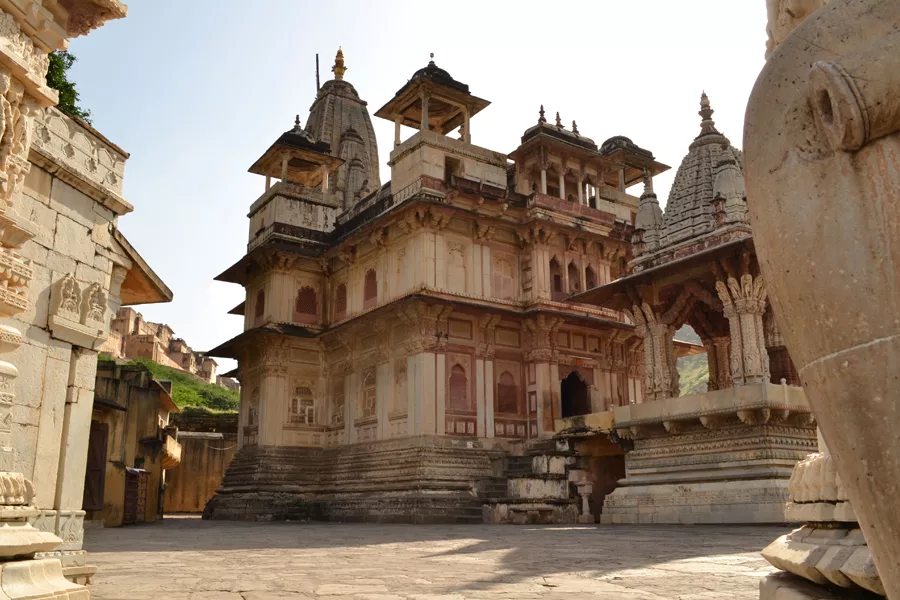
Most people arrive in Amer looking uphill. Amber Fort dominates the skyline, so the lanes below it become something to pass through. Jagat Shiromani rewards the traveller who looks down, slows down and walks inside.
This is not a newly invented “hidden gem.” Rajasthan's own Devasthan Department has a dedicated government temple profile for Mandir Shri Jagat Shiromaniji, while Rajasthan Tourism includes it among Jaipur's attractions. Both government sources preserve the same essential story: a temple at Amer built by Queen Kanakwati around the turn of the seventeenth century in memory of her son Jagat Singh.
Its second story is devotional rather than architectural. Rajasthan Tourism says the temple houses Lord Krishna, Lord Vishnu and Meera Bai and records the tradition that the Krishna image here is connected with the image worshipped by the celebrated poet-saint Meera Bai in Mewar.
Complete Guide
Jagat Shiromani Temple Entry Fee & OBMS Ticket
Jagat Shiromani is an active Hindu temple. In the current Rajasthan Devasthan and Rajasthan Tourism records checked for this update, we found no published Indian-versus-foreigner OBMS monument tariff for normal temple darshan.
| Item | Latest Verified Position |
|---|---|
| Normal temple darshan | No government monument tariff found in official sources checked |
| Indian visitor | Do not invent an OBMS ticket |
| International visitor | No separate official foreign monument tariff found |
| Donation | Separate from entry |
| Guide / ritual service | Optional; confirm price first |
If a future official tariff is introduced, use the rate displayed by the authorised authority/counter on the day. Do not convert a donation into an “entry fee.”
Jagat Shiromani Temple Timings
The official government profiles we checked establish the temple's identity and history but do not publish a current daily darshan timetable. Recent 2026 visitor references commonly report a morning and evening schedule, with an afternoon closure; reported hours vary, so exact current darshan hours should be confirmed locally if you are travelling specifically for worship.
For a sightseeing visit, morning is the safest choice: it combines well with Amber Fort, temperatures are lower, and the carved entrance is easier to appreciate before Amer becomes busy.
The Story Behind Jagat Shiromani Temple
Rajasthan Devasthan Department records the temple as built in 1608 AD by Queen Shringar Devi Kanakawat. Its detailed profile says construction took place from 1599 to 1608 AD.
The queen was the wife of Raja Man Singh and commissioned the temple in memory of her son, Jagat Singh. This is why the monument feels both royal and personal: it was an act of religious patronage shaped by a mother's memorial to her son.
Rajasthan Tourism independently gives the same 1599–1608 period and identifies Queen Kanakwati, wife of King Man Singh I, as the builder.
Why Is It Called Meera Bai Temple?
Rajasthan Tourism says the temple houses idols of Lord Krishna, Lord Vishnu and Meera Bai. It also carefully frames the famous Krishna-idol story as a tradition: according to old religious accounts, the image is associated with the deity worshipped by Meera Bai in Mewar.
That wording matters. A good heritage guide should distinguish documented construction history from devotional tradition rather than turning a sacred legend into an unsupported archaeological claim.
Who Was Meera Bai?
Meera Bai was one of India's best-known Krishna bhakti poet-saints. Her devotional compositions and life tradition centre on an intensely personal devotion to Krishna. The Amer temple's Meera association gives visitors a bridge between Rajasthan's royal history and the wider Bhakti tradition.
Jagat Shiromani Architecture: Look Beyond the Main Shrine
Rajasthan Tourism describes the temple as an unusual blend of Jain, Hindu, Mughal and South Indian architectural influences. The Rajasthan Devasthan profile confirms the use of locally available stone, white marble and black stone.
Carved Narrative Surfaces
The official Devasthan description specifically mentions trumpeting elephants, horses, scenes from the Puranas, figures and social scenes arranged across the structure. These are not decoration to rush past: they are one of the main reasons to visit.
Two-Storeyed Mandapam
The Devasthan profile notes that the temple's mandapam is two storeys high, giving the shrine a more palatial vertical presence than many smaller temples in Amer's lanes.
The Marble Toran
The ornamental toran at the entrance is the architectural feature visitors remember most. It creates a ceremonial transition from Amer's street into the temple court. Examine its carving before moving toward the sanctum.
What to See Inside
- Entrance and toran: pause before walking through.
- Raised temple composition: step back to understand the full elevation.
- Mandapam: notice its scale and carved supports.
- Elephants and horses: specifically documented in the government temple profile.
- Puranic and social scenes: look across walls and ceilings rather than only at the sanctum.
- Krishna/Vishnu shrine: remember this remains a place of worship.
- Meera Bai association: understand the devotional tradition rather than reducing it to a photo caption.
How Long Do You Need?
| Type of Visit | Allow |
|---|---|
| Quick stop | 20–30 minutes |
| Architecture + darshan | 45–60 minutes |
| Slow photography/history visit | 60–90 minutes |
Best Time of Year
October to March is easiest for walking through Amer. In April–June, visit early because the stone lanes and open courtyards become hot. During monsoon, Amer's hills can look beautiful but surfaces may be slippery.
Janmashtami & Festival Visits
As a Krishna temple, Janmashtami is naturally a significant devotional period. Festival visits can offer a richer religious atmosphere but also bring larger crowds and altered worship arrangements. Confirm current temple timings locally on festival days.
Guide for Foreign & International Visitors
International visitors can appreciate Jagat Shiromani as both a living temple and a heritage site. There is no need to approach it as an Amber Fort ticket extension.
- wear clothing covering shoulders and knees;
- remove footwear where instructed;
- do not interrupt worship for photographs;
- ask before photographing people closely;
- follow any no-photography rule near the sanctum;
- do not assume a donation request is an official foreigner ticket.
Photography Tips
Morning light is useful for the entrance, toran and courtyard. A wide-angle view helps with the raised temple composition, while details of carved animals and figures reward a longer lens or phone zoom. Never let photography interfere with prayer.
How to Reach Jagat Shiromani Temple
The Rajasthan Devasthan profile places the temple in Amer and gives a road distance of about 8 km from Jaipur, with Jaipur railway station about 10 km and Jaipur airport about 20 km away.
From Amber Fort
Jagat Shiromani lies in Amer town below the fort and is best treated as part of the same heritage walk/drive rather than a separate cross-city excursion.
From Jaipur Old City
Taxi, cab or auto-rickshaw toward Amer is simplest. If your day already includes Jal Mahal and Amber Fort, add Jagat Shiromani to that same north-Jaipur route.
By Public Transport
Local buses run toward Amer, but a taxi/auto is easier if you are combining several sites or travelling with family.
Best Amer Route
| Order | Stop | Why |
|---|---|---|
| 1 | Amber Fort | Main UNESCO hill-fort experience |
| 2 | Jagat Shiromani Temple | Royal memorial + Krishna/Meera tradition |
| 3 | Panna Meena ka Kund | Historic stepwell nearby |
| 4 | Jal Mahal viewpoint | Easy stop while returning toward Jaipur |
Why Jagat Shiromani Is Worth Adding Even on a One-Day Jaipur Tour
It adds something Amber Fort cannot. The fort explains royal power; Jagat Shiromani reveals royal grief, devotion and craftsmanship at a more intimate scale. Because the temple is close to Amber, the extra time required is small compared with the historical value gained.
Common Mistakes to Avoid
- Driving past because Amber Fort is the only pin on your itinerary.
- Inventing an OBMS ticket price from a blog.
- Presenting a donation as mandatory entry.
- Calling the Meera-linked Krishna image an archaeologically proven fact instead of a temple tradition.
- Photographing only the sanctum and missing the toran and carvings.
- Visiting in peak summer midday heat.
- Ignoring temple dress and footwear etiquette.
- Assuming Amber Fort admission includes or controls temple darshan.
Official Sources
- Rajasthan Devasthan Department — Jagat Shiromani Temple Profile
- Rajasthan Tourism — Jaipur / Jagat Shiromani
- Rajasthan Devasthan Department — Jaipur Temples
- Rajasthan OBMS — Official Monument Booking Portal
Related Jaipur Guides
- Amber Fort Jaipur Complete Guide
- Jal Mahal Jaipur Guide
- Govind Dev Ji Temple Guide
- Galtaji Monkey Temple Guide
- Jaipur Complete Travel Guide
Jagat Shiromani Temple FAQs
Who built Jagat Shiromani Temple?
Rajasthan Devasthan Department says Queen Shringar Devi Kanakawati, wife of Raja Man Singh, built it in memory of her son Jagat Singh.
When was it built?
Construction is officially recorded from 1599 to 1608 AD, with 1608 listed as the completion year.
Why is it called Meera Bai Temple?
Rajasthan Tourism records Meera Bai among the figures housed/honoured here and preserves the tradition connecting the Krishna image with the deity she worshipped in Mewar.
Is entry free?
The government sources checked do not publish a normal Indian/foreigner OBMS monument tariff. Do not confuse donations or optional services with an official ticket.
What are the temple timings?
The government profiles checked do not provide a current daily timetable. Recent visitor sources report morning and evening darshan with an afternoon closure, so confirm locally when timing is critical.
How far is it from Jaipur?
Rajasthan Devasthan Department gives a road distance of approximately 8 km from Jaipur.
Is it near Amber Fort?
Yes. It is in Amer and is an excellent addition to an Amber Fort visit.
What should architecture lovers see?
The carved toran, two-storeyed mandapam, white marble/black stone work, elephants, horses and narrative Puranic/social carvings.
Can foreigners visit?
Yes. Respect normal Hindu temple etiquette and current photography/footwear rules.
How much time is enough?
About 45–60 minutes is comfortable for architecture and darshan; allow longer if studying carvings or photographing the complex.
Final Advice
Jagat Shiromani is one of those Amer places where a small detour produces a disproportionately good experience. Its value is not a fabricated “secret temple” label. The documented story is already strong enough: a queen commissioned it between 1599 and 1608 in memory of her son; Rajasthan's government temple record preserves its material and architectural details; Rajasthan Tourism records its Krishna, Vishnu and Meera Bai connection.
Visit it with Amber Fort, but do not treat it as an Amber Fort annex. Give the toran, mandapam and carvings their own time, respect the living shrine, and separate documented history from devotional tradition. That is the most useful way to understand Jagat Shiromani.