Maharani Ki Chhatriyan Jaipur: Complete Guide to the Royal Queens' Cenotaphs
Maharani Ki Chhatriyan: Quick Visitor Guide
- What is it? Jaipur's historic funeral and memorial precinct for women of the royal family.
- Official Rajasthan Tourism name: Maharani Ki Chhatri (Memorials of Queens).
- Location: on the Jaipur–Amber route, before the Ramgarh Road crossing.
- Current ticket: recent sources commonly report about ₹30, but no current dedicated Rajasthan Tourism tariff or verifiable OBMS place-details ticket was found in our August 2026 check; confirm at the counter.
- Timing: commonly reported around 9:30 AM–5:00 PM, but published hours vary and Rajasthan Tourism does not currently display official hours for this attraction.
- Time needed: 45–60 minutes for most visitors.
- Known for: carved marble and local-stone chhatris dedicated to Jaipur's royal women.
- Special detail: Rajasthan Tourism records the tradition connecting roofed and roofless memorials with whether a queen died before or after her king.
- Best combination: Jal Mahal + Maharani Ki Chhatriyan + Amber Fort.
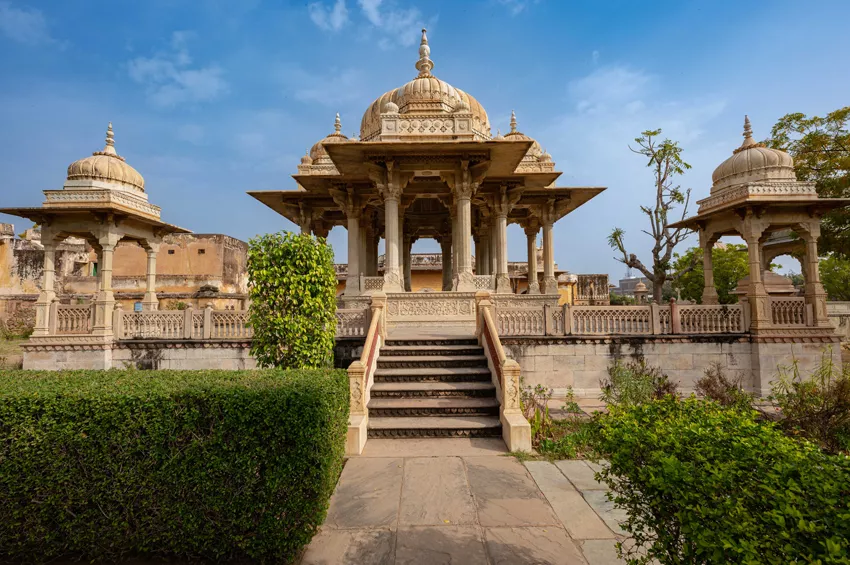
Thousands of travellers drive from Jaipur to Amber every day. They slow down for Jal Mahal, continue toward the fort, and pass one of the city's most meaningful royal memorial sites without knowing it is there.
Maharani Ki Chhatriyan is not another palace. It is not a fort. It is not a museum filled with weapons, costumes and royal objects.
It is a place of remembrance.
Rajasthan Tourism describes Maharani Ki Chhatri as a special funeral area for women belonging to Jaipur's royal family. Within the precinct stand carved cenotaphs made from marble and local stone. These chhatris commemorate royal women whose lives are far less visible in Jaipur's mainstream sightseeing circuit than the kings whose forts, palaces and memorials dominate the usual itinerary.
That difference is precisely why the site deserves a stop.
Come here after a crowded morning at Hawa Mahal or before Amber Fort and the change in atmosphere is immediate. Instead of queues and palace courtyards, you find carved pillars, domed memorials, open platforms, stone surfaces, filtered light and a much quieter chapter of Kachhwaha Jaipur.
Complete Guide
Maharani Ki Chhatriyan Entry Fee: What Should You Actually Pay?
This is where travel websites become unreliable.
Recent visitor-oriented sources commonly report a small entry charge of approximately ₹30. Other pages quote different amounts. Rajasthan Tourism's current Jaipur listing explains the monument but does not publish a current admission price.
More importantly, during our August 2026 check we could not verify a dedicated Maharani Ki Chhatriyan place-details ticket on the Rajasthan Government OBMS portal comparable with Amber Palace, Hawa Mahal, Jantar Mantar or Albert Hall.
| Question | Current Answer |
|---|---|
| Is there an entry charge? | Recent sources report a modest counter charge. |
| Commonly reported amount | About ₹30, but verify at entrance. |
| Official Rajasthan Tourism tariff published? | No current price field found on its attraction listing. |
| Dedicated OBMS place-details ticket verified? | Not during our 22 August 2026 check. |
| Best payment advice | Confirm the displayed counter tariff before paying. |
Indian vs Foreign Tourist Ticket
We found inconsistent third-party claims about separate Indian and foreign visitor charges. Without a current official tariff to support those numbers, we will not invent a foreigner price.
If the counter displays separate categories on your visit, follow the official on-site rate. International visitors should ask for the current printed/displayed tariff rather than relying on an old blog screenshot.
Is It Included in a City Palace / Royal Composite Ticket?
Some recent sources say royal-heritage composite products may include Maharani Ki Chhatriyan along with other privately managed royal sites. Products and inclusions can change. If you already have a City Palace or Jaigarh-related combined ticket, show it at the entrance and ask whether Maharani Ki Chhatriyan is included before purchasing another ticket.
Do not confuse such a royal/private combined ticket with Rajasthan Government's OBMS monument products.
Maharani Ki Chhatriyan Timings
Recent visitor sources commonly place the opening window at approximately 9:30 AM to 5:00 PM. Other published pages use 9:00 AM or 10:00 AM as opening time.
Rajasthan Tourism's current Maharani Ki Chhatri listing does not display an official timing field. For that reason, this guide does not pretend that one inconsistent third-party time is guaranteed.
| Planning Detail | Recommendation |
|---|---|
| Commonly reported hours | Approx. 9:30 AM–5:00 PM |
| Safest arrival | 10:00 AM–4:00 PM |
| Time needed | 45–60 minutes |
| Photography visit | Allow 60–90 minutes |
| Special late visit | Confirm locally first |
Best Time of Day
Morning gives softer light and cooler stone. Late afternoon can be beautiful for side-light on carved pillars, but do not arrive close to closing unless you have confirmed the gate time.
Best Season
October to March is easiest for walking and photography. During April–June, visit earlier in the day. Monsoon can bring greener surroundings and softer skies, but carry rain protection.
Maharani Ki Chhatriyan History: Jaipur's Royal Women Remembered in Stone
The strongest official description comes from Rajasthan Tourism: this was a special funeral area for women belonging to Jaipur's royal family.
That sentence is simple, but historically important.
Most travellers learn Jaipur through its male rulers: Sawai Jai Singh II founded the city; rulers expanded palaces; kings built forts; royal cenotaphs at Gaitore commemorate the Maharajas. Maharani Ki Chhatriyan adds the parallel story of women within the royal household.
The site developed as a memorial landscape where individual cenotaphs commemorated royal women over generations. Different materials, scale, ornament and surviving condition mean the complex should not be read as one building constructed on one date. It is a collection accumulated across royal history.
What Is a Chhatri?
The word chhatri literally evokes an umbrella or canopy. In Rajput architecture, the form became a distinctive pavilion: columns supporting an elevated domed canopy, often used on palaces, forts and memorial structures.
At a royal cremation ground, a chhatri is a cenotaph—a commemorative monument associated with the deceased. It should not automatically be described as a Western-style grave or tomb containing a buried body.
Architecture: Marble, Local Stone, Domes & Carved Pillars
Rajasthan Tourism specifically notes that the cenotaphs here are built from marble or local stone and highlights the chhatri as a quintessential Rajput architectural form.
A government-linked IGNCA heritage record for a structure within the Maharani Ki Chhatri precinct describes an elevated, octagonal chhatri with a canopied superstructure, inverted lotus, pinnacle and floral decoration on its drum.
What to Look For Instead of Just Taking a Wide Photo
- the transition from square or octagonal base to dome;
- carved pillar capitals;
- floral bands;
- lotus forms beneath the canopy;
- stone brackets supporting roof elements;
- finials at the top of completed domes;
- differences between marble and local stone;
- ceiling patterns beneath the chhatris;
- open, roofless memorial platforms;
- weathering that reveals the age and texture of the stone.
Why Are Some Maharani Ki Chhatriyan Unfinished or Roofless?
This is the detail that makes the site much more than a collection of pretty domes.
Rajasthan Tourism records a popular belief that the roof communicated something about the queen's relationship to the reigning king at the time of her death:
- if a queen died before her king, her cenotaph could be completed with a roof;
- if she died after the king, the memorial could remain unfinished or roofless.
Heritage writing on the precinct also notes exceptions and unidentified memorials, which is another reason to avoid oversimplifying the rule.
Rajmata Gayatri Devi & Maharani Ki Chhatriyan
Rajmata Gayatri Devi, one of the twentieth century's best-known members of Jaipur's royal family, died in Jaipur in 2009. Contemporary reporting documented the public funeral procession, while later heritage writing associates Maharani Ki Chhatriyan with her final rites and memorial landscape.
Her presence connects the precinct's eighteenth- and nineteenth-century architectural language to living memory. This is not simply an “ancient ruin”; Jaipur's royal memorial traditions continued into the modern era.
Why You Should Be Careful with Online Claims
Older reports and later heritage accounts can differ on the timing/status of an individual cenotaph after a royal cremation. For that reason, do not identify every pavilion from an unverified blog photograph. If inscriptions are legible or an authorised guide is present, use those as the first reference on site.
Maharani Ki Chhatriyan vs Gaitore Ki Chhatriyan
These are frequently confused, but they are not the same site.
| Feature | Maharani Ki Chhatriyan | Gaitore Ki Chhatriyan |
|---|---|---|
| Commemorates | Royal women / queens | Former Maharajas of Jaipur |
| Official Rajasthan Tourism description | Special funeral area for royal women | Royal memorial/cremation site of Jaipur rulers |
| Architecture | Marble/local-stone chhatris | Elaborate royal chhatris, including white marble |
| Most useful for | Women's history, quiet architecture, photography | Dynastic history and rulers' cenotaphs |
| Same entrance? | No | No |
Rajasthan Tourism describes Gaitore's most notable chhatri as that of Maharaja Jai Singh, with 20 carved pillars. Maharani Ki Chhatriyan gives you the complementary female royal history.
Why This Place Is Still Offbeat
Maharani Ki Chhatriyan sits on a route used by huge numbers of tourists, yet it is not a headline Jaipur attraction.
That creates a rare combination: genuine royal architecture without the pace of a major ticketed fort. Travellers interested in photography, women's history, memorial architecture or quieter places often get more from this site than visitors simply trying to collect Jaipur's “top five”.
Maharani Ki Chhatriyan Photography Guide
Best Light
Morning and later afternoon light can enter between pillars and create strong layers of shadow. Midday is brighter but flatter and hotter.
Best Frames
- shoot through one pavilion toward another;
- use columns to frame a dome;
- photograph the underside of carved ceilings;
- look for symmetry in octagonal plans;
- use roofless memorials as a contrast to completed chhatris;
- include a person sparingly to show architectural scale;
- use longer focal lengths to isolate floral stone details.
Professional & Pre-Wedding Shoots
Do not assume a normal visitor ticket covers commercial photography, costume shoots, tripods, lights or a crew. Ask the ticket counter/site staff about current permission and charges before setting up equipment.
Respectful Behaviour at a Royal Cremation & Memorial Site
This is not just an Instagram backdrop. It is a royal memorial precinct.
- do not climb onto cenotaph platforms where access is restricted;
- do not scratch names into stone;
- keep music low or off;
- avoid loud staged behaviour around memorial structures;
- do not move objects for photographs;
- follow staff instructions on footwear if requested at a particular structure;
- carry your waste out if bins are unavailable.
Guide for Foreign & International Visitors
International travellers often know Jaipur through Amber Fort, Hawa Mahal and City Palace. Maharani Ki Chhatriyan offers something different: a small site that helps explain how Rajput royal identity continued after death through architecture.
Foreign Visitor Ticket
We found conflicting online rates and no current official government tariff for a separate foreign category. Confirm the displayed counter price rather than accepting an unofficial quote away from the entrance.
Do You Need a Guide?
A guide is useful if they know the royal women's history and can identify individual memorials accurately. A generic city guide who only repeats the roofed/roofless story may add little. Ask what they can explain before hiring.
Families, Children & Senior Citizens
Families
The site is compact enough to add between larger attractions. Children may find it more interesting if you turn the architecture into a visual exercise: find lotus motifs, count pillars, compare roofed and roofless chhatris.
Senior Citizens
It is physically easier than Amber, Jaigarh or Nahargarh because there is no major hill climb. Uneven historic surfaces and steps around individual platforms still require care.
Accessibility
Wheelchair access should be considered partial rather than guaranteed throughout every memorial platform. Ask staff for the easiest route through the grounds.
How to Reach Maharani Ki Chhatriyan Jaipur
Rajasthan Tourism places the attraction on the way to Amber Fort. IGNCA heritage documentation gives the location as Maharaniyon Ki Chhatriyan, before the Ramgarh Road crossing, Jaipur 302002.
From Jal Mahal
This is the easiest combination. Continue along the Amber-side corridor toward the Maharani Ki Chhatriyan/Ramgarh Road area. Use current navigation for the exact gate because Jaipur road patterns and stopping points can change.
From Hawa Mahal / City Palace
Taxi, auto-rickshaw or private car toward Amber Road is simplest. Combine the stop with Jal Mahal and Amber rather than making a separate return trip.
From Jaipur Railway Station
A taxi or auto is the practical direct option. Metro alone does not take you to the monument gate.
From Jaipur Airport
Use a cab/private car. If you are sightseeing immediately after arrival, combine the monument with the north Jaipur/Amber side rather than crossing the city twice.
Parking & Facilities
Facilities are much more limited than at Amber Fort or City Palace. Do not plan your lunch, major shopping stop or long rest break here.
- carry drinking water;
- use the restroom at a larger attraction when possible;
- keep small change / digital payment options available;
- ask before assuming parking is free;
- do not expect a large museum shop or visitor centre.
Best Places to Visit Near Maharani Ki Chhatriyan
| Place | Why Add It | Best Use |
|---|---|---|
| Jal Mahal | Same general Amber-road corridor | 15–30 minute lake-view stop |
| Amber Fort | Jaipur's major hill-fort experience | 2–3 hours |
| Jaigarh Fort | Military architecture and Jaivana | 1.5–3 hours |
| Kanak Vrindavan | Garden and temple setting | 30–60 minutes |
| Gaitore Ki Chhatriyan | Compare kings' and queens' memorial traditions | 45–90 minutes |
Best Maharani Ki Chhatriyan + Amber Route
Option 1: Best for First-Time Jaipur Visitors
| Time | Plan |
|---|---|
| 8:00 AM | Jal Mahal photos from lakeside |
| 8:30/9:00 AM | Continue toward Amber |
| 9:00–11:30 AM | Amber Fort |
| Late morning / return | Maharani Ki Chhatriyan after confirming gate is open |
| Afternoon | Old Jaipur / lunch / City Palace area |
Option 2: Heritage-Lover Route
Jal Mahal → Maharani Ki Chhatriyan → Amber Fort → Jaigarh Fort → Gaitore on return. This is a much fuller day and is better with a private car.
Is Maharani Ki Chhatriyan UNESCO Listed?
No. Do not label the site itself as a UNESCO World Heritage monument. Jaipur City is UNESCO-listed and Amber forms part of UNESCO's Hill Forts of Rajasthan, but Maharani Ki Chhatriyan has its own heritage significance without needing a false UNESCO claim.
12 Mistakes to Avoid
- Confusing Maharani Ki Chhatriyan with Gaitore.
- Calling every cenotaph a tomb or grave without understanding cremation memorial traditions.
- Publishing an unverified “official” ₹30 ticket as if OBMS currently confirms it.
- Inventing a foreigner rate because another Jaipur monument has one.
- Arriving near sunset without confirming closing time.
- Treating the roofless-chhatri belief as an absolute rule with no exceptions.
- Climbing onto memorial structures for photos.
- Using loud music at a cremation memorial precinct.
- Skipping the site simply because it is less famous.
- Making a separate cross-city trip instead of combining it with Amber Road.
- Confusing a City Palace/private composite product with Rajasthan Government OBMS tickets.
- Assuming commercial photography is covered by ordinary admission.
Official & Heritage Sources
- Rajasthan Tourism — Jaipur / Maharani Ki Chhatri (Memorials of Queens)
- Rajasthan Tourism — Official Website
- Rajasthan Government OBMS Tourist Portal
- IGNCA — Jaipur Archaeological / Heritage Documentation
Related Jaipur Guides
- Jal Mahal Jaipur Complete Guide
- Amber Fort Jaipur Complete Guide
- Jaigarh Fort Jaipur Complete Guide
- Royal Gaitor Cenotaphs Guide
- Jaipur Complete Travel Guide
- Jaipur Monuments Timings & Entry Fees
Maharani Ki Chhatriyan FAQs
What is Maharani Ki Chhatriyan?
Rajasthan Tourism describes it as a special funeral area for women belonging to Jaipur's royal family, with carved cenotaphs commemorating them.
What is Maharani Ki Chhatriyan famous for?
It is known for Jaipur's royal women's memorials, marble and local-stone chhatris, Rajput architecture and a much quieter atmosphere than the city's major forts.
What is the entry fee?
Recent independent sources commonly report around ₹30, but Rajasthan Tourism does not currently publish a tariff for this attraction and we could not verify a dedicated live OBMS place-details ticket during our August 2026 check. Confirm at the counter.
Is there a separate foreign tourist fee?
Online information is inconsistent. We found no current official tariff supporting a specific foreigner amount, so ask the ticket counter for the displayed rate.
What are the timings?
Recent sources commonly report approximately 9:30 AM–5:00 PM, but timings vary online and Rajasthan Tourism's current attraction listing does not publish official hours. Aim for the middle of the day or confirm before a late visit.
How long should I spend?
45–60 minutes is enough for most visitors. Allow up to 90 minutes for detailed photography.
Is it the same as Gaitore?
No. Maharani Ki Chhatriyan commemorates royal women; Rajasthan Tourism describes Gaitore as the memorial site of Jaipur's former Maharajas.
Why are some cenotaphs roofless?
Rajasthan Tourism records a popular belief that a queen who died before her king received a completed roofed cenotaph, while one who died after the king could have an unfinished memorial.
Was Gayatri Devi associated with this site?
Yes. Heritage accounts associate Rajmata Gayatri Devi, who died in 2009, with the royal women's cremation and memorial precinct.
Can I visit it with Amber Fort?
Yes. This is the most logical way to visit because Rajasthan Tourism itself places Maharani Ki Chhatri on the road to Amber.
Is Jal Mahal nearby?
Yes. Jal Mahal and Maharani Ki Chhatriyan fit naturally into the same north Jaipur sightseeing route.
Is photography allowed?
Visitor photography is commonly practiced, but ask before professional, commercial or pre-wedding shoots and before using large equipment.
Is it crowded?
It is generally far quieter than Amber, Hawa Mahal or City Palace, though no crowd level is guaranteed.
Is it good for foreign tourists?
Yes, especially for travellers interested in royal women's history, architecture and offbeat Jaipur rather than only headline monuments.
Is it UNESCO listed?
No. The site itself is not a UNESCO World Heritage property.
Can I buy the ticket on OBMS?
During our 22 August 2026 check we could not verify a dedicated Maharani Ki Chhatriyan place-details product on Rajasthan Government OBMS. Use the entrance counter unless an official product becomes available later.
Final Advice
Maharani Ki Chhatriyan does not need a giant fort wall, a mirrored palace room or a famous city panorama to justify a visit.
Its strength is quieter. Jaipur's royal history is often told through kings. Here, the architecture changes the subject.
Spend time beneath the chhatris. Compare marble with local stone. Look at the lotus and floral carving. Notice the memorials without roofs and understand the tradition Rajasthan Tourism records behind them. Then compare this precinct with Gaitore, where the Maharajas are commemorated.
For practical planning, avoid false precision: recent sources commonly report roughly ₹30 and around 9:30 AM–5:00 PM, but Rajasthan Tourism currently publishes neither a tariff nor opening-hours field for this attraction, and we could not verify a dedicated OBMS ticket page. Confirm at the entrance.