Royal Gaitor Cenotaphs Jaipur Complete Guide 2026: Ticket, Timings, History, Architecture & Route
Royal Gaitor: Quick Answers
- Also called: Gaitore Ki Chhatriyan / Gaitor Ki Chhatriyan / Memorials of Kings.
- Location: just off Jaipur-Amber road, below the Nahargarh hills in Brahmpuri.
- What it is: royal cremation and cenotaph complex of Jaipur's Kachwaha rulers.
- Current gate fee: recent 2025–2026 visitor reports commonly show about ₹30–₹50; confirm at the official gate because a current OBMS tariff was not found.
- Timing: commonly around 9:30 AM–5:00 PM.
- Time needed: 45–90 minutes; government planning material notes typical stays around 1–2 hours.
- Most famous chhatri: Maharaja Sawai Jai Singh II's white-marble cenotaph with 20 carved pillars.
- Best for: architecture, photography, quieter Jaipur heritage and repeat visitors.
- Best combination: Gaitore + Jal Mahal + Garh Ganesh / Nahargarh / Amber side.
- Important: Rajasthan Government planning material says the site is owned, run and maintained by Jaipur's royal family, so do not assume Rajasthan OBMS controls its gate tariff.
Royal Gaitor Ticket Price 2026 — Current Practical Position
| Visitor | Current Planning Reference | How to Use It |
|---|---|---|
| Indian Visitor | Recent reports commonly around ₹30 | Confirm at official gate and take receipt/ticket |
| Foreign Visitor | Recent reports commonly around ₹50 | Confirm at official gate |
| Student / Child | Current third-party listings vary | Do not hard-code an old concession; ask at gate |
| Professional Shoot | Separate permission may apply | Normal admission should not be assumed to cover commercial work |
Why there is no fake “government OBMS price” here: the Rajasthan Government masterplan for the Nahargarh eco-sensitive zone states that Gaitor is owned, run and maintained by Jaipur's royal family and that a nominal entrance fee is charged. Recent visitor reports support a low gate charge, but a current official OBMS listing was not found in this review. The gate-issued ticket is therefore the safest current price confirmation.
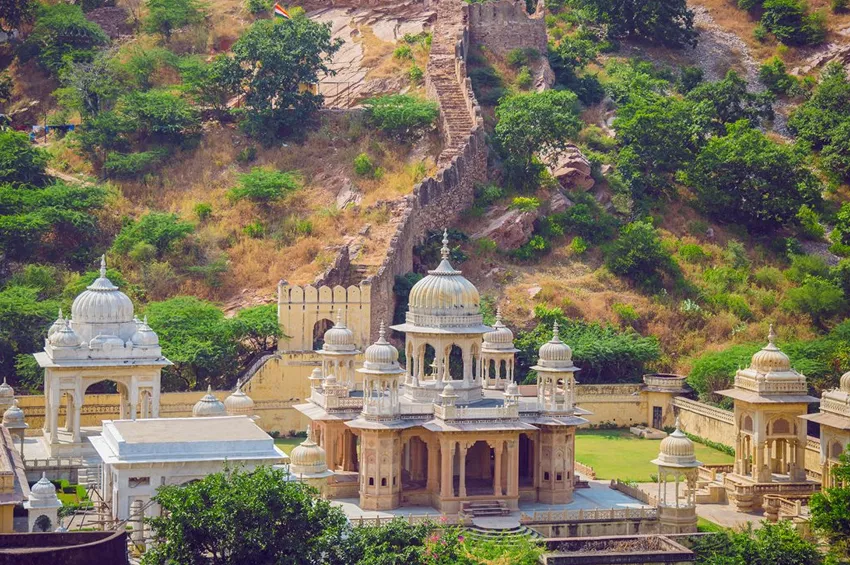
Royal Gaitor is one of the rare Jaipur places where the first thing you notice is not the monument—it is the silence around it.
There are no palace courtyards full of tour groups, no elephant road, no observatory instruments and no busy bazaar immediately outside. Instead, white marble chhatris rise between yellow-brown hills at the foot of Nahargarh. The memorials are open to the sky, their domes resting on carved pillars, with details that become more impressive the longer you look.
Rajasthan Tourism describes Gaitore as the place, just off the Jaipur-Amber road, where Jaipur's former Maharajas are commemorated. The government tourism site specifically highlights the white-marble Rajput architecture, open pavilions, ornate domes, delicately carved pillars and the cenotaph of Maharaja Jai Singh with its twenty carved pillars.
This guide separates reliable government information from internet repetition. You will find current practical ticket guidance, timings, ownership, history, Jaipur royal-family context, architecture, the Jai Singh cenotaph, photography, transport, Garh Ganesh, Jal Mahal, Nahargarh combinations, families, foreigners, senior visitors and FAQs.
Royal Gaitor Guide Contents
Royal Gaitor Cenotaphs Ticket Price 2026
Unlike Amber, Hawa Mahal, Jantar Mantar and other Rajasthan Government OBMS monuments, Royal Gaitor has a different management situation.
A Rajasthan Government tourism masterplan for the Nahargarh eco-sensitive zone states that Gaitor Ki Chhatriyan is owned, run and maintained by Jaipur's royal family and that a nominal entry fee is charged.
Recent 2025–2026 visitor reports commonly describe ₹30 for Indian visitors and around ₹50 for foreign visitors. Because a current official royal-family tariff page or OBMS listing was not located during this update, treat these as current planning references rather than a permanently fixed government tariff.
Is Gaitore Included in Rajasthan Government Composite Ticket?
Do not assume so. Rajasthan Archaeology & Museums lists the cenotaphs of Gaitore among Jaipur's protected monuments, but the current government planning material also identifies the site as being run by Jaipur's royal family. This management distinction means you should not automatically expect an OBMS Jaipur composite ticket to cover the gate unless the current product explicitly says it does.
Royal Gaitor Timings & How Long to Stay
Current visitor listings consistently place Gaitore around 9:30 AM to 5:00 PM, with some sources listing 9:00 AM as opening.
Government planning material records typical visitor stay durations of around one to two hours. Most travellers can comfortably see the complex in 45–90 minutes.
| Visit Length | What You Can Do |
|---|---|
| 30 minutes | Quick look at major cenotaphs |
| 45–60 minutes | Good first visit with architecture and photos |
| 75–90 minutes | Slow photography and detailed carving study |
| 2 hours | Gaitore plus nearby Garh Ganesh approach / relaxed heritage visit |
Best Time of Day
Morning: cooler, quieter and better for detailed architecture.
Late afternoon: attractive side light on white marble and sandstone, but do not arrive near closing.
What Is Gaitore Ki Chhatriyan?
Gaitore is the royal cremation and memorial ground of Jaipur's Kachwaha rulers.
Government tourism and forest-planning documents place the site in the foothills of Nahargarh and trace its royal use to Jaipur's eighteenth-century foundation era. The government masterplan states that the site was designated by Jaipur's founder and that the cenotaphs of successive rulers are scattered through the complex.
Cenotaph, Not Conventional Tomb
The word chhatri literally refers to the umbrella-like domed form seen throughout Rajput architecture. At Gaitore, these structures act as memorials marking royal cremation places.
Calling the complex a “royal tomb” is common tourist shorthand, but royal cenotaph / cremation memorial is more accurate.
Why the Site Was Chosen
The small valley beneath Nahargarh provides privacy, sacred-seeming enclosure and separation from the dense city. Government geoheritage material describes Royal Gaitor as a walled funerary complex surrounded by quartzite hills of the Nahargarh ridge.
Royal Gaitor Architecture: Why the Site Is Special
Rajasthan Tourism describes the chhatris as white-marble memorials in a distinctive Rajput style, with ornate domes supported by delicately sculpted pillars.
Other government heritage material also recognises a blend of Rajput and Mughal influence across the complex.
What to Look For
- domed chhatri pavilions;
- carved marble pillars;
- lotus and floral motifs;
- mythological carving;
- repeated arches;
- differences in scale between rulers' memorials;
- white marble contrasted with local sandstone and hills.
The Memorials Are Not Identical
Rajasthan Tourism makes an important point: the decoration and extravagance of each chhatri reflects the stature and prowess associated with the ruler being commemorated. That is why walking the full complex is more rewarding than photographing only the first pavilion.
Maharaja Sawai Jai Singh II Cenotaph
The government tourism site identifies Maharaja Jai Singh's cenotaph as the most graceful at Gaitore and specifically notes its 20 carved pillars.
Jaipur's environmental planning material describes this white-marble memorial as the most prominent cenotaph and notes carvings of mythological scenes and figures.
Why Jai Singh II Matters
Sawai Jai Singh II founded Jaipur in 1727 and was responsible for moving the Kachwaha capital from Amber to a newly planned city. His legacy also includes Jaipur's astronomical tradition and Jantar Mantar.
That makes his cenotaph more than the most ornate structure at Gaitore—it connects the memorial ground directly to the creation of Jaipur itself.
Which Rulers Are Commemorated at Gaitore?
The complex contains memorials of multiple Jaipur rulers across generations. Popular visitor accounts focus particularly on the memorials associated with Sawai Jai Singh II and later Jaipur Maharajas.
Because online lists often mix cenotaph names, royal titles and later memorials, use on-site plaques or a knowledgeable guide when identifying every individual chhatri rather than relying on an unverified social-media caption.
Gaitore vs Maharani Ki Chhatri
| Gaitore / Memorials of Kings | Maharani Ki Chhatri |
|---|---|
| Royal memorial ground of Jaipur's rulers | Royal cremation memorial area associated with women of Jaipur's royal family |
| White marble and sandstone chhatris | Marble/local stone cenotaphs |
| Near Nahargarh foothills / Brahmpuri | On the road toward Amber |
| Most famous for Jai Singh II's cenotaph | Known for royal women's memorial architecture |
Rajasthan Tourism treats them as separate attractions. Do not combine their histories into one site.
How to Reach Royal Gaitor from Jaipur
Gaitore lies in the Brahmpuri / Jaipur-Amber road side, below the Nahargarh hills and near Garh Ganesh.
From Hawa Mahal / Pink City
Auto-rickshaw or taxi is easiest. It is close enough to combine naturally with Jal Mahal and north-Jaipur sightseeing.
From Jaipur Railway Station
Use a direct taxi or auto. The route passes through central/northern Jaipur depending traffic.
From Jaipur Airport
A taxi is simplest. Do not use Gaitore as a rushed airport stop if you have luggage and a tight flight schedule.
Public Transport, Auto & Taxi
A Rajasthan Government Nahargarh eco-sensitive-zone masterplan specifically notes no dedicated public transport facility at Gaitore.
Auto-Rickshaw
Good from central Jaipur. Agree return/waiting if you do not want to search for another vehicle at the site.
Taxi / Private Car
Best when combining Gaitore with Jal Mahal, Amber, Jaigarh or Nahargarh.
Metro
Jaipur Metro does not take you directly to Gaitore. An onward auto/taxi from the old-city side remains necessary.
Facilities at Gaitore
Government planning material states that the site has:
- toilet facilities;
- seating arrangements;
- drinking water;
- CCTV;
- security personnel.
The same document notes no cloakroom and weak roadside signage. Carry only what you need.
Photography at Royal Gaitor
This is one of Jaipur's strongest places for architecture photography because visitor levels are usually far lower than Amber or Hawa Mahal.
Best Frames
- domes aligned through multiple arches;
- carved pillar details;
- white marble against Nahargarh hills;
- symmetrical pavilion interiors;
- shadow patterns beneath chhatris;
- wide view of multiple memorial groups.
Best Light
Morning is clean and comfortable. Late afternoon can produce stronger texture and warmer contrast.
Portraits / Pre-Wedding / Commercial Work
Normal tourist photography should not be assumed to cover professional shoots. Since the site is managed separately from standard OBMS monuments, confirm current permission and charges with the gate/management before bringing a crew, lighting or commercial equipment.
Is Royal Gaitor Worth Visiting?
Yes, If You Like...
- architecture;
- quiet heritage places;
- photography;
- Jaipur royal history;
- offbeat sightseeing;
- places that take under two hours but feel different from the main circuit.
Skip It on a Very Short Jaipur Day If...
You have never seen Amber, Hawa Mahal, City Palace or Jantar Mantar and have only one rushed sightseeing day. Gaitore becomes much more valuable on a second day or when you want a quieter stop between major attractions.
Gaitore for Families, Seniors & Foreign Visitors
Families
A short, calm visit. Children may be more interested in the open pavilions and carvings than in detailed dynastic history.
Senior Citizens
Generally easier than Jaipur's hill forts because there is no major fort climb inside the memorial complex. Watch for steps and uneven stone.
Foreign Visitors
Gaitore is particularly good for international visitors who have already seen one or two major Jaipur palaces and want a quieter architectural site. Recent reports suggest only a nominal foreign visitor charge.
Places to Visit Near Royal Gaitor
Garh Ganesh Temple
Located above/near the Gaitore area and associated with Jaipur's religious landscape. The climb is separate from a normal cenotaph visit and needs additional time.
Jal Mahal
A natural short stop on the Jaipur-Amber road. The standard visitor experience is the lakeside exterior view.
Nahargarh Fort
The hills immediately frame Gaitore, although the driving route to Nahargarh is longer than the map visually suggests.
Amber Fort
Easy to combine geographically on a north-Jaipur sightseeing day.
Jaigarh Fort
Works naturally after Amber and before/after other northern Jaipur stops depending your timing.
Best Gaitore Half-Day / Full-Day Routes
Option 1 — Quiet Jaipur Morning
9:30 AM: Royal Gaitor.
10:45 AM: Jal Mahal.
11:15 AM onward: Amber / lunch.
Option 2 — North Jaipur Heritage Day
Amber → Jaigarh → lunch → Gaitore → Jal Mahal.
Option 3 — Gaitore + Nahargarh
Gaitore in the morning or afternoon, then drive to Nahargarh with enough time before its current closing. Do not assume the two are directly connected by a short tourist road simply because one sits below the other.
Best Season
October–March
Best overall for comfortable walking and soft light.
July–September
The hills can become greener and the setting especially attractive after rain.
April–June
Visit early. Marble and open stone areas become uncomfortable in strong midday heat.
What to Carry
- water;
- comfortable shoes;
- sun protection;
- small cash backup;
- camera/phone;
- driver number if using a private vehicle.
15 Royal Gaitor Mistakes to Avoid
- Calling the cenotaphs conventional burial tombs.
- Assuming Rajasthan OBMS controls the gate tariff.
- Hard-coding an old ₹30/₹50 fee as permanent.
- Confusing Gaitore with Maharani Ki Chhatri.
- Visiting only the first cenotaph.
- Ignoring Jai Singh II's 20-pillar chhatri.
- Touching delicate carvings.
- Arriving at 4:55 PM.
- Expecting a large museum or audio-visual show.
- Planning a public-transport route without a final auto/taxi leg.
- Assuming there is a cloakroom.
- Bringing professional equipment without permission.
- Climbing nearby hills casually in extreme heat.
- Trying to combine every northern Jaipur attraction in one rushed afternoon.
- Skipping the site because it is less famous than Amber.
Official & Reliable Sources
- Rajasthan Tourism — Jaipur / Gaitore Memorials of Kings
- Rajasthan Tourism — Gaitore Listing
- Rajasthan Government — Nahargarh Eco-Sensitive Zone Masterplan
- Rajasthan Archaeology & Museums — Protected Monuments List
Related Jaipur Guides
- Nahargarh Fort Jaipur Guide
- Amber Fort Jaipur Complete Guide
- Jaipur Monument Tickets & Timings
- Jaipur Complete Travel Guide
- Jaipur UNESCO World Heritage Guide
Royal Gaitor Cenotaphs FAQs
What is Royal Gaitor ticket price?
Recent visitor reports commonly show around ₹30 for Indians and ₹50 for foreign visitors. Confirm the current gate-issued rate on arrival because the site is not operating like a standard OBMS monument.
Is Gaitore on Rajasthan Government OBMS?
A current official OBMS tariff was not located during this review. Rajasthan Government planning material says the site is owned, run and maintained by Jaipur's royal family.
What are the timings?
Current visitor listings commonly show approximately 9:30 AM–5:00 PM.
How much time is enough?
45–90 minutes is enough for most travellers. Government planning material records visits commonly lasting around one to two hours.
Where is Royal Gaitor?
In the Brahmpuri area, just off the Jaipur-Amber road, at the foot of the Nahargarh hills.
What is Gaitore famous for?
Royal cenotaphs of Jaipur's Kachwaha rulers, especially white-marble chhatris with carved pillars and domes.
Which cenotaph is the most famous?
Rajasthan Tourism identifies Maharaja Jai Singh's cenotaph, with 20 carved pillars, as the most graceful at the site.
Is Gaitore a cemetery?
It is better described as a royal cremation and cenotaph memorial ground.
Is Gaitore a tomb?
The memorial structures are cenotaphs rather than conventional burial tombs.
Is Gaitore worth visiting?
Yes if you like architecture, photography, royal history and quieter places. It is especially good on a second Jaipur sightseeing day.
Can I combine Gaitore with Jal Mahal?
Yes. They are geographically convenient to combine.
Can I combine Gaitore with Amber?
Yes. Gaitore sits off the Jaipur-Amber road and can be added before or after Amber depending timing.
Can I combine Gaitore with Nahargarh?
Yes, but the driving route to the hill fort takes longer than the visual proximity suggests.
Is public transport available?
Government planning material notes no dedicated public transport facility at the site. Auto/taxi/private car is easier.
Are toilets available?
Government planning material states that toilet, seating and drinking-water facilities are present.
Is there a cloakroom?
The same government source states there is no cloakroom.
Is it good for photography?
Yes. The low crowds, marble pavilions, carved pillars and hill backdrop make it one of Jaipur's best quiet architecture-photography spots.
Can I do professional photography?
Do not assume a normal entry ticket covers commercial or pre-wedding work. Confirm separate permission with site management.
Is Gaitore suitable for senior citizens?
Generally yes. It involves much less climbing than Amber or Nahargarh, though there are steps and uneven surfaces.
Is it suitable for children?
Yes for a short heritage stop, although there are no entertainment facilities.
What is the best time to visit?
Morning or late afternoon from October to March. In summer, go early.
Final Advice
Royal Gaitor works because it does not feel like the rest of Jaipur's sightseeing circuit. It is quiet, compact and architectural. You can stand beneath the carved domes, look up toward the Nahargarh ridge and understand how the Kachwaha rulers chose to memorialise themselves without needing a giant palace around you.
Do not over-plan it. Allow an hour, pay the current gate-issued nominal fee, spend time at Jai Singh II's cenotaph, look at the smaller memorials instead of photographing only one pavilion and combine the stop with Jal Mahal or the Amber side of Jaipur.