Taj Mahal Guide 2026: Tickets, Timings, Sunrise, Night View & Travel Tips
Taj Mahal Visitor Guide: Quick Answer
The Taj Mahal in Agra is open on normal visiting days from 30 minutes before sunrise until 30 minutes before sunset and is closed to general visitors every Friday. Current official daytime entry is ₹50 for Indian/OCI visitors, ₹540 for SAARC/BIMSTEC visitors and ₹1,100 for other foreign visitors. Entry to the main mausoleum costs an additional ₹200 for every ticket category.
For most first-time visitors, 2–3 hours is a comfortable amount of time for the gardens, main marble platform, mausoleum area and classic viewpoints. Sunrise is usually the best choice for softer light, lower temperatures and a calmer start; the official Taj Mahal FAQ also identifies sunrise as the preferred time for many visitors.
This guide focuses on decisions travellers actually need to make: which ticket to buy, which gate to use, when to arrive, what night viewing costs, what to carry, how to avoid outdated information and how to combine the Taj Mahal with Agra Fort, Mehtab Bagh or a Delhi–Agra–Jaipur itinerary.
Taj Mahal Tickets & Timings at a Glance
Location: Agra, Uttar Pradesh, India
UNESCO status: World Heritage Site, inscribed in 1983
Normal hours: 30 minutes before sunrise to 30 minutes before sunset
Weekly closure: Friday for general viewing
Indian / OCI: ₹50 + optional ₹200 main-mausoleum ticket
SAARC / BIMSTEC: ₹540 + optional ₹200 main-mausoleum ticket
Other foreign visitors: ₹1,100 + optional ₹200 main-mausoleum ticket
Children below 15: No daytime entry fee
Entry gates: East and West; South Gate is currently exit-only
Night viewing: Five nights around the full moon, subject to official schedule
Why the Taj Mahal Is More Than a Photo Stop
- UNESCO significance: UNESCO describes the Taj Mahal as an outstanding achievement of Indo-Islamic architecture and notes its balance, symmetry and craftsmanship.
- Riverside plan: the mausoleum stands at the end of the garden beside the Yamuna rather than in the garden's centre, creating the long perspective visitors recognise instantly.
- Marble inlay: floral decoration uses precious and semi-precious stone inlay set into white marble.
- Calligraphy and geometry: the gateways, arches, garden axes, mosque and guest house work together as one carefully controlled composition.
- The cenotaphs are not the graves: the decorated cenotaphs seen in the main chamber are symbolic; the actual graves lie in the lower crypt.
- Light changes the experience: dawn, midday, late afternoon and moonlight create very different visual impressions of the marble.
Understanding the Taj Mahal
The Timeless Love Story Behind the Taj Mahal
The Taj Mahal is, above all, a love story in stone. In 1631, Empress Mumtaz Mahal, beloved wife and chief companion of Mughal emperor Shah Jahan, died while giving birth to their fourteenth child. Historical records describe the emperor's overwhelming grief; he is said to have withdrawn from public life, his hair turning white in a short time, and the court falling unusually silent. Out of this intense sorrow came a promise—to build a tomb so beautiful that the world would remember Mumtaz and their love forever.
Shah Jahan summoned the finest minds and hands of his time. Architects, engineers, mathematicians, calligraphers and master stone‑carvers arrived from across the Mughal empire and from lands that are now Iran, Turkey and Central Asia. It is believed that more than 20,000 workers were involved at different stages. Construction began around 1632 and continued for roughly two decades, with landscaping, finishing work and subsidiary buildings perfected even after the core mausoleum was completed.
The final result was not just a single tomb, but a complete riverside universe. Inside lie the cenotaphs of Mumtaz Mahal and, later, Shah Jahan himself. Their actual graves rest in a lower chamber directly beneath the cenotaphs. Even, nearly four centuries later, millions still travel each year to honour their story.
The Taj Complex – More Than Just a Dome
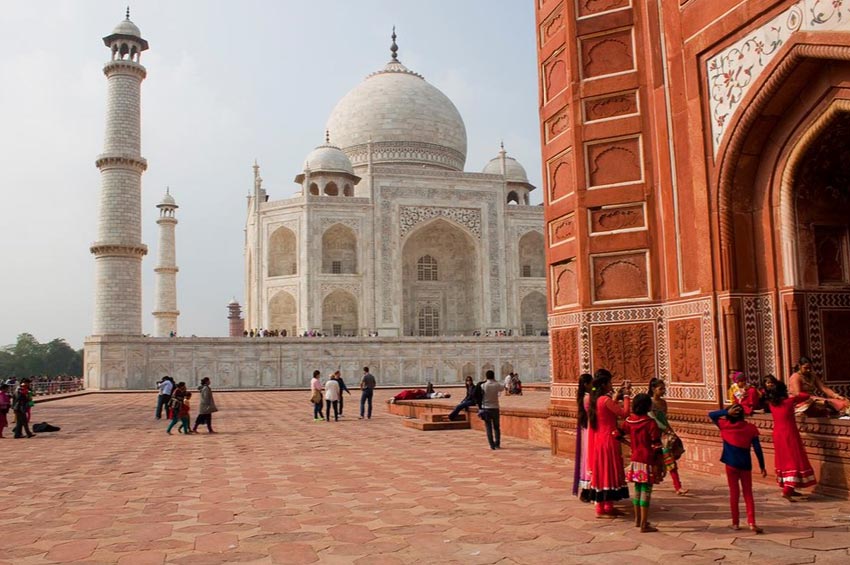
Most postcards show only the white marble building, but the Taj Mahal is actually a carefully planned complex. Visitors first pass through the outer forecourt and then approach the monumental red‑sandstone gateway, the Darwaza‑i‑Rauza or Great Gate. Its central arch is framed by inlaid floral motifs and Quranic verses, with the size of each letter increasing as it rises so that the calligraphy appears perfectly even from the ground.
Beyond the gate, the classic Mughal charbagh garden opens up: four main lawns divided by two cross‑axes of pathways and water channels. A long reflecting pool runs down the centre. On calm mornings the entire Taj, dome and minarets, appears upside‑down in the water like a painted mirror. To the west, a red‑sandstone mosque faces Mecca; to the east, an almost identical "jawab" building balances the composition but is not used for worship.
At the northern edge flows the Yamuna River. Across the water lies Mehtab Bagh, a favourite viewpoint for sunset silhouettes. Within the grounds, a small museum displays original drawings, calligraphy samples and rare artefacts related to the construction.
Light, Colour and the Magic of Marble
One of the Taj Mahal's quiet secrets is the way it changes colour throughout the day. Around sunrise, the marble can appear cool blue or soft pink as the first light filters through mist. By mid‑morning, under a clear sky, it turns bright white and sharp. In the late afternoon, the stone reflects warm gold and peach. Under a full moon, the monument seems to give off its own light, glowing gently against a dark sky.
This effect is partly due to the quality of the Makrana marble used in construction. The stone has a very fine grain and high translucency, which helps it respond dramatically to changes in light. For photographers, visiting at two different times—sunrise and sunset—can make the building look like two completely different monuments without ever changing your camera settings.
Pietra Dura, Calligraphy and Marble Screens
Move close to the walls and the Taj transforms once again, this time into a gallery of tiny masterpieces. The lower surfaces and main arches are covered in pietra dura, a technique in which extremely thin slices of coloured stones—jasper, jade, agate, carnelian, lapis lazuli and onyx—are cut into precise shapes and set into carved grooves in the marble. Because the colours come from the stones themselves, they have not faded with time.
Around the great arches, Quranic verses are written in inlaid black marble. The letters gradually increase in size as they move higher, so that from ground level the entire band of script looks perfectly balanced. Inside the main chamber, a finely carved marble screen surrounds the cenotaphs. The screen, or jali, is cut with such delicacy that it looks like lace frozen in stone. Light filters through its tiny openings, casting patterned shadows across the floor.
Engineering Genius – Minarets, Foundations and Symmetry
The four minarets do not stand perfectly straight; they lean very slightly outwards. This almost invisible tilt means that, if a powerful earthquake ever struck, the minarets would be more likely to fall away from the central mausoleum than onto it. The wide marble plinth itself rests on complex foundations designed to stabilise the building on the soft, river‑side soil.
Symmetry lies at the heart of the design. The mosque on the western side is balanced by the jawab on the east. The gardens mirror each other across north–south and east–west axes. The only significant break in perfect symmetry is Shah Jahan's cenotaph, placed slightly off‑centre beside Mumtaz's. That small human irregularity inside an otherwise perfectly ordered monument seems to make the story feel even more real.
Taj Mahal Tickets, Booking, Gates & Best Time
Current Taj Mahal Ticket Prices
The official Taj Mahal visitor site currently lists the following daytime entry fees:
- Indian / OCI visitors: ₹50 for general entry; add ₹200 if you want to enter the main mausoleum.
- SAARC / BIMSTEC visitors: ₹540 for general entry; add ₹200 for the main mausoleum.
- Other foreign visitors: ₹1,100 for general entry; add ₹200 for the main mausoleum.
- Children below 15: no daytime entry fee for Indian or foreign children.
Official information also states that online tickets receive a discount of ₹5 per Indian ticket and ₹50 per foreign ticket. Do not rely on old screenshots or third-party price tables when planning your budget.
Where to Buy Taj Mahal Tickets
Day tickets can be purchased through official online ticketing channels linked by the Taj Mahal authorities or at the official ticket counters near the East and West Gates. The official visitor site currently identifies asi.payumoney.com and asiagracircle.in for ticketing/information.
Carry government-issued identity proof. If you specifically want to enter the main mausoleum, make sure the additional ₹200 mausoleum ticket is included in your purchase.
Official Visiting Hours & Friday Closure
The official rule is more reliable than fixed seasonal clock times: the Taj Mahal opens 30 minutes before sunrise and closes 30 minutes before sunset on normal operating days. It is closed every Friday for general viewing.
Because sunrise and sunset move through the year, check the local Agra sunrise time for your exact travel date rather than depending on a generic “summer” or “winter” opening hour.
East Gate, West Gate & South Gate
East Gate and West Gate are the normal visitor entry points. The official site currently states that South Gate has no entry and is exit-only. Choose East or West mainly according to your hotel, driver drop-off and the queue on the day rather than treating one gate as universally “best”.
Is Sunrise Really the Best Time?
For many travellers, yes. The official Taj Mahal FAQ says sunrise is preferred by many visitors because it can help avoid summer heat and larger crowds while providing attractive early light. Sunrise is especially useful if photography and a quieter atmosphere matter to you.
In winter, however, Agra can experience haze or fog. A later morning can sometimes provide clearer visibility, so build a little flexibility into photography-focused plans.
Taj Mahal Night Viewing: Current Rules & Prices
Night viewing is offered on five nights around the full moon: the full-moon night, two nights before and two nights after, subject to the official schedule. It is closed on Fridays and during the month of Ramzan.
- Current timing: 8:00 PM to 11:59 PM in eight 30-minute batches.
- Indian adult: ₹510.
- Foreign adult: ₹750.
- Child age 3–15: ₹500.
- Reporting: arrive at Shilpgram near the East Gate about 30 minutes before the time printed on the ticket for security checks.
Night-viewing availability is limited, so check the official night-view calendar before building flights, hotels or a wider India itinerary around it.
Practical Taj Mahal Tips That Matter
- Carry ID: official visitor information asks tourists to carry government-issued identity proof.
- Pack light: security screening is part of the entry process, so a small bag is easier than carrying unnecessary items.
- Water: a water bottle is allowed. Official information says foreign entry tickets include services such as a water bottle, shoe cover, Agra guide map and battery-bus/golf-cart service.
- Drones: drone cameras are strictly prohibited inside the Taj Mahal.
- Main mausoleum: the additional ₹200 ticket is required if you want to enter the main mausoleum; shoe racks are available below it.
- Photography: respect on-site signs and staff directions, particularly around restricted or sensitive interior areas.
- Heat: from late spring into early summer, an early visit is usually more comfortable. Carry sun protection and stay hydrated.
- Winter mornings: haze and fog can affect visibility, so travellers focused on photography may want some schedule flexibility.
- Friday planning: do not schedule a standard Taj Mahal visit for Friday; use that day for other Agra sights instead.
- Time inside: allow roughly 2–3 hours for a normal first visit, and more if you want slow photography or detailed architectural viewing.
Which Taj Mahal Visit Fits Your Trip?
Only One Morning in Agra
Choose sunrise, spend 2–3 hours at the Taj Mahal, then continue to Agra Fort. This is the simplest high-value plan for travellers with limited time.
One Full Day from Delhi
Use an early private car or suitable train connection, visit the Taj Mahal and Agra Fort, then add either Itmad-ud-Daulah or Mehtab Bagh if time and energy allow. Avoid Friday.
Photography-Focused Trip
Stay overnight in Agra so you are not dependent on Delhi traffic. Use sunrise for the main visit and consider a Yamuna-side or Mehtab Bagh perspective later in the day.
Golden Triangle Trip
Place Agra between Delhi and Jaipur. This reduces backtracking and makes the Taj Mahal a natural part of a wider Delhi–Agra–Jaipur route.
Top Taj Mahal Tours & Itineraries
Same‑Day Delhi–Agra–Delhi by Expressway
The classic same‑day tour from Delhi remains the most popular way to visit the Taj Mahal. Travellers are picked up early in the morning, drive about three hours along the Yamuna Expressway, visit the Taj Mahal and Agra Fort, optionally add Baby Taj or Mehtab Bagh, have lunch and return to Delhi by late evening. A private car with driver and guide gives maximum flexibility and comfort; shared tours are a budget‑friendly option for solo travellers.
Overnight Agra with Sunrise and Sunset
If you can spare one extra day, staying overnight in Agra significantly improves your Taj Mahal experience. You can enjoy a relaxed sunset visit or view the monument from Mehtab Bagh on the first evening, and then return for sunrise the next morning when the light and atmosphere are completely different. Choosing a hotel with a rooftop or partial Taj view turns the monument into a constant presence during your stay.
Golden Triangle and Rajasthan Extensions
The Delhi–Agra–Jaipur "Golden Triangle" circuit is still the best short introduction to North India. In four to six days, you can see the Taj Mahal and Agra Fort, Jaipur's forts and palaces, and key sites in Delhi. With a few extra days, you can extend into Rajasthan—to Ranthambore for tigers, Bharatpur for birdwatching at Keoladeo National Park or Udaipur for lakeside palaces—creating a rich blend of culture, wildlife and landscapes anchored around your Taj visit.
Luxury & Special‑Occasion Taj Trips
For honeymoons, anniversaries, proposals and milestone birthdays, luxury Taj Mahal itineraries are more popular than ever. These often include stays at top‑tier properties such as The Oberoi Amarvilas, private guided sunrise visits, curated dinners with a Taj view, spa treatments and chauffeur‑driven transfers. The goal is simple: remove all logistical stress so you can focus entirely on the experience and on creating memories.
Taj Mahal FAQs
How much is the Taj Mahal ticket for a foreign tourist?
The current general-entry fee for other foreign tourists is ₹1,100. Add ₹200 if you want to enter the main mausoleum, making ₹1,300 before any applicable online discount.
How much is the Taj Mahal ticket for Indian visitors?
Indian and OCI visitors currently pay ₹50 for general entry. Main-mausoleum access costs ₹200 extra.
Is the Taj Mahal closed on Friday?
Yes. The Taj Mahal is closed every Friday for general viewing.
What time does the Taj Mahal open?
On normal visiting days it opens 30 minutes before sunrise and closes 30 minutes before sunset. The exact clock time therefore changes through the year.
Which Taj Mahal gates can tourists enter through?
Visitors normally enter through the East or West Gate. The South Gate is currently exit-only according to the official Taj Mahal site.
Is sunrise or sunset better at the Taj Mahal?
Sunrise is the stronger choice for many first-time visitors because of softer light, cooler temperatures and usually lighter crowds. Sunset can also be beautiful but is often busier.
How long should I spend at the Taj Mahal?
About 2–3 hours works well for most first visits. Add more time if you want slow photography, architectural detail or a relaxed pace.
Are children free at the Taj Mahal?
Children below 15 currently have no daytime entry fee, whether Indian or foreign.
How much does Taj Mahal night viewing cost?
Current night-view prices are ₹510 for an Indian adult, ₹750 for a foreign adult and ₹500 for a child aged 3–15.
Can I fly a drone at the Taj Mahal?
No. The official Taj Mahal visitor information states that drone cameras are strictly prohibited inside the monument.
Official Sources for Last-Minute Checks
Ticket rules and operating arrangements can change. Before travelling, verify time-sensitive details with the official Taj Mahal visitor website, the Government of Uttar Pradesh Agra district page and UNESCO's Taj Mahal listing.
Contact & Premium Tour Support
Ready to turn this 2026 Taj Mahal guide into a real itinerary? Rajasthan Tour Trip can arrange tickets, private cars, expert guides, hotel bookings and custom sunrise/sunset plans so your visit feels seamless from airport to hotel and back.
Email: enquiry@rajasthantourtrip.com | WhatsApp: +91-7976900625
Popular Related Tours
- Day Trip From Jaipur to Taj Mahal
- Same Day Agra Fatehpur Sikri Tour
- Delhi Agra Same Day Tour
- Taj Mahal Sunrise Tour
- Taj Mahal Sunset Tour
- 05 Nights 06 Days Taj with Wildlife Tour
- 10 Nights 11 Days Golden Triangle with Lake City
- 11 Nights 12 Days Khajuraho & Taj Mahal Tour
- 14 Nights 15 Days Best Of Rajasthan with Taj
- 14 Nights 15 Days Taj Mahal with Royal Rajasthan Tour